
Self-host coolify
v4.7.0Open-source PaaS for deploying apps on your own servers
- Stars
- 65 826
- CPU
- 2 cores
- RAM
- 2 GB RAM
- Storage
- 10 GB free space
- Ports
- 8080 (Coolify dashboard (container port)), 6001 (Reverb/WebSocket server), 6002 (Additional WebSocket port)
coollabsio/coolify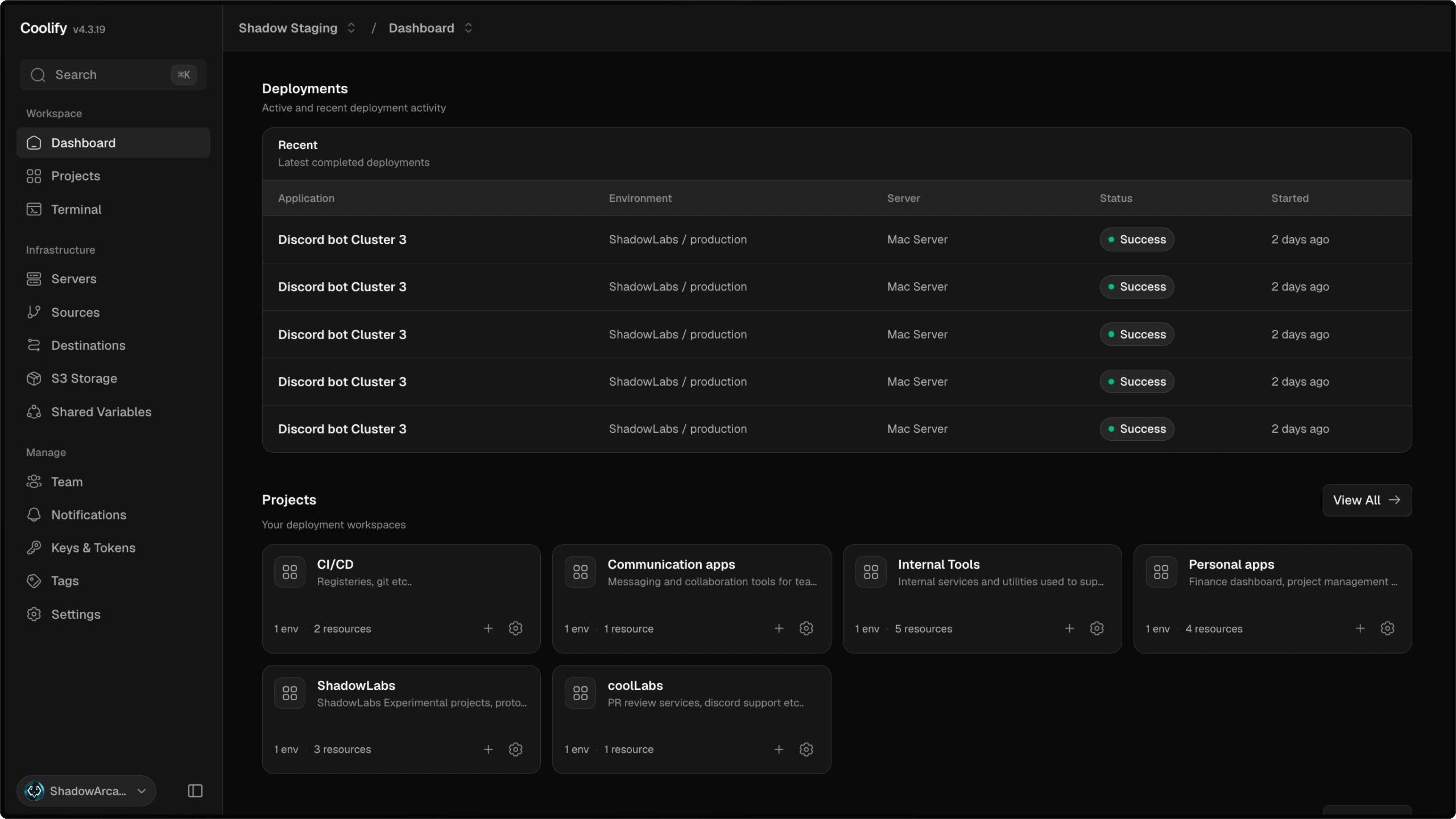
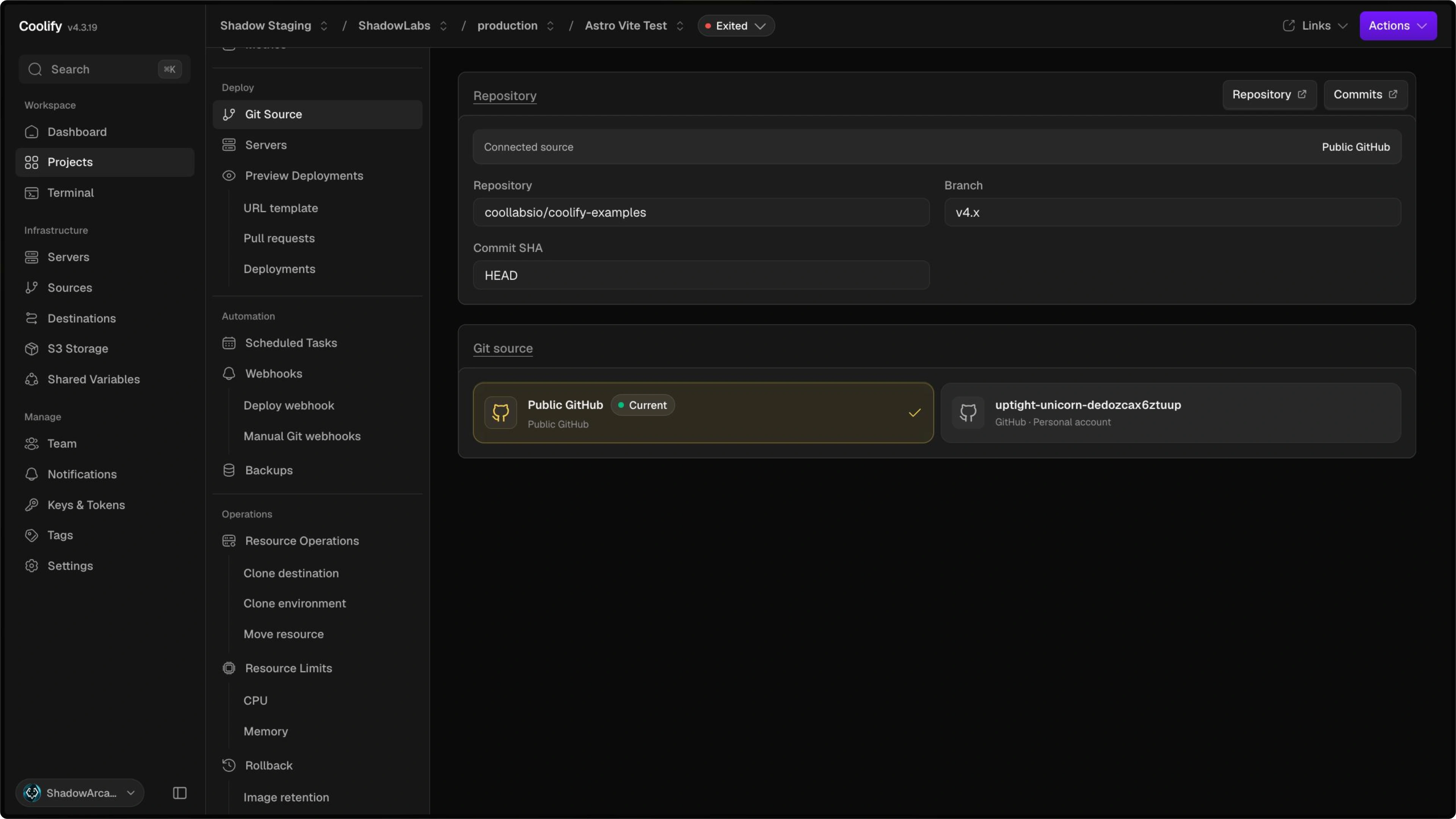
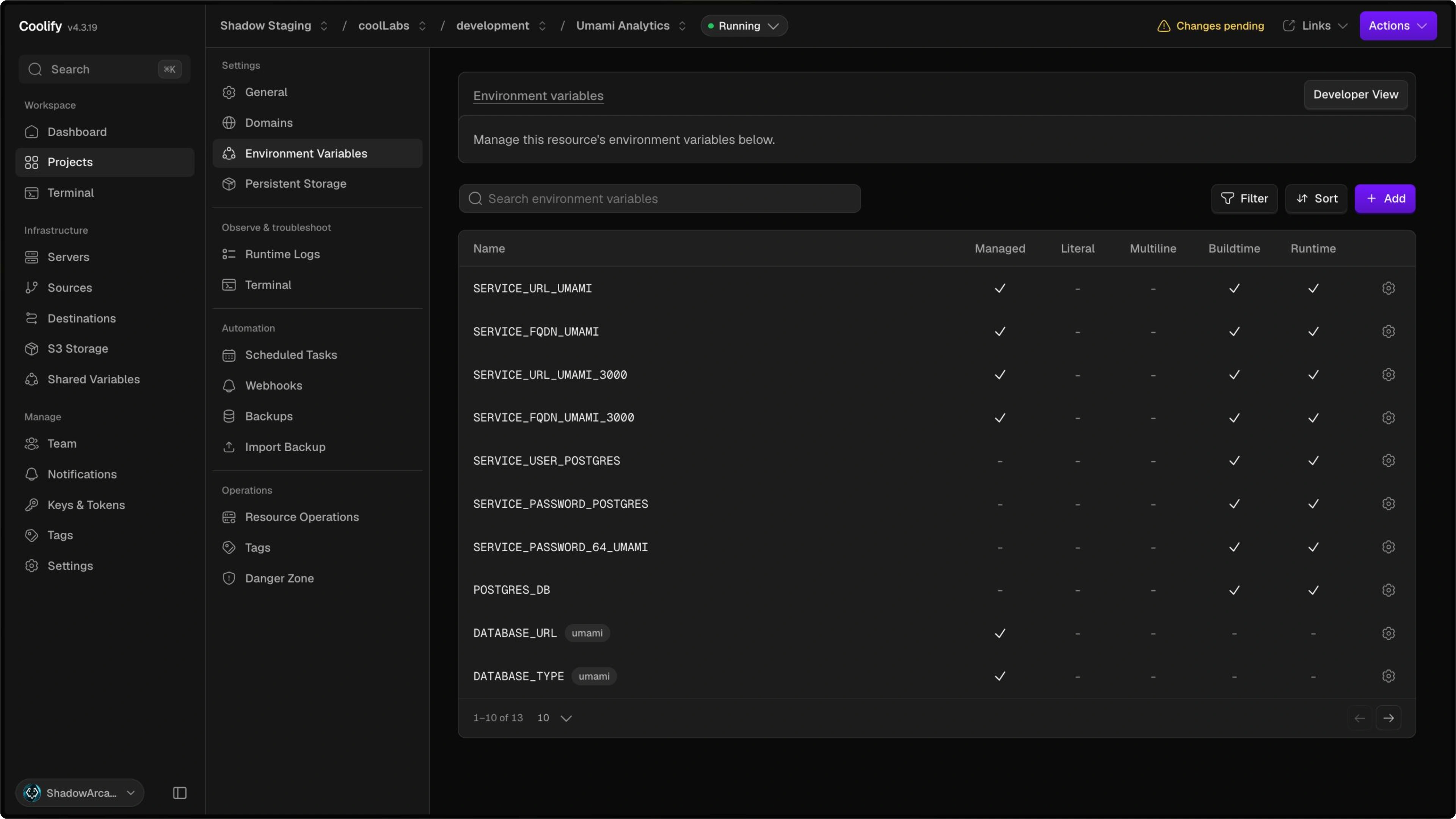
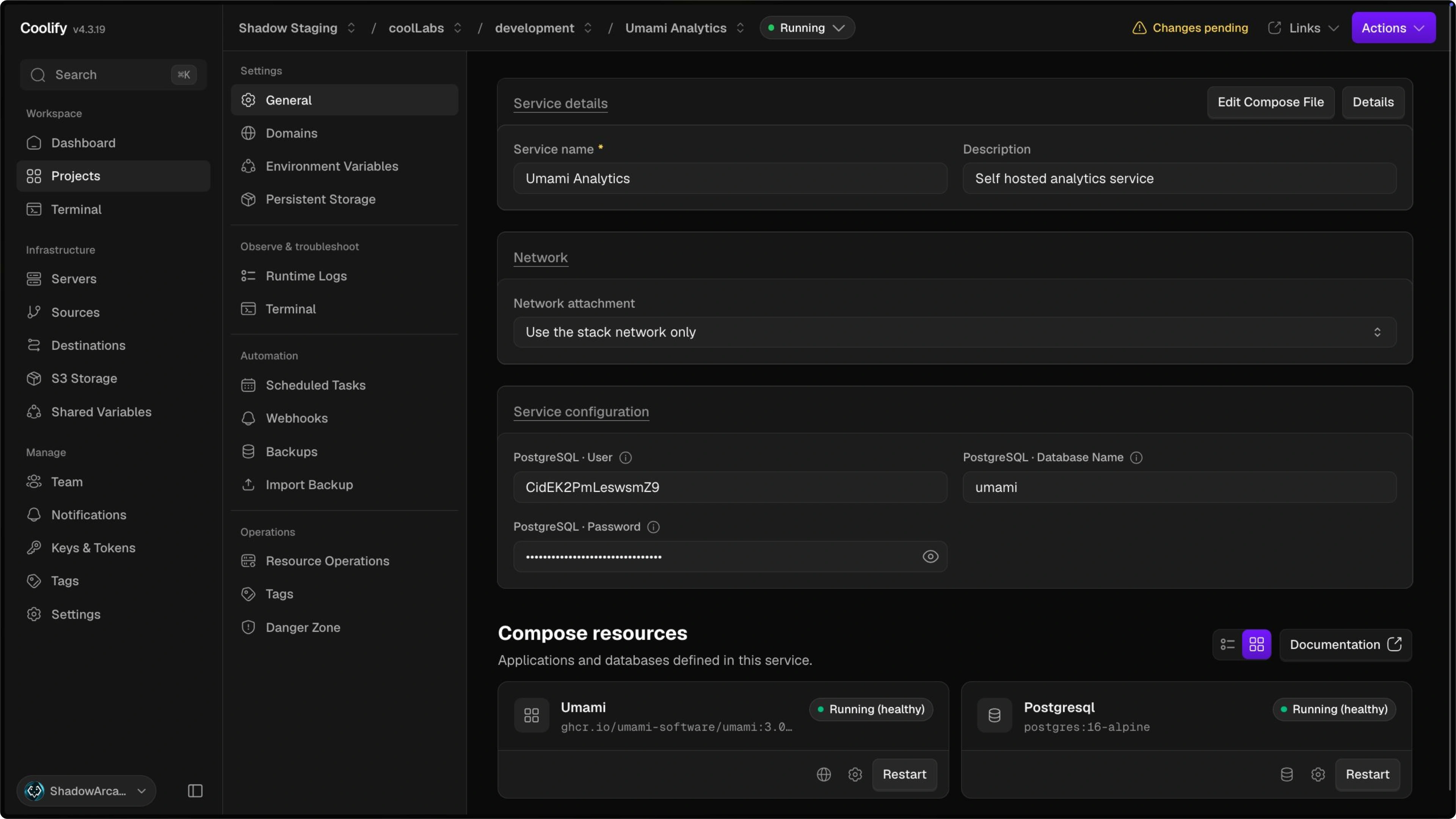
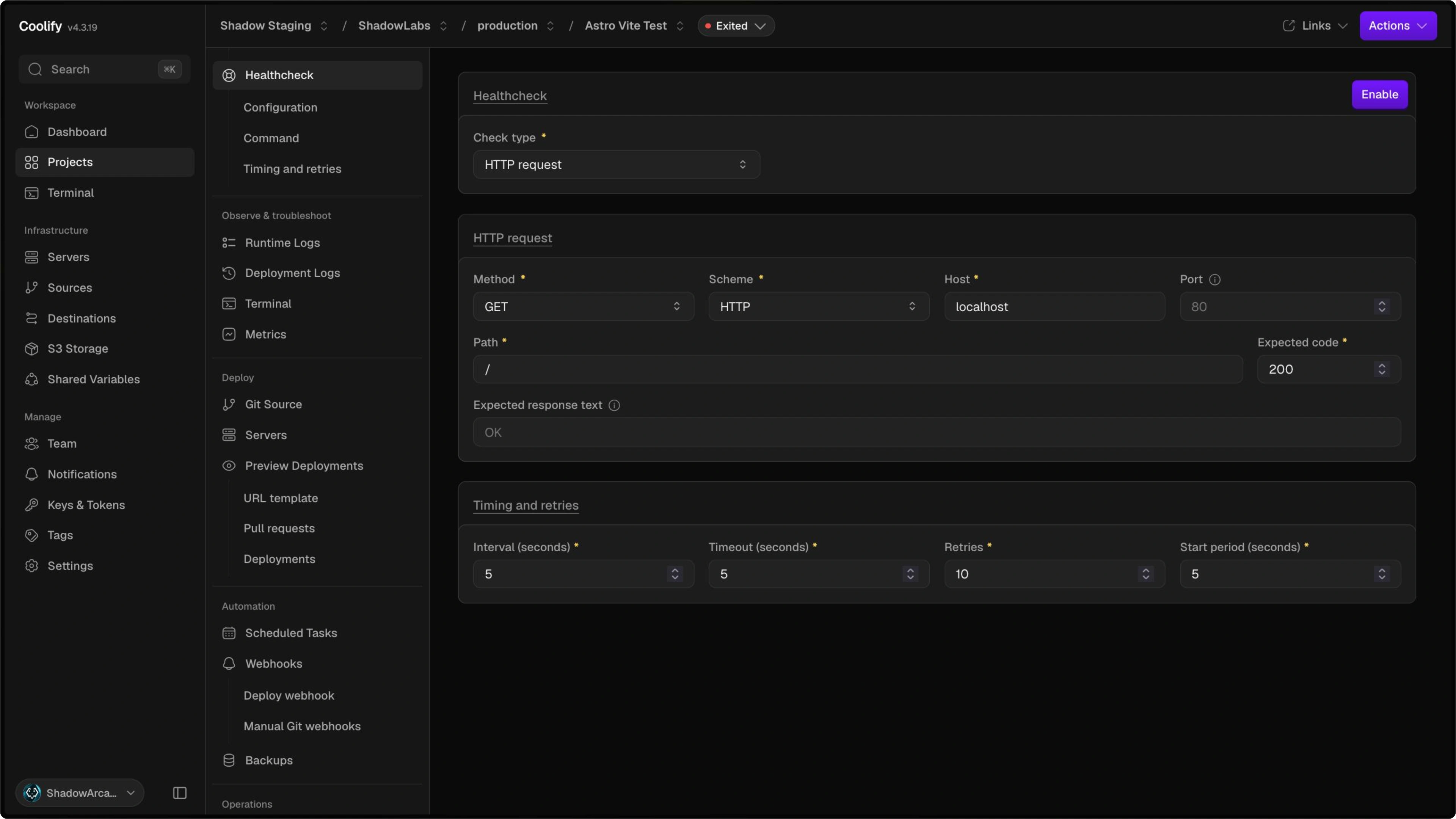
What is coolify?
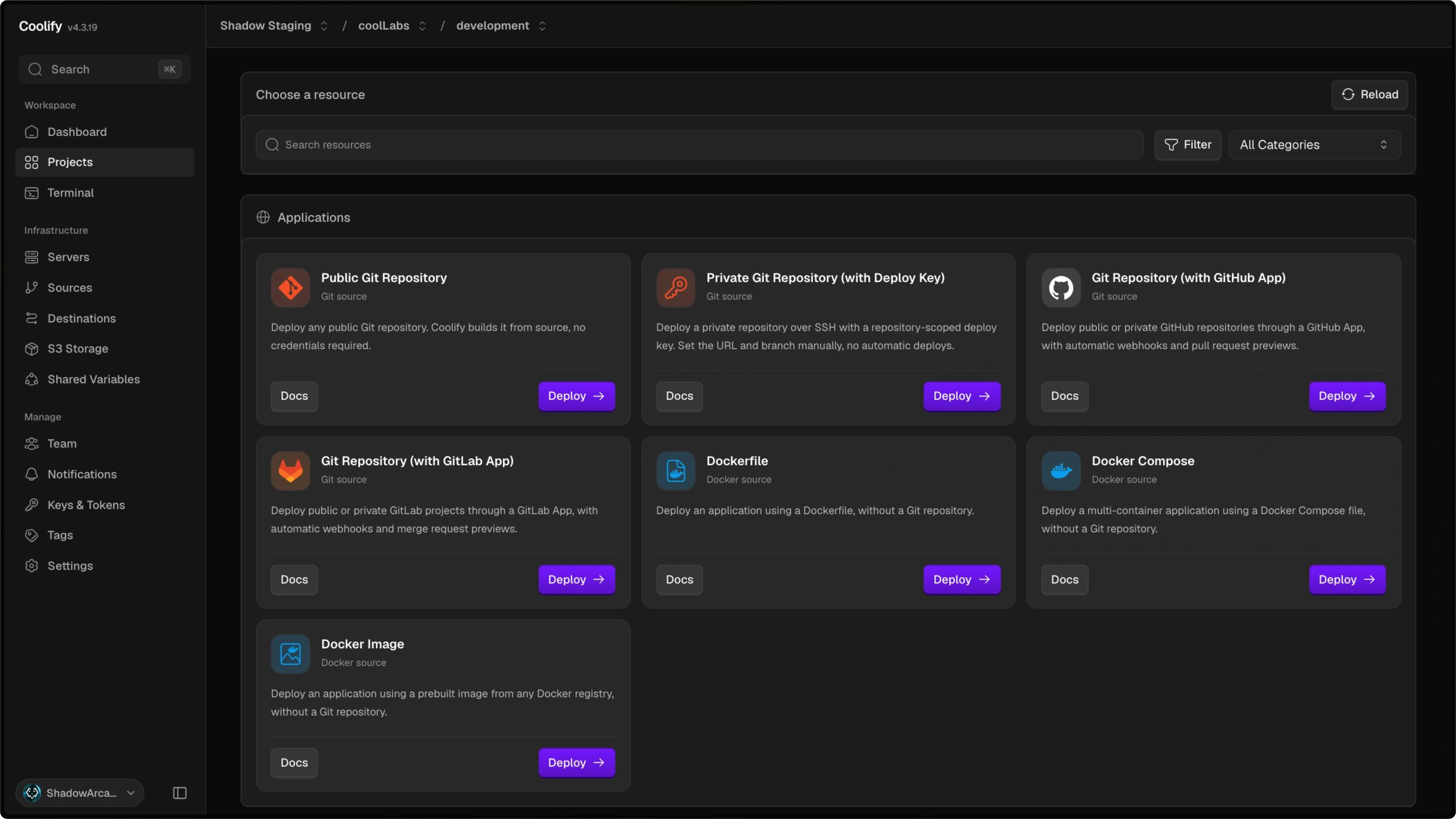
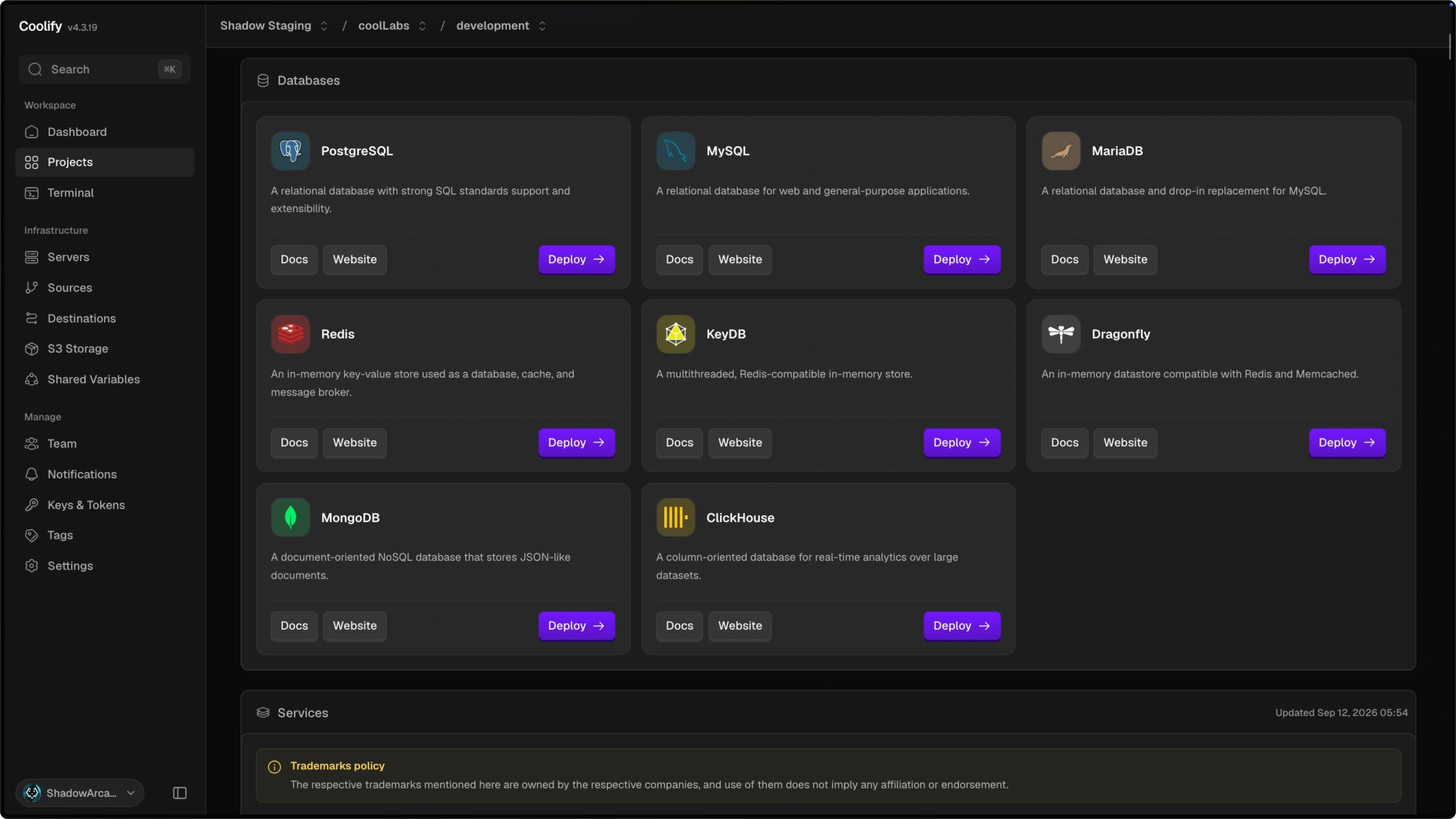
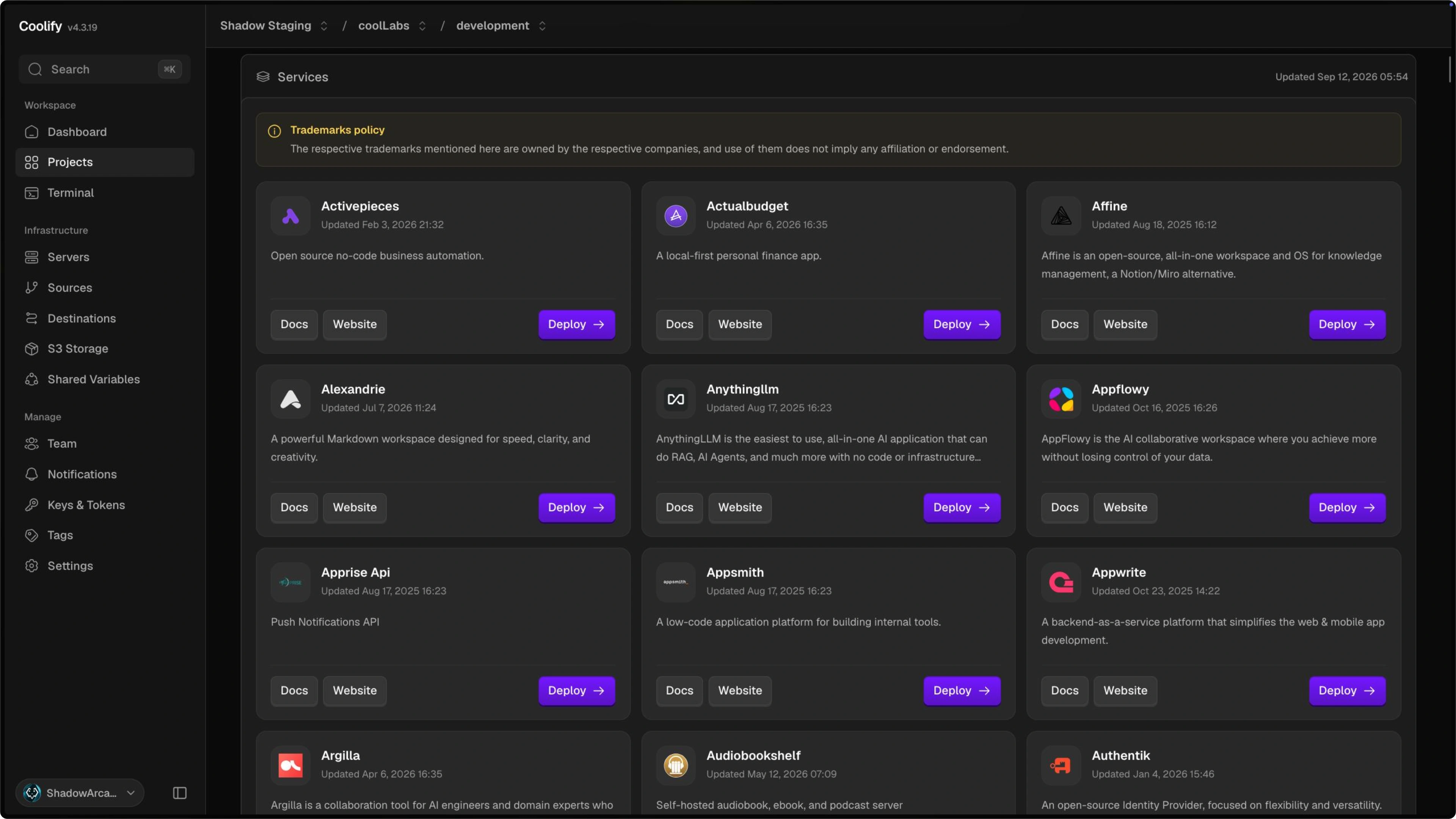
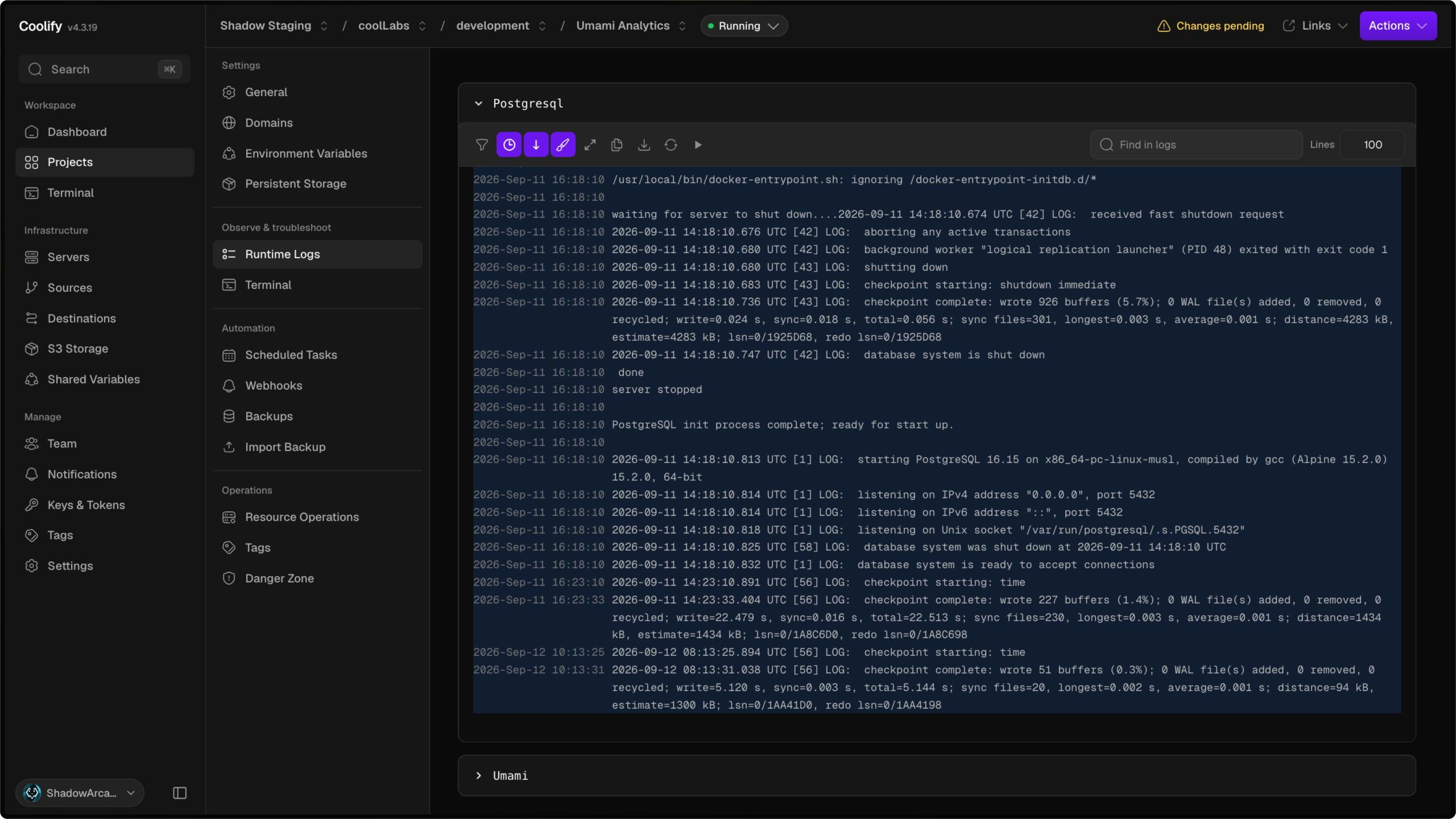
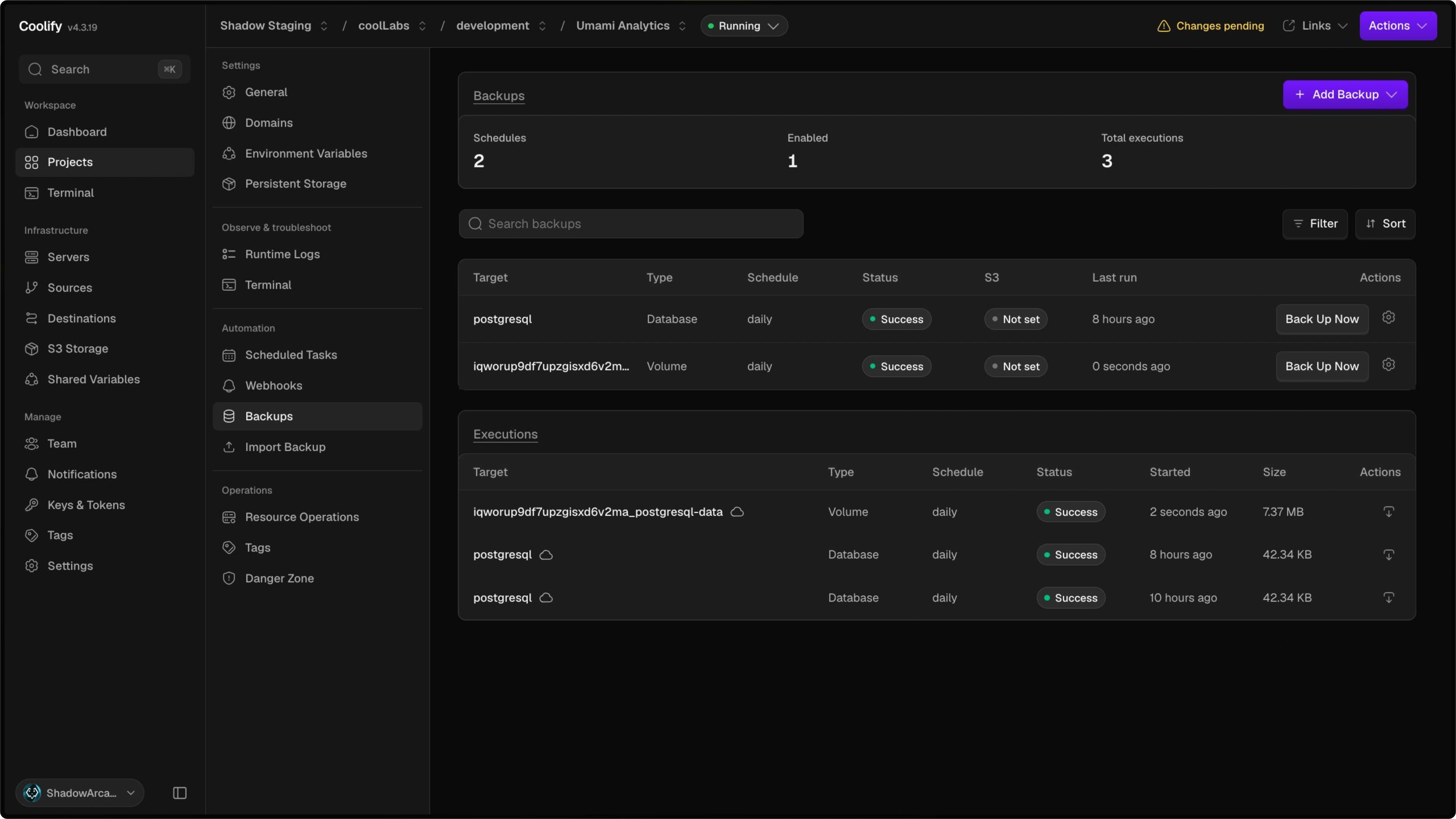
Coolify is an open-source, self-hostable platform-as-a-service that gives you a Heroku-like experience on your own infrastructure. You install it on a Linux server (VPS, bare metal, Raspberry Pi, or any device with SSH access) and then use its web dashboard to deploy applications from Git repositories, spin up managed databases (PostgreSQL, MySQL, MariaDB, MongoDB, Redis, and more), and launch over 300 one-click services. It builds projects using Nixpacks, Railpack, Dockerfile, or Docker Compose, handles automatic HTTPS via Let's Encrypt, manages custom domains and reverse proxies, and provides real-time logs, container terminals, scheduled tasks, backups to S3-compatible storage, and team collaboration with role-based access. Coolify also offers a REST API, CLI, and MCP server for AI agents. The self-hosted edition is free and open-source (Apache-2.0) with no paywalled features; a managed Cloud version is available as a paid service.
coolify alternatives
 InstaCloud OSSInstaCloud OSS is a self-hosted PaaS giving you a serverless cloud on one machine with Postgres, S3, Redis, MySQL, MongoDB, git push-to-deploy, and instant branching.CompareInstaCloud OSS with coolify
 ToolJetSelf-hosted, open-source low-code platform for internal tools and dashboards: visual builder, 90+ data sources, built-in database, AI app generation and MCP agent access.CompareToolJet with coolify
 CapRoverSelf-hosted open-source PaaS: deploy apps and one-click databases via a web dashboard, CLI, git or webhook pushes, with free Let's Encrypt HTTPS on Docker Swarm.CompareCapRover with coolify
 doktainerA self-hosted Docker control panel that manages servers, apps, domains, SSL, and backups in one interface.Comparedoktainer with coolify
 osInfinite OS is a self-hosted, open-source hosting environment that runs in a single container with a cPanel-like dashboard to deploy apps without Dockerfiles.Compareos with coolify
 nocodbSelf-hosted open-source Airtable alternative that turns any database into a no-code platform with spreadsheet-like interface, supporting PostgreSQL, MySQL, and SQLite.Comparenocodb with coolify
 QuantumRun your own Platform-as-a-Service: deploy GitHub projects, databases, templates, and Compose stacks on a private server with a web UI.CompareQuantum with coolify
 hot-updaterSelf-hosted OTA update server for React Native apps. Deploy on major cloud platforms or your own Docker setup. Includes bundle diffing, web console, and rollback support.Comparehot-updater with coolify
All self-hosted alternatives to Heroku → All self-hosted alternatives to Netlify → All self-hosted alternatives to Railway →
Should you self-host coolify?
coolify scores 88/100 on selfhost.directory (how scoring works) and ranks #1 of 14 in Platform as a Service. It has 65 826 GitHub stars, +3 202 in the last 30 days.
It shipped 47 stable releases in the past year. The latest, v4.7.0, came out on 9 November 2026. New versions land roughly every 1 days.
Setup is moderate: expect some configuration beyond a single command. An official Docker image is available. It is Apache-2.0-licensed and written mostly in PHP.
Its closest alternative on selfhost.directory is Appwrite (84/100, 57 906 stars). coolify scores higher overall. See coolify vs Appwrite side by side.
Features
- Application deployment from Git
- Automatic Backups
- Automatic HTTPS
- CLI
- Cloudflare Tunnels
- Instant Rollbacks
- MCP Server
- Multi-Server Management
- One-click databases
- One-Click Services
- Pull request previews
- Real-time Terminal
- REST API
- Scheduled Tasks
- Team Collaboration
coolify README

An open-source platform to deploy applications, databases, and services on your own servers.
Open source & free forever, backed by our philosophy.
Website · Documentation · Cloud · Discord · Community
Coolify is an open-source and self-hostable alternative to Heroku, Netlify, and Vercel. It helps you manage servers, applications, and databases on your own hardware. You only need an SSH connection.
You can use a VPS, a bare-metal server, a Raspberry Pi, or any other server that accepts SSH connections. Coolify gives you the convenience of a cloud platform while you keep control of your infrastructure.
How to configure coolify
APP_NAME=CoolifyApplication nameAPP_IDApplication IDAPP_KEYLaravel application keyAPP_PORT=8000Host port for Coolify dashboardDB_USERNAME=coolifyPostgreSQL username
coolify releases & version history
AI summary Only latest commit is built by default
Breaking Changes
- Cancelled the older queued webhook deployments of an application by default when a newer push arrives, so only the latest commit is built (#10921, #7678)
- It works per application, pull request and server
Advanced>Deploymentandis_auto_cancel_queued_deployments_enabledin the applications API turn it off- Manual, API, restart and rollback deployments are never cancelled
- An opt-in setting,
is_auto_cancel_building_deployments_enabledin the API, also stops an older webhook deployment that is still building, a deployment that started to replace containers always finishes cancel_previous(none,queuedorbuilding) on/api/v1/deployand the MCPdeploytool cancels the older webhook, API and MCP deployments, the default isnone
- Limited the cloud provider token API to team admins and owners
- Other members get
403
- Other members get
- Moved the Resend sender to the new
resend_from_addressandresend_from_namefields, API clients must use the new fields- A migration copies the current values
Security
- Applied the limits of API tokens to more permission checks
- A message explains when a token limit blocks a change
- Built team invitation links from the instance URL instead of the request host, when no instance domain is set
- Checked that members with access grants can use the selected server and the team credentials
- A new, cloned or migrated resource needs a server that the member can use, the localhost server needs an instance admin
- Server lists show only the servers that the member can use
- Team private keys, GitHub Apps, Gitea Apps and new S3 storages of backup schedules need write access on the whole team, also through the API
- A message explains when write access on the whole team is needed
- Checked the deploy permission before a deploy through the API creates a preview or changes its image tag
- Ended terminal sessions when access to the server is lost
- Enforced fixed SSH connection options on every connection, also for health checks
- Generated new SSH keys as Ed25519 and validated private keys more strictly
- Hardened SMTP and terminal connections
- SMTP hosts are validated, and Coolify connects only to the checked address
- The error message explains why an SMTP host is refused
- Limited the server data in the application, service, and database API responses to tokens that cover the whole team
- Removed the server details from the response of the
get_serviceMCP tool - Kept personal data and credentials out of audit events
- The audit events of a deleted user are anonymized
- Kept stored private keys out of the browser
- Kept the Sentinel token out of process arguments
- Sentinel reads it from an env file
- Limited API clients that keep failing to 30 failed requests per minute for one token or IP
- More failed requests get
429,API_FAILED_REQUEST_RATE_LIMITsets the limit - The team of the token gets one notification a day when the token reaches the limit
- More failed requests get
- Pinned the SSH host key of a server on the first connection, the team gets a notification when it changes
SSH_HOST_KEY_CHECKINGsets the mode:warn,enforceoroff
- Pinned the SSH host keys of Git hosts across deployments
- Coolify shows the published host keys of GitHub, GitLab and Bitbucket
- Restricted preview changes, rollbacks and repository URL changes
- Opening a preview, changing its pull request URL, Git type or Docker tag, or choosing a commit through the API needs write access, a deploy token can only redeploy an existing preview
- A rollback goes only to a listed rollback image or a successful production deployment
- A new
git_repositoryof an application is validated like in the UI - The
docker_tagof/api/v1/deployis validated like in the preview API
- Validated webhook URLs, limited DNS lookups and tightened the authorization of team resources
Added
- A list view on the new resource page
- A
Not usedlabel on the TLS certificates of the Traefik proxy page, and aDelete unusedbutton that deletes them in one step (#12447)- A certificate is unused when no route and no resource on the server uses its domain
- Traefik renews every certificate in
acme.jsonuntil you delete it and restart the proxy
- API endpoints and MCP tools that manage image scanning and read the scan results
GETandPATCH /api/v1/servers/{uuid}/image-scanning,GET /api/v1/vulnerabilitiesandGET /api/v1/{applications|databases|services}/{uuid}/vulnerabilities- The MCP tools are
get_vulnerabilitiesandmanage_image_scanning
- A
Run in a shelloption on scheduled tasks, so containers withoutsh, such as distroless or scratch images, can run them (#8244)- Turn it off to split the command into arguments and run it directly
- The API and the MCP tools set it too
- A separate notification sender in the instance email settings
- Team notifications through the instance email settings, the S3 connection error alert and the channel disabled alert use it
- Account emails keep the default sender
- The
emailsartisan command no longer exists
- A
Skip TLS certificate verificationsetting on S3 storages, for endpoints with a self-signed or private CA certificate (#9762, #4402)- It applies to the connection test, backups, restores and the deletion of old backups
- The S3 storages API sets it with
skip_tls_verification - Browsers that download files from the storage must still trust the certificate
- A star button on servers and resources for quick access on the dashboard
- The button is after the status in the top bar
- A
UI scaleoption in the appearance settings - Automatic update notifications, the root team gets one when an automatic update starts, fails or finishes
- A manual upgrade that fails before the upgrade script starts shows the error in the upgrade modal
- A warning when the Docker Compose file of an application is in a subdirectory of the base directory, with a button that moves the directory of the file into the base directory (#9525)
- Coolify runs Docker Compose in the base directory, so relative paths such as
build.context: ..resolve from there
- Coolify runs Docker Compose in the base directory, so relative paths such as
- Container image vulnerability scanning, opt-in for each server and each application
- Syft and Grype run on your server, and no data goes to a third party
- Each resource gets one security status and version recommendations, with an optional deploy gate for each application
- The team
Securitypage and the notifications show the results
- Forgejo and Codeberg in the Gitea App source
- A
Providerlist fills in the Gitea.com or Codeberg URLs - Webhooks accept the
X-Forgejo-*headers
- A
- Gitea App endpoints in the API and the MCP tools,
GET /gitea-appsandPOST /applications/private-gitea-app(#12459)gitea_app_uuidsets the source when you create or update an application
- GitHub Deployments sync, each deployment and preview reports to GitHub Deployments with links to the log and the environment
- It needs a private GitHub App with
Deployments: write
- It needs a private GitHub App with
- One email provider list with None, SMTP and Resend, more than one named SMTP server with its own sender, and SMTP templates for common providers
Rotate keyon private keys, which replaces a key on all servers that use it- Coolify adds the new key to
authorized_keys, can undo the rotation, and removes the old key - A server delete can remove the key from
authorized_keys - Coolify deletes unused SSH key files every hour
- The button shows only when a server uses the key
- Coolify adds the new key to
- Server usage in the server table of the dashboard on mobile
- SFTP, FTPS and WebDAV backup storages for database and volume backups, with downloads, retention and restores
- SFTP restores and downloads need a host key that an admin saved with a validation
- The finish time of recent deployments on the dashboard
- The logo and name of the resource on the resource creation screen
- The Orbit service template, a self-hosted workspace for teams with tasks, docs, chat and an MCP server for AI clients
- Valkey as an image of the Redis database type
- A new step of a new Redis database asks for Redis or Valkey
- Global search accepts "new valkey"
Changed
Import Backupfrom the resource menu to anImport backupbutton on theBackupspage of databases and services (#11818)- The button opens the import in a dialog
- Old
Import Backuplinks open theBackupspage
- Maintenance mode to its own
Maintenancepage of applications and services, and you must confirm the toggle - The data retention of unsubscribed teams on Coolify Cloud from 30 to 60 days
- The cleanup saves the deleted users to
cloud-deleted-users.csvon the backups disk
- The cleanup saves the deleted users to
- The default image of new Redis databases to
valkey/valkey:9-alpine- Existing databases keep their image
- The default images of new databases to PostgreSQL 18, MongoDB 9, MySQL 9.7, MariaDB 12.3 and ClickHouse 26.8
- Existing databases keep their image
- The default images on the new resource page to Supabase PostgreSQL 17.11.0.018 and PostGIS 18-3.7-alpine
- The notifications of scheduled jobs that keep failing, to the first failure and then at most once a day
- This covers scheduled tasks, database backups, storage backups and Docker cleanup
- The first successful run after a failure sends one "works again" notification to the failure channels
- A database backup whose S3 upload keeps failing also notifies at most once a day
- A scheduled task disables itself after 10 failures in a row when the first failure is more than 24 hours old, one notification and the task page give the reason, and enabling the task again clears it
- The scheduled tasks API returns
consecutive_failures,failing_sinceanddisabled_reason - Backups and Docker cleanup are never disabled automatically, so they start again by themselves after an outage
- A scheduled task skips a run when the application or service has no running container, without a notification and without a count toward the automatic disable
- The security settings of a server to one
Securitypage with patches, terminal access, SSH host key and image scanning - The Sentinel version to 1.1.5
Removed
Copy from instance settingsfrom the email notification page, selectUse system-wide settingsinstead- The unused MinIO client from the Coolify image
Fixed
- API token search out of sync after you create, edit or revoke a token (#12465)
- Applications and databases removed from the Docker Compose file of a service showing as
Exitedand keeping the service degraded (#9591)- They show
Not in Compose fileand do not count in the service status - Coolify keeps their settings and uses them again when you add the service back under the same name
- To remove one, delete it in its settings
- Existing ones are marked at the next deployment or save of the service
- They show
- Applications deleted on all their servers when you delete a server that they use only as an additional destination
- This applies to
Delete all resourcesandDELETE /api/v1/servers/{uuid}?force=true - Coolify removes the application only from the deleted server and stops its containers there
- A server that has only such applications can be deleted without
Delete all resources - The delete confirmation lists the resources it deletes and the applications that keep running on another server
- This applies to
- Bugsink service template filling the disk with MySQL binary logs until Bugsink stopped (#10626)
- New services use PostgreSQL 17 and Bugsink 2
- To stop the growth in an existing service, run
PURGE BINARY LOGS BEFORE NOW();in MySQL, then addcommand: ['--disable-log-bin']to themysqlservice and restart it
- Builds that failed with x509 errors behind a TLS-inspecting proxy, although the server trusts the proxy CA (#7568)
- The helper container mounts the CA bundle of the server read-only
- Compose services that could not reach each other by name in preview deployments and failed to start (#8030)
- The original name is an alias on the preview network
Copy logsnot changing the clipboard on iPhone and iPad, in the runtime and deployment logs (#9408)- Coolify starts the clipboard write during the tap and adds the logs when they load
- Cut-off descriptions of PostgreSQL, MongoDB and ClickHouse on the new resource page
- Database backup executions table that did not fit the page and was hard to read (#7188)
- It shows the file name of the archive, with a button that copies its path
- It shows
All databasesfor a backup of all databases
- Database backups saved to S3 when an API request does not send
save_s3- The backup page resets the S3 selection when a change is not allowed
- Database backups that passed the worker timeout, stayed running, and left the upload container and the dump file on the server
- Each step gets only the time that is left of the backup timeout, so a run that takes too long fails and cleans up
- An SSH retry does not start a second dump
- The backup log explains exit code 124, and the timeout help says that it covers the complete run
- The daily helper container cleanup removes the upload containers of executions that are not running
- Data that looked lost after you changed the name of a persistent volume, because a new name points to a new, empty Docker volume (#8816)
- A dialog asks for confirmation and tells you to copy the data into the new volume
- Deleted
coolify.yamland an unreachable dashboard on a server with the IPhost.docker.internalthat is not the default localhost server (#12444)- Coolify keeps treating this server as localhost after a save, for example after a proxy restart
- Deleted volume coming back after a redeploy when the image declares
VOLUMEat its path (#6875)- Coolify removes containers that still mount a deleted volume before it starts the new ones
- The stale volume delete dialog warns when a container still uses the volume
- Deploy canvas cards with another border than the resource tiles
- Deployments started through the MCP server saved as API deployments
- The deployment list shows them with the
MCPsource and filter - The API and MCP deployment data have a new
is_mcpfield
- The deployment list shows them with the
- Deployments that failed on one
502or one timeout from the GitHub API (#9785)- GitHub API reads retry up to three times on a 5xx error or a failed connection
- Writes, such as pull request comments, are not retried
- Deployments that failed with
cURL error 28onhttps://api.github.com/zen, because Coolify compared its clock with GitHub before each token request (#9785)- Coolify compares the clocks only when GitHub rejects a request, from the
Dateheader of that response
- Coolify compares the clocks only when GitHub rejects a request, from the
- Deployments that failed with "The container name ... is already in use" when
Use build secretsis on (#9363)- Coolify removes the old helper container and waits until Docker frees the name
- Deployments that stopped on a broken
.envfile, because multi-line JSON values saved before exact escaping had no quotes (#8279)- These values use exact escaping, which gives the container the same value as before beta.463
- Deployments to additional servers losing the source of the main deployment
- The audit log records actions that MCP tools do through the API as MCP events
- Different
COOLIFY_BRANCHvalues in the parts of a preview deployment (#9572)- All parts use
pull/<pull request number>/head
- All parts use
- Disabled self-hosted servers that stayed disabled after a validation that connects (#12475)
- The unreachable cleanup skips the localhost server
- The server page explains why a server is disabled
- Coolify Cloud servers and transferred servers stay disabled
DNS matcheson a domain in a connected Cloudflare zone that goes through Cloudflare to a different server, which then failed with Cloudflare error 526 and a Let's Encrypt error (#12436)- The domain shows
DNS mismatch - CNAME records, for example of a Cloudflare Tunnel, are still accepted
- A clone of an application or a service, or a new one through the API, gets a Cloudflare DNS record for each domain in a zone with automatic DNS, a clone only for the domains that the source does not use
- The domain shows
- Docker builds that failed with "BuildKit is enabled but the buildx component is missing or broken" when an application has a build-time variable
HOMEorDOCKER_CONFIG(#9726)- The Docker CLI in the helper container always uses
/root/.docker - A
HOMEbuild argument keeps its value
- The Docker CLI in the helper container always uses
- Docker Compose previews sharing one project with the application and the other previews, so Docker Compose treated their containers as orphans (#9014)
- Each preview has its own Compose project, and the networks that the Compose file declares are not shared
- Dockerfile
HEALTHCHECKoptions not imported as Docker reads them, zero and sub-second values became 0 seconds (#12455)- Coolify reads compound and fractional durations, quoted values, only the flags before
CMD, theescapedirective andNONEwith flags
- Coolify reads compound and fractional durations, quoted values, only the flags before
- Dockerfile
HEALTHCHECKread from a stage that is not built (#9475) - Domains showing
Not checkedwhen an existing Cloudflare DNS record of a new domain has a different IP- Coolify replaces the record when it created the record and no other resource uses it
- Otherwise it opens the
Configure DNSdialog, where you can replace the record, and the domain shows the conflict
- Duplicate and empty rows in the audit log
- Duplicate environment variables, and extra copies that could not be removed (#8041)
- Empty database backups of Odoo services, which backed up only the empty
postgresdatabase (#7555)- New backup schedules of Odoo services back up all databases by default
- Empty disk usage on the
Metricstab, theFleetpage and in the MCPget_server_metricstool when Sentinel reports the Coolify data disk under another mount point than/,/dataor/data/coolify(#12448)- This occurs for example on a NAS where
/datais a symlink into a data volume
- This occurs for example on a NAS where
- Empty list of the commit images of Docker Compose applications on the
Rollbackpage and inGET /api/v1/applications/{uuid}/rollback-images, since v4.5.0 (#12446)- The page also shows the running commit when the Compose file has services from other images
- Exact start time in service backup executions that is hard to read
- The table shows the relative time, with the exact date in a tooltip
- Expired sessions kept for the retention days of the database cleanup (#7394)
- The cleanup deletes sessions older than the session lifetime
- Failed backups to S3 endpoints with a path, such as
/storage/v1/s3of Supabase Storage (#8530)- Database backups, volume backups and S3 restores use curl with a presigned URL for these endpoints
- Failed clone of an application with a fixed preview URL template, with a duplicate preview domain error and a stopped, partial clone
- A clone does not copy preview deployments and gets its own from new pull requests
- Failed Docker install on Ubuntu derivatives such as Pop!_OS and Linux Mint, and on Raspbian 13 (Trixie) (#9455)
- The fallback uses the Ubuntu repository with
UBUNTU_CODENAMEon Ubuntu derivatives - It uses the Debian repository on Raspbian 13, which has no Docker repository of its own
- The fallback uses the Ubuntu repository with
- Failed image pull in the Convex service template, after the rename to the
ghcr.io/convexnamespace (#12449) - Failed parse of a Docker Compose file whose
serviceskey is empty or is not a map, and unexplained exit code 255 in failed commands- The message explains that the SSH connection to the server closed before the command finished
- Failed S3 uploads of backups larger than about 15.6 GiB on providers that accept only 1000 parts, such as Scaleway (#8411)
- Failed sign-up and login in the Rybbit service template,
/apirequests got a 404 error (#9055)- The template routes
/apion the same domain to the backend on port 3001 and keeps the/apiprefix - For an existing service, add
SERVICE_URL_RYBBIT_3001=/apitorybbit_backend, move it aboverybbitin the Docker Compose file, setPath prefixestoKeep prefixesin the advanced settings of the backend and redeploy
- The template routes
- Failed startup and broken public album links in the Ente service templates (#7405)
- An albums service with its own domain serves public links
- The images come from
ghcr.io/ente, and the JWT secret is URL-safe so that Museum can decode it - With S3, the template uses the routed
MINIO_SERVER_URLas the S3 endpoint and allows all CORS origins
- Generic error when a new private key cannot connect to a server (#7980)
- The message shows the SSH error
- Health checks in their start period shown as unknown, not as
running:starting(#9411) - High CPU use of
dockerdwhile you stream the logs of a container with a large log file (#7693) - Ignored concurrent build limit of build servers (#7649)
- Each build counts on the server that runs it, and a deployment reserves a build server with a free slot when it starts
- A freed build server slot starts the waiting deployments of other servers
- Inconsistent status badges and S3 storage names in service backup tables
- Instance database backups running on the wrong server when the destination of
coolify-dbpoints to another one (#8139)- The backup always runs on the Coolify host
- A failed pre-update backup shows why it failed
- The pre-update backup skips a disabled schedule
- LiteLLM service template with a master key that did not start with
sk-(#10521)- The admin API key is
sk-followed by the value ofSERVICE_PASSWORD_MASTERKEY - A separate
LITELLM_SALT_KEYkeeps stored model credentials readable when the master key changes STORE_MODEL_IN_DBisTrueby default, so you can add models in the LiteLLM UI
- The admin API key is
- Live updates, such as proxy restart logs, that did not reach the browser, because the WebSocket handshake failed with
413with large cookie headers - Localhost server page that did not refresh after its connection is validated
- Locked environment variables that could not be changed, unlocked or deleted when Docker Compose uses them (#6803)
- A locked value can be replaced without showing it
- The lock is permanent in the UI, the API and MCP, and
Lockasks for confirmation
- Lost audit events
- Coolify writes audit events at commit time
- Lost Telegram notifications when Telegram rejects a button URL, for example localhost or an IP address without a domain (#8269)
- Coolify then sends the links as text
- Lost trailing newline of multiline environment variables, so OpenSSH rejected an SSH private key with "error in libcrypto" (#9438)
- A value with more than one line is saved exactly as you enter it, in the UI and in the API
- Single-line values still lose their edge whitespace
- Save a variable again to add the newline that Coolify removed
- Lost update channel in
Settings>Updatesand lost healthcheckCheck typewhen one of them is the only change- The
Save changesbar opens for them
- The
- Missing check of the closest Cloudflare wildcard record for deeper domain names, such as
app.apps.example.comthrough*.example.com(#12436) - Missing Cloudflare DNS record when you edit a domain to a hostname in a connected Cloudflare zone, for example a generated domain changed to your own domain
- Coolify adds the record automatically or opens the
Configure DNSdialog, as it did only for new domains - This applies to the
Domainspages, the application and service application settings and the service application API
- Coolify adds the record automatically or opens the
- Missing disabled server message on the localhost server page (#12475)
- Missing Git error reason when Coolify cannot read a repository
- Missing links to the provider dashboards on the secret manager token forms
- Missing project, environment and service in Fluent Bit log drains for containers without the Coolify default variables (#8415)
- The
fluentddriver also sends the Coolify container labels, and the built-in configurations use them as a fallback
- The
- Missing
Resource status changesnotification when an application, preview, service or database stops unexpectedly, for example after a crash ordocker kill(#9493)- Coolify waits 2 minutes and notifies only when the resource is still stopped
- A stop, restart or redeploy from Coolify sends no notification
- The same resource sends at most one notification in 15 minutes
- Missing
Traefik Proxy Outdatednotification when a newer Traefik patch version of the running branch is available (#9727)- Coolify sends one notification for each new patch version, not one for each hourly check
- Names and descriptions saved through the API and the MCP server that the UI rejects, so the resource could not be saved in the UI afterwards (#12466)
- Applications, services, databases, servers and private keys use the rules and the error messages of the UI
- Nested
testkey in theapiservice when you update the image of a service named likeapi.test(#12456)- A service name that Docker cannot use as a container name prefix gets a clear error on save
- "Network error" when you sign in with email in AppFlowy Web (#10545)
- The template sets
GOTRUE_CORS_ALLOWED_HEADERS=redirect_to - For an existing service, add this variable to the
gotrueservice in the Docker Compose file and restart the service
- The template sets
- New RSA deploy keys that GitHub rejected, because Coolify made 2048-bit keys (#12461)
- New RSA keys are 4096 bits
- OAuth redirect URIs that silently sent the user back to the login page
- A redirect URI must point at the callback route of the provider, any other path gets a validation error
- Old cached image in the Usesend service template, which used
latest(#12443)- The template pins
usesend/usesend:v1.10.0, which has the Next.js, Node.js 24 and nodemailer security updates
- The template pins
- Outline service template restarting in a loop with
syntax error at or near "TRIGGER"onpostgres:12-alpine(#12345)- New services use PostgreSQL 16
- An existing service keeps PostgreSQL 12, the Outline service documentation has the steps to upgrade it
- Paid Coolify Cloud subscriptions that lost their link to Stripe staying active after the customer cancels them
cloud:sync-stripe-subscriptionsreports them
- Port warning on a service domain without a port, although Coolify routes it to the required port
- The edit dialog shows the effective port, and the warning buttons name the ports
- Rebuilt Docker layers when a preview comes or goes, and unreachable hosts on a build server (#12452)
- Preview containers and the hosts of the deployment server stay out of
--add-hoston a build server - A setting of the application turns off the network hosts during the build
- Preview containers and the hosts of the deployment server stay out of
- Rebuilt Docker layers when a short-lived container joins or leaves the network between two builds (#12452)
- Database backup and S3 import helpers, Sentinel and the proxy error page container stay out of
--add-host
- Database backup and S3 import helpers, Sentinel and the proxy error page container stay out of
- Redis health check that always passed, because it did not ping the database
- The check pings with the password and requires
PONG
- The check pings with the password and requires
- Refused servers with the same IP and different SSH ports (#7573)
- Resource limits shown for Docker Compose applications
- Sentinel that kept pushing after its server was deleted or its team stopped paying
- Coolify removes the Sentinel container of unpaid servers once a day and before a server is deleted
- Server error when a backup was uploaded in
Import Backupfor a database that the team cannot open- The upload now answers with
Database not found
- The upload now answers with
- Server page that did not refresh after a background validation
- The validation dialog that a background job opens closes when the job finishes
- Server shared variables that did not resolve in Docker Compose files
- Their values are redacted in the rendered Compose file
- Servers that refused new SSH logins with "Maximum number of sessions (8192) reached", because each connection check opened three SSH logins (#9148)
- The Docker and Docker Compose version checks use the multiplexed SSH connection, so each check opens one login
- To remove the stuck sessions, run
systemctl restart systemd-logindon the server
- Service backup path that could not be copied, and an S3 badge on runs that are not stored in S3
- Service backup tables that were not aligned or sortable by column
- Service resource cards showing a starting health check as success (#9411)
- The card shows it as a warning
- Service resource cards that did not update their status together with the heading badge
- Services that stopped and stayed down after a
Restartwhen an image could not be pulled (#12485)- Coolify pulls the missing images before it stops the containers. If an image cannot be pulled, the restart fails and the service keeps running
- Startup and the nightly cleanup of stuck resources stopping with "Allowed memory size exhausted" on instances with many large deployment logs (#12435)
- Stuck deployments, tasks and backups are marked as failed, and the proxy configuration is set up
- Database backup pages and
Settings>Backupdo not load all executions on each request
- Supabase Studio showing the API logs of another stack when two Supabase services run on one server (#10324)
- The Vector container of the template reads only the logs of its own stack
- An existing service keeps its
vector.yml, to fix it addinclude_labels: ['com.docker.compose.project=${COOLIFY_RESOURCE_UUID}']undersources.docker_hostin/data/coolify/services/<service-uuid>/volumes/logs/vector.ymland restart the service
- Tooltips on close and dismiss buttons that stayed visible
- Two deployments of one application running at once when started from the MCP
deploytool or the MCPcontrolstart action, which could stop the application (#12442)- They queue behind a deployment in progress, as the API and the
Deploybutton do - A deployment of the same commit is skipped, and the response gives the UUID of the deployment in progress
- A rolling update removes only the containers that ran before it started
- They queue behind a deployment in progress, as the API and the
- Unexplained UUID prefix on the names of new volumes (#8620)
- The dialog explains that Coolify adds the prefix so that the volume name is unique on the server
- Unreadable accent text and fills in custom themes (#12468)
- Accent text reaches a contrast of 4.5:1 on the page and in the sidebar, and the preview shows the real fill
- Unreadable account menu entries, such as
Log out, when a custom theme sidebar uses the other light or dark scheme than the page (#12467) - Unreadable subscription and server limit banners in light mode (#12494)
- The banners now use a light background with dark text in light mode
- Upgrade modal that did not finish when the new version answered (#8024)
- The modal shows success as soon as the new version is up
- Livewire error pages stay hidden while an upgrade runs
- Volume data checkboxes that were not next to their labels
- WebSockets closed by Caddy on every configuration reload (#7942)
- The application, service and dashboard routes set
stream_close_delay
- The application, service and dashboard routes set
- White flash of the dark theme during page loads and
wire:navigate(#7866) - Wrong
Docker Compose file not founderror for an empty Compose file (#12477)- An empty Compose file now gives an error that says that the file is empty
AI summary API delete operations now require root or delete ability
Breaking Changes
- Require the new
deleteability, orroot, for every delete through the API and the MCP server, an API token withwritealone can no longer delete resources, environment variables, storages, backups, scheduled tasks or tags, or detach a tag
Security
- Harden the CI workflows
- Require every action to be pinned to a full-length commit SHA, with an Actions setting on GitHub that enforces it
- Lock every action and the actions it calls to a commit in
.github/workflows/actions.lock, together with the IDs of its owner and repository, which a commit SHA alone does not check - Require every workflow to use the lockfile, with an Actions policy on GitHub that enforces it
- Keep the Docker Hub credentials and the CDN token in the
releaseenvironment, which only the branches that release can use - Run without the GitHub Actions cache, layer caches and cached tool binaries, so no run restores what another run wrote
- Grant every job the least permissions it needs and state the reason for every write permission
- Keep the tokens that delete images in the
cleanupenvironment, which onlymaincan use - Fix every finding of jactionlint pedantic
- Refuse to update, force-push or delete the git tag of a release, with a tag protection rule on GitHub
- Refuse to delete or force-push
main,next, release and maintenance branches, with branch protection rules on GitHub - Hide locked environment variable values in the resource lists of
GET /api/v1/resourcesandGET /api/v1/projects/{uuid}/{environment}, like the other endpoints already do - Require an instance admin to disable the API, or to enable or disable the MCP server, through the API
- Route only the Reverb WebSocket path
/app/through the domain of the Coolify dashboard, the generated Traefik and Caddy configurations no longer expose the Reverb HTTP API under/apps - Require the
deployability for the registry check and the registry logout of the API and the MCP server, like the registry login - Keep the file names of PostgreSQL init scripts inside the init script directory
- Protect archive branches from updates, deletions and force-pushing, with branch protection rules on GitHub
Added
- Limit a team member or an API token to selected projects, environments or resources, with the access levels read, read sensitive, deploy, write, delete and root, where a higher level includes the lower ones
- Give an API token access to the whole team or to selected projects, environments or resources, a token never gets more access than its owner and stops working when its owner loses that access
- Set the access of a member when you invite them, or later with a preset (viewer, developer, operator or full access) or per scope
- Show members and tokens limited to some scopes only the projects, environments, resources, deployments and search results they can access, and keep them out of the team-wide pages and API endpoints
- Set a member back to read-only to clear their grants and revoke their API tokens
- See a summary of the access of every member under their email in the members list
- Choose the update channel of an instance on the update page: stable, preview with betas and release candidates, nightly with a warning that breaking changes are possible, or a custom image such as
pr-1234 - Publish prereleases from
nextand the release branches, tagged like4.6.0-beta.1, and the movingpreviewtag - Publish a nightly version twice a day, tagged like
4.6.0-alpha.0.20261026.1, with the movingnightlytag and the nightly channel of the CDN, fromnextor from the release branch while one is in progress - Keep the updates of the old channel after a switch to a more stable channel, until the stable release of the installed version is out
- Install the newest preview or nightly version with
install.sh --previeworinstall.sh --nightly, which also switches the update channel of the instance - Switch the update channel from the command line with
php artisan app:update-channel - Manage DNS records, integration tokens and secret managers through the API and the MCP server
- View, create, replace and release the Cloudflare DNS records of the domains of applications and services
- Create the DNS records of the domains that
PATCH /applications/{uuid}andPATCH /services/{uuid}add, when exactly one zone with automatic DNS manages them, like the Domains page does - List, update, rotate and delete integration tokens, sync their DNS zones, and create Cloudflare tokens with DNS and tunnel capabilities
- Set, remove and import the secret manager of applications, services and databases, key names are listed and values are never returned
- Add the MCP tools
manage_dns,manage_integration_tokens,manage_secret_managerandmanage_cloudflare_tunnel
- Edit the description, permissions, access and expiry of an API token, its value stays the same
- Pause and resume an API token, a paused token cannot authenticate to the API or the MCP server
- Roll an API token to replace its secret and keep its description, permissions, access and expiry
- Clone private repositories from custom Git hosts over HTTPS with a username and a password or access token, set on the Source page or through the API, instead of a token in the repository URL
- Open the console of the main process of a container from the terminal, next to the shell, for containers that keep stdin open, such as game servers and REPLs, with the last 200 log lines and a command box that sends whole lines to the process
- Keep the stdin of a Docker image application open with
-ior-itin its custom Docker options, so its terminal can open the console - Send the logs of a server to Amazon CloudWatch Logs with the Docker
awslogslog driver as a log drain - Include the commit SHA, branch and message in deployment emails, with an opt-in setting of the email notifications
- Filter a table by clicking a type, status, server, source or role value in a row, and sort it by clicking a column header, also the projects and servers of the dashboard
- Show the Compose default of an empty environment variable in the developer view
- Add the Hi.Events one-click service
- Attach an SBOM attestation to every image, which lists every package of the image
- Publish the image of every pull request from a branch of this repository as
ghcr.io/coollabsio/coolify:pr-<number>, so a change can be tried before it is merged - Build
maintwice a day when it changed and move themaintag on ghcr.io to it, versioned like4.5.0.20261028.1, to test fixes before their patch release - Add OCI labels to the image, such as its version, commit, creation date, license and base image, instead of the labels it took over from its serversideup/php base image
- Copy the labels of the image to the annotations of its index, ghcr.io reads the description and the license of an image of several platforms from there
- Send a reminder email with a recovery link to the admin who started a subscription checkout on Coolify Cloud and did not finish it
Changed
- Replace the release process,
RELEASE.mddescribes it- Keep the Coolify versions in
release.json,stable.coolifyformainand the maintenance branches andpreview.coolifyfornextand the release branches - Pin the helper, Sentinel and Traefik versions in
upstream.jsoninstead ofversions.json, the CDN writesversions.jsonfrom it - Release from
main,next, release branches such asrelease/v4.6and maintenance branches such asv4.xandv4.4.x - Select the stage and the version with
scripts/release.sh, which offers the versions the branch allows and preselects the bump the commits need - Publish the version a push of
release.jsonsets, unless it is published already, instead of a reviewed draft release - Move
latestandpreviewto their place among all published tags, so a release of an older version never moves a tag back - Plan the version, the releases, the moving tags and the nightlies with
scripts/plan-version.sh, which also reports what a push publishes - Take the release commit back before the push with
scripts/undo-release.sh
- Keep the Coolify versions in
- Take the Coolify version from the image alone, the upgrade script removes
COOLIFY_VERSIONfrom.env - Compress the image layers with zstd instead of gzip, it compresses better and compresses and decompresses faster, pulling needs Docker Engine 23.0 or later and Coolify requires 24.0
- Fetch the Fleet Metrics of all servers at the same time, with one SSH command per server instead of one per metric, so the page loads 10 to 19 times faster with 1 to 10 servers in our benchmark
- Move the helper image to coollabsio/coolify-helper, which releases it
- Bump the SQLite image to
3.54.1-v0.2.0with SQLite 3.54.1, which lets any user ID write the database files, so a connected application no longer has to run as65532or root- Replace the user ID note on the connect page with a warning that a bind mount opens the database files to every user on the host
- Streamline the CDN
- Sync every channel with the install and upgrade scripts and the compose files of the commit it releases, instead of the copies in
other/nightly - List the Coolify, helper, Sentinel and Traefik versions of every channel in
/coolify/versions.json, older instances keep reading itscoolifyandtraefikkeys - Add a preview channel for the betas and release candidates
- Sync it with
scripts/sync-cdn.shinstead ofphp artisan sync:cdn, from the release workflow whenlatestorpreviewmoves and from the nightly workflow - Open a pull request for the stable channel and push the preview and nightly channels directly
- Clear the Cloudflare cache of the CDN with
scripts/sync-cdn.sh --purge
- Sync every channel with the install and upgrade scripts and the compose files of the commit it releases, instead of the copies in
- Rework the CI workflows for the new release process
- Build each platform once and publish exactly that build, not a second build
- Split the build and release workflows, the release, nightly, main and pull request workflows call the build workflow
- Write the notes of the GitHub release from
CHANGELOG.mdinstead of git-cliff - Queue release runs instead of cancelling them, so no two runs publish or move tags at the same time
- Mark the GitHub release that
latestpoints at as the latest release - Run every step with bash, so a failing command in a pipe fails the step
- Skip the build of a push to a pull request from
main,next, a release branch or a patch branch that changesrelease.json, the release workflow builds it
- Merge
mainforward intonextand the release branches only after a release, instead of every 10 minutes, which cluttered the commit history ofnextwith merge commits - Warn about an expiring API token 7 days before it expires instead of 1 day, a token that lives 7 days or less gets the warning 1 day before
- Show a new or rolled API token in a modal of its own until you close it
- Show the actions of a table row with two or more actions in one
...menu, and ask for confirmation before you remove a team member or revoke an invitation - Enter the two-factor code in separate digit boxes
- Show a spinner on deployments that are in progress
- Refresh the status at the cloud provider with the server details action of a server
Removed
- Remove the Windows support with Docker Desktop,
docker-compose.windows.ymland.env.windows-docker-desktop.example, and the testing host image on Docker Hub, which only it used - Remove the
next,sha-<commit>and<version>-rc.N.<commit>image tags, prereleases and nightlies take their place, and themaintag on docker.io, it moves on ghcr.io alone - Remove the workflow that deleted every untagged image on ghcr.io, one run would delete the platform images and attestations of every release
- Remove the new team button from the team settings
- Remove the git-cliff workflow that generated
CHANGELOG.md, it is written by hand - Remove the temporary hotfix release workflow, patch branches release hotfixes
- Remove the workflow that moved pull requests to
mainornextby their category, for now - Remove the Claude workflow and the temporary workflow and image of the PHP base image
Fixed
- Quote root user values with spaces in
.envduring the upgrade, unquoted values from older installers made every page return HTTP 500 after the upgrade - Keep the values that the variables of Docker Compose applications had before the upgrade to 4.5, backslashes in them were doubled inside the containers
- Reject a Docker image name that another application of the team builds, two applications that build the same image name could run each other's image
- Clear the forced password reset after a password reset, so a new invitation no longer replaces the password and a revoked or expired invitation no longer deletes the account
- Store the Compose default of a variable that a service references without a default, so one-click services such as Umami start again
- Keep build secret values out of the runtime of Docker Compose applications, so containers get their runtime values, and give build secrets the stored value without the quotes of the
.envfile - Pass the
SERVICE_URL_<NAME>_<PORT>andSERVICE_FQDN_<NAME>_<PORT>variables to Docker Compose applications, for production and preview deployments, at runtime and build time - Remove only the helper containers of finished deployments during the helper cleanup, it also removed the helpers of running backups, imports and file browsers
- Upload S3 backups from IPv6-only servers and restore them there, Coolify pins the first IP of the S3 host that connects instead of always its IPv4 address
- Let the databases of services choose the databases to back up
- Stop unreachable servers from blocking web workers when a page loads metrics, with a short timeout, one fetch per server at a time and a pause of 60 seconds after a failed fetch
- Speed up slow queries on large instances
- Index the lookups of team deployments, the Docker cleanup history, server settings, team memberships, the deployment history and active servers by private key
- Load the server settings without the patch check results, and the servers of the server manager and interrupted Docker cleanups in batches
- Load only the commit details for the application heading, and skip the payload columns in deployment lists
- Limit the recent deployments of the dashboard per application
- Select the servers of GitHub runners and the applications of manual webhooks in SQL
- Stop the helper container on the build server when a deployment that builds there is cancelled
- Send working invitation links to invited users who have no password, and keep your session when you change the password of another user
- Start a stopped Docker daemon in
install.shwhen Docker is installed already, the installer stopped without an error before - Count only the scheduled jobs that run on this host when the upgrade waits for running jobs
- Push nothing but the release index, its images and their attestations, the old workflows pushed every platform image with an index of its own, which stayed behind unused next to the release index on ghcr.io and docker.io
- Resolve the host names of IPv6-only servers in the domain check of the server transfer checklist and in the SSH check of Coolify Cloud
- Accept the same port mappings in the API as in the UI, such as UDP, port ranges and IP bindings
- Add the Compose labels to the volumes of a cloned Docker Compose service
- Accept a base directory without a leading slash for new applications from a Git repository
- Fall back to a usable shell in the terminal when the shell of the user is
nologinorfalse - Show the watch paths of applications with a deploy key
- Keep the order of preview environment variables when sorting is disabled
- Show whether a scheduled task or backup is disabled in their lists
- Show SQLite in the database engines of the canvas
- Document the request bodies of the shared environment variable endpoints in the OpenAPI specification, and remove the
is_previewfield of service environment variables and the Highlight log drain fields from it, the API does not accept them - Start the Locations card and the table pagers on the analytics tabs of resources
- Style log lines by their declared level instead of by error keywords
- Change the avatar URL when an avatar is replaced, so the new picture shows
- Open the patches page from the patches badge of a server
- Restore the main menu row that reopens the resource menu, and name it after the deepest menu
- Keep unsaved GitHub runner settings during Sysbox checks
- Keep the
.gitignorefiles of the storage directories in the image - Skip the broadcast of a Docker cleanup of a deleted server
- Show the deletion of unused private keys in red
Maintenance
- Add
scripts/clean-manifests.shand a workflow that delete the unused manifests from ghcr.io and docker.io, such as the leftovers of the old workflows and the images of closed pull requests, and keep every release, every moving tag, the nightlies of the last 14 days and the images of open pull requests - Add
scripts/size.shto measure the compressed and the on-disk size of every platform - Comment the size change of every pull request compared with the latest release
- Give every job a name, a timeout, a fixed runner image and a concurrency group
- Bump
actions/staleto v11, GitHub Actions removed the Node.js 20 it ran on - Describe the new release process in
AGENTS.md
Fixes
- Kept the Dockerfile
HEALTHCHECKof existing applications. Since v4.5.1, the Coolify healthcheck replaced it. - Fixed Docker Compose builds that failed with "required variable is missing a value" when a required variable was set only for runtime. (#12363)
- Fixed Railpack builds that failed when they started at the same time as another build.
- Removed orphaned SSH connection processes that collected on the Coolify host.
- Fixed server validation, which now continues over SSH when the Hetzner API call fails.
- Stopped retries of HTTP requests that timed out after they were sent, so the same action did not run two times.
- Fixed MCP tokens with the
read:sensitivepermission, which did not see the commands and configuration of applications and databases.
Improvements
- Updated the Coolify helper image to 1.0.19.
Full Changelog: v4.5.2...v4.5.3
Fixes
- Fixed pull request previews that existed before the upgrade breaking on redeploy. They keep the production values they were first deployed with. New previews use only their own variables.
- Fixed 503 errors from Traefik during the first rolling update after you saved application settings. The retry proxy labels from v4.5.1 were removed, so the proxy labels are the same as in v4.5.0.
- Fixed SSH connections that stayed open and used up memory on the server when another process held the multiplexing socket.
- Fixed S3 backups that failed when the MinIO client fell back to S3v2 signing. Requests now always use S3v4, and failed uploads are tried again.
- Improved MySQL and MariaDB restores. They use the restore options of newer client versions, check the backup before they change the database, and stop with a clear message for unsupported content (#12352).
- Custom database configuration and custom Docker options of standalone databases are now shown only to team admins and owners, and to API tokens with sensitive read access (#12353).
- Application commands and configuration are now shown only to team admins and owners, and to API tokens with
read:sensitiveaccess. - The service configuration form now uses the same role permissions as the environment variables page. Users who cannot manage the service environment see its fields as read-only (#12356).
- Finish events of background tasks now apply only to servers and services of their own team (#12355).
- API tokens with the
writeability can now set manual webhook secrets. - Pushover notifications no longer write the message payload to the log.
What's Changed
- fix(database-import): improve MySQL and MariaDB restore handling by @andrasbacsai in #12352
- fix(databases): show custom configuration only to admins by @andrasbacsai in #12353
- fix: scope finish events of background tasks to their team by @andrasbacsai in #12355
- fix(services): align service configuration form with role permissions by @andrasbacsai in #12356
Full Changelog: v4.5.1...v4.5.2
Breaking Changes
- Removed the "Remove from Coolify only" service delete option. A normal delete now works when the server is unreachable, and the services API rejects
delete_from_coolify_onlywith 422. - Removed the Highlight log drain because the service ended. Coolify stops its running containers.
Features
- (Self-hosted only) Limited first root account registration to ten minutes after Coolify starts. Restart Coolify to open the window again.
- Let team owners and admins require 2FA for all team members.
- Skipped the Compose image build when the images match the build inputs, so runtime-only changes no longer rebuild.
- Added a four-color custom theme dialog with presets and share codes.
- Let admins drag project and server zones on the canvases.
- Reworked the dashboard layout and showed live CPU and memory in the server table.
- Synced metric chart tooltips across charts and added local or UTC tooltip times.
- Made live refresh a toggle for every metrics and analytics range.
- Added compact traffic metrics with scaled latency units.
- Replaced native number spinners with a branded stepper.
- Moved the file browser container picker to a header dropdown.
- Added
# coolify:flag directives (literal,buildtime,runtime) to the developer view of environment variables (#12349). - Added a "Use path-style URLs" setting to S3 storages for providers that need virtual-hosted-style URLs.
Improvements
- Stopped 502 errors during rolling updates with proxy retries and a configurable drain time (#8627).
- Made metrics faster with one Sentinel SSH command and Sentinel-side bucketing (#12300).
- Stopped syncing file storages on every Compose parse.
- Made canvas pan and zoom faster.
- Added a confirmation when you clone with volume data, and stopped the source while data is copied.
- Verified helper downloads by SHA256 and updated Docker CLI, Compose, Buildx, and Railpack.
- Updated Sentinel images to 1.1.3.
- Updated Laravel to 12.70.1, the PHP image to v5.0.3, and Nginx to 1.31.8.
- Hid container tooling user agents in traffic analytics by default (#12335).
- Added a DNS menu to the domains toolbar.
- Explained what 100% CPU means in chart tooltips.
- Retried connection failures of idempotent HTTP requests, including Cloudflare API calls.
- Updated Fluent Bit for log drains from 2.0 to 5.1, and restarted running drains when their files change.
- Fetched Sentinel analytics dashboards of all servers at the same time.
- Validated new cloud servers automatically when they are running.
Fixes
- Security: enforced resource permissions for stored secrets and hid locked and admin-only secrets in forms, Compose, and the API.
- Security: closed holes in server transfer import, claim, and archives.
- Security: blocked PostgreSQL restore scan bypasses and stopped restores on SQL errors (#12333).
- Security: enforced GitHub App webhook signatures in the local environment.
- Security: limited system-wide Gitea sources to instance admins and source app lists to the current team.
- Security: hid database URLs in API create responses without sensitive access (#12297, fixes #11190).
- Security: scoped database backup API endpoints to the database type (#12279).
- Security: used the Cloudflare client IP for API allow-lists and audit logs (#12301).
- Wrote the generated Compose file after the image build (#12331).
- Wrote regular deployment files when the repository has symlinks (#12324).
- Prevented Git fetches from hanging (#12321, fixes #10316).
- Read the Compose file from Git objects and from Git submodules (#12320, fixes #11018).
- Allowed safe percent-encoded repository paths (#12319).
- Stripped paths and ports from
COOLIFY_FQDNin env files (#12245, fixes #9649). - Used SSH user registry credentials for host image pulls (#12216, fixes #12205).
- Rebuilt when a build secret value changed.
- Replaced the Dockerfile
HEALTHCHECKwhen the healthcheck was enabled (#10974). - Kept the healthy new container when a rolling update failed late (#12253).
- Stopped false pending changes (#11101, #12284).
- Found the current rollback image for containers with any name (#12296).
- Reported a failed application stop (#11063).
- Parsed mode suffixes in long-form bind targets.
- Created one Compose service on repeated submits and rejected Compose without services (#11078).
- Skipped the PORT mismatch warning when readonly labels were disabled (#10941).
- Deployed previews with their own environment variables (#12325).
- Kept custom preview domains on redeploy (#6536).
- Built the PR commit on manual Bitbucket preview redeploys (#10806).
- Keyed preview Docker tags by preview ID and stopped the DNS poll from re-queuing sync jobs.
- Kept open preview volumes out of stale Compose volumes (#10855).
- Kept locked variables and their preview copies locked with their values (#12299).
- Kept omitted values and flags when patching env variables through the API (#12240, fixes #9977).
- Included Infisical imported secrets (#12267).
- Regenerated proxy labels when the API changed exposed ports (#12334, fixes #11074).
- Saved
is_auto_deploy_enabledfor Docker image and Dockerfile apps created by the API (#12339). - Wrote file storage content to the server on API PATCH (#12248, fixes #11759).
- Accepted API settings that the UI can change (#11092).
- Showed only permitted MCP tools and actions in help and hints (#12295).
- Kept privileges in PostgreSQL backups (#12244).
- Signed S3 uploads with the storage region (#12264).
- Saved removed databases in the backup list (#11548) and explained dumps that stopped without an error (#11549).
- Identified the instance database backup by ID.
- Used the instance URL in volume backup notifications (#12285).
- Kept the proxy status current and stopped auto-start during proxy restarts.
- Validated servers without a proxy (#11048) and explained Docker Engine version check failures (#11089).
- Blocked server migration when the target proxy is not running.
- Replaced wedged SSH multiplexing masters (#12241, fixes #10077, #11130).
- Proxied realtime and terminal WebSockets on the dashboard port (#11707).
- Kept new images during Docker cleanup (#11069) and skipped scheduled cleanups during deployments (#12183).
- Removed orphaned legacy realtime containers.
- Kept a detected public IP when the other IP family's lookup timed out (#12275).
- Quoted root credentials in the installer
.env(#12276) and kept operator SSH keys that mention coolify (#12278). - Reported a failed manual update check (#12266).
- Passed the cloudflared Access service token to the terminal SSH (#12312).
- Browsed files in containers without a shell (#12305).
- Trimmed Telegram bot tokens and chat IDs (#12323).
- Showed the server timezone in scheduled task help (#10904).
- Listed production, staging, and development environments first (#12317).
- Hid deleted resources on the environment page after the redirect.
- Showed held-back package updates separately.
- Fixed the filtered tag count in pagination.
- Recreated the Mosquitto password file on each start (#11691).
- Updated the Reactive Resume template to v6 (#12282).
- Fixed server online status (#12289), disk detection (#12315), chart density (#12281), and loading on slow servers in metrics.
- Fixed checkbox clicks in confirmation dialogs (#12338).
- Fixed the database image picker (#12337) and server IDs in the new resource wizard (#12327).
- Floated listbox panels over modals (#11529) and fell back to the default for invalid theme colors (#12287).
- Fixed sidebar, tooltip, canvas, chart, list, and Compose loading issues in the UI.
- Kept member API tokens when a member is promoted (#12342).
- Returned
success: falseon API access denied responses (#12343). - Documented database and resource list responses in OpenAPI, and stopped requiring both
environment_nameandenvironment_uuidon create endpoints (#10449). - Allowed environment variable references in image tags (#10642).
- Kept quoted values when saving the developer view of environment variables (#10406).
- Reported Compose files with no parsed services during deployments.
- Stopped containers again while they restart past their restart limit (#10761).
- Showed container logs that contain invalid UTF-8 (#10628).
- Fixed terminal connections that closed with "Missing required tokens" when the session cookie name was custom.
- Updated breadcrumb names after a rename (#12341).
- Showed why Hetzner, DigitalOcean, and Vultr API requests fail, stopped duplicate Hetzner create requests, and deleted unsaved VPS instances.
- Recreated database TCP proxies that run an outdated configuration.
- Skipped Git LFS downloads when Git LFS is disabled (#10360).
- Kept the base directory in new repository applications (#10319).
- Kept saving applications with unchanged legacy build commands.
- Used the owner/repo slug for GitHub API calls with SSH repository URLs (#10175).
- Showed GitHub App errors when loading repositories (#10174).
- Fixed terminal authentication when a sibling subdomain sets another XSRF-TOKEN cookie.
- Added an Axiom edge domain setting to log drains, so EU datasets work.
- Hid out-of-stock and deprecated Hetzner server types, or showed them as disabled.
- Let password managers autofill the confirmation password (#9963).
- Checked out short commit SHAs with shallow clones (#9926).
- Replaced the clone suffix instead of adding one for each clone (#9976).
- Kept port-suffixed
SERVICE_URLandSERVICE_FQDNvariables in sync with the domain (#9877). - Returned logs of stopped containers through the API, like the UI.
- Renamed the old Security labels to Keys & Tokens.
What's Changed
- fix(api): hide DB URLs in create responses without sensitive access by @andrasbacsai in #12297
- fix(deployments): strip paths and ports from COOLIFY_FQDN in env files by @andrasbacsai in #12245
- fix(compose): read the Compose file from Git objects by @andrasbacsai in #12320
- fix(git): allow safe percent-encoded repository paths by @andrasbacsai in #12319
- fix(ssh): bound mux control checks and replace wedged masters by @andrasbacsai in #12241
- fix(deployments): prevent Git fetches from hanging by @andrasbacsai in #12321
- fix(previews): deploy previews with their own environment variables by @andrasbacsai in #12325
- fix(deployments): write regular deployment files when the repository has symlinks by @andrasbacsai in #12324
- fix(new-resource): pass server ids in the resource wizard by @andrasbacsai in #12327
- fix(deployments): write generated compose file after image build by @andrasbacsai in #12331
- fix(api): write file storage content to server on PATCH by @andrasbacsai in #12248
- fix(postgres): block restore scan bypasses and stop on SQL errors by @andrasbacsai in #12333
- fix(deploy): use SSH user registry credentials for host image pulls by @andrasbacsai in #12216
- fix(analytics): hide container tooling user agents by default by @andrasbacsai in #12335
- fix(api): regenerate proxy labels when exposed ports change by @andrasbacsai in #12334
- perf(metrics): ask Sentinel to bucket metric history rows by @adiologydev in #12300
- feat(env): support variable flag directives in developer view by @andrasbacsai in #12349
- fix(api): preserve omitted env var values and flags on PATCH by @andrasbacsai in #12240
Full Changelog: v4.5.0...v4.5.1
@ Every self-hosted release, weekly
One Monday email with the week's stable releases across the directory.
More in Platform as a Service
 cozystackCozystack is a self-hosted, open-source cloud platform turning bare metal into managed infrastructure with Kubernetes clusters, databases, VMs, and object storage.
 disco-daemonDisco Daemon runs on your Linux server to manage Docker Swarm deployments with automatic HTTPS, GitHub webhooks, and a REST API for the Disco CLI.
 dokkuSelf-hosted PaaS alternative to Heroku for building and managing applications. Open-source platform with Git-based deployment using Docker containers and buildpacks.
 dokploySelf-hosted, open-source PaaS to deploy apps, Docker Compose stacks and databases on your VPS, with one-click templates, Traefik, backups and multi-server support.
 EncoreOpen-source backend dev platform: declare databases, queues and cron jobs in Go or TypeScript code, and build standalone Docker images for self-hosted deploys.
 ethiboxEthibox is a self-hosted, open-source web app hoster for one-click deployment of 58+ apps like Nextcloud and Mattermost with auto-updates, backups, and custom domains.
 MesherySelf-hosted, open-source cloud native manager: model, deploy and operate multi-cluster Kubernetes with visual GitOps and nearly 400 integrations.
 mortiseMortise brings Railway-style git-push deployments to your own Kubernetes cluster. Open-source, self-hosted, handles builds, TLS, domains, and preview environments.
- QuantumRun your own Platform-as-a-Service: deploy GitHub projects, databases, templates, and Compose stacks on a private server with a web UI.
 tempsSelf-hosted open-source deployment platform replacing Vercel, Sentry, PostHog with one Rust binary — deploy from git, track errors, monitor uptime, analyze traffic.
 tsuruSelf-hosted, open-source PaaS that runs apps on your own Kubernetes clusters with one-command deploys, autoscaling, teams, quotas and add-on services.
 turbocloud-agentTurboCloud Agent is an open-source, self-hosted PaaS for deploying web apps to any Ubuntu 22.04 server with built-in WAF, VPN, load balancing, and CI/CD.
0 comments