
Self-host ToolJet
v3.21.96-ltsOpen low-code platform for internal tools and dashboards
docker run --name tooljet --restart unless-stopped -p 80:80 --platform linux/amd64 -v tooljet_data:/var/lib/postgresql/13/main tooljet/try:ee-lts-latest- Stars
- 41 229
- CPU
- 1 vCPU
- RAM
- 4GB
- Storage
- At least 8GiB
- Port
- 80 (ToolJet web server (client plus API), set via SERVE_CLIENT/PORT in the compose file)
- Requires
- PostgreSQL, Redis
tooljet/tooljet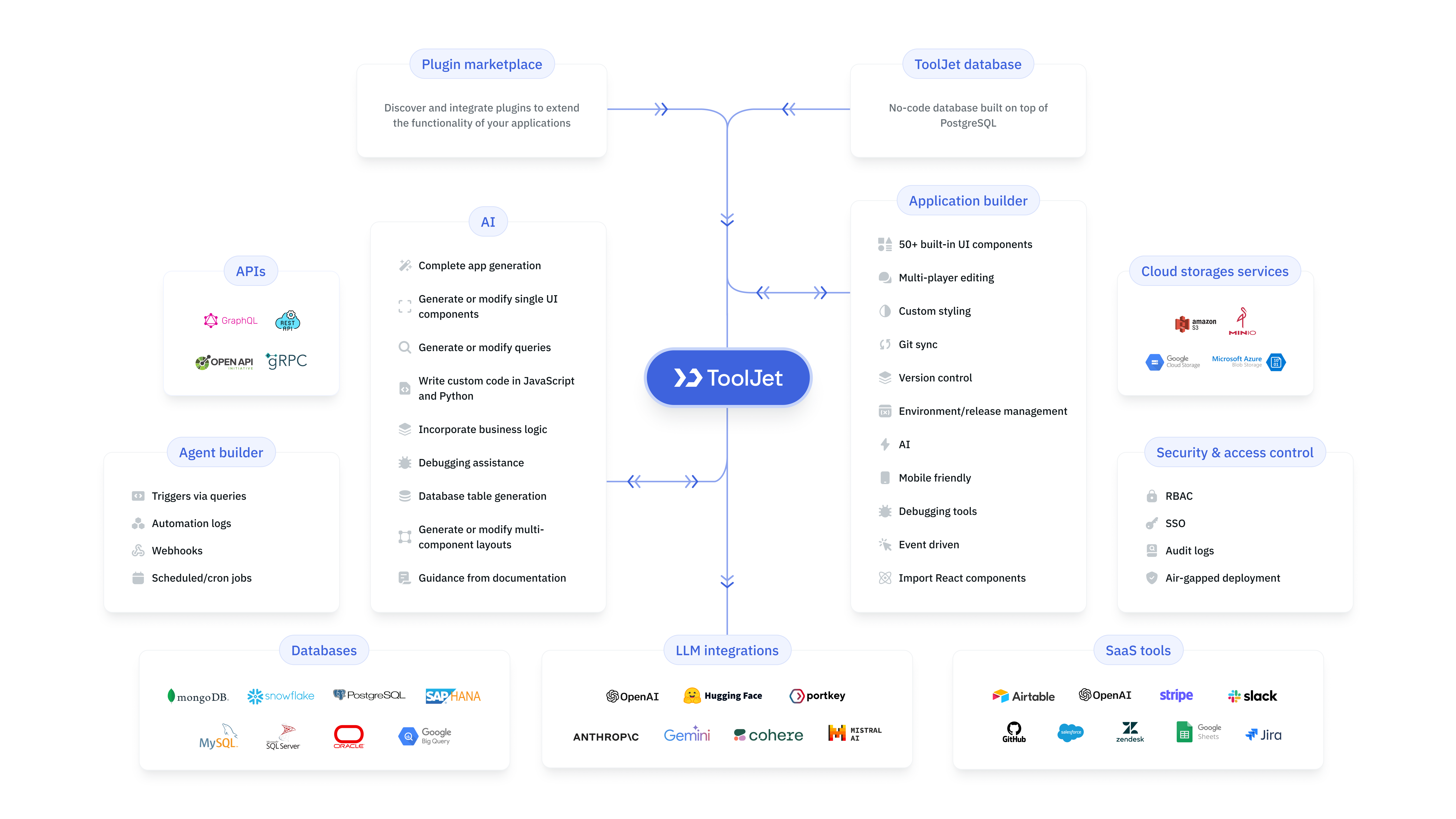
What is ToolJet?
ToolJet is an open-source low-code platform (AGPL-3.0) aimed at teams who need admin panels, dashboards and other back-office apps wired to databases, APIs and SaaS services they already run. In the Community Edition you assemble screens from 80+ responsive components, keep data in a built-in no-code database, reach more than 90 sources, and drive behaviour with JavaScript or Python while teammates edit alongside you. Higher ToolJet AI and Enterprise tiers add prompt-based app generation, an agent builder, workflows fired on a schedule or by webhook, GitSync against GitHub or GitLab, dev/stage/prod environments, RBAC with SCIM, audit logs, white-labeling and secure app embedding. An MCP server also lets coding agents such as Claude Code or Cursor build and modify apps, though that part is still called beta. Self-hosting works through a one-command Docker trial image, a production Docker Compose file (in-built or external PostgreSQL), or guides for Kubernetes, Helm, OpenShift, EC2, Cloud Run and DigitalOcean; workflow workers spread across instances need external Redis. The docs ask for a 64-bit x86 Linux host with a single vCPU, 4GB memory and 8GiB disk, and rule out arm64. ToolJet Cloud is the hosted alternative, and fully offline operation is an Enterprise add-on.
Should you self-host ToolJet?
ToolJet scores 77/100 on selfhost.directory (how scoring works) and ranks #1 of 17 in Low Code. It has 41 229 GitHub stars, +151 in the last 30 days.
It shipped 83 stable releases in the past year. The latest, v3.21.96-lts, came out on 13 November 2026. New versions land roughly every 1 days.
Setup is moderate: expect some configuration beyond a single command. An official Docker image is available. It is AGPL-3.0-licensed and written mostly in HTML.
Its closest alternative on selfhost.directory is windmill (78/100, 18 597 stars). It scores higher overall, so compare the two before you pick. See ToolJet vs windmill side by side.
ToolJet README
ToolJet is an open-source platform for building internal tools: admin panels, dashboards, and operational apps that run on your existing databases, APIs, and SaaS systems.
Build them by prompting. ToolJet AI turns a description into pages, queries, and components, and the coding agent you already use can do the same through ToolJet's MCP server. Agents build against ToolJet's real component and data contracts rather than emitting free-form code, so what you get is an actual ToolJet app: one your team keeps editing in the visual builder, under the same permissions, environments, and version history as everything else.
FAQ
Can I use my own LLM API keys?
Yes, Enterprise plans support bring-your-own LLM keys for cloud and self-hosted, using ToolJet's managed AI server with your provider keys instead of ToolJet AI credits.
Is it possible to upgrade from self-hosted community edition?
It is quick - the pricing FAQ says moving from the community edition to enterprise edition takes only a few minutes.
Who handles upgrades and backups?
On a self-managed installation your own team performs upgrades and backups; with managed hosting those responsibilities are agreed with ToolJet.
Does self-hosting keep all AI processing inside our network?
Not by itself: the default setup uses ToolJet's managed AI gateway, BYOK is an Enterprise option, and a customer-hosted gateway plus a local model endpoint are needed to keep inference inside your network.
Can we run ToolJet without internet access?
Yes - with the Enterprise air-gapped add-on, which also supports offline licensing, provided data sources and identity services are reachable inside the isolated network.
Can I deploy ToolJet on-premise?
Yes, ToolJet can run on your own infrastructure from the free Community Edition; fully offline operation including licensing needs the Self-hosted Enterprise air-gapped add-on.
What infrastructure does ToolJet require?
The documented baseline is x86-64 Linux (arm64 unsupported) with 1 vCPU, 4 GB RAM and 8 GiB storage, plus PostgreSQL 16.x recommended and Redis 7.x required.
Can I self-host ToolJet for free?
A free self-hosted option exists and the Community Edition is AGPL-3.0; advanced governance features and Enterprise add-ons are licensed separately.
More in Low Code
 windmillOpen-source, self-hosted developer platform that turns scripts into APIs, background jobs, workflows and internal UIs, pitched as an alternative to Retool and Temporal.
 apitableOpen-source, self-hosted Airtable alternative: realtime visual database with grid, kanban and gantt views, one-click forms, a REST API panel, dashboards and widgets.
 AppsmithOpen-source low-code platform for self-hosted internal tools, admin panels and dashboards, deployed as one Docker container or via Helm with Git version control.
 budibaseOpen-source low-code platform for building AI agents, internal apps and automations; self-hosted via Docker, Compose, Kubernetes or Digital Ocean.
 canonic-self-hostedSelf-hosted low-code platform to build full-stack apps via Docker Compose with MongoDB and nginx proxy on port 9191, supporting Google OAuth.
 CortezaSelf-hosted, open-source low-code platform for building CRM, workflow and integration apps; an Apache-2.0 alternative to Salesforce that deploys via Docker.
 DropbaseSource-available, self-hosted low-code tool where AI generates Python app code for admin panels and internal tools; runs locally as Docker Compose services.
 FlowForgeConnect, Collect, Build, and Scale with FlowFuse
 FlowFuseSelf-hosted platform for building industrial applications at scale using Node-RED with AI-assisted development, team collaboration, and DevOps pipelines.
 GristA self-hosted, open-source relational spreadsheet with database-style columns, Python formulas, row-level access rules, forms and drag-and-drop dashboards.
 illa-builderSelf-hosted open-source low-code platform for internal tools: dashboards, CRUD apps, admin panels, with database/API connectors and scheduled or webhook automation.
 langflowLangflow is a self-hosted, open-source low-code platform for building AI agents and RAG workflows with a visual drag-and-drop interface.
0 comments