
Self-host dokploy
v0.31.2Deploy apps and databases with Docker Swarm
- Stars
- 38 551
- RAM
- at least 2GB of RAM
- Storage
- 30GB of disk space
- Port
- 3000 (Dokploy web interface (published as published=3000,target=3000,mode=host))
dokploy/dokploy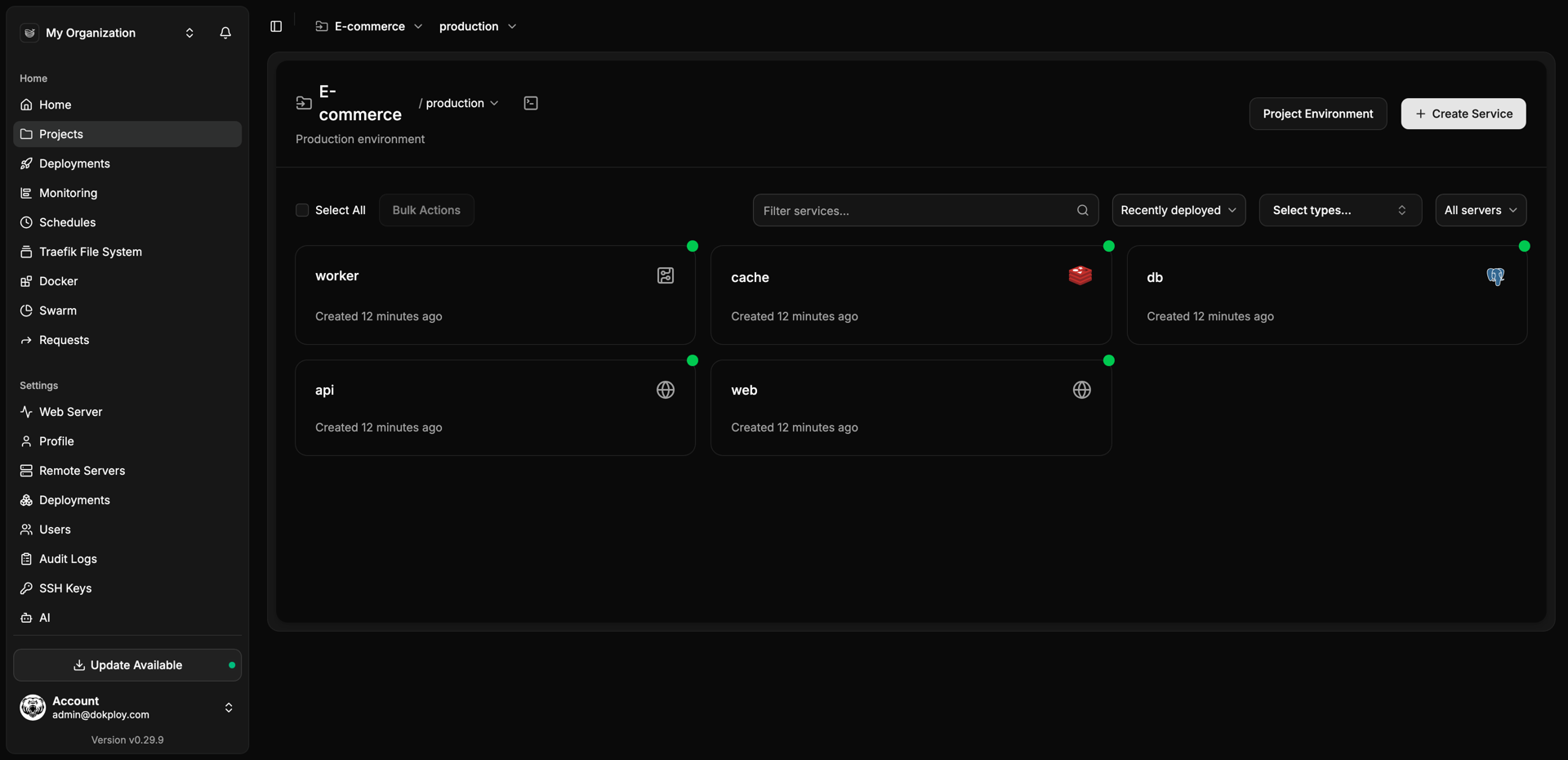
What is dokploy?
Dokploy is a deployment platform in the spirit of Heroku, Vercel and Netlify that you install on a VPS you own, so the control plane, its Postgres database and Redis all sit on hardware you manage. It ships applications built from GitHub, GitLab, Bitbucket, Gitea or raw Git using Docker, Nixpacks, Heroku or Paketo build types, handles native Docker Compose stacks, and can run MySQL, PostgreSQL, MongoDB, MariaDB and Redis services for you with manual or scheduled dumps sent to any S3-compatible bucket. Traffic goes through a bundled Traefik that Dokploy configures itself, giving each service a domain with a Let's Encrypt certificate plus a file editor for custom rules; per-service CPU, memory, disk and network charts sit next to realtime logs and a terminal inside each container. Teams get organizations, projects and environments, invited users with roles, passkey and TOTP sign-in, and webhook-driven auto deploys with preview builds, queues and rollbacks across several servers or a Swarm cluster. Installation is a single curl pipe to sh on Ubuntu, Debian, Fedora or CentOS (the same script updates the instance), or you can create the dokploy-postgres, dokploy and dokploy-traefik services by hand from the published image. Single sign-on, SCIM sync, tailor-made roles, activity trails and rebranding are not part of the free self-hosted build: they need a paid Enterprise license key, and a hosted Dokploy Cloud subscription starts at $4.50 per month per server.
dokploy alternatives
 vitoOpen-source, self-hosted server management panel: provision VPS clouds, deploy PHP/Laravel or Node.js apps, and manage databases, SSL, firewall, cron and monitoring.Comparevito with dokploy
 tempsSelf-hosted open-source deployment platform replacing Vercel, Sentry, PostHog with one Rust binary — deploy from git, track errors, monitor uptime, analyze traffic.Comparetemps with dokploy
 nixopusNixopus is a self-hosted, open-source deployment platform with an AI agent that handles the full app lifecycle.Comparenixopus with dokploy
 DeployrrDeployrr is a self-hosted CLI tool automating 160+ Docker apps for homelabs with reverse proxy, security, and authentication.CompareDeployrr with dokploy
 SenchoSelf-hosted, open-source control plane for managing Docker Compose stacks across multiple nodes with a web UI, real-time logs, and fleet-wide orchestration.CompareSencho with dokploy
 AppwriteThe open-source cloud for agents & devs. Including Auth, Databases, Storage, Functions, Messaging, Hosting, Realtime, WAF and moreCompareAppwrite with dokploy
 DBackupSelf-hosted open-source backup for 10 databases and files. Supports S3, Google Drive, SFTP with AES-256-GCM encryption, incremental backups, GFS retention, OIDC SSO, 2FA.CompareDBackup with dokploy
 DockerizaloDockerizalo is a self-hosted platform that clones apps from Git, builds containers, and manages secrets, volumes, and ports via a web UI for homelabs.CompareDockerizalo with dokploy
All self-hosted alternatives to Heroku → All self-hosted alternatives to Netlify → All self-hosted alternatives to Vercel →
Should you self-host dokploy?
dokploy scores 80/100 on selfhost.directory (how scoring works) and ranks #2 of 14 in Platform as a Service. It has 38 551 GitHub stars, +780 in the last 30 days.
It shipped 30 stable releases in the past year. The latest, v0.31.2, came out on 13 November 2026. New versions land roughly every 7 days.
Setup is easy: most people get it running in one sitting. An official Docker image is available. It is Apache-2.0-licensed and written mostly in Typescript.
Its closest alternative on selfhost.directory is coolify (87/100, 66 126 stars). It scores higher overall, so compare the two before you pick. See dokploy vs coolify side by side.
Features
- Auto-deploy webhooks
- Automated database backups
- CLI and API access
- Custom domains with auto SSL
- In-container web terminal
- Managed database deployment
- Multi-server deployment
- One-click app templates
- Real-time monitoring and logs
- Role-based user managementFine-grained custom roles need an Enterprise license
- Rollbacks
- Scheduled jobs
dokploy README
More in Platform as a Service
 EncoreOpen-source backend dev platform: declare databases, queues and cron jobs in Go or TypeScript code, and build standalone Docker images for self-hosted deploys.
 ethiboxEthibox is a self-hosted, open-source web app hoster for one-click deployment of 58+ apps like Nextcloud and Mattermost with auto-updates, backups, and custom domains.
 MesherySelf-hosted, open-source cloud native manager: model, deploy and operate multi-cluster Kubernetes with visual GitOps and nearly 400 integrations.
 mortiseMortise brings Railway-style git-push deployments to your own Kubernetes cluster. Open-source, self-hosted, handles builds, TLS, domains, and preview environments.
 QuantumRun your own Platform-as-a-Service: deploy GitHub projects, databases, templates, and Compose stacks on a private server with a web UI.
- tempsSelf-hosted open-source deployment platform replacing Vercel, Sentry, PostHog with one Rust binary — deploy from git, track errors, monitor uptime, analyze traffic.
 tsuruSelf-hosted, open-source PaaS that runs apps on your own Kubernetes clusters with one-command deploys, autoscaling, teams, quotas and add-on services.
 turbocloud-agentTurboCloud Agent is an open-source, self-hosted PaaS for deploying web apps to any Ubuntu 22.04 server with built-in WAF, VPN, load balancing, and CI/CD.
 1backend1Backend is a self-hosted, open-source platform for AI microservices and microfrontends with service discovery, auto-HTTPS proxy, and LLM orchestration.
 apl-coreApp Platform for Linode Kubernetes Engine
 bexbex is a self-hosted, open-source PaaS deploying apps from Git to HTTPS on your infrastructure, with a Render-compatible workflow for developers and AI agents.
 CapRoverSelf-hosted open-source PaaS: deploy apps and one-click databases via a web dashboard, CLI, git or webhook pushes, with free Let's Encrypt HTTPS on Docker Swarm.
0 comments