
Self-host Appwrite
2.7.2Open-source backend platform with Auth, Database, Storage
- Stars
- 58 106
- Ports
- 20080 (Installer wizard), 8883 (MQTT over TLS), 8084 (MQTT over WebSocket (WSS)), 3000 (Console (internal)), 1883 (MQTT (internal))
appwrite/appwrite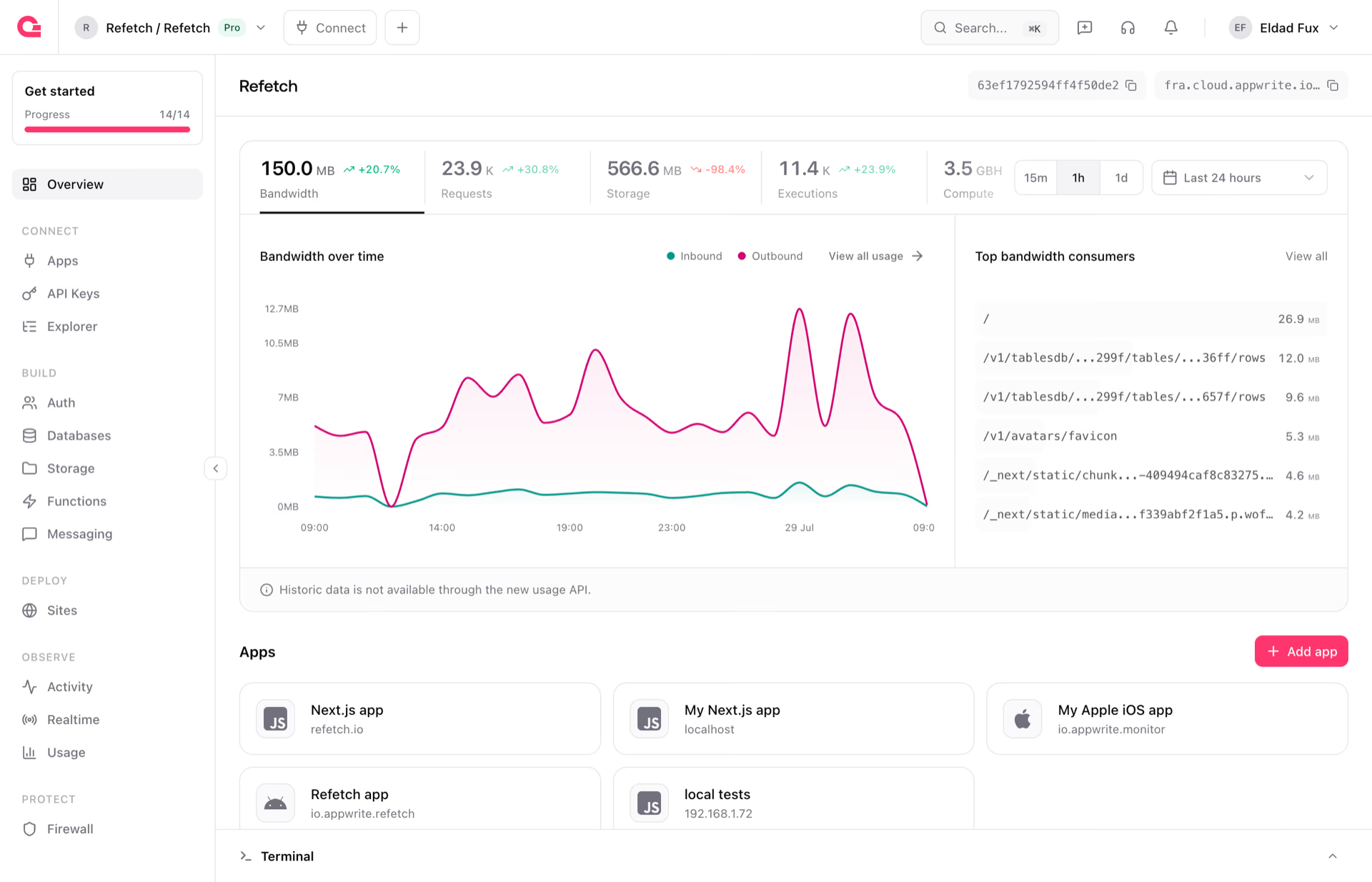
What is Appwrite?
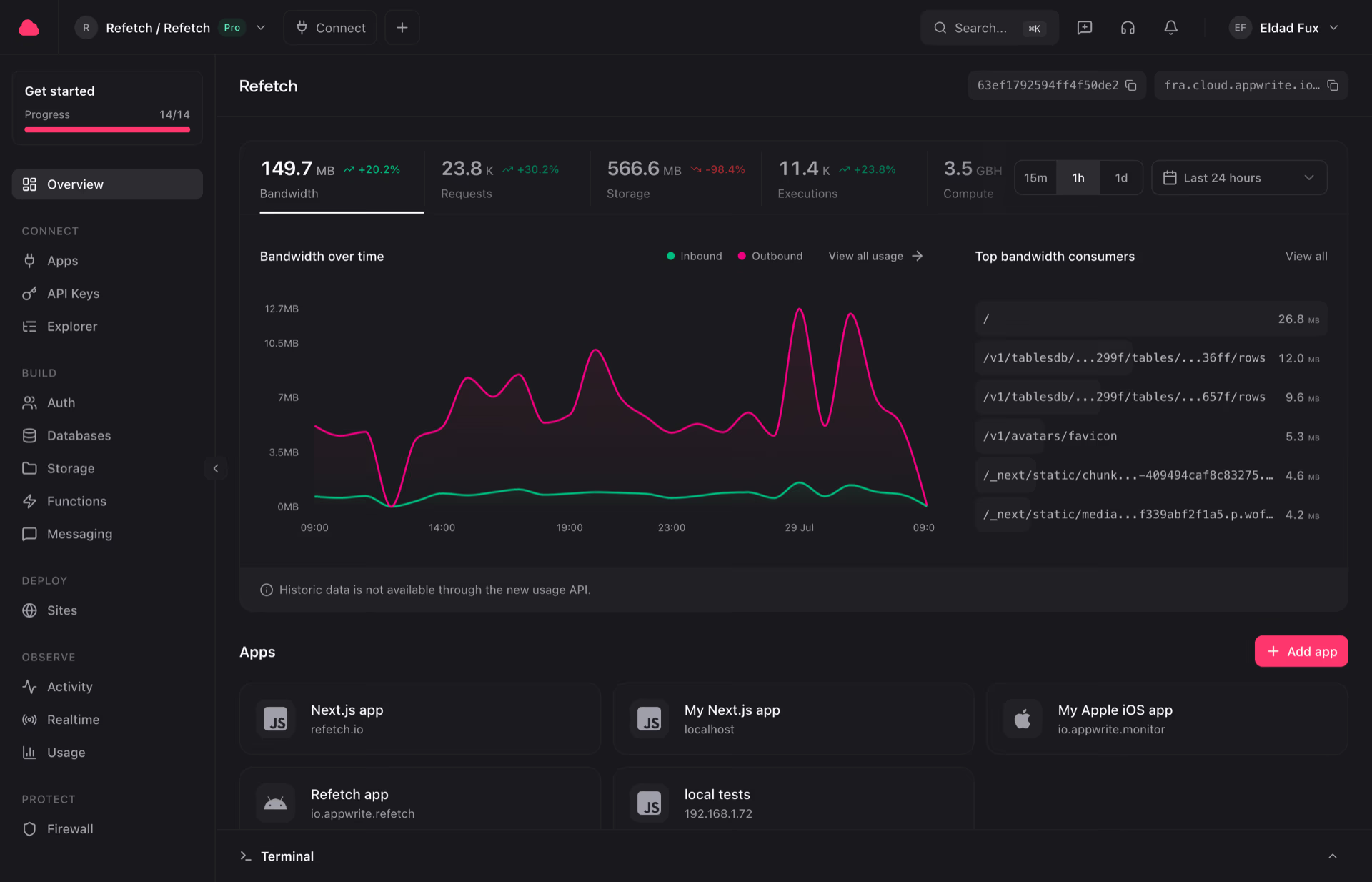
Appwrite is an open-source backend-as-a-service platform built for developers and AI agents. It delivers a full suite of backend services including authentication with email, SMS, OAuth and magic links; databases with managed PostgreSQL and MySQL options; file storage with compression and encryption; serverless functions; realtime event subscriptions; messaging for email, SMS and push; static site hosting; and a firewall. The platform exposes REST, GraphQL and WebSocket APIs and includes MCP servers so coding agents like Cursor, Claude Code and Codex can operate directly on a live project. Appwrite runs via Docker or Docker Compose on any infrastructure, with one-click deployments for DigitalOcean, AWS, Linode, Gitpod and other platforms. Its architecture combines a monolithic API layer with microservices for workers, using Traefik for routing, Redis for caching and queues, PostgreSQL or MariaDB or MongoDB for data, and ClickHouse for analytics.
Should you self-host Appwrite?
Appwrite scores 86/100 on selfhost.directory (how scoring works) and ranks #1 of 15 in Backend as a Service. It has 58 106 GitHub stars, +453 in the last 30 days.
It shipped 20 stable releases in the past year. The latest, 2.7.2, came out on 12 November 2026. New versions land roughly every 7 days.
Setup is moderate: expect some configuration beyond a single command. An official Docker image is available. It is BSD-3-Clause-licensed and written mostly in Typescript.
Its closest alternative on selfhost.directory is supabase (90/100, 115 074 stars). It scores higher overall, so compare the two before you pick. See Appwrite vs supabase side by side.
Features
- Authentication
- CLI & Terraform
- Databases
- Firewall/WAF
- Functions
- MCP (Model Context Protocol)
- Messaging
- Multi-database Support
- Multiple APIs
- Realtime
- S3-compatible Storage
- Sites/Hosting
- Storage
Appwrite README

How to install Appwrite
Install Appwrite with Docker Compose
docker compose up -d --remove-orphans
Manual setup with docker-compose.yml, .env, clickhouse-config.xml, clickhouse-init.sh
Install Appwrite with Windows
DOCKER_API_VERSIONdocker run -it --rm ^ --publish 127.0.0.1:20080:20080 ^ --volume //var/run/docker.sock:/var/run/docker.sock ^ --volume "%cd%"/appwrite:/usr/src/code/appwrite:rw ^ --entrypoint="install" ^ appwrite/appwrite:2.5.0
Windows Command Prompt
How to configure Appwrite
_APP_OPTIONS_ROUTER_FORCE_HTTPSForce HTTPS at router level_APP_OPENSSL_KEY_V1OpenSSL key for encryption_APP_DOMAIN=localhostMain domain for Appwrite instance_APP_USAGE_STATS=enabledEnable/disable usage statsvalues: enabled, disabled
_APP_LOGGING_CONFIGSentry DSN for error reporting
Appwrite releases & version history
Appwrite 2.7.2 is a security patch for the 2.7 line. It backports the security fixes released on main since 2.7.1, rebuilds on appwrite/base 2.2.11 to clear the image's open vulnerability findings, and ships with the 1.2.181 self-hosted Console (was 1.2.138). Upgrading from 2.7.1 needs no schema changes; we recommend every 2.7 install upgrades.
Highlights
- Security fixes across auth, abuse limits, storage, realtime, messaging, functions, VCS and proxy (below).
- Base image
appwrite/base2.2.11: patched git, curl, libexpat, perl, rsync and Docker CLI packages, and Go 1.27.4 forgit-remote-entire. - Console 1.2.181.
Fixes
Abuse limits
- Rate limits kept per account or per email address are now also kept per project. (#15280)
- Code and secret confirmation routes (verification, recovery, token, phone and magic URL sessions, MFA) now count every caller, including API keys. (#15277, #15470)
Auth
- Email verification tokens are claimed under the user row lock. (#15278)
- Organization project transfers require an organization owner. (#15178)
Storage
- Buckets with
allowedFileExtensionscheck the uploaded content against the allowed formats. (#15458, #15546)
Realtime
- Membership events respect membership privacy. (#15176)
- Account events are addressed by the full user ID. (#15308)
- Member sockets end when their project team is deleted. (#15335)
Messaging
- Attaching a push notification image requires
files.read, and its URL is withheld from callers without it. (#15302, #15341) - A message can only be updated through its own provider type's route. (#15409)
Functions, sites and deployments
- Server credentials stay out of client-readable schedules. (#15259)
- Deployment downloads with a key check the read scope. (#15460)
- Password-typed template variables are stored as secrets, and template variables match their code. (#15477, #15414)
VCS
- Webhook deployments are pinned to the resolved repository and build only at the branch head the provider reports. (#15261, #15279)
- Entire and Origin installation state is bound to the caller. (#15181)
- Commit preview hostnames are bound to their project and resource. (#15334)
Proxy, databases, GraphQL and migrations
- Rule domains are claimed only on a DNS label boundary. (#15303)
- Cached list fields are scoped to the version they were read at. (#15187)
- GraphQL list complexity is charged even when the selection is skipped. (#15305)
- The migration export download link is hidden from keys without data access. (#15268)
Under the hood
appwrite/base2.2.11 (#15492, #15531) and patched Debian packages in the Console image (#15491).- The migration package holds
appwrite/appwrite(PHP SDK) at 32.2 on 2.7.x (#15534); the abuse package requires^32.2.0(#15474).
Removed
Nothing.
Install
docker run -it --rm \
    --volume /var/run/docker.sock:/var/run/docker.sock \
    --volume "$(pwd)"/appwrite:/usr/src/code/appwrite:rw \
    --entrypoint="install" \
    appwrite/appwrite:2.7.2
Upgrade
Upgrading from 2.7.1 uses the same command with --entrypoint="upgrade", then run the migration. 2.7.2 uses the same migration as 2.7.1, so migrate changes no data on an install already on 2.7.1.
cd appwrite
docker compose exec appwrite migrate
Back up your data first.
Contributors
Thank you to everyone who contributed to 2.7.2:
Appwrite 2.7.1 is a security release that moves the Open Runtimes executor to 1.3.1. It ships with the same 1.2.138 self-hosted Console as 2.7.0, has no schema changes, and upgrading from 2.7.0 only replaces the images.
Security
- Update the Open Runtimes executor from 1.1.2 to 1.3.1 (open-runtimes/executor#269, #15310). Executor 1.1.2 followed symlinks that a function or site plants in its execution log files, build logs, build output or build cache, and it used the runtime's log id without checking it. A function could read files from the executor container, including its environment with
_APP_EXECUTOR_SECRET, as its own logs or build output. With that secret, code in a function can call the executor API directly, and the executor controls Docker on the host. You are affected if anyone you don't fully trust can deploy functions or sites on your instance. Upgrade, then rotate_APP_EXECUTOR_SECRETif that applies to you. - Executor 1.2.x and 1.3.x also bring changes that keep existing behaviour:
OPR_EXECUTOR_SECRET_PREVIOUSfor rotating the executor secret without downtime, a storage DSN check that is off by default, and an opt-in streamed response format.
Install
docker run -it --rm \
    --volume /var/run/docker.sock:/var/run/docker.sock \
    --volume "$(pwd)"/appwrite:/usr/src/code/appwrite:rw \
    --entrypoint="install" \
    appwrite/appwrite:2.7.1
Upgrade
Upgrading from 2.7.0 uses the same command with --entrypoint="upgrade", then run the migration, which has nothing to change for this release:
cd appwrite
docker compose exec appwrite migrate
If you maintain your own docker-compose.yml, set the openruntimes-executor image to openruntimes/executor:1.3.1 and run docker compose up -d.
To rotate the executor secret, set a new _APP_EXECUTOR_SECRET in .env and run docker compose up -d. This recreates the API, the workers and the executor together, so nothing needs the old value.
Back up your data first.
Contributors
Thank you to everyone who contributed to 2.7.1:
Full Changelog: 2.7.0...2.7.1
AI summary Added server key rotation, bulk sign-out, and enhanced security policies
Appwrite 2.7.0 adds server key rotation, a way to sign out every user of a project, a realtime policy that keeps guests from subscribing, origin-bound OTP-Token headers on code emails, Gitea in the Console's Git connect flow, and per-connection limits for realtime and MQTT. It also carries the security and reliability fixes merged since 2.6.2 across auth, databases, realtime, storage, functions, sites, VCS and migrations. It ships with the 1.2.138 self-hosted Console (was 1.2.108). Upgrading from 2.6.2 needs migrate: V25 now adds new attributes, indexes and collections. No configuration change is required, but several defaults tighten, so read Upgrade before you upgrade.
Highlights
- Server key rotation. The server key is now versioned.
_APP_OPENSSL_KEY_CURRENTpicks the_APP_OPENSSL_KEY_V{n}that signs new tokens and encrypts new data._APP_OPENSSL_KEY_OLDESTis the oldest version still accepted when verifying JWTs, ephemeral keys, resource tokens and OAuth/VCS state. Stored values keep decrypting with the version they record. The newencryptiontask re-encrypts stored data under the current version. With the defaults (CURRENT=1,OLDEST=1) nothing changes (#15198, #15199). - Sign out every user in a project.
DELETE /v1/project/sessionsand a new card on Auth > Settings invalidate every session in the project at once. Old session documents are removed in the background, and realtime connections on those sessions are closed, impersonated ones included (#14647, #15089). - Realtime guests policy. Auth > Policies > Realtime can stop guests from opening realtime subscriptions (#14945, #14996).
- Realtime and MQTT limits. A realtime connection can hold at most 100 subscriptions, 100 channels and 100 queries in total (nested
and/orqueries count), and one project user at most 32 connections per realtime worker. Set the first three with_APP_LIMIT_REALTIME_SUBSCRIPTIONS,_APP_LIMIT_REALTIME_CHANNELSand_APP_LIMIT_REALTIME_QUERIES. The MQTT broker caps topic filters per SUBSCRIBE at 100, connections at 32 per user per worker, and SUBSCRIBE packets at 32 a minute per user when_APP_OPTIONS_ABUSEis on. Realtime also closes connections that have been silent for two minutes, so presence no longer sticks for clients that dropped off (#14945, #14948, #15056, #15059). OTP-Tokenemail header. Email OTP sign-in, OTP password recovery, OTP email verification and email MFA challenges carry anOTP-Tokenheader bound to the request's origin, so mail clients and password managers can autofill the code only on that origin. It is sent only for HTTPS origins (orlocalhost), so server SDK calls and native apps get the same email as before (#15096).- Gitea in Git connect. Create function, create site, the repository picker and project Git settings offer Connect Gitea when
_APP_VCS_GITEA_*is configured. The connect buttons now show only the providers the server has configured, instead of offering ones whose authorization fails (#15004). - Playground. API Explorer and Realtime now share one Playground screen with a REST / Realtime switch. Old Explorer and Realtime links redirect to it.
- Console 1.2.138. Besides the screens above: Logs on verified domains, so certificate renewal warnings can be read (#15015); a warning and Disconnect action when a site's or function's repository is no longer reachable through its installation (#15043); column editor fixes (#15081, #15117, #15072); API explorer keys kept in memory instead of
localStorageand cleared on sign-out (#14994); and patched Zod copies (#14908).
Fixes
Auth and accounts
- Require an MFA challenge from the last few minutes to turn MFA off, as deleting an authenticator already does (#15057).
- Make TOTP codes single-use, so one code can't complete a challenge on a second session; the enrolment code can't be reused either (#15154).
- Proving an unverified phone now claims the account the same way an unverified email does. Every claim path (magic URL, email OTP, password recovery, signed-out team invite) revokes what the registrant left behind, keeps MFA in force when the account needs two factors, and closes the registrant's live realtime and MQTT connections (#15058, #14976, #15144, #15062).
- Bind the OAuth2 state to the user who started the flow (#15029).
- Scope the email sign-in rate limit to the project and address (#15023).
- Keep created token and session secrets out of realtime events (#14520). Fixes #14415.
- Apply a project's custom session alert template only when its custom SMTP is enabled, like every other email (#15055).
- Stop granting
rules.readto project end users, who could list the project's proxy rules (#15013). - Let API keys call
publicscope endpoints such as the runtimes and frameworks lists, whichappwrite init functionneeds in CI (#15156). - Fall back to the default locale when a translation is an empty string, which queued recovery emails without a subject (#15069).
Users and teams
- Stop a blocked user from impersonating (#15021).
- Reject imported Argon2 hashes that can never verify (#14924).
- Delete a user's presence when the user is blocked or deleted (#14397). Fixes #14344.
- Revoke MQTT topic subscriptions when a user's push targets are deleted with their credentials (#14952).
- Check whether the caller may invite to a team before the invitee is looked up or created (#14947).
- Apply membership privacy to the create and update membership responses (#15027).
- Enforce the last-owner rule on console teams for every caller, API keys included, and count only confirmed owners (#15153).
Databases
- Scope transactions to the API they were created from: a transaction created through VectorsDB can't be read or committed through TablesDB, and the other way around. Existing transactions are treated as legacy and stay usable through Databases and TablesDB (#14350).
- Require an API key or a privileged user for bulk update, upsert and delete, as bulk create already did (#15235).
- Emit row events for bulk operations in a transaction (#14383). Fixes #14219.
- Lock the transaction while staging operations (#14384). Fixes #14332.
- Apply transaction bulk updates once, to matching rows only, and handle missing query operators in transaction state filters (#14378, #14324). Fixes #14217, #14222.
- Load transaction metadata once per database and table (#14190). Fixes #14176.
- Bound offset and limit for transaction-aware listing (#14964).
- Refresh cached lists when document permissions change (#14869).
- Chunk the batch duplicate lookup by the maximum number of query values (#15017).
- Accept
upsertin row and document event subscriptions for functions and webhooks (#14742). Fixes #14653. - Console: restrict column number inputs and stop prefilling unbounded min/max (#15081, Fixes #7706, #9217); drop renamed or deleted columns from the saved rows selection, which made every row list fail (#15117); don't crash the columns and indexes tabs while no table is selected (#15072).
- The project onboarding checklist counts VectorsDB databases, collections and documents (#15186).
Realtime and MQTT
- Reset a connection's authorization when it re-authenticates, so a connection opened in admin mode doesn't stay privileged after switching to a project user (#15064).
- End admin-mode connections when the console user loses access to the project (#15060).
- Re-authorize console tails on project transfer and re-authentication (#14989).
- Send console copies of project events to the project's readers, and address cross-tree event copies to the right audience (#14988, #15002).
- Keep execution logs and errors out of realtime payloads (#15024).
- Fail closed when a permission check is stuck, instead of stalling delivery for every project on the worker, and keep exceptions out of the pub/sub subscribe loop (#15086, #15166, #15169, #15168).
- Bound the MQTT revoke wait and fail closed on a verification timeout (#15085, #15170).
- Scope stored push messages to the topic instance (#14867).
Storage
- Harden chunked uploads, file rename and preview (#14935).
- Decode only supported raster formats in image transformations, and return 404 for favicons in an unsupported format (#14980, #15070).
- List local directory entries by literal name (#15033).
- S3 gateway: stop storing and returning
x-amz-server-side-encryption, and refuse bucket names that are not valid IDs (#14990, #15210). - Sign
Content-Lengthonly on S3 storage requests that have a body (#14523). Fixes #14326. - Keep the root directory when flushing the filesystem cache (#14515, #14059). Fixes #14007.
Functions and sites
- Keep function and site scopes within the scopes of the key that sets them (#15026).
- Reject control characters in execution header values (#15143).
- Keep the fallback session header out of function and site requests (#14925).
- Read deployment downloads through the file handle that was checked (#15022).
- Reserve the functions fallback domain for preview URLs, so rules can't claim it (#15025).
- Builds: reconcile missing build output callbacks, keep readiness across cache eviction, and clear the output of deployments deleted mid-build, so deployments no longer stay
building(#14914, #15135, #14927). - Retention: protect branch-pinned deployments, and retire deployments in small batches to stop worker OOMs (#15075, #15122).
- Require project read permission for private site previews (#14936).
- Bind screenshot keys to their project and rule, make screenshot capture deterministic, keep it within one HTTP timeout, and grant screenshots to the team a project moves to (#14977, #15031, #13315, #15077, #15157).
- Keep
{}objects such as emptyprefsas objects in event payloads instead of[](#13650). Fixes #6360.
VCS
- Bind GitHub repository links to the project's installation (#14975).
- Strip only the leading branch namespace from push refs (#15035).
- Reject
.gitsegments in repository root directories, and confine Gogs file writes to the checkout (#15036, #14993). - Skip an unnecessary personal OAuth2 refresh for GitHub installations (#12972).
- Entire: report deployments, create repositories, fix token minting, checks and path triggers, follow a repository to the installation that pushes it, and request every permission an installation holds (#14883, #15042, #15006, #15012).
- Console: correct the Silent mode description and show exclusion paths correctly in the build trigger summary (#15043).
Migrations
- Cap a migration's authority to the scopes of the key that created it (#15145).
- Fix Appwrite-to-Appwrite migrations of projects with more than one database, where the first table arrived without its columns, indexes and rows (#15039).
- Confine Local destination writes to the export directory, and neutralise formula-like values in CSV exports (#14933, #14516). Fixes #14428.
- Retry migrations stranded by a killed worker (#14399). Fixes #14334.
- Report membership counts (#13598).
Messaging, mails and webhooks
- Map APNs results to the token each request was sent for (#15020).
- Retry a stale SMTP session once (#14213, #15211). Fixes #12623.
- Fix a 500 when updating a scheduled draft message that has no schedule (#15167).
- Resolve and check webhook destinations before connecting, and dial project SMTP only on checked addresses (#15037, #15028, #15032).
- Cap the decoded response size for OAuth2, webhook and migration requests (#15030).
- Render email template placeholders in a single pass (#15034).
- Detect disposable email providers that hand out a subdomain per mailbox, and refresh the free and disposable domain lists (#15192, #15212, #14942).
Platform
- Scope the proxy rules list cursor to the project (#15065).
- Bound abuse time-limit increments at the limit atomically (#14992).
- Queue: move retried jobs off the failed list atomically, and drop the old payload when a job is retried (#15000, #14524). Fixes #14491.
- Resolve a queued project by its sequence as well as its ID (#14991).
- Scheduler: keep its claim in Redis across restarts, and restart combined scheduler loops that stop (#14531, #15007). Fixes #14488.
- Time out unresponsive Redis connections (#14540). Fixes #14490.
- Treat a negative lock acquire timeout as wait-forever (#14521, #13756). Fixes #13719.
- Accept non-ASCII characters in URLs (#15080). Fixes #9717.
- DNS: bound compression pointers and decoded name length, and add a TCP write deadline (#14983, #14939).
- Choose TLS from the
wssscheme rather than the port in the WebSocket client (#14984). - Handle invalid queries in the GraphQL complexity callback (#15073).
- Specs: give hashed password params valid examples, and detect header cycles through media-type encodings (#15040, #14998).
- Pass
_APP_MEMORY_LIMITto the maintenance worker (#14926). - Stop deep-cloning the user document on every request (#14110). Fixes #14087.
- Estimate large collection counts in the usage stats sweep, and defer maintenance on the deletes queue's wait time rather than its depth (#15163, #15159).
- Escape control characters in pretty logs, and keep Sentry events whose attributes hold invalid UTF-8 (#14958, #14995).
- Linear-time bot detection, URL dot-segment removal and MQTT user property building (#14966, #14967, #14968).
- Console: correct the file level security description in bucket settings (#14937). Fixes #14931.
Under the hood
utopia-php/databasemoves from 8.3 to 10.1, with an eviction-safe compare-and-swap cache protocol. Existing caches stay valid; no flush is needed (#15134, #15150).- Open Runtimes Orchestrator 4.0.0; its Docker environment is unchanged (#14893).
appwrite/browser0.3.10 (#14930, #15014) and the bundled PHP SDK 32.2.0 for migrations (#15054, #15242).- The bundled PostgreSQL now accepts 500 connections by default, set with
_APP_DB_MAX_CONNECTIONS(#14987). Fixes #13517. - Maintenance for projects accessed in the last 30 days now runs through the slot scheduler, spread across five-minute slices, instead of all at once every
_APP_MAINTENANCE_INTERVAL(#15097). - Realtime publishes connection usage off the close path, and reports telemetry for its pub/sub handler and worker uptime (#15001, #15113, #15114, #15116).
- Messaging send counters include the email template and SMS country, and spans carry
http.uri(#15219, #14940). - Actions are built on first use and registered under literal names, and the remaining account, GraphQL, locale, mock, project, projects and console versions controllers moved into modules with no API change (#15162, #15180, #15119, #15123, #15124, #15125, #15128, #15129, #15130).
- 2.7.0 maps to migration V25, the same class as 2.6.2, with new steps (see Upgrade).
Removed
- The project
usersrole no longer holdsrules.read(#15013). - The S3 gateway no longer stores or returns
x-amz-server-side-encryption(#14990). - No environment variables are removed.
Install
docker run -it --rm \
    --volume /var/run/docker.sock:/var/run/docker.sock \
    --volume "$(pwd)"/appwrite:/usr/src/code/appwrite:rw \
    --entrypoint="install" \
    appwrite/appwrite:2.7.0
Upgrade
Back up your data first. Upgrading from 2.6.2 uses the same command with --entrypoint="upgrade". Then run the migration:
cd appwrite
docker compose exec appwrite migrate
The V25 migration is idempotent and adds:
prefson projects;alertsUnsubscribedon users; the GeoIP attributes on sessions; andfolderwith its index on buckets created before 2.0.0 (#15120, #15079, #14329).typeon transactions, backfilled tolegacyfor existing ones (#14350).topicInternalIdindexes on the push ledger (#14867). Ledger entries are now bound to their topic, so entries written before the upgrade have notopicInternalIdand are never replayed. Push messages a device had not yet received over MQTT when you upgrade are not delivered when it reconnects; the age-based prune removes those entries. New messages replay as before.- The
transfers,monitors,monitorAlertsandreviewscollections, used by API features that have no self-hosted Console screen yet (#14722, #15079, #15216, #15038, #15044).
Check these before upgrading:
- Server key: nothing to change. Keep
_APP_OPENSSL_KEY_V1. To rotate it later, recreate the containers after each configuration change withdocker compose up -d(docker compose restartkeeps the old environment): set_APP_OPENSSL_KEY_V2in.envand rundocker compose up -d; set_APP_OPENSSL_KEY_CURRENT=2and rundocker compose up -d; rundocker compose exec appwrite encryption(a dry run that counts what's left), thendocker compose exec appwrite encryption --commit=true(resume with--after=<projectId>if it stops); then set_APP_OPENSSL_KEY_OLDEST=2and rundocker compose up -dto stop accepting V1 tokens. JWTs and resource tokens signed with V1 stop working at that point. Files already encrypted in storage are not re-encrypted, so keep_APP_OPENSSL_KEY_V1configured. - Realtime and MQTT clients: a connection over 100 subscriptions, channels or queries now gets an error, and a user's 33rd connection on one worker is closed. Raise the realtime limits with the variables above if your app needs more.
- Bulk writes: bulk update, upsert and delete from client sessions now return 401. They need an API key or a console user.
- API keys: a key that creates a migration now needs the write scope of every resource it imports, and a key that configures a function or site can only add scopes it holds itself.
- MFA: turning MFA off now needs a recent MFA challenge, and a TOTP code can be used once.
- PostgreSQL: the bundled PostgreSQL starts with
max_connections=500. Set_APP_DB_MAX_CONNECTIONSlower on small hosts. - Functions domain: if you changed
_APP_DOMAIN_FUNCTIONS, list the old domain in_APP_DOMAIN_FUNCTIONS_FALLBACKto keep serving preview URLs on it. - Maintenance:
_APP_MAINTENANCE_INTERVALshould be a multiple of 300 seconds. The default, 86400, is. - New optional variables:
_APP_OPENSSL_KEY_V2,_APP_OPENSSL_KEY_CURRENT,_APP_OPENSSL_KEY_OLDEST,_APP_LIMIT_REALTIME_SUBSCRIPTIONS,_APP_LIMIT_REALTIME_CHANNELS,_APP_LIMIT_REALTIME_QUERIES,_APP_DB_MAX_CONNECTIONSand_APP_DOMAIN_FUNCTIONS_FALLBACK.
Contributors
Thank you to everyone who contributed to 2.7.0:
@SahilArate @Spandan-Mishra @ItsRoy69 @flcrom @ChiragAgg5k @adityaoberai @loks0n @atharvadeosthale @ArnabChatterjee20k @abnegate @HarshMN2345 @Meldiron @TorstenDittmann @callmegautam @eldadfux @lohanidamodar @imtia33 @fogelito @shimonewman @aishwaripahwa12 @jaysomani @levivannoort
Full Changelog: 2.6.2...2.7.0
Appwrite 1.9.10 is a security release for self-hosted deployments on the 1.9 line. It backports the hardening shipped in 2.6.2 across auth, API keys, databases, realtime, GraphQL, storage, VCS, functions, migrations and messaging, and moves the runtime to a patched Brotli. It keeps Console 8.7.37 for compatibility with the 1.9 server APIs. Upgrading from 1.9.9 reuses migration V25 and introduces no schema changes, but a few fixes tighten defaults, so read Upgrade first.
Highlights
- Brotli CVE-2026-111497.
appwrite/base1.4.6 requiresbrotli-libs1.2.1, which fixes an out-of-bounds write in the Brotli decoder (appwrite/docker-base#128, #14912). libcurl and the Swoole client decodebrresponses from URLs users control, such as avatar and favicon fetches, webhooks and migration sources. - API keys and JWTs stay within their grant, invalid keys are refused instead of running as a guest, and secrets stay write-only (#14910).
- Realtime and GraphQL follow the HTTP session and permission rules (#14913).
- Outbound connections stay on public addresses for SMTP, migration sources and certificate checks, with the new
_APP_ALLOWED_INTERNAL_ADDRESSESto allow an internal relay (#14911).
Fixes
- Auth and accounts: authenticate API keys before skipping Origin checks (#14910, backports #14352), allow admin mode only from console origins (#14813), clear email-bound tokens and invites when the email or phone changes (#14347, #14819), revoke prior credentials when OAuth links an unverified account (#14801), rate limit token sign-ins per account (#14880), compare MFA codes in constant time (#14762).
- Keys and users: hold keys and JWTs to their original grant (#14888), keep write-only secrets on their endpoint and bind ephemeral keys to their project and purpose (#14795, #14825), keep key and webhook secrets out of the 1.9.4 response format (#14815), hide credentials from impersonators (#14818), require
users.writeto read MFA recovery codes (#14872), bound imported password hash costs (#14825), gate development-only routes on_APP_ENV=development(#14824). - Databases: enforce permissions when staging transaction operations, and rate limit guest transaction writes (#14913, backports #14754, #14762), gate increment/decrement and fix upsert permissions (#14755), scope the list cache to collection permissions and gate inline encryption (#14791).
- Organizations and projects: accept only keys and console sessions on organization routes (#14779), evaluate project roles against the project in the path (#14787), require owner on both organizations to transfer a project (#14780).
- Realtime and GraphQL: require project access for admin mode connections (#14790), apply the HTTP session rules to realtime connections (#14803), send migration events only to project readers (#14805), validate presence messages like the HTTP endpoint (#14829), keep the caller's identity across GraphQL fields (#14820), cost invalid list limits at the complexity cap (#14821).
- Storage and platform: validate file names and build
Content-Dispositionper RFC 6266 (#14789), refuse reads of incomplete uploads (#14876), keep the platform default bucket private (#14814), cap avatar remote fetches and rate limit image and favicon requests (#14788), key rate limits on the route path and keep them on out-of-rangeContent-Range(#14785, #14816), drop client-named Swoole uploads and never call request values as code (#14909, backports #14897, #14792), strip control characters from webhook headers (#14806). - VCS, functions and sites: verify the GitHub webhook signature before fan-out, verify installation access, and sign and expire installation state (#14911, backports #14771, #14783, #14793), verify GitHub API certificates (#14802), confine repository root directories (#14808), bind branch preview rules to their project (#14786), validate reserved execution headers case-insensitively (#14185), keep session cookies and the fallback session header out of function and site requests (#14874, #14823).
- Migrations and messaging: keep migration, certificate check and SMTP connections on public addresses (#14794, #14870, #14811), validate NHost source hosts (#14798), check DocumentsDB and VectorsDB source key scopes (#14868), stop returning secret messaging provider credentials (#14875), require
files.readto attach files to emails (#14827), escape the redirect in email templates (#14822), never fall back to the platform database for a missing project (#14812).
Under the hood
- Fixes in vendored libraries that 1.9's dependency set can't update are applied in Appwrite's own code: the Swoole upload guard, request values never being called as code, and GitHub API certificate verification (#14909).
- Not backported, because the feature doesn't exist on 1.9: ID-token email policies (#14633), console realtime tails (#14797), the jobs callback secret (#14116), the onboarding hook (#14807) and multi-provider VCS events (#14800). #14778 was already the behaviour on 1.9.
- 1.9.10 maps to migration V25, the same class as 1.9.9.
Removed
No environment variables, collections or public APIs are removed. Secrets that were previously readable (messaging provider credentials, webhook passwords and key secrets for callers without the right grant) are no longer returned.
Install
docker run -it --rm \
    --publish 20080:20080 \
    --volume /var/run/docker.sock:/var/run/docker.sock \
    --volume "$(pwd)"/appwrite:/usr/src/code/appwrite:rw \
    --entrypoint="install" \
    appwrite/appwrite:1.9.10
Upgrade
Back up your database and persistent storage first. From the parent directory of an existing 1.9.9 installation:
docker run -it --rm \
    --publish 20080:20080 \
    --volume /var/run/docker.sock:/var/run/docker.sock \
    --volume "$(pwd)"/appwrite:/usr/src/code/appwrite:rw \
    --entrypoint="upgrade" \
    appwrite/appwrite:1.9.10
cd appwrite
docker compose exec appwrite migrate
Check these before upgrading:
-
Run the upgrade interactively as shown, or pass your current ports with
--http-portand--https-port: a non-interactive upgrade resets custom ports to 80/443 (also true of 1.9.9). -
New optional variable
_APP_ALLOWED_INTERNAL_ADDRESSES: project SMTP, messaging SMTP providers and migration sources on a private or reserved address must be listed here. -
Ephemeral keys minted before the upgrade are refused until reissued, and an invalid
X-Appwrite-Keynow returns401instead of running the request as a guest. -
Changing an SMTP host, port or
secureflag, or an OAuth provider endpoint, requires sending the secret again. -
Sites and functions whose stored root directory contains
..fail to build until the directory is changed to a path inside the repository. -
Mock routes and the time-travel task require
_APP_ENV=development.
Contributors
Thank you to everyone who contributed to 1.9.10:
@ChiragAgg5k @abnegate @Meldiron @ArnabChatterjee20k
Full Changelog: 1.9.9...1.9.10
Appwrite 2.6.2 is a security release for self-hosted deployments on the 2.6 line. It brings the hardening work merged since 2.6.1 across auth, API keys, databases, realtime, GraphQL, storage, VCS, functions, sites, migrations and messaging. It also moves the runtime to a patched Brotli and the Console to 1.2.108. There are no schema changes: upgrading from 2.6.1 keeps migration V25. A few fixes tighten defaults that a self-hosted install may rely on, so read Upgrade before you upgrade.
Highlights
- Brotli CVE-2026-111497.
appwrite/base2.2.7 updatesbrotli-libsfrom 1.2.0-r1 to 1.2.1-r0. 1.2.1 fixes an out-of-bounds write in the Brotli decoder. Appwrite is exposed through its outbound HTTP client: when a caller doesn't setAccept-Encoding, the cURL adapter accepts and decodesbr, and the avatar image and favicon endpoints fetch user-supplied URLs that way. The Swoole HTTP client links the same library (#14765). - API keys and JWTs stay within their grant. A key can no longer create or change a key with scopes it doesn't hold or an expiry later than its own, a JWT can't manage keys, account keys are limited to the console, and ephemeral keys are bound to their project (#14888, #14795, #14755, #14825).
- Realtime and GraphQL follow the HTTP rules. Realtime connections apply the same session checks as HTTP, admin mode needs project access, and console tails need project read. GraphQL keeps the caller's identity across the fields of one request (#14803, #14790, #14797, #14820).
- Outbound requests stay on public addresses. Project SMTP, messaging SMTP providers, migration sources and certificate checks now refuse private and reserved hosts unless you list them in
_APP_ALLOWED_INTERNAL_ADDRESSES, the same rule webhooks already use (#14811, #14794, #14870). - Console 1.2.108, which includes the DOMPurify sanitization fixes (#14892).
Fixes
Auth and accounts
- Clear pending recovery tokens when the account email changes (#14347).
- Authenticate API keys before skipping Origin checks (#14352).
- Apply project email policies to ID-token sign-in (#14633).
- Match existing users by exact email on OAuth and ID-token sign-in (#14778).
- Revoke prior credentials when OAuth links an unverified account (#14801).
- Tie phone tokens and invite verification to the address they reached (#14819).
- Rate limit token session attempts per account (#14880).
- Accept admin mode only from console origins (#14813).
- Read the onboarding project from the request params (#14807).
- Compare MFA codes in constant time (#14762).
Users and keys
- Hide credentials from impersonators (#14818).
- Require
users.writeto read MFA recovery codes (#14872). - Bound imported password hash costs, fix updates that send an empty password, and require a purpose for ephemeral keys (#14825).
- Keep key and webhook secrets out of the 1.9.4 project response format (#14815).
Databases
- Enforce permissions when staging transaction operations, and accept
documents.readon legacy transaction reads (#14754). - Gate increment and decrement, fix upsert permissions, and remove
embeddings.writefrom guests (#14755). - Rate limit guest transaction writes (#14762).
- Scope the list cache to collection permissions and gate inline encryption (#14791).
- Build transaction delete events from the stored document (#14781).
- Read staged increments on top of the stored value (#14751).
- Read transaction logs and the tenant database once per request (#14749).
- Fix writes to columns with dots in their names (#14753).
- Match exact searches without InnoDB phrase positions, and tighten function name and cast parsing in queries (#14871, #14866).
Organizations and projects
- Accept only keys and console sessions on organization routes (#14779).
- Evaluate project roles against the project in the path (#14787).
- Require owner on both organizations to transfer a project (#14780).
Realtime and GraphQL
- Apply the HTTP session rules to realtime connections (#14803).
- Require project access for admin mode connections (#14790).
- Authorize console tails with project read access (#14797).
- Send migration events only to project readers (#14805).
- Validate presence message IDs and metadata like the HTTP endpoint (#14829).
- End MQTT connections with the session or token they were opened with, and close the connection on a second CONNECT (#14804, #14809).
- Keep the caller's identity across the fields of one GraphQL request (#14820).
- Cost invalid list limits at the GraphQL complexity cap (#14821).
Storage
- Build
Content-Dispositionper RFC 6266 and validate file names (#14789). - Refuse reads of files whose upload isn't complete (#14876).
- Keep the platform default bucket private (#14814).
- Neutralize client-controlled upload paths in the Swoole adapter (#14897).
- S3 gateway: require
x-amz-*request headers to be signed, bound multipart parts, reclaim expired staging, honour bucket antivirus, send the same content headers as storage view, and reclaim replaced object versions (#14799, #14796, #14634, #14766).
Functions and sites
- Validate reserved
x-appwriteexecution headers case-insensitively (#14185). - Strip Appwrite session cookies from function and site requests (#14874).
- Keep console auth cookies out of runtimes and tighten preview access (#14823).
- Bind branch preview rules and build state to their project (#14786).
- Confine repository root directories and build artifact reads (#14808).
- Commit a deployment's ready status with its activation (#14525).
- Keep runtime and build job IDs unambiguous when IDs contain hyphens (#14817).
- Delete build cache with its function, site or runtime, and delete screenshot rows with their deployment (#14761, #14764).
- Reject an empty or default
_APP_JOBS_SECRET(#14116).
VCS
- Verify the GitHub webhook signature before fanning out the event (#14771).
- Verify GitHub installation access before connecting it (#14783).
- Bind installation state to the console user and an expiry (#14793).
- Match event repositories to their provider's installations (#14800).
- Verify TLS for Git provider API calls (#14802).
- Stop printing request params on provider errors (#14826).
- Name lost installation access in the repository-not-found error (#14650).
Migrations
- Confine migration and certificate check connections to public addresses (#14794).
- Apply the outbound host policy to migration sources (#14870).
- Validate NHost migration host parts (#14798).
- Check source key scopes for DocumentsDB and VectorsDB (#14868).
- Expose Migrations to server SDKs (#14882).
- Clean up expired and failed CSV/JSON exports, and remove import copies on project delete and refused imports (#14758, #14759).
Messaging and mails
- Require public SMTP hosts for project and messaging SMTP (#14811).
- Stop returning secret messaging provider credentials (#14875).
- Require
files.readto attach files to emails (#14827). - Escape the redirect variable in email templates (#14822).
- Expire push image tokens fifteen days after delivery (#14782).
- Use spam-safe characters for email preview padding, and decode HTML entities in the plain-text part (#14111, #14118).
Platform
- Key rate limits on the route path rather than the request host, and keep them on requests with an out-of-range
Content-Range(#14785, #14816). - Cap remote fetch size and rate limit avatar image and favicon requests (#14788).
- Reject CR, LF and NUL in header values (#14806).
- Resolve only registered param defaults as callables (#14792).
- Gate development-only routes on an explicit development environment (#14824).
- Never fall back to the platform database for a missing project in deletes (#14812).
- Report an unavailable cache as a 503 (#14863).
- Keep one copy of identical records in a DNS zone (#14371).
- Refuse CDN cache paths with dot segments (#14887).
- Check collector certificates on HTTPS OTLP exports, and serialize overlapping telemetry collects (#14865, #14732).
- Keep derived image crop sides at least one pixel (#14828).
- Set PHP precision to -1 so floats keep every digit (#14381).
- Make the PHP memory limit configurable with
_APP_MEMORY_LIMIT(#14522). - Tick the maintenance scheduler every second, start it on the next interval step, and release its claim on SIGTERM (#14734, #14885).
Under the hood
appwrite/base2.2.7 also updatesgit-remote-entirefor golang.org/x/net 0.61.0 (#14765).appwrite/browser0.3.8,appwrite/defender0.1.1 and ExifTool 0.1.1 (#14864, #14886).- The PostgreSQL container runs with
init, so orphaned health check processes no longer crash it (#14769). - Install generates the executor secret (#14770).
- 2.6.2 maps to migration V25, the same class as 2.6.1.
- Not in this release: the transaction
typeattribute (#14350), the MQTT topic instance ledger (#14867) and Orchestrator 4.0.0 (#14893). They need a schema change or a major dependency bump, so they wait for 2.7.0.
Removed
- The guests role no longer has
embeddings.write(#14755). - Messaging provider secrets and key/webhook secrets are no longer returned by the API (#14875, #14795, #14815).
Install
docker run -it --rm \
    --volume /var/run/docker.sock:/var/run/docker.sock \
    --volume "$(pwd)"/appwrite:/usr/src/code/appwrite:rw \
    --entrypoint="install" \
    appwrite/appwrite:2.6.2
Upgrade
Back up your data first. Upgrading from 2.6.1 uses the same command with --entrypoint="upgrade". Then run the migration, which has nothing to change in this release:
cd appwrite
docker compose exec appwrite migrate
Check these before upgrading:
_APP_JOBS_SECRET: an empty value or the shipped placeholderyour-secret-keyis now refused, and function job callbacks fail.upgradegenerates a secret for you. If you manage.envyourself, set a random value;doctorwarns while it's insecure.- Private hosts: project SMTP, messaging SMTP providers and migration sources that point at a private or reserved address now need that address in
_APP_ALLOWED_INTERNAL_ADDRESSES. Operator_APP_SMTP_*settings are not affected. - Self-hosted Git providers: Git provider API calls now verify TLS certificates. Clone and OAuth always did, so a provider behind a self-signed certificate never worked end to end.
- API keys: account keys work only from the console, a key can't grant scopes it doesn't hold, and stored keys can't be created with an API key or a JWT.
- New optional variable:
_APP_MEMORY_LIMIT(default512M) sets the PHP memory limit of every Appwrite process.
Contributors
Thank you to everyone who contributed to 2.6.2:
@ChiragAgg5k @HarshMN2345 @abnegate @ArnabChatterjee20k @Meldiron @atharvadeosthale @adityaoberai @loks0n @TorstenDittmann
Full Changelog: 2.6.1...2.6.2
@ Every self-hosted release, weekly
One Monday email with the week's stable releases across the directory.
More in Backend as a Service
 bkndbknd is a self-hosted, open-source backend-as-a-service with REST APIs, admin dashboard, auth, media, and workflows — a lightweight Firebase/Supabase alternative.
 clinSelf CLI provisions a production-ready backend — PostgreSQL, Hasura GraphQL, Auth, Nginx — on your own server in minutes via Docker. MIT licensed with 171 plugins.
 DaptinAn open-source, self-hosted application server: model your data once and Daptin serves JSON:API and GraphQL endpoints, users, permissions, files, jobs and realtime.
 directusDirectus is a self-hosted headless CMS that puts instant REST and GraphQL APIs, a no-code admin Studio, media library and an MCP server on top of your own SQL database.
 EncoreOpen-source backend dev platform: declare databases, queues and cron jobs in Go or TypeScript code, and build standalone Docker images for self-hosted deploys.
 Firefox Sync ServerSelf-hosted, open-source Firefox Sync storage backend in Rust, compatible with Mozilla Accounts for syncing bookmarks, history, passwords, and tabs.
 FrostbaseFrostbase is a self-hosted, open-source Firebase alternative on Cloudflare Workers with auth, realtime DB, SQL, storage, and remote config.
 FusioSelf-hosted, open-source API management platform: expose databases and services as REST APIs, with developer portal, SDK generation, MCP/AI agents, and monetization.
 instantSelf-hosted, open-source backend-as-a-service: relational queries, realtime sync, offline caching, auth, storage and permission rules on PostgreSQL.
 KintoOpen-source, self-hosted JSON document store behind an HTTP API with fine-grained permissions and device synchronisation; used at Mozilla for Firefox settings sync.
 kuzzleKuzzle is a self-hosted, open-source backend platform with real-time APIs, data storage, advanced search, user authentication, and pub/sub for web, mobile, and IoT apps.
 NakamaSelf-hosted, open-source game backend with realtime plus turn-based gameplay, matchmaking, leaderboards, chat, player data, and an embedded admin console.
0 comments