
Self-host Mobile-Security-Framework-MobSF
v4.6.6- Stars
- 22 225
- Port
- 8000 (MobSF web interface (container))
opensecurity/mobile-security-framework-mobsf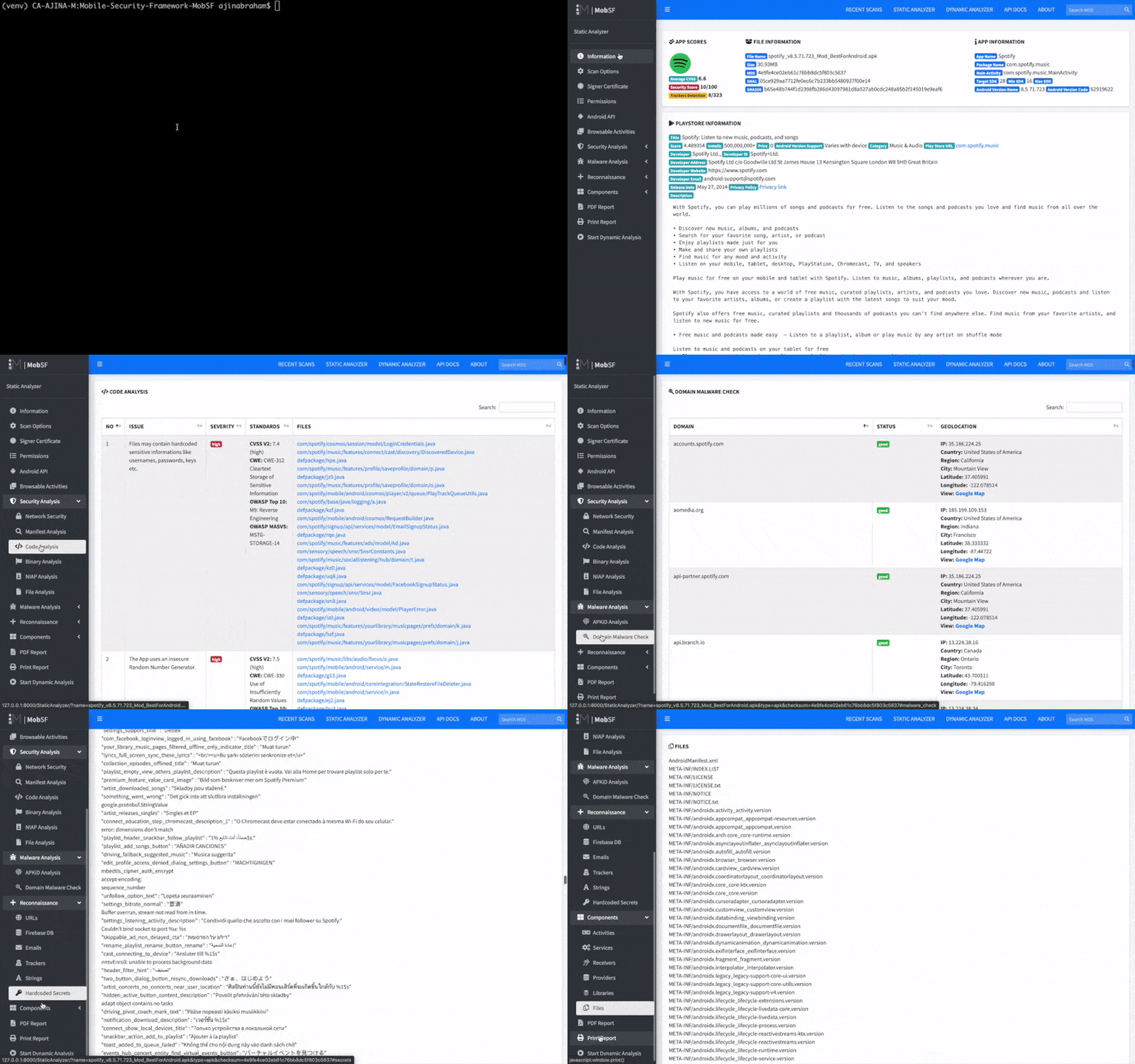


What is Mobile-Security-Framework-MobSF?
Mobile Security Framework (MobSF) is a security research platform for mobile applications in Android, iOS, and Windows Mobile. It can be used for mobile application security, penetration testing, malware analysis, and privacy analysis. The Static Analyzer supports popular mobile app binaries like APK, IPA, APPX, and source code, while the Dynamic Analyzer supports both Android and iOS applications, offering a platform for interactive instrumented testing, runtime data, and network traffic analysis. MobSF seamlessly integrates with DevSecOps or CI/CD pipelines, facilitated by REST APIs and CLI tools, enhancing security workflows with ease.
Mobile-Security-Framework-MobSF alternatives
 FleetOpen-source MDM and endpoint management for macOS, Windows, Linux and mobile: self-hosted software patching, vulnerability tracking and live device reports.CompareFleet with Mobile-Security-Framework-MobSF
 pwnflowPwnflow is a self-hosted, open-source mind-mapping platform for cybersecurity professionals to visualize and track security testing methodologies with AI assistance.Comparepwnflow with Mobile-Security-Framework-MobSF
 spiderfootSpiderFoot automates OSINT for threat intelligence and mapping your attack surface.Comparespiderfoot with Mobile-Security-Framework-MobSF
 measureAn open-source crash reporting and mobile performance monitoring platform with session replays, self-hosted via Docker Compose on a Linux VM.Comparemeasure with Mobile-Security-Framework-MobSF
 frekiSelf-hosted, open-source malware analysis platform with hash extraction, PE static analysis, YARA matching, VirusTotal queries, user accounts, comments and a REST API.Comparefreki with Mobile-Security-Framework-MobSF
 crowdsecSelf-hosted, open-source intrusion detection and web-app firewall that reads your logs, bans abusive IPs, and shares a crowdsourced blocklist across users.Comparecrowdsec with Mobile-Security-Framework-MobSF
 Zed Attack Proxy (ZAP)Self-hosted, open-source web app security scanner: an intercepting proxy with passive and active scans, three spiders, API scans and Docker automation for CI/CD.CompareZed Attack Proxy (ZAP) with Mobile-Security-Framework-MobSF
 WazuhSelf-hosted, open-source XDR and SIEM platform: endpoint agents plus server, indexer and dashboard for log analysis, file integrity, vulnerabilities and compliance.CompareWazuh with Mobile-Security-Framework-MobSF
Should you self-host Mobile-Security-Framework-MobSF?
Mobile-Security-Framework-MobSF scores 78/100 on selfhost.directory (how scoring works) and ranks #8 of 78 in Security. It has 22 225 GitHub stars, +306 in the last 30 days.
It shipped 8 stable releases in the past year. The latest, v4.6.6, came out on 15 November 2026. New versions land roughly every 5 weeks.
Setup is advanced: plan for several services and some ongoing maintenance. An official Docker image is available. It is GPL-3.0-licensed and written mostly in Python.
Its closest alternative on selfhost.directory is CyberChef (83/100, 36 410 stars). It scores higher overall, so compare the two before you pick. See Mobile-Security-Framework-MobSF vs CyberChef side by side.
Mobile-Security-Framework-MobSF README

Mobile Security Framework (MobSF) is a security research platform for mobile applications in Android, iOS, and Windows Mobile. MobSF can be used for a variety of use cases such as mobile application security, penetration testing, malware analysis, and privacy analysis. The Static Analyzer supports popular mobile app binaries and libraries (APK, XAPK, AAB, JAR, AAR, DEX, SO, IPA, DYLIB, A, APPX) as well as Android and iOS source code. Meanwhile, the Dynamic Analyzer supports both Android and iOS applications across emulators, simulators, Corellium, and physical devices (including stock non-rooted Android devices via Frida Gadget), offering an interactive platform for instrumented testing, runtime data inspection, and live web traffic analysis. MobSF seamlessly integrates with your DevSecOps or CI/CD pipeline via REST APIs and CLI tools.
More in Security
 mosparomosparo is a self-hosted, open-source spam protection for web forms that blocks spam by analyzing content instead of puzzles, making it accessible and privacy-friendly.
 mullgateSelf-hosted command-line tool converting a Mullvad account into multiple authenticated proxy endpoints for selective traffic routing.
 naiveproxyYurich Panel is a Bash script that automates deploying a proxy service on Ubuntu VPS with Caddy, Naive transport, Xray, Hysteria 2, WARP, and Unbound DNS.
 NetworkOptimizerSelf-hosted UniFi NMS with Wi-Fi optimization, security auditing, ISP health scoring, and multi-site management for up to 3 sites free.
 nforwardauthnforwardauth is a self-hosted, open-source forward auth service for Traefik, Caddy, and nginx that protects apps behind a single login using username/password credentials
 nginx-loveSelf-hosted open-source platform for managing Nginx reverse proxies with ModSecurity WAF, Let's Encrypt SSL, load balancing, JA4 bot detection, and multi-user RBAC.
 Nginx-Reverse-EmbySelf-hosted Go reverse proxy with HTTP/HTTPS and TCP/UDP forwarding, auto ACME certs, multi-node agents, Relay tunnels, and traffic quotas — managed via web UI.
 NoEyesSelf-hosted terminal chat with E2E encryption and a blind-forwarder server that cannot read messages or identify users. For small trusted groups wanting private comms.
 Nova ServerSelf-hosted proxy running Xray, sing-box, AmneziaWG behind one port with trilingual admin panel, multi-user management, Iran bridge tunnels, Telegram bot.
 NPMplusNPMplus is an open-source fork of nginx-proxy-manager offering hardened TLS, HTTP/3 (QUIC), crowdsec integration, and external authentication provider support.
 NucleusSelf-hosted container runtime for Linux/NixOS with kernel-level isolation, three modes, declarative NixOS integration, gVisor, signed snapshots, TLA+ verified.
 OAuth2 ProxyOpen-source, self-hosted auth proxy that puts OAuth2/OIDC sign-in in front of web apps, with email/domain/group checks and Redis sessions.
0 comments