
Self-host Wazuh
v4.14.10Open source XDR and SIEM for endpoints and cloud workloads
- Stars
- 17 752
- CPU
- At least 4 cores
- RAM
- At least 8 GB
- Storage
- At least 50 GB
- Ports
- 1514 (Agent communication with the Wazuh server (TCP)), 1515 (Agent enrollment port (TCP)), 514 (Syslog ingestion from network devices and applications (UDP)), 55000 (Wazuh server API), 9200 (Wazuh indexer API), 443 (Wazuh dashboard HTTPS)
wazuh/wazuh-manager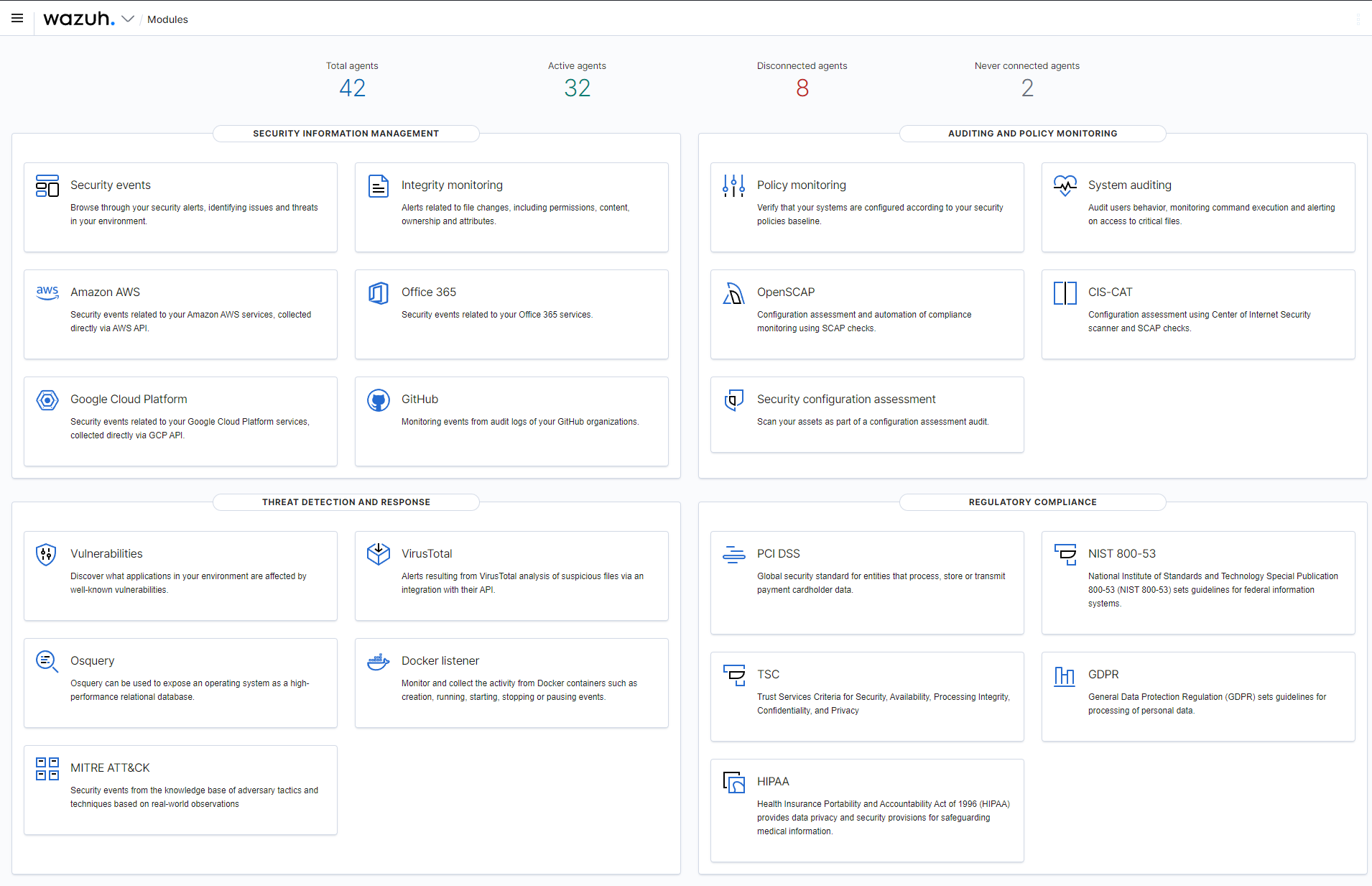


What is Wazuh?
Wazuh is a free, open-source security product covering both XDR and SIEM duties for machines you run on-premises, in virtual machines, in containers or in public clouds. A lightweight agent on each endpoint gathers data and reacts, while three central pieces do the heavy lifting: the server decodes and correlates what agents send, the indexer stores and makes the alerts searchable, and the dashboard is the browser UI for hunting, reporting and configuration management. Documented capabilities include signature-based intrusion detection with malware and rootkit scanning, rule-driven log analysis, file integrity monitoring that also names the user or application behind a change, CVE-driven vulnerability detection, security configuration assessment, active-response countermeasures, and ready-made compliance views for standards such as PCI DSS, GPG13 and GDPR. Modules extend visibility to AWS, Azure and Google Cloud at the API level and to Docker hosts and containers, while agentless gear such as firewalls and routers can be watched through syslog, SSH probing or their APIs. Self-hosting is documented through an all-in-one installation assistant for Linux, Docker Compose single-node and multi-node stacks, Kubernetes, Ansible, Puppet, offline and from-source builds, and pre-built OVA or AWS images; the manager listens on 1514 and 1515, its API on 55000, and the dashboard serves HTTPS on 443. People log in with an internal user database, optionally extended by SAML single sign-on or Active Directory and LDAP. The code is GPLv2 with components also under Apache 2.0, and the project grew out of OSSEC, the work Daniel Cid started; Wazuh Inc. additionally sells a managed cloud environment, professional support, consulting and training.
Wazuh alternatives
 FleetOpen-source MDM and endpoint management for macOS, Windows, Linux and mobile: self-hosted software patching, vulnerability tracking and live device reports.CompareFleet with Wazuh
 WildboxWildbox is a self-hosted, open-source security operations platform with threat intelligence, AWS cloud security, vulnerability management, SOAR, and LLM analysis.CompareWildbox with Wazuh
 homesocSelf-hosted, open-source SOC dashboard for home networks that unifies Wazuh alerts, AdGuard DNS logs, and CVE tracking with AI-powered alert explanations via Claude CLI.Comparehomesoc with Wazuh
 corootSelf-hosted, open-source APM and observability platform where eBPF agents capture every telemetry signal without code changes, with service maps and SLO alerting.Comparecoroot with Wazuh
 crowdsecSelf-hosted, open-source intrusion detection and web-app firewall that reads your logs, bans abusive IPs, and shares a crowdsourced blocklist across users.Comparecrowdsec with Wazuh
 netdataNetdata is an open-source, self-hosted infrastructure monitoring platform with per-second metrics, automated dashboards, ML anomaly detection, and zero-config deployment.Comparenetdata with Wazuh
 UUSEC WAFUUSEC WAF is a self-hosted, open-source WAF and API gateway using ML and semantic engines for zero-day detection, with HIPS/RASP defense and Lua rule engine.CompareUUSEC WAF with Wazuh
 AiSOCSelf-hosted, open-source AI SOC with 2,535 detection rules and agents that record every step in an auditable ledger. MIT licensed, no API keys needed.CompareAiSOC with Wazuh
Should you self-host Wazuh?
Wazuh scores 80/100 on selfhost.directory (how scoring works) and ranks #4 of 78 in Security. It has 17 752 GitHub stars, +539 in the last 30 days.
It shipped 10 stable releases in the past year. The latest, v4.14.10, came out on 5 November 2026. New versions land roughly every 4 weeks.
Setup is advanced: plan for several services and some ongoing maintenance. An official Docker image is available. It is Other-licensed and written mostly in C++.
Its closest alternative on selfhost.directory is CyberChef (83/100, 36 415 stars). It scores higher overall, so compare the two before you pick. See Wazuh vs CyberChef side by side.
Features
- Active response
- Agentless monitoring
- Cloud security monitoring
- Compliance reporting
- Configuration assessment
- Container Security
- Cross-platform agents
- File integrity monitoring
- Intrusion detection
- Log data analysis
- Multi-node clustering
- REST API
- Vulnerability Detection
- Web Dashboard
Wazuh README
Wazuh is a free and open source platform used for threat prevention, detection, and response. It is capable of protecting workloads across on-premises, virtualized, containerized, and cloud-based environments.
Wazuh solution consists of an endpoint security agent, deployed to the monitored systems, and a management server, which collects and analyzes data gathered by the agents. Besides, Wazuh is fully integrated with the Wazuh Indexer, providing a search engine and data visualization tool that allows users to navigate through their security alerts.
More in Security
 web-checkOpen-source, self-hosted OSINT tool that runs 44 checks on any URL - DNS, TLS, headers, ports, CVEs, trackers - through a web UI or plain API.
 WebterminalSelf-hosted open-source bastion host unifying SSH, RDP, VNC, database and Kubernetes access via browser or native clients with fine-grained auth and full audit.
 werbotWerbot is a self-hosted bastion host providing single sign-on access to servers, databases, and apps via SSH, RDP, VNC with full session recording and audit logging.
 whisperSelf-hosted, open-source tool for securely sharing passwords via encrypted one-time links with client-side AES-256-GCM encryption and Argon2id hashing.
 who-rangSelf-hosted doorbell dashboard using AI to identify visitors, recognize faces, and provide analytics. Integrates with Home Assistant, supports 5 AI providers.
 WikiSuiteWikiSuite is the most comprehensive and integrated Open Source enterprise solution, offering a suite of tools for communication, collaboration, data management, and more.
- WildboxWildbox is a self-hosted, open-source security operations platform with threat intelligence, AWS cloud security, vulnerability management, SOAR, and LLM analysis.
 wiredoorOpen-source, self-hosted ingress exposing HTTP/TCP/UDP from private networks via WireGuard tunnels, with full control over endpoints and routing.
 WireGuard EasyThe easiest way to run WireGuard VPN + Web-based Admin UI.
 wlgblockSelf-hosted Wayland session locker that replaces password entry with a patched Pokémon Crystal game challenge, using the ext-session-lock-v1 protocol for secure locking.
 WPMgrWPMgr is a self-hosted, open-source WordPress fleet management platform for backups, updates, uptime monitoring, image optimization, and security from one dashboard.
 Zed Attack Proxy (ZAP)Self-hosted, open-source web app security scanner: an intercepting proxy with passive and active scans, three spiders, API scans and Docker automation for CI/CD.
0 comments