
Self-host pwnflow
1.0.3Visual mind-mapping platform for offensive security
- Stars
- 281
- Ports
- 5173 (Frontend development server), 8000 (Backend API), 8001 (AI Microservice API), 5555 (Flower Celery monitoring), 80 (Production HTTP (nginx)), 443 (Production HTTPS (nginx))
- Requires
- Neo4j, Redis


What is pwnflow?
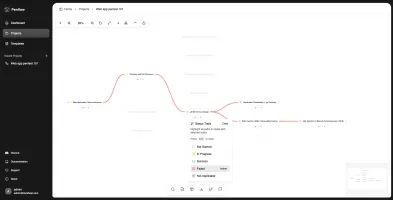
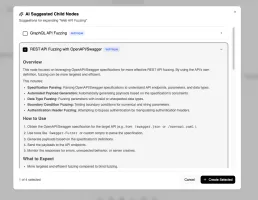
Pwnflow is a self-hosted mind-mapping tool for security professionals doing penetration testing, red teaming, and incident response. It lets you build interactive visual workflows, get AI-powered node suggestions via Google Gemini, save command templates with variables, and track methodology progress. Data stays on your infrastructure with AES-256-GCM encrypted exports, JWT authentication, and AI that only sees node titles. You can import methodologies from GitHub, export to CSV or encrypted formats, and migrate from older versions. The stack is React 19, TypeScript, Vite, TailwindCSS, XYFlow on the frontend, and FastAPI with Neo4j and Redis on the backend. Deploy with Docker Compose using the provided run.sh script for development or production behind nginx. Registration is off by default; admins create users via CLI.
Should you self-host pwnflow?
pwnflow scores 44/100 on selfhost.directory (how scoring works) and ranks #56 of 78 in Security. It has 281 GitHub stars.
There was no stable release in the past 12 months, so check the repository's recent activity before you rely on it.
Setup is moderate: expect some configuration beyond a single command. It is AGPL-3.0-licensed and written mostly in Typescript.
Its closest alternative on selfhost.directory is pentagi (83/100, 32 629 stars). It scores higher overall, so compare the two before you pick. See pwnflow vs pentagi side by side.
Features
- AI-Powered AssistanceRequires GOOGLE_API_KEY
- AI Privacy
- Bulk Operations
- Command Templates
- Encrypted Exports
- Interactive Mind Maps
- Legacy Migration
- Multiple Export Formats
- Progress Tracking
- Template Import
- Token-based authentication
- Zero telemetry
pwnflow README
More in Application Management
 QuantumRun your own Platform-as-a-Service: deploy GitHub projects, databases, templates, and Compose stacks on a private server with a web UI.
 QuickStackA free, open-source platform you host yourself that replaces Vercel or Heroku — deploy apps and databases on your own hardware with automatic HTTPS and backups.
 sandboxdSelf-hosted AI app builder with isolated sandboxes and live previews. Build apps from prompts or run 80+ curated apps. MIT licensed, one-command Docker install.
 sandboxed.shOrb is a self-hosted platform connecting AI subscriptions and hardware to orchestrate coding agents from macOS and iOS.
 SenateSelf-hosted PaaS for deploying Docker containers on your own server with automatic HTTPS, live monitoring, and a web dashboard — no vendor lock-in or monthly fees.
 SenchoSelf-hosted, open-source control plane for managing Docker Compose stacks across multiple nodes with a web UI, real-time logs, and fleet-wide orchestration.
 Shiny ServerSelf-hosted server to run Shiny R web applications with multi-app hosting, user deployment, and authentication options.
 SmallwebSmallweb is a self-hosted personal cloud mapping subdomains to folders for instant app deployment. Runs as a single Go binary with Deno, no build step, sandboxed apps.
 Steedos PlatformOpen-source, self-hosted low-code platform using AI to generate enterprise apps from prompts. Metadata-driven with generative UI, workflows, and multi-database support.
 stoatchat-platformSelf-hosted deployment platform for Stoatchat (Discord alternative) using Helmfile on Kubernetes with Docker Compose fallback, featuring deterministic secret derivation.
 switchfeatSelf-hosted feature flag and A/B testing service with React dashboard and REST API. Runs via Docker, keeps data on your network.
 SyncloudSyncloud is a self-hosted, open-source platform turning your hardware into a personal app server with one-click installs for 50+ apps.
0 comments