
Self-host ThoughtDAG
v0.5.26AI chat graph on an infinite canvas with editable context
docker run --rm -i --network none thoughtdag-mcp- Stars
- 715
- Ports
- 3001 (LLM proxy server), 5173 (Frontend dev server (http://localhost:5173))
What is ThoughtDAG?
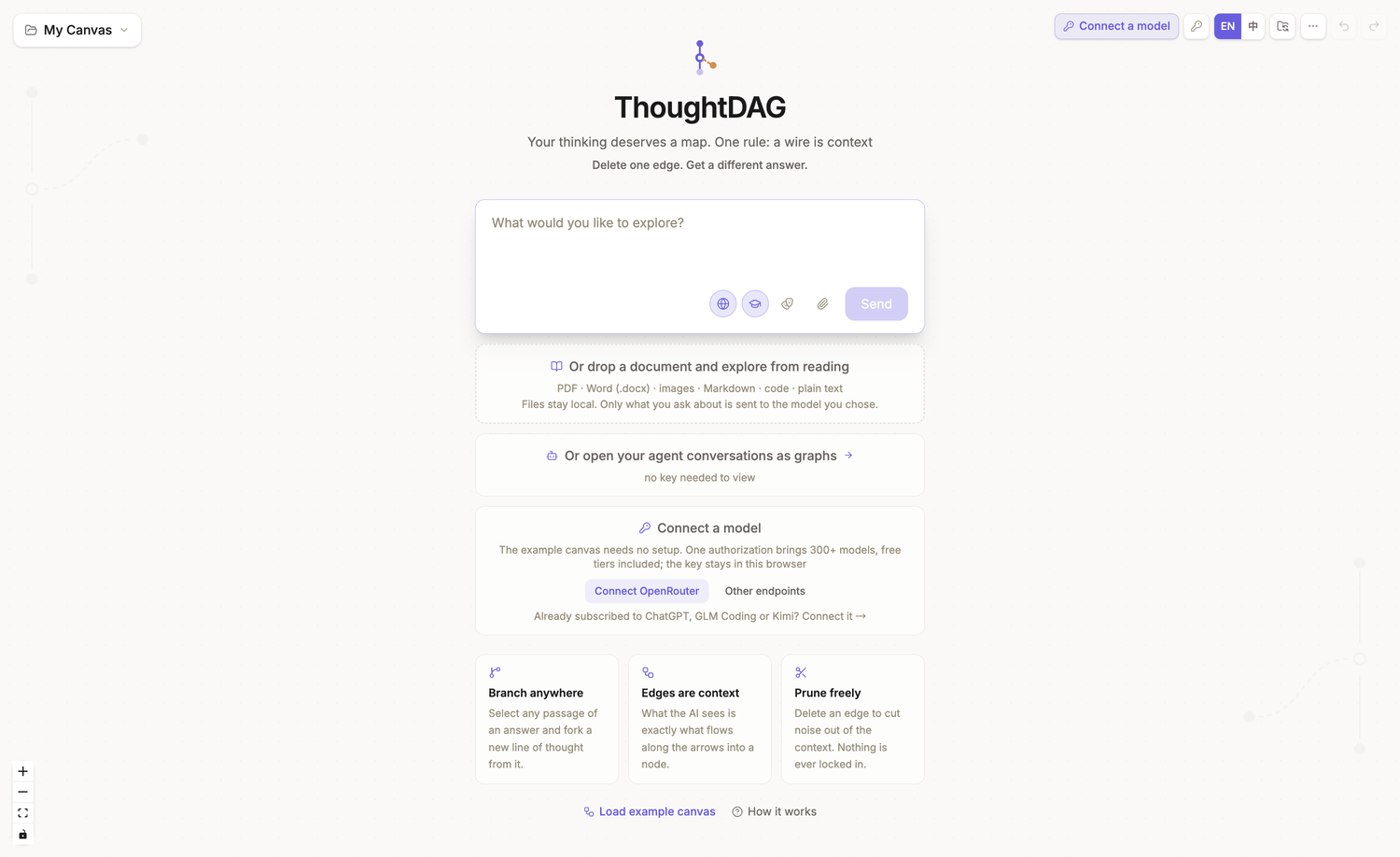
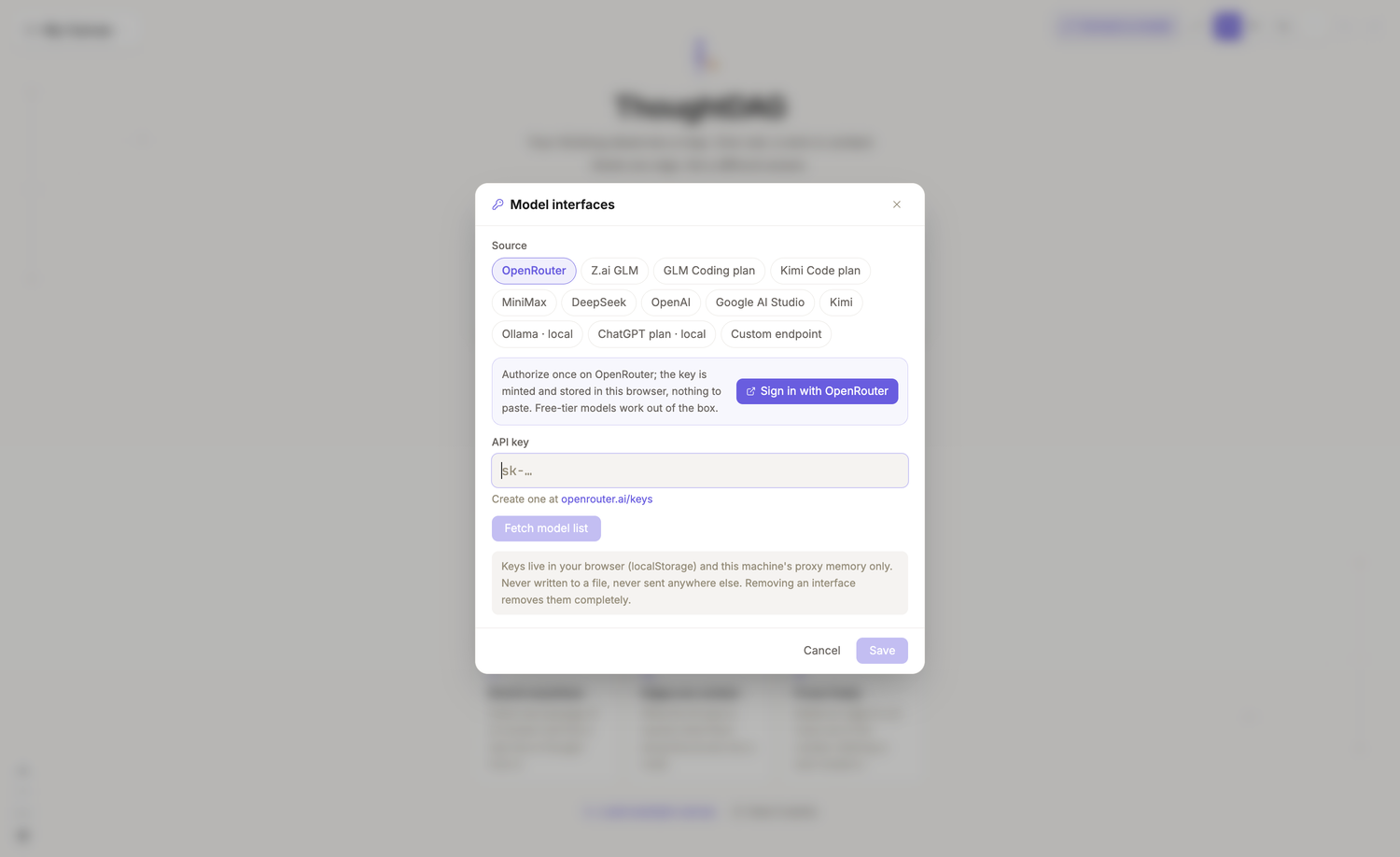
ThoughtDAG puts LLM chats on an infinite canvas as a graph you can edit: a node holds one question plus its answer versions, and only the edges flowing into that node decide which earlier exchanges the model will read. Pull out a wire and that branch is really gone from the next request; a preview panel shows the assembled prompt and its token cost before anything is sent. Documents — PDFs, pictures, HTML, DOCX, Markdown — open as material nodes, so you can question a chosen passage or turn a figure into a standalone node that keeps its page provenance. A machine-built index of transcripts from local coding agents (Claude Code, Codex, Pi and DeepSeek Harness) powers Session Atlas mirror graphs, topic dossiers and opt-in recall; the thoughtdag CLI queries that same index from a terminal (why, find, topics) and exposes it to agents as read-only MCP tools. Model access runs through provider presets, OpenRouter, Ollama, or any OpenAI-compatible endpoint, configured in the UI or via .env, with per-node model pinning. Data stays on your machine, though remote providers obviously receive whatever context you route to them. Ship it as the desktop app (Homebrew cask or GitHub Releases installers for macOS, Windows and Linux), or host it yourself with npm — an LLM proxy at 3001 alongside a 5173 frontend; the hosted browser demo leaves out the local history and memory layer. The project is pre-1.0 (0.5.x) and its own docs note it is neither an autonomous research agent nor a coding-harness replacement.
Should you self-host ThoughtDAG?
ThoughtDAG scores 51/100 on selfhost.directory (how scoring works) and ranks #25 of 69 in AI Chat. It has 715 GitHub stars.
It shipped 10 stable releases in the past year. The latest, v0.5.26, came out on 25 October 2026. New versions land roughly every 1 days.
Setup is easy: most people get it running in one sitting. It is MIT-licensed and written mostly in Typescript.
Its closest alternative on selfhost.directory is LibreChat (85/100, 46 421 stars). It scores higher overall, so compare the two before you pick. See ThoughtDAG vs LibreChat side by side.
Features
- Branching and pruning
- CLI history search
- Condense and Weave
- Context preview
- Document reader
- Graph-based AI conversations
- Local memory and recall
- Local model support
- MCP Server
- Per-node model selection
- Read-only sharing
- Replay and staleness tracking
- Session AtlasDesktop app or local hosting only
- Thought Map export
ThoughtDAG README
FAQ
Will all my past chats appear automatically?
No — the desktop app only indexes supported local records you have connected, cannot restore unsaved history, and cannot automatically access chats stored only in a web account.
How does branching support nonlinear thinking?
You keep alternative questions on separate branches, compare them on the canvas, and connect selected findings into a new downstream question; a branch inherits its upstream conversation path.
Can I edit context without deleting the conversation?
Yes — removing a wire removes that route from a later request while the nodes stay; you should still check other input paths, attachments and recall, and existing answers only change when you regenerate.
More in Notes & Editors
 TinyListTinyList is a self-hosted, open-source PWA for checklists and notes that works offline, requires no registration, and syncs via your own CouchDB instance.
 TracksOpen-source, self-hosted Getting Things Done web app built on Ruby on Rails with contexts, projects, tagging, stats, feeds, API and multi-user support.
 Trilium NotesBuild your personal knowledge base with Trilium Notes
 Trilium TranslationSelf-hosted, open-source AGPL-3.0 fork of Trilium Notes localized for Chinese users, with server and desktop builds, Docker images, AUR/scoop packages, themes and sync.
 TurtlOpen-source, self-hosted backend server for Turtl clients: account management, data storage, syncing, sharing permissions and a plugin architecture, on Node and Postgres.
 UniBoardUniBoard is an open-source, self-hosted personal dashboard with homepage, Markdown notes, URL shortener, file sharing, and server monitoring via Docker Compose.
 VaultSyncVaultSync syncs Obsidian vaults peer-to-peer between iPhone/iPad and a personal server via Syncthing, with optional Cloud Relay for faster background wake-ups.
 WastebinA self-hosted, open-source minimal pastebin in Rust with 170+ language highlighting, Markdown rendering, encrypted pastes, expiry, burn-after-reading and nine themes.
 WeChat Markdown EditorOpen-source WeChat Markdown editor turning plain Markdown into styled Official Account posts with image hosts, themes and AI; run it self-hosted via Docker or npm.
 Will Be DoneSelf-hosted task manager with visual weekly timeline. Local-first, works offline, syncs across devices, runs in one Docker container with SQLite.
 WorldLoomSelf-hosted offline worldbuilding and storywriting app with rich-text articles, maps, manuscripts, timelines, and HTML export. Node.js, file-based storage, no database.
 xEditxEdit is a self-hosted, open-source Markdown editor and lightweight Notion/Obsidian alternative with live preview, wiki links, and MCP for AI.
0 comments