
Self-host Opencast
19.10Open-source lecture capture and video management
- Stars
- 509


What is Opencast?
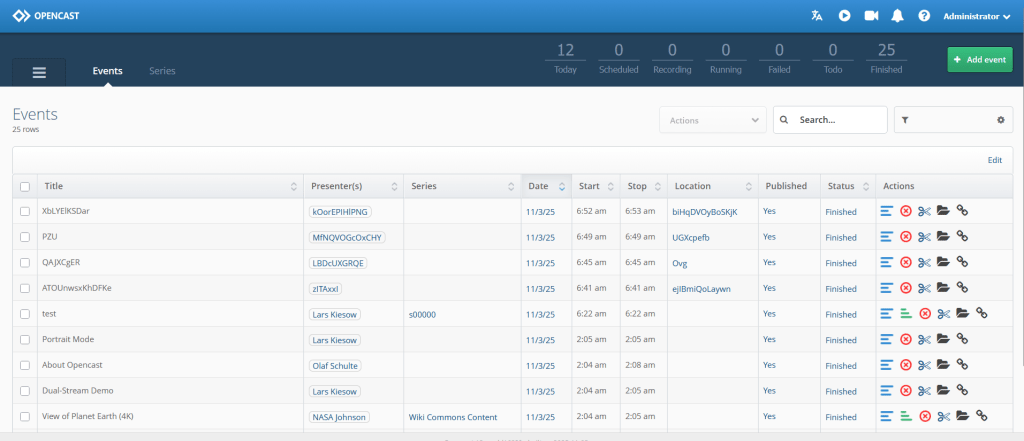
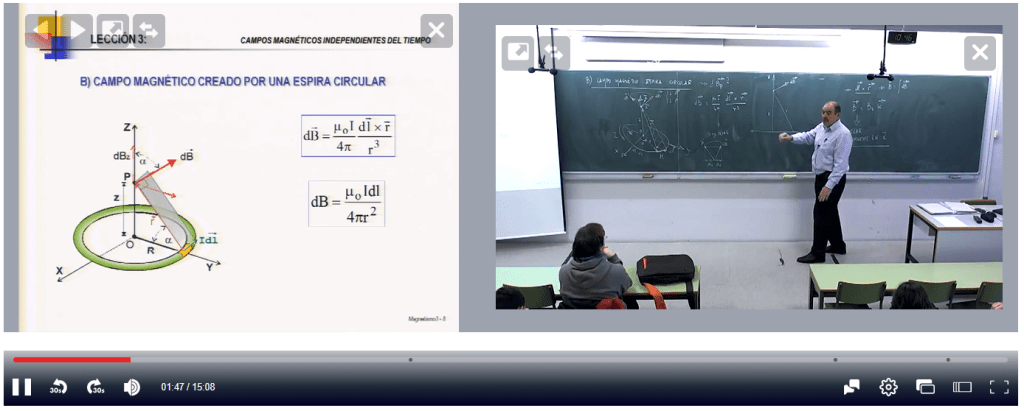
A free, open-source platform for automated video capture and management built for educational institutions. It handles lecture scheduling and capture, live streaming, browser-based recording via Opencast Studio, video upload and management, configurable workflows for transcoding and captioning, a built-in video editor for multi-stream editing, fine-grained access control, and distribution through the Paella Player and Tobira video portal. It integrates with major LMS platforms (Moodle, Canvas, Brightspace, ILIAS, Sakai, Stud.IP) via LTI and plugins, supports video conferencing recordings from BigBlueButton and Zoom, and connects to analytics (Matomo) and transcription services (Whisper, cloud providers). The system runs on Linux servers and can be deployed via Docker, native packages (Debian/Ubuntu, RHEL/Rocky/CentOS), Ansible, or from source. Built on Java with a distributed architecture separating capture, processing, and presentation layers for scalability.
Should you self-host Opencast?
Opencast scores 57/100 on selfhost.directory (how scoring works) and ranks #37 of 142 in Media Management. It has 509 GitHub stars.
It shipped 11 stable releases in the past year. The latest, 19.10, came out on 28 October 2026. New versions land roughly every 2 weeks.
Setup is advanced: plan for several services and some ongoing maintenance. It is ECL-2.0-licensed and written mostly in Java.
Its closest alternative on selfhost.directory is Sonarr (81/100, 17 472 stars). It scores higher overall, so compare the two before you pick. See Opencast vs Sonarr side by side.
Features
- Analytics Integration
- Automated transcription
- Browser-based recording
- Configurable workflows
- Distributed deployment
- Fine-grained Access Control
- Lecture capture scheduling
- LMS Integration
- Multi-stream video editor
- Multi-stream video player
- Prometheus Metrics
- Video conferencing integration
- Video portal (Tobira)
- Video upload and management
- YouTube publishing
Opencast README
More in Media Management
 openinaryOpen-source, self-hosted Cloudinary alternative for on-the-fly image/video transforms, S3 storage, and edge caching — run via Docker.
 OpenPostSelf-hosted, open-source toolkit replacing Buffer, Canva, CapCut — write posts, design graphics, edit video, schedule to 15+ networks from one workspace.
 open-record-poolOpen Record Pool is a self-hosted DJ record pool that scans music, extracts MP3 metadata into PostgreSQL, and provides a web UI with search, playback, and DJ exports.
 OpenTranscribeOpenTranscribe is a self-hosted, open-source AI transcription platform with speaker identification, cross-video matching, hybrid search, and AI summarization.
 ownphotos-frontendOwnphotos is a self-hosted, open-source photo app replicating Google Photos with face recognition, object detection, event albums, and map browsing via Docker Compose.
 pastaSelf-hosted, browser-based Plex helper to batch-change audio and subtitle tracks for whole TV shows or single episodes, with Docker image and Unraid template.
 pellicolaPellicola is a self-hosted PHP photo publishing app with EXIF, maps, albums, RSS, and GDPR compliance.
 petioSelf-hosted open-source Plex companion app that lets users request, review, and discover media content, integrating with Sonarr and Radarr for automated media management.
 PHOBOSSelf-hosted AI OS running LLMs, image/video generation, web browsing, audio, and tasks locally with no cloud.
 PhotoMigratorPhotoMigrator is a self-hosted, open-source tool for migrating photos between cloud services and processing Takeout archives. Offers web, desktop, terminal, CLI.
 PhotoPrismAI-Powered Photos App 🌈💎✨
 Pic-OSelf-hosted photo publishing platform (Laravel 12) with albums, tokenized share links, masonry grid viewer, slideshow, and Docker deployment.
0 comments