
Self-host KaaS
v0.1.0-rc.2LLM compiler turning notes into a queryable Markdown wiki
- Stars
- 152
- Ports
- 8080 (HTTP server (REST API, Web UI, MCP endpoint)), 8082 (MCP HTTP transport (kb-ai mcp --http))
ghcr.io/bybit-exchange/kaas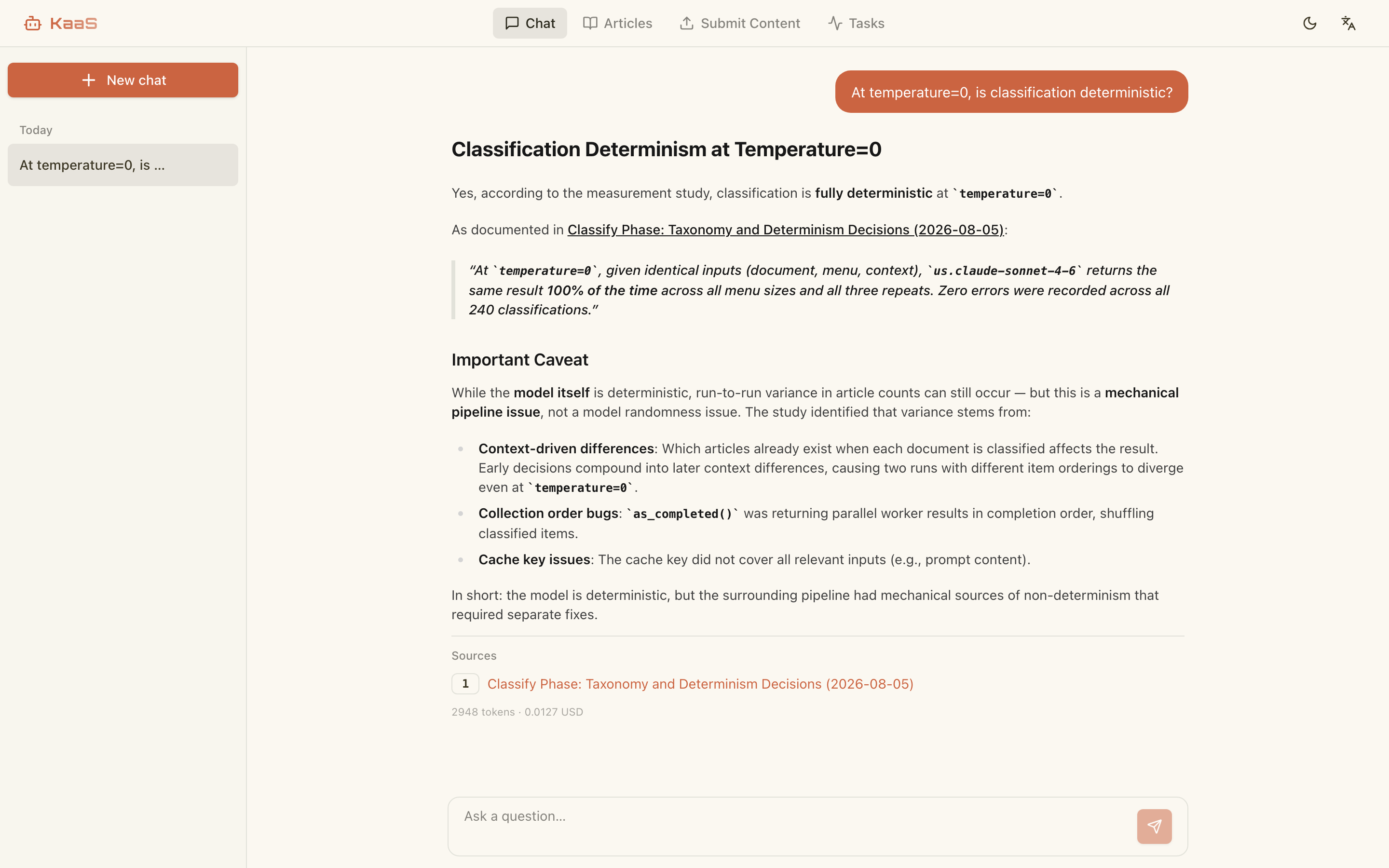
What is KaaS?
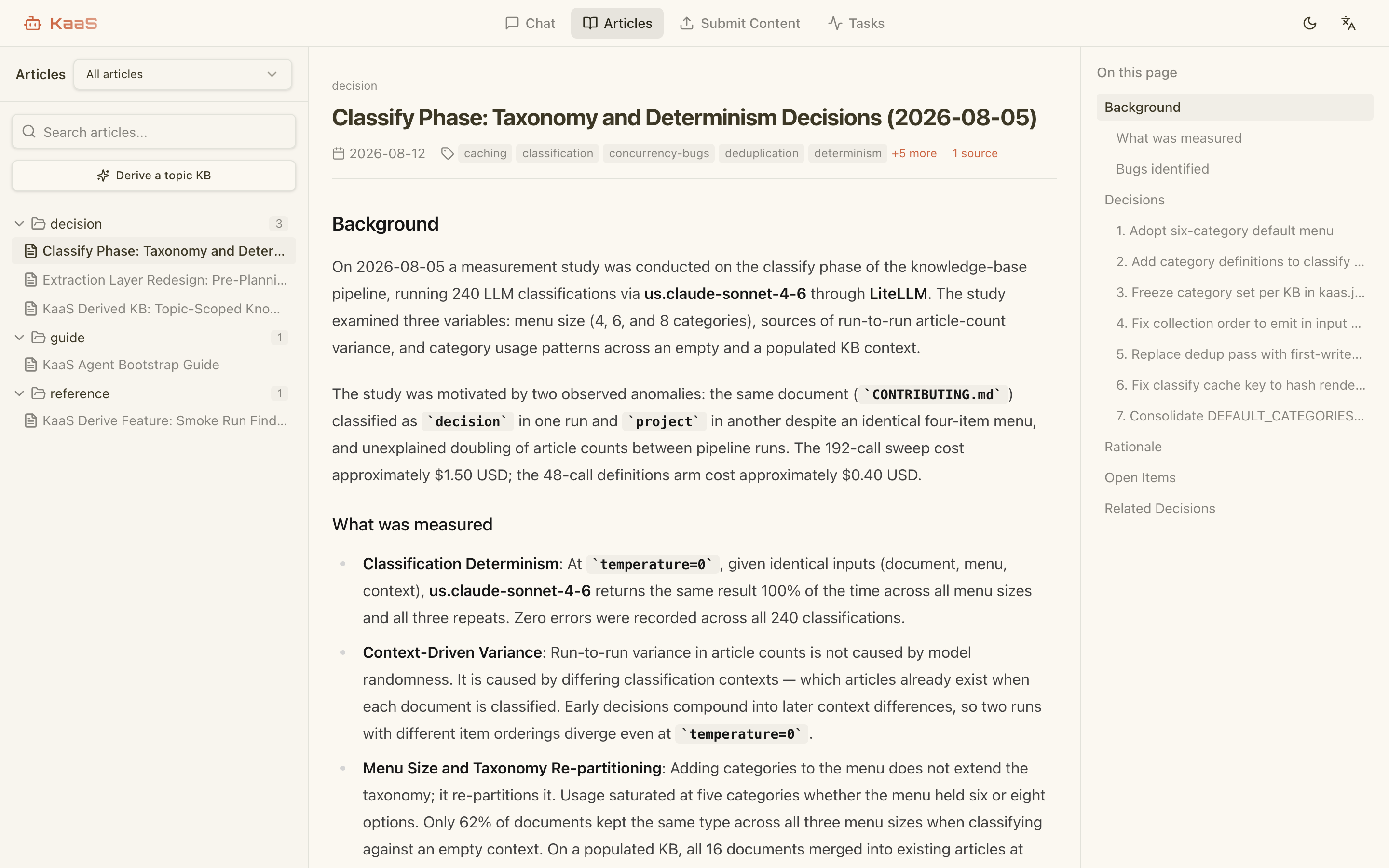
KaaS (Knowledge as a Service) compiles raw content — pasted text, uploaded files, or fetched URLs — through a four-phase LLM pipeline (Extract, Classify, Write, Index) into human-readable Markdown articles organized as a wiki. Unlike typical retrieval systems that break text into embedded fragments, KaaS produces structured, cited articles you can read, edit, and version with Git. The compiled wiki is queryable via a web UI with streaming cited answers, or through MCP (Model Context Protocol) for integration with coding agents like Claude Code and Codex. It runs as a single Docker image bundling a Go backend, React frontend, and Python AI daemon, using SQLite by default with optional MySQL. Configuration is via TOML file with environment variable overrides for secrets. The project is MIT-licensed and developed by Bybit Exchange.
Should you self-host KaaS?
KaaS scores 44/100 on selfhost.directory (how scoring works) and ranks #25 of 42 in Knowledge Management. It has 152 GitHub stars.
There was no stable release in the past 12 months, so check the repository's recent activity before you rely on it.
Setup is moderate: expect some configuration beyond a single command. An official Docker image is available. It is MIT-licensed and written mostly in Python.
Its closest alternative on selfhost.directory is Project N.O.M.A.D. (85/100, 41 087 stars). It scores higher overall, so compare the two before you pick. See KaaS vs Project N.O.M.A.D. side by side.
Features
- Cited answers with SSE streaming
- Compile-then-retrieve pipeline
- Fault-tolerant worker pool
- Human-readable Markdown wiki
- Incremental compilation
- MCP access (stdio and HTTP)
- Multiple input methods
- OpenAI-compatible LLM Support
- Single binary CLI installer
- Web UI with chat and wiki browser
KaaS README
More in Knowledge Management
 KarakeepOpen-source, self-hosted app for saving links, notes, images and PDFs, with LLM auto-tagging, semantic search, offline mobile reading, and page archives.
 KeptA local-first desktop app that saves conversations from major AI providers as searchable Markdown files, adding a knowledge graph and MCP server for agent access.
 KhojSelf-hosted, open-source AI second brain: RAG chat over your notes and the web, custom agents, semantic search and scheduled research emailed to you.
 kiwifsKiwiFS is a self-hosted markdown filesystem turning .md files into a knowledge server with git versioning, search, a web UI, and 78 MCP tools for AI agents.
 knowledge-graph-extractorTurn any document or a whole zip into an interactive knowledge graph, using a self-hosted Qwen3.6-35B-A3B-MTP on a single NVIDIA L4
 kotaemonSelf-hosted open-source RAG chat UI for QA over your own documents, with hybrid retrieval, PDF citations, multi-user collections and local LLMs via Ollama.
 LeafWikiLeafWiki is a self-hosted, open-source wiki storing content as plain Markdown files with SQLite — no external database needed. Runs as a single Go binary.
 LeantimeSelf-hosted project management for non-PMs with neurodivergent-friendly design, offering Kanban, Gantt, time tracking, wikis, and LDAP/OIDC auth.
 LibreKBLibreKB is a free, open-source, self-hosted knowledge base web app with PHP/MySQL. Features user groups, TinyMCE editing, email password resets, responsive Bootstrap UI.
 LightRAGSelf-hosted, open-source RAG framework that builds a knowledge graph over your documents, with dual-level retrieval, a WebUI, a REST API and pluggable storage backends.
 LinkWardenOpen-source, self-hosted bookmark manager that keeps a screenshot, PDF and HTML copy of every saved page, with reader annotations and shared team collections.
 llm-appOpen-source, self-hosted template collection that streams your files, Google Drive or S3 into live RAG, vector-store and enterprise-search APIs.
0 comments