
Self-host knowledge-graph-extractor
Extract knowledge graphs from docs with a self-hosted LLM
- Stars
- 221
- CPU
- 8 vCPU (GCP g2-standard-8)
- RAM
- 32 GB system RAM (implied by g2-standard-8)
- Storage
- ~20 GB for model + data
- Port
- 3000 (FastAPI app UI and extraction API)
- Requires
- Jina AI API (Jina Reader)

What is knowledge-graph-extractor?
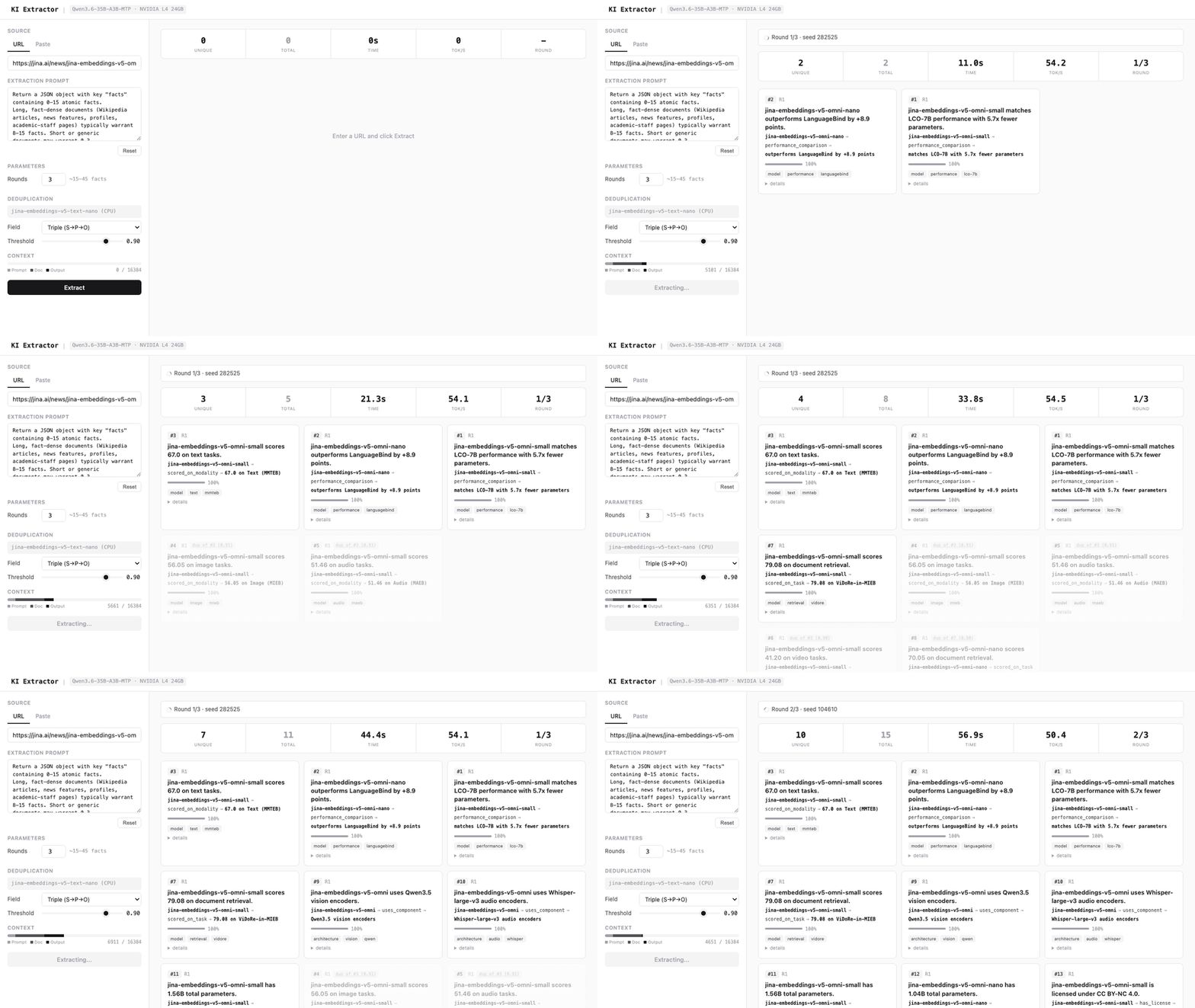
Knowledge Graph Extractor is a self-hosted application that converts unstructured text — pasted content, fetched URLs, or zip archives of documents — into an interactive knowledge graph. It uses a self-hosted Qwen3.6-35B-A3B-MTP model running on llama.cpp with CUDA on a single NVIDIA L4 24GB GPU. The pipeline chunks oversized documents instead of truncating, extracts atomic (subject, predicate, object) triples with canonicalized entities, applies optional semantic deduplication via jina-embeddings-v5-text-nano on CPU, and visualizes the resulting graph in a force-directed UI where edges show evidence spans and confidence scores. A single-slot job scheduler with foreground preemption and auto-backfill persists jobs to disk so they survive restarts. Results can be downloaded as JSONL. The stack runs via Docker Compose with two services: llama-server (port 8080) serving the OpenAI-compatible LLM API, and a FastAPI app (port 3000) handling extraction, scheduling, deduplication, and the UI. Configuration is via a .env file requiring a Jina AI API key for URL-to-markdown conversion. The project is MIT-licensed with no paid tiers.
Should you self-host knowledge-graph-extractor?
knowledge-graph-extractor scores 39/100 on selfhost.directory (how scoring works) and ranks #32 of 42 in Knowledge Management. It has 221 GitHub stars.
There was no stable release in the past 12 months, so check the repository's recent activity before you rely on it.
Setup is advanced: plan for several services and some ongoing maintenance. It is MIT-licensed and written mostly in Python.
Its closest alternative on selfhost.directory is Project N.O.M.A.D. (85/100, 41 087 stars). It scores higher overall, so compare the two before you pick. See knowledge-graph-extractor vs Project N.O.M.A.D. side by side.
Features
- Document chunking (no truncation)
- Interactive force-directed graph visualization
- Job queue with preemption and persistence
- JSONL Export
- Knowledge graph extraction from documents
- MTP speculative decoding
- Multiple input formats
- OpenAI-compatible LLM API
- Semantic DeduplicationEnabled by default
knowledge-graph-extractor README
More in Data Extraction
 maxunSelf-hosted and open-source web data platform: build scrape, crawl, extract, search and monitor robots in a no-code recorder or with an API, SDK, CLI or MCP.
 PaddleOCROpen-source, self-hosted OCR and document-parsing toolkit: scanned PDFs and photos come out as Markdown or JSON for RAG pipelines, across 100+ languages.
 Receipt Parser ServerSelf-hosted, open-source receipt parser server that uses Tesseract OCR to extract structured data from receipt images via a REST API with token authentication.
 textsnaptextsnap is a self-hosted OCR CLI extracting text from images, screenshots, URLs, and webpages using local CPU models with no GPU or cloud required.
 webclawSelf-hosted web extraction turning pages into clean Markdown, JSON, and LLM-friendly text. CLI, HTTP API, and MCP server for AI assistants. Rust, AGPL-3.0.
 13ftSelf-hosted, open-source paywall bypass proxy: paste a URL and 13ft fetches it as Googlebot, with Freedium and archive snapshot fallbacks, in Docker or plain Python.
 anakinSelf-hosted open-source web scraping API turning pages into clean markdown or JSON, with an anti-detect Camoufox browser, proxy auto-selection and a web dashboard.
 Apache TikaOpen-source toolkit that extracts text and metadata from 1000+ file types, with a self-hosted REST or gRPC server for search indexing and LLM/RAG pipelines.
 Crawl4AICrawl4AI converts websites into LLM-ready Markdown for RAG and AI agents. Self-host via pip/Docker or use the cloud API. Open-source Apache-2.0.
 dots.ocrOpen-source vision-language model for self-hosted OCR that turns multilingual PDFs and images into Markdown or JSON with layout boxes, and charts into SVG.
 ExcaliburExcalibur is a self-hosted, open-source web interface for extracting tabular data from text-based PDFs, powered by Camelot, with CSV, Excel, JSON and HTML export.
 firecrawlSupercharge your AI agents with data from the web and beyond. Building the library for superintelligence. 🔥
0 comments