
Self-host dashlit
v1.1.3Multi-user start page with live service status chips
docker run -d --name dashlit --restart unless-stopped -p 3000:8080 -e JWT_SECRET='replace-with-a-long-random-secret' -v dashlit-data:/data ghcr.io/codewec/dashlit:latest- Stars
- 474
- Port
- 8080 (HTTP listen address of the app (internal; Docker examples publish it as host port 3000))
ghcr.io/codewec/dashlit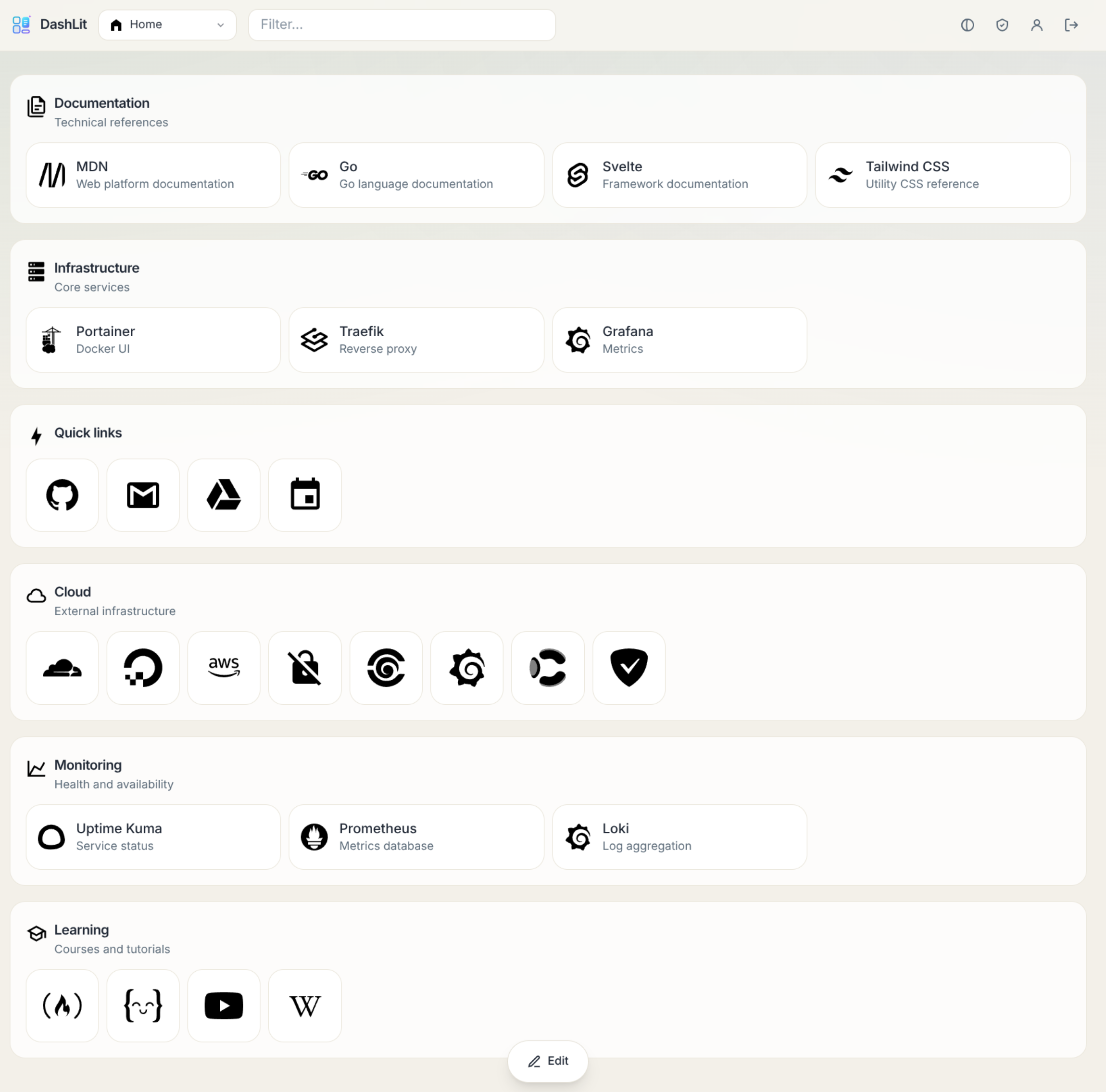
What is dashlit?
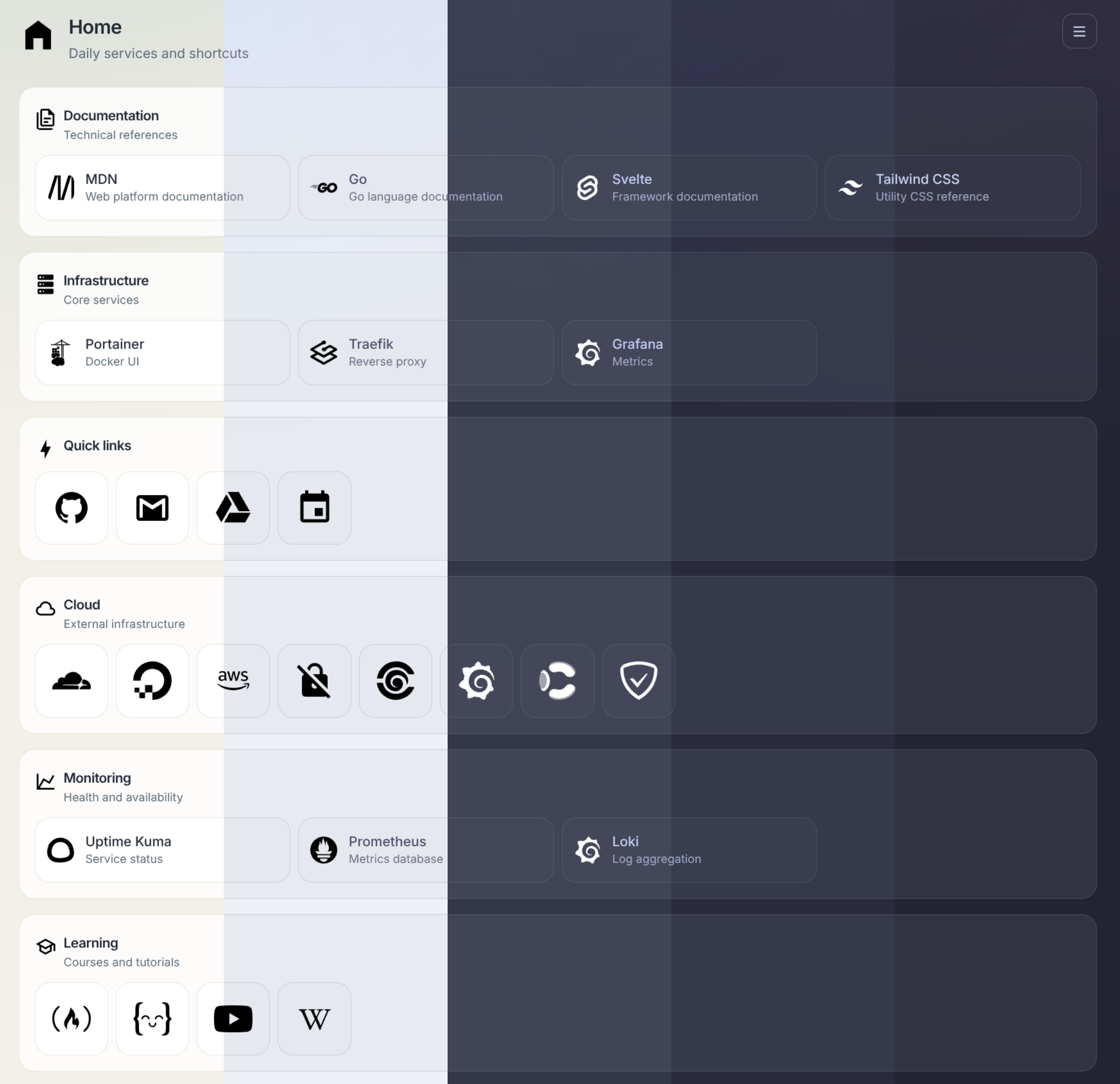
DashLit puts your links, tools, and services on visual dashboards you run yourself. Each dashboard holds ordered groups of links, can be public, sign-in-only, or private, and lays out in rows, columns, or masonry, with drag-and-drop editing on desktop and touch devices. Links can carry URL availability checks whose live status appears as a small chip. Sign-in works with local passwords, OIDC (for example through Pocket ID), or both, with profile and admin pages plus non-interactive bootstrapping of the first administrator. Dashboards can be imported, exported, cloned, and migrated from legacy JSON-based releases. Deployment is one small Go binary with the Svelte UI embedded: a container image on GHCR, a Docker Compose file, a systemd installer for Linux, or a Proxmox VE LXC script, with all state (embedded SQLite database and icons) kept under a single data directory.
Should you self-host dashlit?
dashlit scores 49/100 on selfhost.directory (how scoring works) and ranks #18 of 44 in Dashboard. It has 474 GitHub stars.
It shipped 10 stable releases in the past year. The latest, v1.1.3, came out on 27 September 2026. New versions land roughly every 1 days.
Setup is easy: most people get it running in one sitting. An official Docker image is available. It is MIT-licensed and written mostly in Svelte.
Its closest alternative on selfhost.directory is Homepage by gethomepage (84/100, 33 416 stars). It scores higher overall, so compare the two before you pick. See dashlit vs Homepage by gethomepage side by side.
Features
- Built-in icon search
- Drag-and-drop editing
- Flexible layouts
- Import, export, and cloning
- Keyboard navigation and shortcuts
- Legacy data migration
- Multiple dashboards with visibility levels
- Per-user and system default dashboards
- Service availability monitoring
- Themes and custom palettes
- User and admin pages
dashlit README
More in Uptime Monitoring
 gatusSelf-hosted, open-source uptime monitor and status page: probe HTTP, TCP, ICMP or DNS endpoints with custom conditions and alert via Slack, Discord, PagerDuty, etc.
 HealthchecksOpen-source, self-hosted cron job and background task monitor: each job pings a unique URL, and alerts fire over 25+ integrations when a heartbeat is late.
 hertzbeatApache HertzBeat is a self-hosted, open-source observability system unifying agentless metrics and logs collection, alerting, and notification dispatch.
 kenerAn open-source, self-hosted status page and uptime monitor: 11 monitor types, incidents, maintenance windows, subscriber alerts and OIDC login.
 Kuvasz UptimeSelf-hosted, open-source uptime & SSL monitor with HTTP, ping, TCP, DNS and Docker checks, status pages, maintenance windows, REST API, and Prometheus export.
 logtideOpen-source, self-hosted log management and SIEM unifying logs, traces and metrics on TimescaleDB, ClickHouse or MongoDB, an alternative to Datadog, Splunk and ELK.
 NezhaOpen-source, self-hosted server and website monitor: a dashboard plus agents track host metrics, HTTP/TCP/ping checks, SSL certs, alerts and a web terminal.
 peekapingOpen-source, self-hosted uptime monitor in Go and React: HTTP, TCP, ping, DNS and database checks, status pages, 20+ alert channels, 2FA and a REST API.
 phpservermonSelf-hosted, open-source uptime monitor that checks websites and TCP ports from your own PHP server, with cron jobs, graphs and email, SMS or Telegram alerts.
 Statping-ngA self-hosted, open-source status page and uptime monitor in Go. It checks HTTP, socket and gRPC endpoints, alerts via Slack, Discord or email, and supports oAuth logins.
 statusnookSelf-hosted status page with HTTP endpoint monitoring, incident timelines, and Slack/SMTP notifications.
 UpptimeOpen-source, self-hosted uptime monitor and status page that runs entirely on GitHub Actions, Issues and Pages, checking endpoints every 5 minutes with no server.
0 comments