
Self-host ColliePWA
v1.24.2Terminal agent multiplexer client for your phone
curl -fsSL https://colliepwa.dev/install.sh | sh- Stars
- 1 487
- Port
- 8787 (loopback-only port the bridge listens on, proxied by tailscale serve or a reverse proxy)
What is ColliePWA?
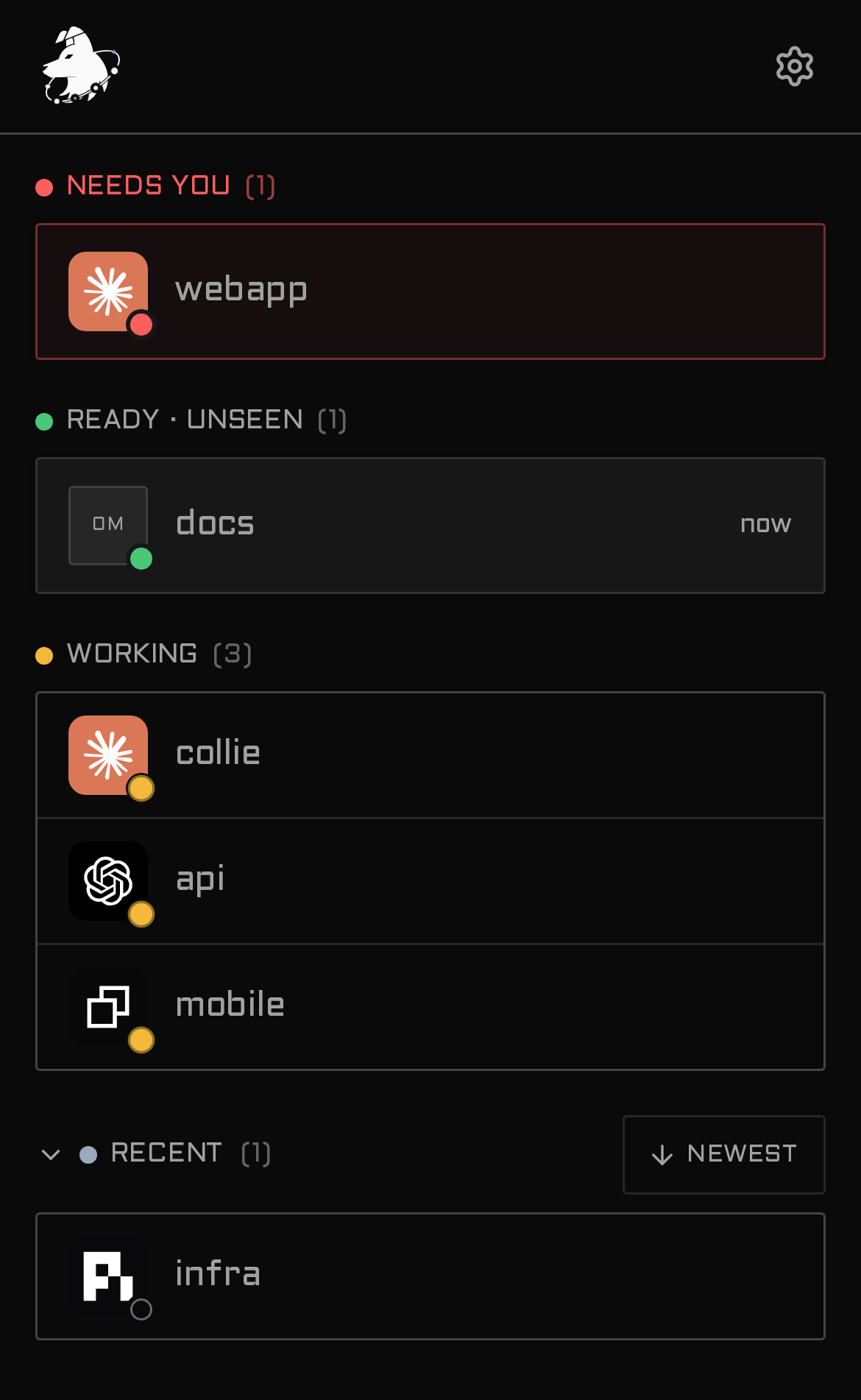
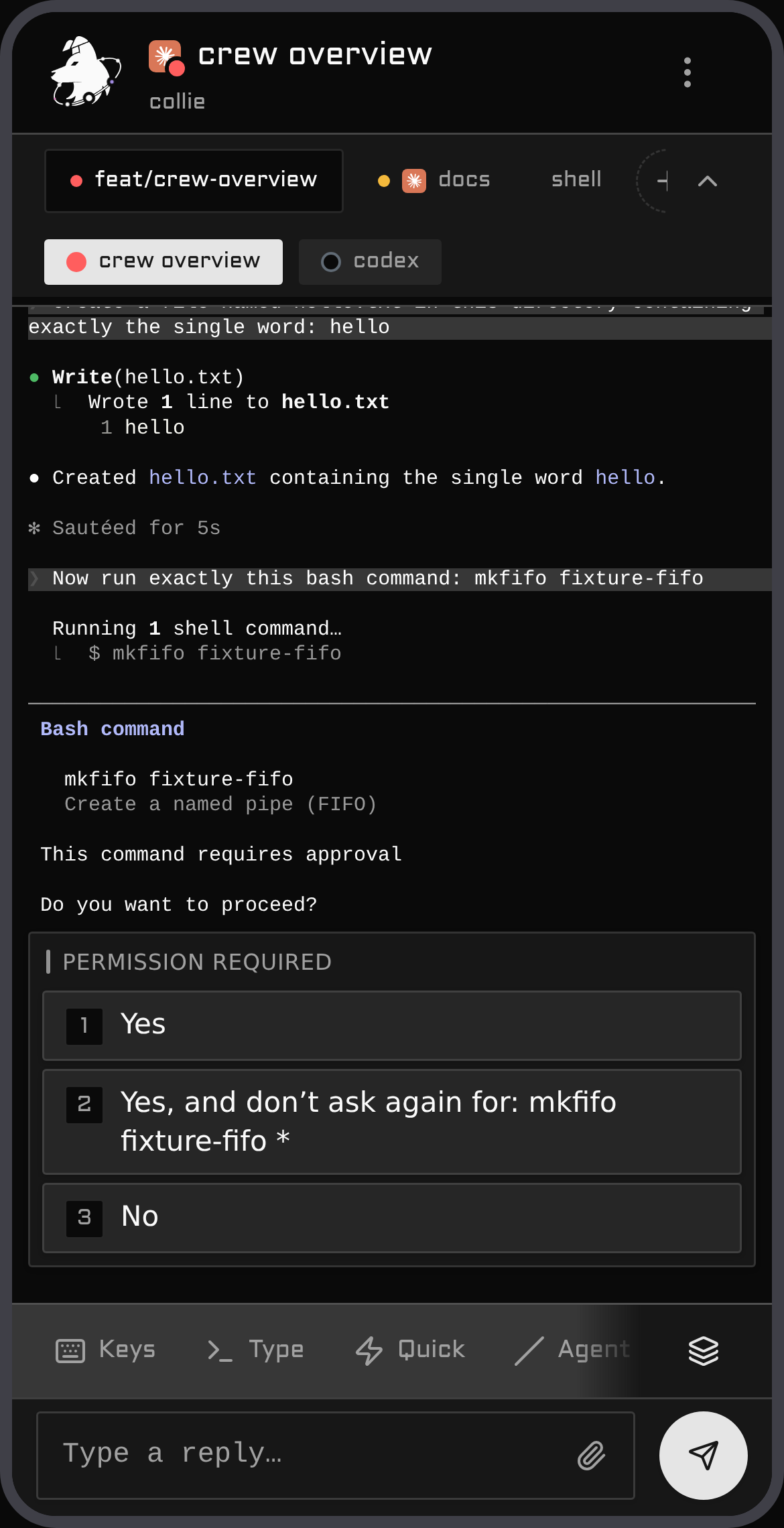
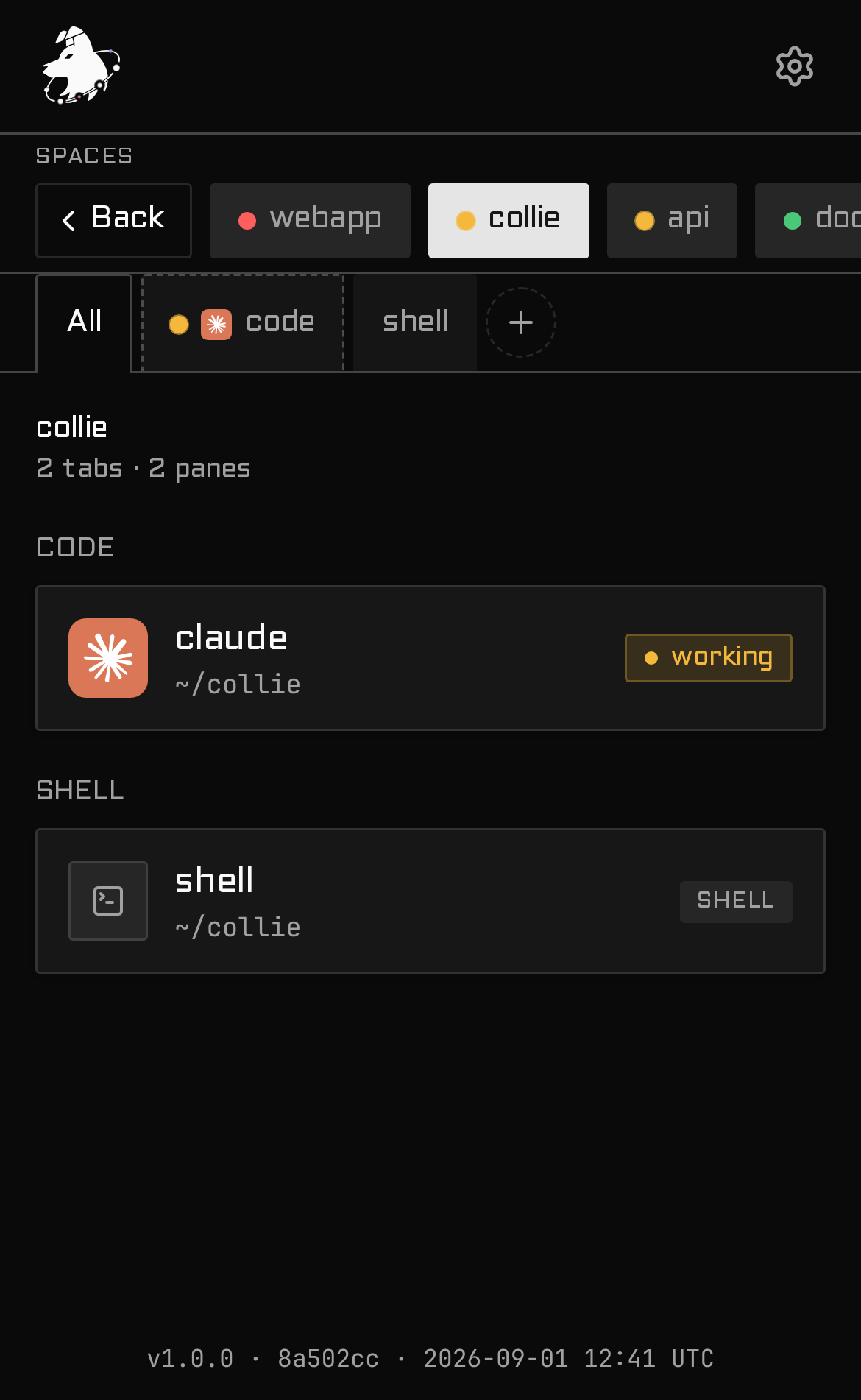
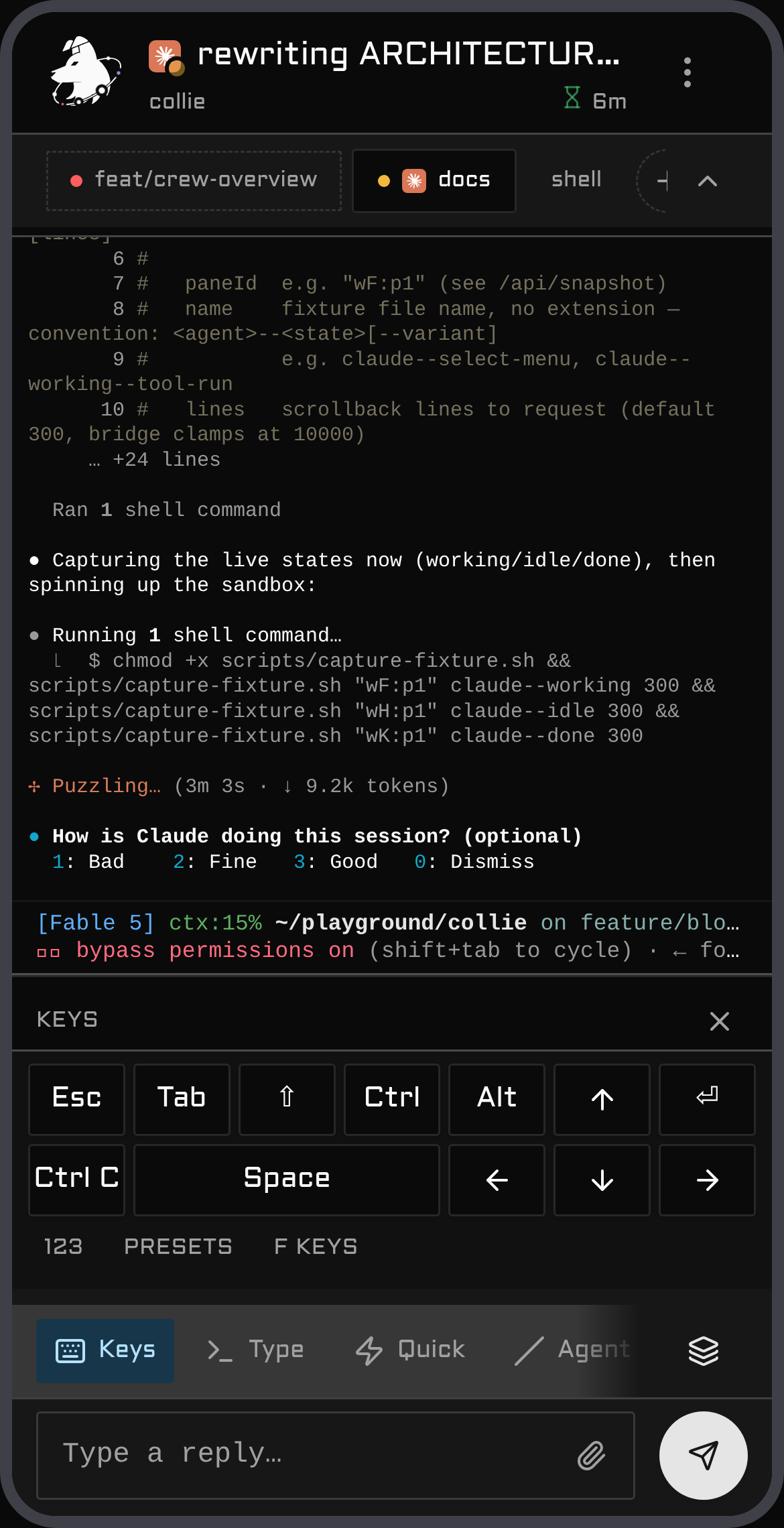
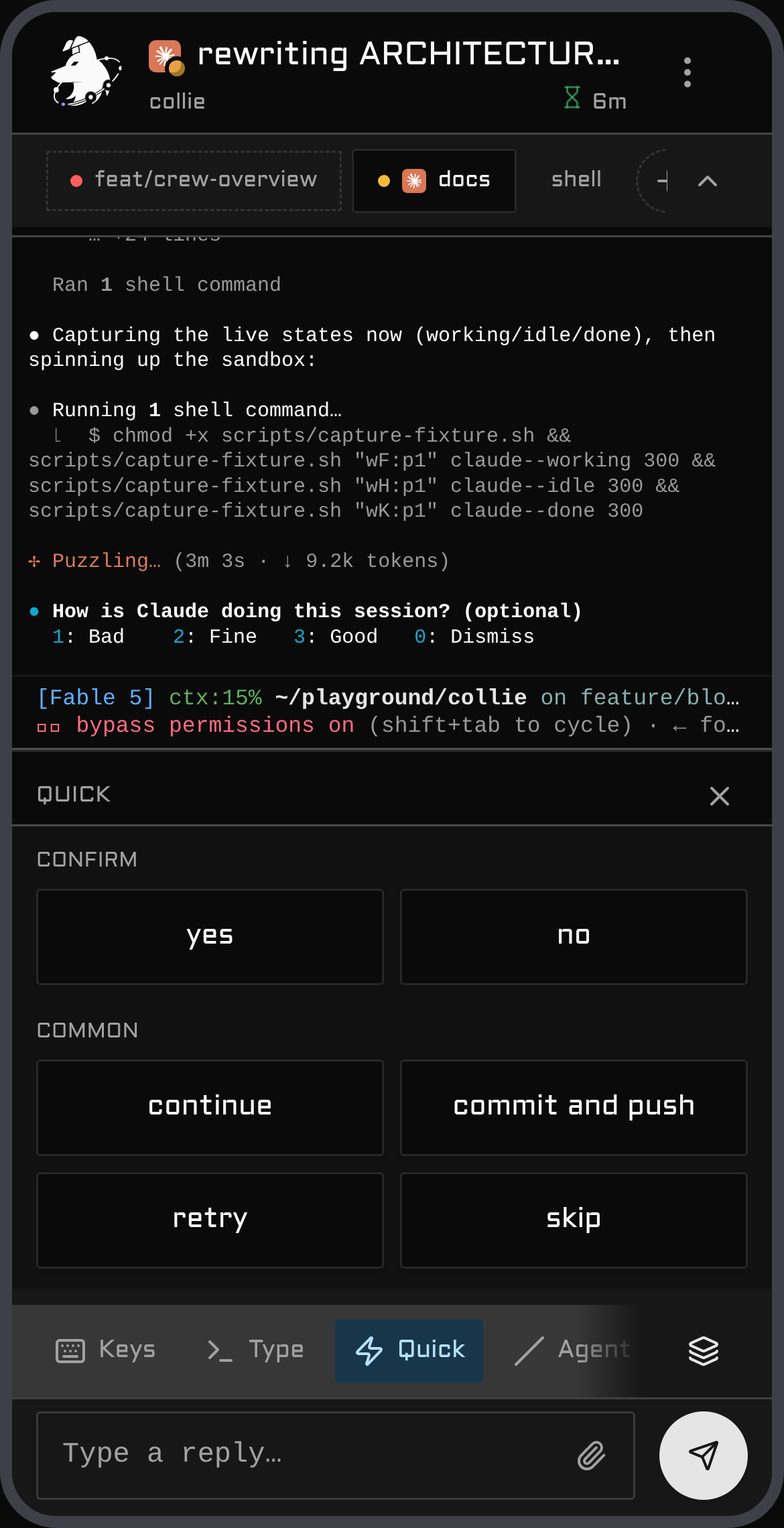
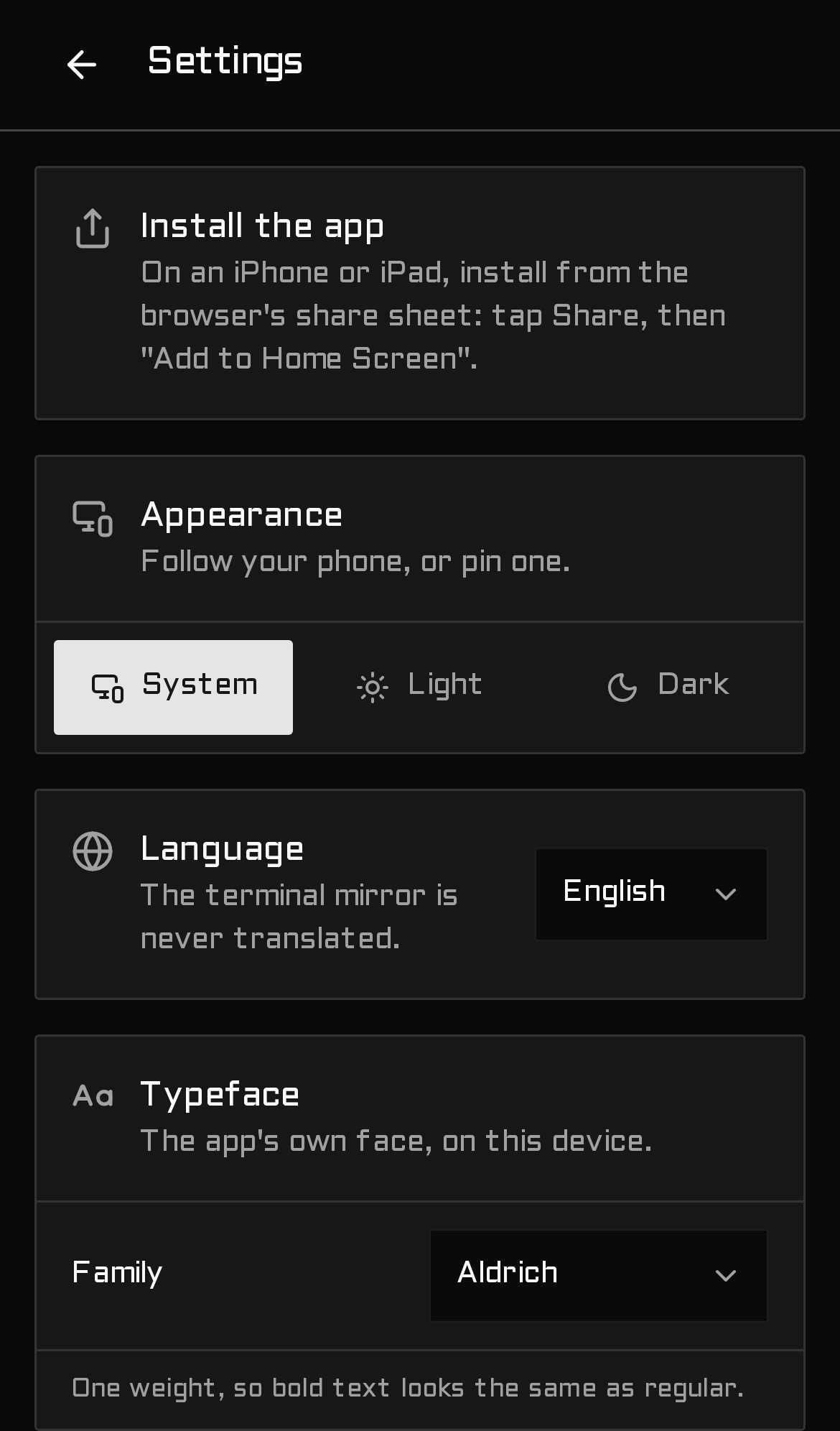
ColliePWA is an MIT-licensed, self-hosted web app that mirrors the panes of a terminal multiplexer — Herdr first, with tmux, zellij, tuios and Tern handled experimentally — inside a phone-first interface, aimed at developers who let coding agents (Claude Code, Codex, OpenCode and friends) keep running on their own machines. A Bun bridge polls the multiplexer and serves a small JSON API plus the UI: panes are grouped per workspace with blocked ones listed first, the agent's conversation can be read turn by turn or as the raw ANSI screen, permission prompts come back as buttons you tap, and an arrangeable keys pad sends Esc, Ctrl+C or custom chords. It can launch a fresh agent, shell or git worktree from the phone, browse an agent's workspace files and their uncommitted diffs without writing anything, upload images and text files, alert you through Web Push, take dictated replies through a speech provider you choose, group several hosts into a crew with failover, and let one agent message another; durable agents are experimental. You install the collie binary with a curl script on Linux or macOS (a Nix flake, an Arch PKGBUILD and an experimental Windows script also exist, and Herdr can manage it as a plugin); it runs as a supervised service bound to 127.0.0.1 and is reached through Tailscale serve by default or any HTTPS reverse proxy, with phones added by pairing code. There is no container image, no App Store or Play Store build, and no team mode — one operator only. Because keystrokes go straight into live shells, the project itself warns to treat the URL like a root login and never expose it publicly.
Should you self-host ColliePWA?
ColliePWA scores 58/100 on selfhost.directory (how scoring works) and ranks #58 of 209 in AI Agents. It has 1 487 GitHub stars.
It shipped 11 stable releases in the past year. The latest, v1.24.2, came out on 28 October 2026. New versions land roughly every 1 days.
Setup is moderate: expect some configuration beyond a single command. It is MIT-licensed and written mostly in Typescript.
Its closest alternative on selfhost.directory is Termix (76/100, 15 703 stars). It scores higher overall, so compare the two before you pick. See ColliePWA vs Termix side by side.
Features
- Agent status dashboard
- Chat and terminal screen views
- Configurable keys pad
- Device pairing tokens
- Durable agentsexperimental
- Interactive browser demo
- Inter-agent messaging
- Multilingual UI
- Multi-machine crews
- Push Notificationsoptional, requires HTTPS and a VAPID key pair
- Quick actions and slash commands
- Read-only file and git diff view
- Start agents and worktrees from the phone
- Tappable agent prompts
- Voice dictationoptional, off until a speech-to-text provider is set up
ColliePWA README
FAQ
Can my team share one ColliePWA?
No, it is built for one operator with no user accounts or per-person permissions; a crew groups several of your own machines behind one address.
Does anything leave my machine?
No telemetry, analytics or crash reports; the only unprompted call is an anonymous update check against GitHub's public tags.
Is it safe?
It gives remote shell access to your machine by design; every request needs a paired device token, it binds to loopback only, and you should keep one private front door and never use tailscale funnel.
Why can't I turn on notifications?
Web Push needs an HTTPS address and a key pair from collie push-keys; on iPhone you must add the app to the home screen first.
Do I need Tailscale?
No. Tailscale is the default because collie start sets it up, but a reverse proxy, Cloudflare Tunnel, NetBird or another mesh also works.
Which operating systems does it run on?
The host runs Linux or macOS; Windows 11 x64 against Herdr 0.9.3 or newer is experimental. Any current phone browser works.
Which terminal multiplexer do I need?
Herdr, tmux or zellij, with tuios and Tern also working as experimental backends; collie start detects what you have and asks.
Which agents does it work with?
Any agent running in a terminal pane — it mirrors the pane and needs no agent API; prompt-cache timers cover Claude Code, Codex, OpenCode and pi.
Why not just SSH in from Termux or Termius?
You can, and that is how Collie started, but driving a TUI through on-screen controls is clumsy; Collie lets you tap the waiting agent, type normally, and hit Esc or Ctrl+C with one thumb.
How is this different from Claude Code Remote Control?
Remote Control pairs the Claude app with a Claude Code session through the Anthropic API; ColliePWA mirrors terminal panes on your own hardware with whatever agent runs in them.
Is ColliePWA an alternative to Termius or Moshi?
Termius and Moshi are SSH terminal apps from app stores; ColliePWA is a machine-served web app that lists your multiplexer's agents and has a dedicated keys tray.
Is there a mobile client or app for Herdr?
Yes, ColliePWA is a mobile client for Herdr, served by your machine and opened in the phone browser; nothing comes from an app store.
Do I need an app from the App Store or Google Play?
No, it is a web app your own machine serves; you open it on your phone and add it to the home screen.
Can I try it before I install it?
Yes, an interactive demo runs the real client in your browser against made-up agents and panes, with nothing installed or sent.
Is ColliePWA free?
Yes, it is MIT licensed with no paid tier, account, or cloud service behind it.
More in Remote Access
 CortenDeskSelf-hosted RustDesk console bundling ID server, relay, and browser client in one Docker image. Fixes signed-in client issues, adds fleet management, access control.
 deqHomelab control plane with native Android app, Wear OS, and Android Auto. SSH-based control from a dashboard. Single Python file. Zero dependencies. Dynamic config. No YAML.
 DezKVMDezKVM is a self-hosted, open-source IP-KVM using commodity USB capture/HID devices to control multiple computers from a Linux SBC or mini PC.
 Docker ZeroTier PlanetA self-hosted ZeroTier Planet you deploy with Docker on a Linux server, with a web management UI for networks and members plus planet/moon file downloads.
 DockTailOpen-source, self-hosted Go agent that watches Docker labels and publishes containers as native Tailscale Services, with HTTPS, TCP, PROXY protocol and Funnel support.
 DroneBridgeDroneBridge is an open-source, self-hosted long-range radio link for drones using WiFi. Supports 1080p video, MAVLink telemetry, RC control, and OSD.
 electerm-webelecterm-web is a self-hosted, open-source web terminal and SSH/SFTP client with AI assistance, multi-language support, cloud sync, and responsive mobile design.
 EpoptesOpen-source computer lab management tool for screen broadcasting, monitoring, remote command execution, and client control in educational environments.
 ESP-KVMOpen-source IP-KVM firmware for ESP32-P4 boards capturing HDMI video and presenting USB keyboard/mouse to any target, accessible via browser console.
 firefoxOpen-source, self-hosted Docker container running the Firefox browser, streamed to any web browser or VNC client with audio, clipboard sync, file manager and terminal.
 FirezoneZero-trust remote access built on WireGuard for teams: gateways run in your network, while policies, device trust and audit logs are managed from a hosted portal.
 friendupFriend OS is a self-hosted, open-source web OS providing a full desktop in the browser with file management, chat, video calls, and collaborative workspaces.
0 comments