
Self-host RAGFlow
v1.0.0Open-source RAG engine with agentic AI for enterprise
- Stars
- 94 239
infiniflow/ragflow

What is RAGFlow?
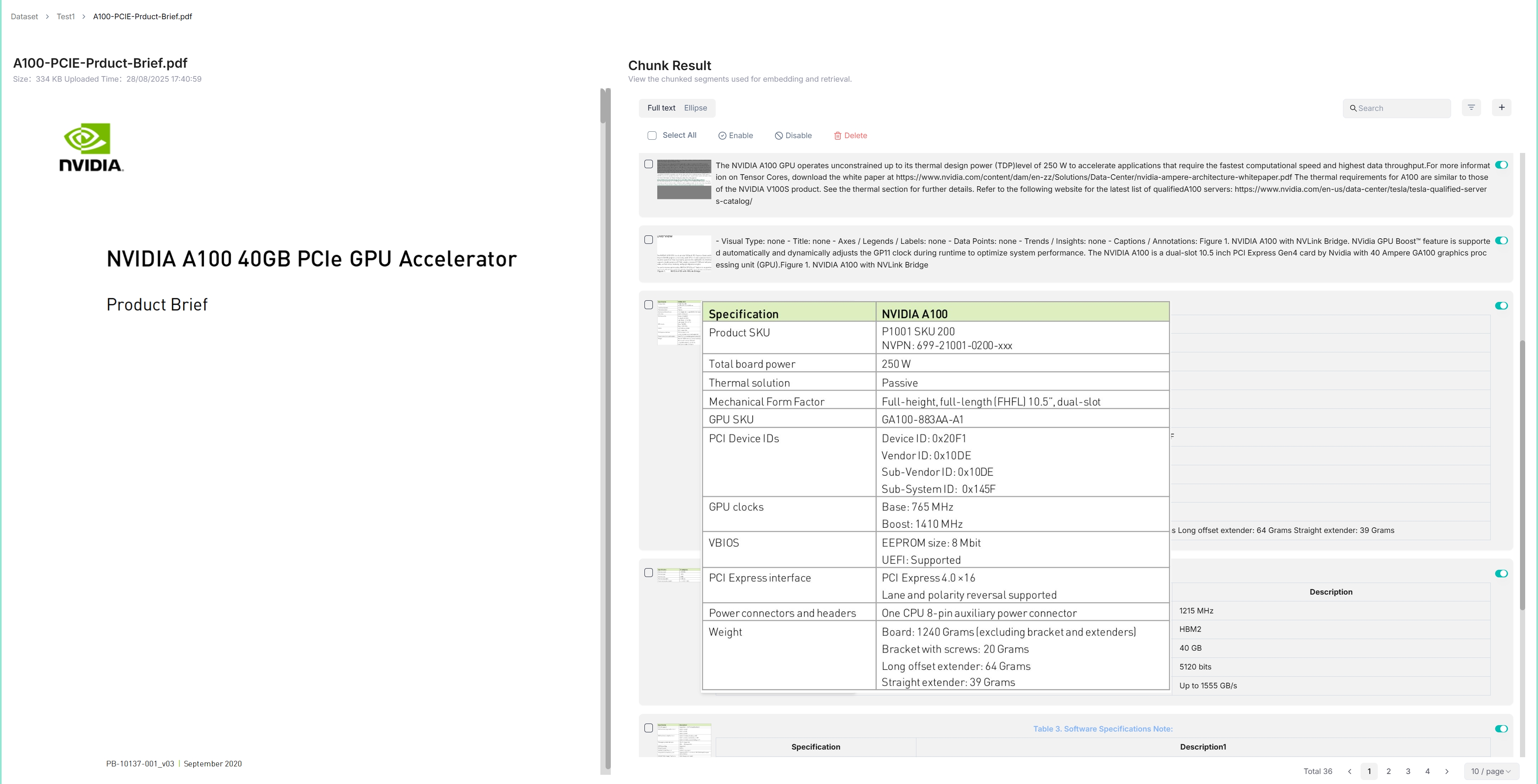
RAGFlow enables users to build production-ready AI systems through an end-to-end RAG platform. It extracts knowledge from complex documents including text, tables, and images using advanced parsing. Users can configure their own LLMs and embedding models, while the system handles retrieval through hybrid search methods with re-ranking. The platform supports both simple workflows and complex agentic patterns with multi-step reasoning.
RAGFlow alternatives
 WeKnoraTencent's open-source knowledge framework for teams: self-hosted RAG Q&A with citations, agents with sandboxed skills, and auto-generated wikis on swappable LLMs.CompareWeKnora with RAGFlow
 fastgptFastGPT is a self-hosted, open-source AI agent platform for building RAG chat apps with visual workflow orchestration, hybrid retrieval and reranking.Comparefastgpt with RAGFlow
 PharosSelf-hosted, open-source RAG system with multi-format document ingestion, hybrid retrieval, enterprise ACL, and dual HTTP + MCP exits for team knowledge bases.ComparePharos with RAGFlow
 vortexSelf-hosted RAG application for document chat with multiple LLM providers. Combines vector and keyword search, re-ranks results, and shows source citations.Comparevortex with RAGFlow
 DocBrainDocBrain is a self-hosted RAG framework with document Q&A, natural language SQL over tables, local vectors, multi-LLM support, and RBAC.CompareDocBrain with RAGFlow
 RowfillSelf-hosted open-source agentic tables platform for document extraction, deep research, and AI data processing.CompareRowfill with RAGFlow
 Big-AGISelf-hosted, open-source AI workspace for experts: run 2 to 24 models in parallel with Beam, personas, image generation, voice and BYO API keys via Docker.CompareBig-AGI with RAGFlow
 TaskingAIAn open-source, self-hosted BaaS stack for building LLM agents: unified model APIs, RAG, built-in tools and an admin console, deployed with Docker Compose.CompareTaskingAI with RAGFlow
Should you self-host RAGFlow?
RAGFlow scores 89/100 on selfhost.directory (how scoring works) and ranks #4 of 123 in AI. It has 94 239 GitHub stars, +2 159 in the last 30 days.
It shipped 18 stable releases in the past year. The latest, v1.0.0, came out on 6 November 2026. New versions land roughly every 9 days.
Setup is advanced: plan for several services and some ongoing maintenance. An official Docker image is available. It is Apache-2.0-licensed and written mostly in Go.
Its closest alternative on selfhost.directory is openclaw (93/100, 394 569 stars). It scores higher overall, so compare the two before you pick. See RAGFlow vs openclaw side by side.
Features
- Deep document understanding
- Streaming Responses
RAGFlow README

Cloud | Documentation | Roadmap | Discord
RAGFlow releases & version history
After three release candidates, we are pleased to announce the official release of RAGFlow 1.0, now ready for production. Built on a complete rewrite in Go, this release significantly reduces deployment and runtime overhead and introduces an all-new Agentic Chat experience. We encourage all users to upgrade for improved stability, performance, and question answering.
Highlights
- Rewritten in Go for lighter deployment: Docker images are approximately 10× smaller, and startup is approximately 10× faster.
- Approximately 100× greater concurrency, with substantial improvements in query latency, memory usage, and document parsing speed.
- All-new Agentic Chat: Enables multi-step reasoning and answers to complex questions through iterative retrieval, tool calls, and evidence sufficiency assessment.
Chat and Agents
- Added Agentic Chat mode, replacing the previous Low, Medium, High, and Ultra thinking levels.
- Introduced the Jev decision model into the agent tool-calling loop to determine whether the available evidence is sufficient to answer a question.
- Added support for the Jev decision model in the Categorize agent component.
- Added storage and display of prompts, token usage, and execution time in chat history.
Document Ingestion and Retrieval
- Unified the 12 built-in document parsers with the pipeline parsers.
- Added support for multiple ingestion pipeline DSL versions.
Architecture and Deployment
- Migrated the message queue from Redis to NATS.
- Adopted Kvrocks for cache and checkpoint storage.
- Added Docker images for the arm64 architecture.
- Reimplemented the RAGFlow CLI in Go.
Stability
- Fixed multiple critical bugs reported by the community and issues identified during the release candidate phase, further improving runtime stability.
Benchmarks
- Achieved 91% accuracy on the FRAMES multi-hop question-answering benchmark using RAGFlow Agentic Chat with MiniMax M3.
Upgrading
- From v1.0.0-rc1, rc2, or rc3: Existing data is fully compatible. You can upgrade directly.
- From v0.27.2: You can upgrade directly to v1.0.0. Data migration runs automatically when the RAGFlow Docker container starts.
- From versions earlier than v0.27.2: Follow the migration guide to complete the required intermediate upgrades before upgrading to v1.0.0.
- Back up all data before upgrading. Data migration from v0.27.2 to v1.0.0 is irreversible. If migration fails, restore the complete pre-upgrade backup before trying again.
Compatibility and Limitations
- Deprecated API aliases are no longer supported.
- The Python SDK is unaffected.
- DeepDoc currently supports CPU environments only.
Relative references
- Backup and upgrade guide: https://ragflow.io/docs/migration_overview
- Removed APIs: https://ragflow.io/docs/http_api_reference#removed-api-aliases
What's Changed
- fix(parser): keep recovered PDF TOC leader lines out of the body guard by @jay77721 in #21768
- CI: Fix log tee failure by @myf-bee in #21791
- Update release notes of 1.0.0.rc3 by @yingfeng in #21793
- feat: add Wally as a model provider by @adityabatra072 in #21719
- add audit hooks to file APIs by @JinHai-CN in #21807
- add log hooks by @JinHai-CN in #21822
- i18n: translate pipeline version and parser settings strings in tr-TR by @bakiburakogun in #21819
- fix(models): honour context cancellation in driver HTTP requests by @ccclucky in #21643
- feat(vastbase): support Vastbase G100 as the metadata database in Go by @FengYikai710 in #20913
- fix: README.md by @eridan-ltu in #21828
- fix(chunker): prevent PDF child chunks from overwriting each other by @jay77721 in #21773
- test(sdk): remove explicit Python SDK test skips by @6ba3i in #21783
- fix(syncer): retain Dropbox checkpoints on download failure by @Zhi-Xiang-Guo in #21809
- fix(api): keep the datasets API error response body shape by @simpleqt in #21831
- perf(web): virtualize chat message lists by @dcc123456 in #21790
- CI: add check for ASCII, disallow none ASCII code check-in by @wangq8 in #21784
- fix(anthropic): support struct json schema in tool parameters by @Sanderhoff-alt in #21638
- feat(parser): hand off Markdown and HTML remote images as media refs by @jay77721 in #21764
- fix(paddleocr): handle submit request creation errors by @QAQadws in #21839
- fix(deepdoc): add cgo constraints to native configuration tests by @QAQadws in #21837
- fix: SoMark web page is missing by @fenglingxiansheng in #21710
- fix(agent): clamp dataset navigation max_docs to the default budget by @flyingwhit in #21755
- feat(admin): add user search, status filtering, sorting, and CLI pagination by @QAQadws in #21729
- feat(chat): add AnySearch web search provider by @GunaPalanivel in #20633
- refa: consolidate model access and tenant defaults by @buua436 in #21740
- fix(ingestion): stop MinerU JSON path from inlining zip figure bytes by @Souravrajvi0 in #21803
- fix(tool): cap tool HTTP response bodies at 4 MiB in arxiv, querit, duckduckgo and yahoo_finance by @flyingwhit in #21769
- fix(models): publish the provider catalog through an atomic pointer and drop the dao-side cache so concurrent readers and publishers no longer race by @flyingwhit in #21749
- fix(agent): resolve DeepL and QWeather credentials from node config or DEEPL_API_KEY/QWEATHER_API_KEY instead of model-visible params by @flyingwhit in #21735
- fix(dify): keep retrieval unscoped when metadata conditions are empty by @MoonPointer-Byte in #21766
- test(retrieval) : add unit tests for retrieval and reranker by @zzy1017-crypto in #21611
- fix(agent): prevent checkpoint crashes and propagate component errors by @6ba3i in #21854
- fix(agent): detect webhook Begin in saved canvases by @6ba3i in #21849
- fix(file): record commit deletions without a missing status column by @ccclucky in #21796
- fix(tokenizer): replace the default fields instead of appending by @ccclucky in #21799
- test(mediacache): cover real Kvrocks lifecycle and index boundary by @jay77721 in #21851
- fix(user): use string for user id in DAO and handler lookups by @xugangqiang in #21792
- fix(build): adjust onnxruntime static link flags on Darwin arm64 by @Sanderhoff-alt in #21162
- release dockerhub image remove unnecessary tag by @myf-bee in #21860
- fix(chunk): number paragraph chunks by their position by @Steve-20-ai in #21823
- perf(chunker): coalesce PDF renders and share crop workers by @jay77721 in #21850
- fix(web): restore entity type colors in knowledge graphs by @okht in #21443
- fix(chunker): align PDF child previews with source positions by @jay77721 in #21853
- fix(cli): list only accepted commands in \help by @mmporong in #21503
- fix(channels): stop leaking a goroutine per WhatsApp events reconnect by @flyingwhit in #21863
- fix(channel): add limit check to qqbot response by @flyingwhit in #21859
- refactor(kvrocks): remove unused Client.GetOrCreateKey by @Sanderhoff-alt in #21298
- refa: remove permission service wrappers by @buua436 in #21856
- fix(ingestion): settle a terminal task's open run before deletion by @ccclucky in #21798
- fix(agent): resolve single-brace variable references by @6ba3i in #21865
- Revert "CI: add check for ASCII, disallow none ASCII code check-in" by @wangq8 in #21873
- test: gate community-only tenant cases from EE by @buua436 in #21874
- Update docs by @yingfeng in #21876
- feat(ingestion): emit structured lifecycle events for document-parse tasks by @xugangqiang in #21711
- refactor by @JinHai-CN in #21875
- fix(agent): serialize HTTP fields and preserve errors by @6ba3i in #21857
- fix(agent): resolve nested subagent components by @6ba3i in #21872
- fix(agent): normalize Invoke proxy URLs and avoid panics by @QAQadws in #21855
- fix(deepseek): validate and normalize thinking effort by @QAQadws in #21852
- fix(test): remove two races that reddened the ingestion packages by @ccclucky in #21716
- fix(gmail): retain complete MIME payload when loading threads by @Zhi-Xiang-Guo in #21811
- feat: add Synap as a model provider by @jimmyplup in #21818
- fix(agentic-rag): make the finalize and claims budgets configurable by @ccclucky in #21879
- test(service): gate API-token identity test out of EE builds by @xugangqiang in #21885
- feat(document): one-click cancel all documents in parsing queue by @xugangqiang in #21861
- fix(docker): stop the SPA fallback from masking stale hashed assets by @ccclucky in #21878
- update readme by @JinHai-CN in #21894
- feat(go): MonkeyOCR PDF dispatch on Go ingestion path by @Souravrajvi0 in #20469
- fix(ingestion): add process_end_at column and keep OSS ingest-log a no-op by @xugangqiang in #21888
- Fix: Increase the spacing between the labels and the dropdown menus for the PDF and table parsers. by @cike8899 in #21882
- refa: derive permission identity from context by @buua436 in #21892
- Refactor: refine response data by @wangq8 in #21858
- Revert "fix(ingestion): add process_end_at column and keep OSS ingest-log a no-op" by @JinHai-CN in #21897
- fix(agent): use stored log titles in tables and exports by @6ba3i in #21890
- fix(agent): pass scalar thresholds to memory retrieval by @6ba3i in #21889
- add sync audit hook by @JinHai-CN in #21901
- Fix: Variables within the "Wait for Input" and "Start" components of an agent are not accessible in the floating window. by @cike8899 in #21900
- remove codecov upload by @JinHai-CN in #21902
- refactor(common): revert OSS ingest-log collection from #21711 (keep instrumentation only) by @xugangqiang in #21893
- Fix: Delete the agent log entry by @cike8899 in #21910
- Stop persisting process_end_at; recover end time from begin + duration by @xugangqiang in #21906
- feat: add user ownership to resources by @buua436 in #21914
- Feat: Add a cancel button to pause tasks that are currently running or queued. by @cike8899 in #21917
- Fix: The referenced content in chat and agent messages is being obscured. by @cike8899 in #21918
- Fix: disable ciation not working in agentic chat by @wangq8 in #21913
- fix(parser): detect Office content before selecting Go parsers by @jay77721 in #21909
- feat(web): add enterprise (ee) seam layer for build-time overlays by @dcc123456 in #21908
- refa: derive service identity from context by @buua436 in #21904
- fix(service): purge engine data from RemoveDocumentKeepFile (#20659) by @Harsh23Kashyap in #20768
- fix(ingestion): share extractor concurrency across tag extraction by @jay77721 in #21891
- fix(dao): include skill spaces in auto migration by @buua436 in #21921
- fix(es): preserve dataset and document scope in single chunk updates by @zzy1017-crypto in #21842
- fix(whatsapp): escape the gateway events session key once by @flyingwhit in #21871
- docs:Restructure the Team documentation and align sharing configuration across Dataset, Agent, and Memory. by @Yannnnnnny in #21922
- fix(file): scope commit changes to the target folder tree by @ccclucky in #21795
- feat(ocr): make MinerU parser timeout configurable via environment and setup by @superwiboy in #21832
- Refactor: Better no such name by @wangq8 in #21925
- Fix: Adjust layout of DatasetFilter component to conditionally render FilterPopover and SearchInput by @dcc123456 in #21924
- Fix: Agent – Incomplete display of blueprint examples when creating a wiki template in Compiler by @cike8899 in #21919
- fix(agent): populate structured output and resolve deferred @structured by @huang-aoqin in #20679
- feat(gpustack): rework provider setup and fix driver issues by @lemisky in #21903
- fix(agent): runtime fixes for tool naming, legacy sessions, tenant scoping and MCP SSRF by @techpreneur-a in #20558
- fix(ingestion): pass the MinerU timeout to the MonkeyOCR file_parse upload by @ccclucky in #21930
- refa: derive service identity from request context by @buua436 in #21923
- fix(retrieval): bound rerank and KNN candidate windows by @zzy1017-crypto in #21907
- feat(ingestion): recognize image tables through the DeepDoc page pipeline by @jay77721 in #21911
- doc: fix typos by @JinHai-CN in #21947
- Fix: Variables inserted using shortcuts fail to display in the message node. by @cike8899 in #21946
- Fix: Chat embedded in a website: automatically scrolls down when a question is answered. by @cike8899 in #21940
- refa: derive service identity from context by @buua436 in #21942
- Fix: Long messages in floating embedded pages overflow the message box. by @cike8899 in #21951
- Fix: The pipeline name is too long and overflows the release dialog. by @cike8899 in #21957
- fix(agent): support String and Object Invoke parameters by @6ba3i in #21953
- feat(chunker): support media context in title and manual pipelines by @ZXLyyds100 in #21111
- refa: derive connector, MCP, and memory identity from context by @buua436 in #21952
- allow chinese words as model instance name by @JinHai-CN in #21948
- Fix: add system_settings seeder by @Lynn-Inf in #21955
- perf(pdf): read page directives once per document by @jay77721 in #21950
- Fix: honor ALLOW_ANY_HOST by @wangq8 in #21949
- Fix: File Management - Move - Folder name is too long, causing visual clipping (clipping through UI elements) by @cike8899 in #21962
- Filter agent version, allow filter with alias by @wangq8 in #21943
- refactor(extractor): resolve chat model config once per run by @xugangqiang in #21960
- Fix: Add a text description to the cancel-parsing button. by @cike8899 in #21966
- Fix: when agentic chat fail, show the real error by @wangq8 in #21964
- refactor(deepdoc): drop dead covered-slice+sort in GroupCells span injection by @xugangqiang in #21954
- refactor(ingestion): consolidate unique* string dedup helpers into common by @xugangqiang in #21961
- Fix: allow to move to root directory by @wangq8 in #21969
- ci: web not run go test by @myf-bee in #21958
- Fix: The messages in the embedded chat interface are positioned too close to the right edge. by @cike8899 in #21974
- feat(observability): carry user_name/tenant_name through IngestionLog by @xugangqiang in #21968
- i18n: translate GPUStack provider setup and parse cancel strings in tr-TR by @bakiburakogun in #21963
- feat(ingestion): record pipeline version on operation logs by @jay77721 in #21916
- fix(agentic_rag): make the decisionhead package compile without cgo by @ccclucky in #21932
- fix(deepdoc): keep DLA-labeled body prose out of table captions by @jay77721 in #21979
- deepdoc/pdf: extend TableBuilder with FinalizeGrid and AttachSpanInfo by @xugangqiang in #21980
- Fix: agent session by default should not return dsl by @wangq8 in #21989
- Fix: Deleting a pipeline bound to a dataset should not trigger an error when navigating to the file list page of a different dataset. by @cike8899 in #21985
- fix(sdk): guard Session._structure_answer against KeyError on non-streaming agent responses by @sandiyochristan in #21933
- fix(storage): add Content-MD5 to S3 batch delete requests by @liuzelei in #21877
- fix(go): paginate the Anthropic models list by @pcbeingused333 in #21899
- fix(chunker): bound the crop page cache by bytes and release pages when a crop task panics by @Xavierando in #21880
- refactor(structure): read STRUCT_MAX_CHUNKS_PER_BATCH via common.GetEnvInt by @xugangqiang in #21984
- docs: Documentation Updates and UI Alignment by @Yannnnnnny in #21986
- fix(nlp): add retrieval prune logic and tests by @zzy1017-crypto in #21627
- fix: align version catalog test with EE permissions by @buua436 in #22011
- Fix: Dataset file configuration: switching from "pipeline" to "built-in" also triggers an exclamation mark warning. by @cike8899 in #22010
- Fix: If the title of an agent operator is too long, it overflows beyond the boundaries of the sheet. by @cike8899 in #22013
- fix(web): hide Agent-related content in chat channel connect dialog by @dcc123456 in #22015
- Fix: Increase the right-hand margin on the agent share page. by @cike8899 in #22016
- Fix: second sort key for memory messages by @Lynn-Inf in #22004
- Upgrade office_oxide to v0.1.16 and drop temporary caption/table fixes by @xugangqiang in #21978
- refa: remove remaining identity arguments by @buua436 in #22005
- fix(es): return error on item-level failures in metadata bulk write by @zzy1017-crypto in #21956
- fix(ingestion): preserve PDF sentences across page boundaries by @jay77721 in #21982
- refactor(ingestion): consolidate duplicated meta-reader helpers into kccommon by @xugangqiang in #21983
- Add Somark VerifyOCRConnection by @fenglingxiansheng in #21927
- fix(knowledge-compiler): honor node settings and degrade missing vector mapping by @buua436 in #22026
- fix(web): pass through 413/504 responses without a duplicate error toast by @dcc123456 in #22024
- fix(core): enforce consistent name and alias length limits by @jay77721 in #22020
- fix(parser): preserve Office table cell spans by @jay77721 in #22012
- Fix: The model category filter does not change based on the system language, and there is no clear visual indicator to show which item is currently selected. by @cike8899 in #22038
- fix(channels): propagate delivery errors without exposing credentials by @6ba3i in #22033
- fix(parser): keep the paragraphs of a Markdown blockquote apart by @L4XB in #21347
- Fix: The agent operator name is too long, causing the icon to be compressed. by @cike8899 in #22042
- feat(doc-generator): render markdown and expose html decorations by @6ba3i in #22040
- fix(channels): support WhatsApp gateways through Docker by @6ba3i in #22032
- Refactor: restrict page_size max value 100 by @wangq8 in #22036
- docs: record name column widening in database change log by @jay77721 in #22030
- Feat: Image parsing: DeepDoc is distinguished from other OCR models and is offered as a separate option. by @cike8899 in #22047
- Bump Infinity to v0.7.5 by @qinling0210 in #22022
- fix(admin): return every user when the list is unpaged by @ccclucky in #21723
- docs: add tutorial in quickstart by @Yannnnnnny in #22027
- docs:add use cases for common scenarios by @Yannnnnnny in #22054
- fix(models): support the MinerU 4.1 Tasks API in ParseMinerUV1 by @ccclucky in #21995
- Fix: Align the agent operator title to the left. by @cike8899 in #22051
- fix(pregel): preserve slice types during state reduction by @6ba3i in #22014
- Add RenderVH dispatch hook to ConstructTable for EE V/H tables by @xugangqiang in #22055
- fix: seed user rows in tenant service tests by @buua436 in #22060
- Resolve the comments by @wangq8 in #22059
- fix: restore harness interrupt resume and events by @buua436 in #22050
- refactor(common): move IngestionLog and ingest-log sink out of stub.go by @xugangqiang in #22006
- fix(chat): always conjoin the authorized kb_id filter to SQL retrieval by @zzy1017-crypto in #21866
- fix(web): harden rename flows and dialog UX by @dcc123456 in #22068
- feat(channels): support agent workflows and isolate startup failures by @6ba3i in #22031
- Revert "fix(web): hide Agent-related content in chat channel connect dialog" by @wangq8 in #22069
- fix(storage): use bounded synchronous MinIO health probes by @liuzelei in #21945
- refactor(ingestion): drop Python/migration-history comments from tree sub-package by @xugangqiang in #22008
- fix: harden native analyzer conversions and JSON output by @buua436 in #22070
- fix: harden agent export, timeout, and artifact handling by @buua436 in #22037
- fix: clean agent subgraphs and repair frontend requests by @buua436 in #22048
- fix(pregel): propagate conditional edge and branch errors by @6ba3i in #22074
- fix(web): use secondary buttons for tenant table actions by @dcc123456 in #22079
- fix(agent): preserve Markdown headings and lists in DOCX by @6ba3i in #22078
- Docs: Get rid of (optional) by @wangq8 in #22085
- feat(parser): add MiniCPM-OCR as a PDF parser by @Caldalis in #21785
- add more glm models by @JinHai-CN in #22087
- Provision native libs from versioned user cache (offline CI, drop /opt pre-bake) by @xugangqiang in #22023
- Fix: handle Vite preload errors with automatic reload by @cike8899 in #22086
- fix: resolve template, rerank, and migration regressions by @buua436 in #22083
- fix(agent): preserve nested Markdown lists in PDF exports by @6ba3i in #22084
- fix: scope upload quotas and lock WeCom listener binding by @buua436 in #22076
- fix: harden OAuth, gateway auth, and provider parsing by @buua436 in #22072
- Fix: long name error by @wangq8 in #22088
- fix(es): prevent Lucene injection in session_id and enforce dataset scope in DeleteChunks by @zzy1017-crypto in #21981
- fix(web): truncate overflowing titles in embedded chat headers by @dcc123456 in #22091
- fix: prefix agent channel sessions with the chat channel name by @flyingwhit in #22090
- feat(chatchannel): stream Feishu, WeCom and DingTalk replies by @flyingwhit in #22041
- fix(channels): truncate Telegram and Discord upstream error bodies to 200 bytes by @flyingwhit in #22075
- fix(channels): apply saved agent updates to existing conversations by @6ba3i in #22093
- Revert "Provision native libs from versioned user cache (offline CI, drop /opt pre-bake)" by @xugangqiang in #22097
- fix(web): refresh tenant user list after removing a member by @dcc123456 in #22096
- fix(test): fix always-true assertions in reranker normalize test by @zzy1017-crypto in #22039
- fix(dataset): sync folder rename in same transaction to prevent binding loss by @zzy1017-crypto in #22021
- refactor(ingestion): centralize component names and identity checks by @jay77721 in #22081
- fix(deepdoc): preserve missed PDF table rows and merged headers by @jay77721 in #22073
- fix(channels): strip citations from outgoing replies by @6ba3i in #22106
- fix(syncer): retry startup task publication failures by @6ba3i in #22101
- fix: align ChatChannel permission tests by @buua436 in #22107
- fix(infinity): decode tag_feas on chunk search reads by @ccclucky in #21782
- Release notes 1.0 GA by @wangq8 in #22109
- Docs: Update version references to v1.0.0 in READMEs and docs by @asiroliu in #22108
- update macos runner to macos-15 for arm64 architecture by @myf-bee in #22110
New Contributors
- @adityabatra072 made their first contribution in #21719
- @eridan-ltu made their first contribution in #21828
- @Zhi-Xiang-Guo made their first contribution in #21809
- @fenglingxiansheng made their first contribution in #21710
- @GunaPalanivel made their first contribution in #20633
- @MoonPointer-Byte made their first contribution in #21766
- @Steve-20-ai made their first contribution in #21823
- @mmporong made their first contribution in #21503
- @jimmyplup made their first contribution in #21818
- @superwiboy made their first contribution in #21832
- @sandiyochristan made their first contribution in #21933
- @liuzelei made their first contribution in #21877
- @pcbeingused333 made their first contribution in #21899
- @Caldalis made their first contribution in #21785
Full Changelog: v1.0.0-rc3...v1.0.0
What's Changed
- Port agentic RAG to GO by @qinling0210 in #19500
- Revert "fix(ingestion): allow re-parsing a document whose parse was canceled at progress 0" by @wangq8 in #19503
- fix(agent/tool): translate MCP tool inputSchema.properties in Info() by @mkaaad in #19244
- Fix: remove deprecated functions by @Lynn-Inf in #19449
- fix(sdk): preserve agent answer references by @AnnaSuSu in #19365
- fix(mcp): send rerank_candidates_count so retrieval paging works past 64 results by @xu-jia-ming in #19018
- fix(agent): compare retrieval KBs by resolved embedding model, not raw embd_id by @kabishou11 in #19206
- Go: add integration test by @JinHai-CN in #19485
- Fix: Modify the text color of the TreeSelect component. by @cike8899 in #19507
- Upon entering a wiki, the top-right corner indicates that modifications have been made, even though no changes were actually performed. by @cike8899 in #19482
- fix(api): authorize task cancellation by dataset access by @Harsh23Kashyap in #19359
- refa: remove unused knowledge compilation code by @buua436 in #19437
- fix: avoid nested compiler pool embedding deadlock by @buua436 in #19486
- fix(invoke): tolerate invalid headers across runtimes by @6ba3i in #19481
- fix(wiki): treat MAP-extracted chunks as cache hits instead of missing by @kabishou11 in #19208
- fix(web): prevent DOCX preview infinite update loop by @Souravrajvi0 in #19475
- fix(web): add Traditional Chinese child delimiter translations by @huyua9 in #18951
- fix(figure_parser): accept lang as named parameter on VisionFigureParser (#17280) by @Taranum01 in #19511
- fix(dataflow): preserve scalar text output shape by @huyua9 in #18921
- fix(i18n): localize Chinese delimiter preview by @huyua9 in #18948
- Unify ONNX Runtime native to 1.29.0 from infiniflow/ragflow-build by @xugangqiang in #19446
- fix(document): validate immutable fields on update by @taek105 in #19444
- fix(structure-graph): discover buckets from raw rows by @6ba3i in #19523
- fix: forward NumberInput ref to input by @huyua9 in #18904
- fix(ssrf): unwrap IPv6 transition addresses in the URL guard by @aroh3006 in #19517
- Feat: Make the files of the parser operators in the pipeline deletable. by @cike8899 in #19384
- fix(template): align data analysis CodeExec prompt by @huyua9 in #18958
- fix(storage): retry transient S3 failures by @6ba3i in #19526
- Port agentic RAG PRs to GO by @qinling0210 in #19527
- refa: remove Go artifact deletion APIs by @buua436 in #19519
- test(infinity): cover SQL literal escaping by @huyua9 in #18956
- Fix: The text in the SelectWithSearch dropdown menu is obscured by the checkmark icon. by @cike8899 in #19534
- fix(build): anchor pdf_oxide version gate against suffix versions by @xugangqiang in #19152
- feat(nlp): rerank on natural chunk text, not tokenized content_ltks by @vincentlambert in #16961
- fix(chunker): one BPE pass per hardSplitPiece iteration instead of two by @changshenhan in #18648
- fix: update knowledge artifacts on document status changes by @buua436 in #19532
- Migrate cache backend from Valkey 8 to apache/kvrocks:2.16.0 by @xugangqiang in #19374
- docs: update FAQs by @Yannnnnnny in #19538
- refactor(parser): unify parser outputs to structured JSON items by @jay77721 in #19467
- feat(agent): support document_ids in retrieval node and tool by @huang-aoqin in #16938
- fix(ingestion): stop dropping QA pairs from multiline table cells by @jay77721 in #19536
- Add claim/evidence to tree/pageindex compilation pipeline by @yingfeng in #19267
- fix(parser): handle large sparse spreadsheets, JSON BOM, and XLSX QA chunking by @Souravrajvi0 in #19237
- fix(wiki): version history always empty on Go API due to page-slug key mismatch by @euvre in #19305
- Port Agentic RAG to Golang by @yingfeng in #19563
- feat(data-source): add Feishu Wiki file connector by @Gonghan-Princess in #19425
- docs: fix dead link to removed docker-compose-gpu.yml by @jrlprost in #19576
- fix(ollama): disable reasoning for vision descriptions by @6ba3i in #19529
- fix(beartype): remove package-wide import hooks by @6ba3i in #19531
- Custom the file extension when saving DB fields, and Parse HTML fragments not just full HTML doc by @wadefelix in #15998
- fix(api): authorize the dataset document download route by tenant in the Go API by @coderdailyone in #19543
- fix: handle indirect PDF annotation arrays by @huyua9 in #18894
- fix(sdk): retain image IDs on chunks by @AnnaSuSu in #19505
- Fix: Set the minimum value for "top n" to 1 and restrict it to an integer. by @cike8899 in #19547
- Fix: Validate webhook form by @cike8899 in #19546
- feat(syncer): add Feishu Wiki connector for the Go backend by @mkaaad in #19453
- feat: add AnonRouter model provider by @anonrouterai in #19561
- fix: surface MinerU API error bodies and re-raise parser failures by @huang-aoqin in #17308
- fix(model): delete provider models and instances in one transaction by @ming1523 in #19562
- fix: fix security issue in ob_conn_base.py by @anupamme in #19524
- feat(connector): support file_extension for MySQL/PostgreSQL sync by @mkaaad in #19466
- feat(channels): WeCom can bind agent by @brucehu in #18598
- fix(wiki): stamp retrieval fields so compiled pages are searchable by @Souravrajvi0 in #18787
- feat(api): add image_update_mode for chunk image updates by @Souravrajvi0 in #18889
- Fix: keep a reference to the qqbot dispatch task so replies are not dropped by @muhzuhaib in #19029
- fix(agent): make Python webhook trace appends atomic by @T1mn in #19091
- fix(rag): assign PDF parser tables to tbls in book chunking method (#19557) by @Ritiky23 in #19559
- fix(storage):preserve original errors after retries by @6ba3i in #19580
- fix(web): scope pipeline log detail query keys by @huyua9 in #18909
- fix(api): validate embedding check sample count by @Harsh23Kashyap in #19574
- fix(api): treat an empty metadata_condition.conditions list as no filter by @Harsh23Kashyap in #19368
- fix(api): intersect metadata filter results with the caller's doc scope by @Harsh23Kashyap in #19353
- fix CI native backend test failed by @myf-bee in #19590
- Remove internal cli 'insert chunks from file' and 'insert metadata from file' by @qinling0210 in #19591
- fix(storage):preserve errors during backend retries by @6ba3i in #19578
- fix: merge same-name knowledge graph entities by @buua436 in #19525
- fix: split knowledge compilation logs by task type by @buua436 in #19548
- fix(parser): emit xlsx spreadsheets as typed table chunks by @xugangqiang in #19509
- Fix: UI chat should pass pass_all_history_messages=false in 1.0 go by @cike8899 in #19602
- Fix: The selected invalid dataset cannot be deleted. by @cike8899 in #19603
- fix: update image utils test stub by @buua436 in #19605
- docs: fix Python frontend proxy startup by @liang0417 in #19606
- fix: align mindmap relations with Python by @buua436 in #19579
- Revert "Fix: UI chat should pass pass_all_history_messages=false in 1.0 go" by @wangq8 in #19618
- refactor(ingestion): decouple document parsing state from document.run in favor of ingestion_task by @jay77721 in #19533
- fix(web): adapt document parsing state for Go ingestion_status (depends on #19533) by @dcc123456 in #19587
- Feat: Hide the delete and update buttons related to the Go version of the wiki. by @cike8899 in #19620
- Fix agentic search bugs by @yingfeng in #19615
- fix(agent): Agent reply empty when a retrieval tool runs — need2cite flips mid-stream by @spicyfishPro in #19483
- fix(agent): preserve Boolean values in Variable Assigner by @LostSnowfluff in #19499
- fix(sdk): stop parsing waits on status lookup failures by @AnnaSuSu in #19506
- feat: add API-Route as a model provider by @DennyHo0917 in #19566
- PY: refactor by @JinHai-CN in #19599
- fix(agent/tools): encode GitHub and QWeather query parameters by @MarMarLabs in #19584
- docs: clarify parser and email text by @gluedtea in #19541
- fix: show document graph entity counts by @buua436 in #19617
- Feat: Shorten the default distance of the timeline connector lines. by @cike8899 in #19612
- Fix: display modelExtra in api response by @Lynn-Inf in #19607
- feat(memory): make Go memory extraction tasks durable and resumable by @taek105 in #19512
- fix(ci): read DeepDoc testdata from the pre-seeded dir instead of linking it in by @xugangqiang in #19594
- test: cover TokenizerFromUpstream empty payload contracts by @huyua9 in #18898
- fix(retrieval): recover dense candidates after empty hybrid search by @6ba3i in #19502
- Implement endpoint GET /datasets/tags/aggregation in GO by @qinling0210 in #19626
- docs: repair stale internal links and license reference by @Mnilax in #19633
- fix(db): abort poisoned transactions on connection loss by @6ba3i in #19530
- Fix: When calling the
childrenandgraphinterfaces on the wiki tree page, thekeywordsparameter should be included. by @cike8899 in #19627 - Fix chat bot reasoning in GO by @qinling0210 in #19641
- fix(agent): reject unsupported image input cleanly by @6ba3i in #19539
- feat(mineru): observability for embedded image loss in chunk stream (#16978) by @Taranum01 in #18761
- fix(chunker): align custom delimiter text metadata by @yzl0ng in #19005
- fix(ocr): prevent OpenCV remap crashes with oversized images by clamp… by @lucasoffchain in #19419
- fix(api): reject empty provider instance deletes by @huyua9 in #18919
- fix(ingestion): enforce text-only pre-index wire contract by @Souravrajvi0 in #19478
- fix(api): preserve parent-child config on partial updates by @huyua9 in #18949
- feat(ingestion): track a run's pipeline log from queue to terminal by @jay77721 in #19494
- fix(naive): do not route vision layout models to MinerU by @huang-aoqin in #19513
- ci: drop the kvrocks-parity workflow and the integration tests it ran by @xugangqiang in #19583
- fix: record generated wiki page versions by @buua436 in #19636
- fix: support keywords in navigation APIs by @buua436 in #19645
- fix: sync navigation tree with document status by @buua436 in #19653
- build(deps): bump flask from 3.1.2 to 3.1.3 by @dependabot[bot] in #19659
- build(deps): bump protobufjs from 7.6.4 to 7.6.6 in /api/channels/whatsapp/gateway-node by @dependabot[bot] in #19655
- build(deps): bump mermaid from 11.16.0 to 11.16.1 in /web by @dependabot[bot] in #19657
- build(deps): bump langgraph-sdk from 0.3.6 to 0.3.15 by @dependabot[bot] in #19660
- Fix: The 'image' parsing method has been configured, but uploading images still results in an error. by @cike8899 in #19667
- fix(engine): filter chunks by requested IDs in update-by-query by @qinling0210 in #19665
- refactor(ingestion): migrate general parser and chunker contract by @jay77721 in #19611
- Refactor: move chat message/reference to dedicated tables by @wangq8 in #19577
- fix(web): reactively render children delimiter field by @huyua9 in #18892
- fix: correct hyphens utility on agent template descriptions by @huyua9 in #18901
- fix(parser): attach positions on TCADP spreadsheet JSON items by @li872 in #19555
- fix: resolve template names in keyword graph search by @buua436 in #19640
- fix: filter compilation status by kind by @buua436 in #19666
- Fix the pipeline email parser failing on every multipart message by @JessYanCoding in #19406
- fix(nlp): detect capitalized table-of-contents headings by @chuenchen309 in #17012
- PY: apply cross_languages translation in Retrieval memory mode by @JinHai-CN in #19669
- Fix saving agent without compiler id should report error by @wangq8 in #19672
- feat(web): explain chunker delimiter semantics in the pipeline forms by @jay77721 in #19676
- Go: invite member by send mail by @JinHai-CN in #19675
- Fix(go): migration cleanup and add DB version tracking by @Lynn-Inf in #19598
- Fix: ignore empty dataset config when creating from a template by @Lynn-Inf in #19677
- fix(memories): derive filter options from page list query to prevent stale filters by @dcc123456 in #19537
- fix(web): add table styling in chunk card content by @dcc123456 in #19614
- feat(web): add virtual scrolling to CSV viewer and chunk list by @dcc123456 in #19621
- feat(web): disable LaTeX math rendering for user messages by @dcc123456 in #19624
- feat: add DaoXE as an OpenAI-compatible model provider by @seven7763 in #19560
- fix(agent): expose token and round controls by @6ba3i in #19637
- fix(ragcon): scope embedding drop_params to official endpoint by @6ba3i in #19476
- fix(agent): wire MCP tools and preserve execution errors by @6ba3i in #19628
- Fix: Agent: Clicking multiple times to view the version history and then clicking the initial version causes an error. by @cike8899 in #19674
- Fix: Remove redundant parameters from the Go-version knowledge base configuration page. by @cike8899 in #19668
- feat(ui): add locked option support to MultiSelect component by @dcc123456 in #19658
- Fix: Knowledge Compilation - Graph - Entity count remains unchanged after search. by @cike8899 in #19652
- fix(web): fall back to dataset ID for tag KB IDs on Go backend by @dcc123456 in #19648
- Fix: When the agent compiler adds a new chunk node via the "Next Step" action, it can generate multiple subsequent nodes. by @cike8899 in #19644
- fix(agent): honor multi-select canvas category filter in Go /agents listing by @euvre in #19625
- fix(llm): skip dashscope/ prefix for Tongyi-Qianwen's OpenAI-compatible endpoint by @Taranum01 in #19288
- fix(auth): separate OAuth JIT provisioning policy by @6ba3i in #19651
- fix(web): guard tenant info in embed app modal by @huyua9 in #18940
- feat(web/switch): allow dot-notation field paths in Switch condition (#14235) by @Khaostica in #15071
- Fix: restrict instance name to digits, underscores, and letters by @Lynn-Inf in #19680
- fix(data_source): support custom base URL and HTTP for Azure DevOps c… by @ori-frenkel in #19407
- fix(bedrock): report the expected key schema instead of a JSONDecodeError (#17373) by @Anai-Guo in #17374
- Fix: append attachment content to last user prompt by @wangq8 in #19691
- fix(llm): honor the batch size BaiduYiyanEmbed already declares by @L4XB in #19690
- Fix: use component name instead of ID by @wangq8 in #19700
- Dev: add LLM_DEBUG to debug LLM request and response. by @wangq8 in #19703
- fix(mineru): upload the PDF once when several page ranges are configured by @devYRPauli in #19183
- fix(parser): flush pending text before table/image chunks in _build_cks by @wang393 in #19521
- feat(ingestion): stop persisting business data in pipeline operation-log DSL by @xugangqiang in #19631
- fix(ingestion): include the image/table context window in the chunk text by @jay77721 in #19678
- Fix: allow use - in instance_name by @Lynn-Inf in #19709
- fix(dao): allowlist orderby columns on the search, chat, file and dataset lists by @MarMarLabs in #19601
- fix(api): stop trusting X-Forwarded-For from every peer in the agent webhook IP whitelist by @coderdailyone in #19550
- fix: improve knowledge compiler LLM handling by @buua436 in #19701
- fix(deepdoc): preserve textless PDF figures for VLM extraction (#19679) by @Ritiky23 in #19688
- Fix: Request artifact logs based on the selected kind. by @cike8899 in #19716
- Fix {date} not take effect in system prompt by @wangq8 in #19713
- fix(chunk): gate claims/evidence panels by compilation template kind by @dcc123456 in #19704
- Fix: Dataset file upload: For unsupported file types, prompt the user to configure the corresponding file parser. by @cike8899 in #19710
- fix(pipeline-log): record the pipeline Parser's parse_method, not document.parser_id (#18306) by @Taranum01 in #18763
- Fix: Self-referencing data returned by the API causes the mind map page to freeze. by @cike8899 in #19720
- fix(csv-preview): move border to inner wrapper so it wraps content only by @dcc123456 in #19715
- Fix: enable admin user by default by @wangq8 in #19718
- fix(deepdoc): keep every inference call within one process CPU budget by @jay77721 in #19695
- Fix the One and Book chunkers when Tika extracts nothing from a .doc by @JessYanCoding in #19692
- perf(chunker): make hardSplitPiece O(L) with a single-encode token walk by @changshenhan in #19712
- fix(parser): keep the word boundary a styled space carries into markdown by @L4XB in #19693
- fix(web): correct metadata filter button semantics by @huyua9 in #18911
- fix(ingestion): count child tokens and cut media context on sentences by @jay77721 in #19696
- Fix: keep file API responsive during large connector ingest by @ondery in #19632
- fix(parser): keep a one-row slide table instead of dropping it by @L4XB in #19705
- fix(parser): accept a one-sheet dict in the Excel pandas fallback by @L4XB in #19706
- fix(api): return document metadata from /dify/retrieval by @ebarkhordar in #19686
- Fix user detail show not work by @wangq8 in #19719
- fix(agent): accept string variable selectors in VariableAggregator by @Harsh23Kashyap in #19413
- fix: filter self-loop knowledge compiler relations by @buua436 in #19721
- docs: update knowledge compilation docs by @Yannnnnnny in #19734
- docs: update MCP documents by @Yannnnnnny in #19730
- fix(i18n): rename 'Max tokens' to 'Max context length' and drop misleading default by @dcc123456 in #19729
- Fix: Switching the document-level graph selector should also update the corresponding total node count. by @cike8899 in #19732
- Fix: An error occurs when clicking the virtual root node of the mind map to call the API. by @cike8899 in #19731
- fix(file-commit): stop delete operations crashing the whole commit by @MarMarLabs in #19654
- Optimizing recall for agentic RAG by @yingfeng in #19687
- Feat: migrate chat message and reference by @Lynn-Inf in #19724
- fix(api): align Go proxy contract parity by @6ba3i in #19723
- fix(go): harden connector SSRF by @mkaaad in #19694
- fix(api): clamp memory list tenant_id filter to joined tenants by @coderdailyone in #19739
- fix(syncer): keep the word boundary a styled space carries into markdown by @mkaaad in #19722
- feat(mcp): add SDK-backed native Go MCP runtime by @6ba3i in #19673
- Fix searchbot return 500, should be 200 with error message by @wangq8 in #19763
- fix(agent): parse composite llm_id right-anchored on provider by @coderdailyone in #19752
- feat(deepdoc): verify PaddleOCR service connectivity in check_installation by @HUAN2022A in #17669
- fix(agent): reject missing models before save and run by @6ba3i in #19761
- fix(parser): skip an unreadable EPUB chapter instead of losing the book by @L4XB in #19708
- docs: run migrations before starting Go servers by @QAQadws in #19776
- Feat: If a compilation type is not selected, the toggle for re-splitting Parser output is not displayed. by @cike8899 in #19771
- fix(ingestion): make running transition atomic across created and scheduled by @jay77721 in #19764
- refa: keep builtin compilation templates out of database by @buua436 in #19760
- fix(infinity): repair chunk ingestion and dataset save by @qinling0210 in #19773
- Fix chunks search with keywords not working by @wangq8 in #19772
- fix: change citation labels from "Fig. 1" to "[1]" by @Yannnnnnny in #19781
- Fix tree navigation search with keywords not working by @wangq8 in #19774
- Refactor thinking log of agentic log by @qinling0210 in #19707
- fix(parser): skip table-of-contents entries when parsing docx by @wang393 in #19491
- fix(parser): preserve unwrapped Markdown code fences by @AnnaSuSu in #19552
- fix: align graph keyword search with Python by @buua436 in #19778
- fix(benchmark): account for failed requests and incomplete streams by @ning-jl in #19498
- feat(go-syncer): retry sync task errors with per-class budgets by @mkaaad in #19790
- docs: update data source documentation by @Yannnnnnny in #19798
- Fix: route API-Route to it's driver by @Lynn-Inf in #19793
- feat(agentic_rag): slot-table harness, table rendering + pre-search/metadata channels by @Caobaining1 in #19780
- feat(sandbox): complete Go sandbox settings and live refresh by @6ba3i in #19783
- fix(admin): correct service details lookup by @6ba3i in #19770
- fix(csv-preview): stable horizontal scroll for ragged CSV rows by @dcc123456 in #19785
- Fix: Update the prompt text displayed when clicking to parse text for an unconfigured audio model. by @cike8899 in #19788
- feat(chunk): add min/max validation for tag frequency field by @dcc123456 in #19794
- Refactor: Replace RAGFlowSelect with SelectWithSearch. by @cike8899 in #19795
- feat(datasource): add BackButton to data source detail page header by @dcc123456 in #19796
- Fix: Selecting an option from the Wiki Graph dropdown menu also triggers an API request to fetch the latest data. by @cike8899 in #19801
- fix(web): open variable dropdown from prompt toolbar icon without prior focus by @euvre in #19728
- Feature: go highlight follow python, follow #19488 by @wangq8 in #19792
- Fix citation of agentic rag by @qinling0210 in #19791
- Fix metadata filter issue by @wangq8 in #19803
- fix(deepdoc): disable ORT BFC memory arena for pooled inference sessions by @xugangqiang in #19800
- feat(go-syncer): add checkpoint resume for MySQL/PostgreSQL connectors by @mkaaad in #19762
- fix(api): return empty documents when doc_ids filter is empty by @JinHai-CN in #19809
- Refact agentic search by @yingfeng in #19811
- feat: sort sync log list by status priority by @mkaaad in #19777
- Enhance LLM_DEBUG with took and first token time, short embedding to 3 float by @wangq8 in #19816
- feat: add Cheaper Inference as an OpenAI-compatible model provider by @aiapienthusiast in #19748
- fix(parser): move PDF TOC and header/footer removal to box level by @jay77721 in #19779
- fix(document): skip active and completed tasks on batch ingest by @jay77721 in #19786
- fix(compiler): keep LLM runtime params when saving a document pipeline config by @euvre in #19554
- Fix authorization for OpenAI-compatible agent completions by @MQ-xz in #19817
- Fix: Negative values can be entered for the maximum number of reflection rounds. by @cike8899 in #19819
- For no auth provider, list models will return empty by @JinHai-CN in #19827
- Refine citation for agentic RAG by @yingfeng in #19822
- Fix: Restrict the parser operator so that it can only be followed by a chunker, and a chunker cannot be followed by another chunker. by @cike8899 in #19833
- refactor(agent-form): remove maxTokens switch field from sub-agent form by @dcc123456 in #19830
- fix: resolve provider aliases for extractor models by @buua436 in #19824
- feat(ingestion): add run-scoped progress events by @jay77721 in #19775
- fix(parser): recover DOCX text boxes in the Python chunkers by @L4XB in #19735
- Go: add generic Go integration test CI job (infinity) by @xugangqiang in #19702
- refa: migrate model resolution to ModelSolver by @buua436 in #19820
- fix(model): move PaddleOCR api_key unwrapping from the generic provider flow into the drivers by @euvre in #19823
- fix: improve UI wording and localization for parsing and chunking settings by @Yannnnnnny in #19839
- Fix: store content to conversation_message by @wangq8 in #19836
- Revert "feat(agent): support document_ids in retrieval node and tool" by @wangq8 in #19837
- fix(embedding): omit unsupported user field for OVH AI endpoint by @techpreneur-a in #19758
- fix(sdk): preserve completion message IDs by @AnnaSuSu in #19551
- fix(tts): send required voice payload for SiliconFlow TTS and surface synthesis failures by @euvre in #19812
- fix(document): hide a disabled document's knowledge-compiled chunks from retrieval by @qinling0210 in #19845
- fix(go): surface the underlying error instead of generic 500 for related search and mindmap by @QAQadws in #19832
- fix(ingestion): unify run duration and timestamp parsing log lines by @jay77721 in #19849
- feat(go,web): port tokenizer counters, embedding limits and multi-provider web search by @yuzhichang in #19802
- Fix: The Go version of the artifact tree also needs to display build logs. by @cike8899 in #19841
- fix(admin): show host and port in service status by @6ba3i in #19848
- refactor(go): default Go cache/queue backend to Kvrocks and fail fast when down by @xugangqiang in #19804
- fix: update words in UI by @Yannnnnnny in #19861
- fix(memory): expose server-side filter discovery by @6ba3i in #19840
- fix(agent): report missing Message variables clearly by @6ba3i in #19831
- fix(admin): use GetKvrocksConfig instead of undefined GetRedisConfig by @xugangqiang in #19867
- feat(models): add OpenAI GPT-5.6 model family by @Souravrajvi0 in #19856
- Go: fix MySQL connection port exhaustion under high concurrency by @JinHai-CN in #19881
- Go: add pprof, use --profile to turn on by @JinHai-CN in #19858
- Go: reuse a global HTTP client and tune connection pool to prevent port exhaustion by @JinHai-CN in #19888
- fix(markdown): support non-numeric citation IDs in reference markers by @dcc123456 in #19846
- fix(dataset): skip clear-chunks confirmation when re-parsing on Go by @dcc123456 in #19851
- Feat/xiaomi list models refresh by @QAQadws in #19855
- fix(agent): keep deferred Agent model failures in the chat stream instead of toast popups by @euvre in #19829
- fix(dataset): move enable/disable below run/cancel in bulk action menu by @dcc123456 in #19893
- fix(web): persist full embed dialog state in agent widget settings by @euvre in #19835
- Fix create build-in dataset parser_config should be pipeline config by @wangq8 in #19860
- fix: enhance PDF figure captions with vision by @buua436 in #19847
- Fix wording the Similarity threshold by @wangq8 in #19898
- Fix: mirror python when call llm to extract memory failed by @Lynn-Inf in #19863
- Expose KVROCKS for easy access by @wangq8 in #19904
- i18n: fill the remaining tr-TR gaps by @bakiburakogun in #19891
- fix(web): constrain flex children in agent version history dialog by @dcc123456 in #19903
- feat(model): fetch Xiaomi model list from remote API by @euvre in #19862
- fix(go-agent): surface CodeExec sandbox artifacts as message attachments by @mkaaad in #19852
- fix(agentic-rag): fail fast when the chat model cannot answer by @qinling0210 in #19850
- Go: fix ES connection port exhaustion under high concurrency by @JinHai-CN in #19901
- Fix: The picture and audio chunkers in the knowledge base display unnecessary configuration options. by @cike8899 in #19911
- fix(agent): host code-exec artifacts instead of leaking base64 into chat by @euvre in #19853
- Fix: expose rerank model error by @wangq8 in #19908
- refactor(go): drop dead KvrocksCheckpointExists probe by @xugangqiang in #19864
- fix(ingestion): route bare MinerU OCR model UUID to MinerU PDF dispatch by @euvre in #19639
- fix(web): surface memory-save failure as a toast in agent chat by @QAQadws in #19844
- Fix the build-in pipeline name by @wangq8 in #19921
- fix(api): enforce document image ownership authorization by @6ba3i in #19818
- Revert "fix(go-agent): surface CodeExec sandbox artifacts as message attachments" by @wangq8 in #19922
- Go: fix resource leak in ES connector by @JinHai-CN in #19912
- Fix: preserve MCP connection settings across import and edit by @georgeatparallel in #19518
- Go: fix other models http clients by @JinHai-CN in #19920
- fix(web): add missing audio and email images to dataset setting ImageMap by @dcc123456 in #19926
- fix(agent): surface invalid variables and deduplicate errors by @6ba3i in #19919
- Perf(deepdoc): free ONNX in/out tensors per Run instead of pinning them per session by @xugangqiang in #19843
- fix: prevent bulk overflow and preserve mindmap results by @buua436 in #19892
- fix(web): make audio attachments and references playable by @euvre in #19842
- fix(memory): stabilize filter option ordering by @6ba3i in #19925
- Removed CLAUDE.md since Claude Code supports AGENTS.md by @yuzhichang in #19932
- Make kvrocks host configurable by @wangq8 in #19916
- fix(service): use common.AssertURLSafe in mcp_test.go by @xugangqiang in #19931
- fix: Updated the pipeline tabs to show consistent labels. by @Yannnnnnny in #19933
- fix: release reused stemmer environments by @buua436 in #19935
- Fix: check SMTP config before send email by @Lynn-Inf in #19929
- Fix: Switching the dataset's embedding model causes the dropdown menu to disappear. by @cike8899 in #19927
- Fix re-parse complete document need pass delete:true for go by @wangq8 in #19936
- fix(web): remount chunk virtual list when result set changes by @dcc123456 in #19940
- refactor(go-ingestion): remove checkpoint/resume support by @xugangqiang in #19924
- fix(api): validate memory search numeric filters by @Harsh23Kashyap in #19883
- Fix dataset logs leak by @wangq8 in #19942
- fix(go): align retrieval and chat pipeline with Python by @qinling0210 in #19934
- Fix: hide MinerU.net by @Lynn-Inf in #19943
- fix(config): read boolean env flags so that off means off by @L4XB in #19689
- feat(agentic_rag): port the harness table/metadata paths to Go, with field-driven metadata_search by @Caobaining1 in #19941
- Fix: parse negative coordinates in @@ position tags by @xugangqiang in #19945
- chore(server): document missing CLI and MCP options by @6ba3i in #19900
- fix: stop SSE stream after terminal error by @midilandlu in #19870
- fix: handle empty final tool answers by @midilandlu in #19872
- fix: return only cited Go chat documents by @buua436 in #19899
- fix(deepdoc): route PDF parse logs through zap and drive colspan e2e in-process by @xugangqiang in #19947
- fix(agent): preserve empty switch input evaluation by @6ba3i in #19953
- fix(parser): keep media page-cache eviction alive after page-order break by @xugangqiang in #19938
- Fix: add a transient error, to retry by @wangq8 in #19956
- Fix/minio missing file error message by @QAQadws in #19918
- fix: honor Go chat citation settings and preserve final streamed citations by @QAQadws in #19797
- feat(models): add recent Gemini models by @Anurag-M1 in #19885
- Fix(codeexec): codeexec artifact attachments by @mkaaad in #19954
- fix(parser): scope TCADP bearer token to API server host only by @Taranum01 in #17672
- fix(retrieval): align Go parent-child chunk behavior by @jay77721 in #19828
- fix(parser): stop inlining PDF base64 media; crop on demand at VLM and chunker by @xugangqiang in #19964
- fix(ingestion): honor the dataset language in the Go parser by @jay77721 in #19966
- Go: update go.mod by @JinHai-CN in #19963
- Go CLI: fix benchmark by @JinHai-CN in #19946
- feat(parser): upgrade PDF header/footer removal with 3D cascaded fusion by @jay77721 in #19957
- refactor(parser): drop write-only setup fields from picture/audio parsers by @jay77721 in #19971
- fix(string_utils): keep spaces between non-Latin words by @chuenchen309 in #17015
- Port PR17015 to GO by @qinling0210 in #19969
- docs: add macOS notes to the launch-from-source guide by @JHWu1117 in #19970
- Fix: to add dataset logs by @wangq8 in #19973
- fix: align agentbot release flag handling by @buua436 in #19968
- fix(web): hide ingestion canvas test run button on Go backend by @jay77721 in #19977
- fix(pipeline): ignore disconnected nodes during terminal detection by @6ba3i in #19976
- fix(dataset): preserve parser config on pipeline switch by @QAQadws in #19978
- feat(ingestion): report sub-component parsing progress instead of a frozen 20% by @jay77721 in #19965
- feat(agentic_rag): put membership and document metadata into the answer's evidence by @Caobaining1 in #19981
- fix(parser): route UI "Plain Text" PDF method to the plain-text parser by @jay77721 in #19979
- Fix Agent cited not show during chat by @wangq8 in #19986
- fix(agent): normalize Switch operators and numeric strings by @6ba3i in #19987
- fix(tag): rebuild tagging on a Go tag source index by @qinling0210 in #19985
- fix(memory): pin memory filter facet options to a canonical order by @euvre in #19906
- chore: update stale CLAUDE.md references after the AGENTS.md rename by @Jinzhengxu in #19990
- Go CLI: show hardware by @JinHai-CN in #19991
- fix(embedding): cut inputs to the model window on every path by @yuzhichang in #19997
- Fix: Add a checklist to the agent canvas to display errors found on the canvas. by @cike8899 in #20000
- Fix save chilren delimiters by @wangq8 in #19998
- Fix: restrict metadata field key by @Lynn-Inf in #19999
- Go CLI: set/show cpu/memory/concurrency by @JinHai-CN in #20002
- Refactor: default log level to warn by @wangq8 in #20001
- fix(dataset): return accessible datasets for ids filter by @QAQadws in #19984
- Go: add deepdoc server framework by @JinHai-CN in #19988
- refactor(mcp): centralize configuration and transport wiring by @6ba3i in #20011
- feat(connector): add Zotero as a data source by @Souravrajvi0 in #19742
- fix(markdown): keep a pipe in a table cell from adding a column by @L4XB in #19749
- Go CLI: fix show user by @JinHai-CN in #20021
- Fix wordnet concurrency panic error by @yingfeng in #20023
- refactor(harness): extract retrieval wiring from server startup by @6ba3i in #20012
- Fix: delete document, does not delete the real file in minio by @wangq8 in #20022
- fix(parser-config): preserve child chunk settings on save by @6ba3i in #20018
- fix(ingestion, web): converge cancels fast and stop logging them as errors by @jay77721 in #19992
- Fix: delete datasets does not delete bucket and files in minio by @wangq8 in #20024
- fix(agent): stamp PDF watermark on every page of DocsGenerator exports by @euvre in #19915
- fix: synchronize document compilation and navigation projections by @buua436 in #20030
- Go: fix log level by @JinHai-CN in #20036
- fix(canvas): clarify unmatched Switch routing errors by @6ba3i in #20038
- fix: rename parserMethod labels by @dcc123456 in #20020
- fix(compilation): show update/log entry on Go backend for running and failed compiles by @dcc123456 in #20037
- fix: render Manual Chunker config in dataset parser tabs by @dcc123456 in #20043
- fix(agent): flag node groups detached from Begin in canvas checklist by @dcc123456 in #20046
- fix(agent): filter dragged next-step menu by source and skip empty menu by @dcc123456 in #20049
- fix(agent): do not create node when dragging from an input handle by @dcc123456 in #20052
- fix: prevent agent message template feedback by @buua436 in #20042
- refa: remove standalone tool support resolver by @buua436 in #20047
- refactor(go): unify Go logging on the zap logger by @jay77721 in #20026
- feat(deepdoc): make inference concurrency configurable (default 4) by @xugangqiang in #20044
- Fix: add hint url for local AI by @Lynn-Inf in #20039
- feat(deepdoc): share ONNX model weights across pooled native sessions by @xugangqiang in #20035
- Feature: delete user all stuffs when delete user by @wangq8 in #20010
- fix(api): align Go proxy route contracts by @6ba3i in #20032
- fix(document): route image and presentation uploads to their dedicated parsers by @jay77721 in #20061
- fix(ingestion): derive component param whitelist from component schemas by @jay77721 in #20060
- fix(parser): catch tight page numbers and site-promo headers/footers by @jay77721 in #20019
- refactor(parser): drop unreachable headerColEnd fallbacks from XLSX table items by @jay77721 in #20053
- refa: remove chat model target resolver by @buua436 in #20055
- fix(qa): read the value Excel computed, not the formula behind it by @L4XB in #19737
- fix(parser): replace slog.Debug with common.Debug+zap in toc_header_footer by @jay77721 in #20071
- perf(deepdoc): add single-core PDF throughput + peak-RSS benchmark by @xugangqiang in #20034
- fix(chunk): scope the chunk list and detail APIs to the route's datas… by @qinling0210 in #20059
- Revert "fix(api): align Go proxy route contracts" by @wangq8 in #20075
- fix(deepdoc): align OCR-rec batching with Python (sort by ratio, <=16, 96*1 pool) by @xugangqiang in #20041
- Fix: move migrate into init flag case list by @Lynn-Inf in #20048
- Fix Connecting other operators after the
messageoperator is prohibited. by @cike8899 in #20076 - Fix unit test by @wangq8 in #20081
- Fix to add font to support generate English PDF by @wangq8 in #20078
- fix(api): add missing comma delimiter between question and extracted keywords by @ming1523 in #19661
- Port PR19661 to go (keyword delimiter) by @qinling0210 in #20069
- build(sh): pin ONNX Runtime archive sha256 instead of fetching it online by @xugangqiang in #20082
- fix(parser): drop eager base64 table image from pdf.TableItem by @xugangqiang in #20051
- fix(api): validate connector create payload by @Harsh23Kashyap in #19472
- chore(deps-dev): bump immutable from 4.3.7 to 4.3.9 in /web by @dependabot[bot] in #20086
- Update rag_analyzer.cpp (align with PR3503 in Infinity) by @qinling0210 in #20083
- test(rag): cover file magic-byte helpers in file_utils by @Bruce-Yii in #20072
- test(model_utils): add comprehensive tests for get_model_type_human and related functions by @Bruce-Yii in #20068
- chore(deps): bump anyio from 4.9.0 to 4.14.2 in /agent/sandbox by @dependabot[bot] in #20085
- chore(deps): bump soupsieve from 2.8.4 to 2.9 by @dependabot[bot] in #20087
- Fix no delete skill since go has no skill by @wangq8 in #20094
- fix(chat): prevent blank reference image preview when image url is not ready by @dcc123456 in #20097
- Fix: Add a loading state to the button that creates a memory. by @cike8899 in #20098
- chore(deps): bump go.opentelemetry.io/otel/sdk from 1.44.0 to 1.45.0 by @dependabot[bot] in #20088
- test(term_weight): add edge case tests for _alphabetic_oov_frequency by @Bruce-Yii in #20066
- chore(deps): bump anyio from 4.12.1 to 4.14.2 in /tools/es-to-oceanbase-migration by @dependabot[bot] in #20104
- fix: add standalone CJK font for Go PDF generation by @buua436 in #20095
- CI: fix kvrocks port is already allocated by @JinHai-CN in #20093
- Fix admin services display by @wangq8 in #20099
- Go CLI: fix --version by @JinHai-CN in #20112
- fix(markdown): read the first row of a header-less table as its header by @L4XB in #19750
- Fix: Restrict the canvas to a single compilation operator. by @cike8899 in #20120
- fix(agent): preserve content semantics with mixed Message branches by @Bruce-Yii in #19565
- fix(deepdoc): scope table/box overlap to the same page to avoid cross-page expansion by @xugangqiang in #20089
- chore(deps): bump anyio from 4.12.1 to 4.14.2 by @dependabot[bot] in #20105
- fix: scope document deletion compile events by @buua436 in #20108
- Fix: If the extractor is not configured with a model, a prompt is displayed in the checklist. by @cike8899 in #20113
- Fix: The configuration for the pipeline manual chunker cannot be displayed. by @cike8899 in #20106
- fix: wait for Elasticsearch chunk updates by @buua436 in #20116
- Fix delete dataset not delete bucket by @wangq8 in #20110
- fix: use configured known_hosts path for SSH sandbox by @buua436 in #20114
- Fix: Add the pipeline's detached operators to the checklist. by @cike8899 in #20127
- Fix: Hide the mind map update button for the Go version. by @cike8899 in #20130
- fix(chunk): support image updates on the chunk PATCH endpoint by @jay77721 in #20107
- Fix: rollback added instance when add model failed by @Lynn-Inf in #20129
- fix(agent): make begin form mode options reactive to language switch by @dcc123456 in #20128
- perf(deepdoc): bucket substring-dedup scan by page and column by @xugangqiang in #20122
- fix(deepdoc): keep highest-indexed table in MarkNoMergeTables page scoping by @xugangqiang in #20125
- fix(storage): correct Azure SPN object existence checks by @AnnaSuSu in #20003
- fix(markdown): delimit a link destination that holds a space or a parenthesis by @L4XB in #19747
- fix(chunker): eliminate O(n^2) coordinate extension and redundant merge copies by @xugangqiang in #20132
- fix(deepdoc): bucket table boxes by page in buildTableHTMLs by @xugangqiang in #20133
- i18n(az): add Azerbaijani (Azərbaycanca) translation by @jamalkamaladdin in #20131
- fix(service): drop citations and reference when the answer reports no… by @Caobaining1 in #20111
- Fix: not drop uncreated unique index by @Lynn-Inf in #20118
- fix(parser): accept longer closing fences during table extraction by @imexlovery in #20028
- fix(parser): split JSONL records only on newline characters by @imexlovery in #20029
- fix(deps): use numpy 2.x wheels on Python 3.13 (#19928) by @Souravrajvi0 in #20014
- i18n: sync tr-TR with recent en changes by @bakiburakogun in #20004
- Fix: clean ingestion task logs by @wangq8 in #20153
- fix: resolve go CLI latest release without GitHub API by @Yannnnnnny in #20159
- Go CI: fix port conflicts by @JinHai-CN in #20157
- docs: drop KIBANA_USER / KIBANA_PASSWORD, which nothing reads by @lihongyuan99 in #20150
- fix: update doc by @JinHai-CN in #20164
- fix(dataset): read document-declared tag sources in tag aggregation by @jay77721 in #20119
- fix: exclude disabled documents from Wiki products by @buua436 in #20154
- Fix rerank model does not take effect when search in searchbot by @wangq8 in #20158
- Fix eval error by @wangq8 in #20180
- Fix: when rerank error stop chat by @wangq8 in #20178
- Fix no regenerate/delete message in multiple model chats by @wangq8 in #20182
- Fix: dedup model name by @Lynn-Inf in #20167
- fix(parser): label PDF table items "table" only when they carry markup by @devYRPauli in #20092
- refactor(agent): pass checkpoint collaborators directly by @6ba3i in https://github.com/infiniflow/ragflow/pull/20168
- fix minimax model ids by @QAQadws in https://github.com/infiniflow/ragflow/pull/20184
- refactor(agent): remove unused canvas stream abstraction by @6ba3i in https://github.com/infiniflow/ragflow/pull/20169
- refactor(agent): remove obsolete component fixtures by @6ba3i in https://github.com/infiniflow/ragflow/pull/20170
- refactor(agent): remove unreachable canvas helpers by @6ba3i in https://github.com/infiniflow/ragflow/pull/20171
- refactor(agent): remove dead document io scaffolding by @6ba3i in https://github.com/infiniflow/ragflow/pull/20172
- refactor(agent): use concrete canvas state access by @6ba3i in https://github.com/infiniflow/ragflow/pull/20173
- fix(agent): reject malformed parallel checkpoints by @6ba3i in https://github.com/infiniflow/ragflow/pull/20174
- refactor(agent): remove dead switch map alias by @6ba3i in https://github.com/infiniflow/ragflow/pull/20175
- fix(agent): preserve standard JSON encodings by @6ba3i in https://github.com/infiniflow/ragflow/pull/20176
- fix(setting): suppress PaddleOCR form autofill and default URL to first option by @dcc123456 in https://github.com/infiniflow/ragflow/pull/20189
- feat(setting): auto-merge newly listed models into draft instance by @dcc123456 in https://github.com/infiniflow/ragflow/pull/20177
- feat(setting): default tool calling on for new provider instances by @dcc123456 in https://github.com/infiniflow/ragflow/pull/20195
- Fix: Switching the parsing mode when creating a dataset will cause the embedding model to change. by @cike8899 in https://github.com/infiniflow/ragflow/pull/20198
- fix(nav): navigation tree search, LLM cluster naming, cluster depth by @qinling0210 in https://github.com/infiniflow/ragflow/pull/20188
- perf(chunker): parallelize cropImageChunks across chunks by @xugangqiang in https://github.com/infiniflow/ragflow/pull/20183
- Fix rerank not working in agent retrieval by @wangq8 in https://github.com/infiniflow/ragflow/pull/20197
- Fix: The checklist allows loop operators to reference the outputs of internal operators. by @cike8899 in https://github.com/infiniflow/ragflow/pull/20205
- Fix: Document Generator – Header Text/Footer Text/Watermark Text configurations cannot be saved. by @cike8899 in https://github.com/infiniflow/ragflow/pull/20187
- fix(dataset): poll ingestion log while parsing and stop after terminal by @dcc123456 in https://github.com/infiniflow/ragflow/pull/20206
- Fix delete user to delete bucket user-downloads, table: file_commit, file_commit_item by @wangq8 in https://github.com/infiniflow/ragflow/pull/20199
- feat(chunker): stream cropped previews to storage instead of batching by @xugangqiang in https://github.com/infiniflow/ragflow/pull/20165
- fix(router): accept beta tokens on document image routes for shared chats by @jay77721 in https://github.com/infiniflow/ragflow/pull/20185
- Feat: Display wiki-related icons on the dataset's log page. by @cike8899 in https://github.com/infiniflow/ragflow/pull/20212
- Doc: add database change log by @Lynn-Inf in https://github.com/infiniflow/ragflow/pull/20211
- fix(dataset): confirm before re-parse Go documents with chunks by @dcc123456 in https://github.com/infiniflow/ragflow/pull/20210
- Fix: Switching from the dataset's "Files" page to the "Configuration" page results in the scrollbar not appearing at the top. by @cike8899 in https://github.com/infiniflow/ragflow/pull/20179
- fix: adjust sandbox SSH host configuration by @buua436 in https://github.com/infiniflow/ragflow/pull/20155
- fix(dataflow): make_encode_batch synchronous so thread_pool_exec can run it by @wuisabel-gif in https://github.com/infiniflow/ragflow/pull/16760
- fix(parser): read the separator a CSV was written with by @L4XB in https://github.com/infiniflow/ragflow/pull/19740
- fix(parser): fail an EPUB with no readable chapter instead of returning nothing by @L4XB in https://github.com/infiniflow/ragflow/pull/19814
- fix(agent): harden runtime boundary contracts by @6ba3i in https://github.com/infiniflow/ragflow/pull/20186
- fix: support wiki map writes on Infinity by @buua436 in https://github.com/infiniflow/ragflow/pull/20203
- Fix: Hide the 'local' option in the sandbox configuration. by @cike8899 in https://github.com/infiniflow/ragflow/pull/20269
- fix(tools): guard temporary table creation during mysql_migration dry run (#19570) by @Ritiky23 in https://github.com/infiniflow/ragflow/pull/19623
- feat: add Uzbek language support by @senovr in https://github.com/infiniflow/ragflow/pull/20264
- fix(parser): escape DOCX table cells in the naive, manual and qa chunkers by @L4XB in https://github.com/infiniflow/ragflow/pull/19746
- fix(chunker): skip crop+upload for non-retrievable empty-text media by @xugangqiang in https://github.com/infiniflow/ragflow/pull/20213
- Fix go workspaces APIs by @wangq8 in https://github.com/infiniflow/ragflow/pull/20272
- Go: remove unused files by @JinHai-CN in https://github.com/infiniflow/ragflow/pull/20271
- [codex] Fix OpenAI-compatible ASR provider by @HUAN2022A in https://github.com/infiniflow/ragflow/pull/19370
- fix(ingestion): read Python logs in Go backend by @jay77721 in https://github.com/infiniflow/ragflow/pull/20214
- fix(knowledge_compile): make compiled rows writable to Infinity by @qinling0210 in https://github.com/infiniflow/ragflow/pull/20208
- fix(ui): ignore outside clicks right after dialog opens by @dcc123456 in https://github.com/infiniflow/ragflow/pull/20270
- fix(pdf): rejoin line-break hyphens / strip U+FFFD in Go layout (temporary workaround) by @xugangqiang in https://github.com/infiniflow/ragflow/pull/20274
- Fix: It is not possible to select dataset metadata values for the condition in the retrieval operator. by @cike8899 in https://github.com/infiniflow/ragflow/pull/20280
- disable python release schedule workflow by @myf-bee in https://github.com/infiniflow/ragflow/pull/20322
- PY: remove go related codes by @JinHai-CN in https://github.com/infiniflow/ragflow/pull/20366
- chore(deps): bump cryptography from 46.0.7 to 50.0.0 by @dependabot[bot] in https://github.com/infiniflow/ragflow/pull/20357
- Fix Python naive_merge dropping bare delimiters (#20276 parity) by @xugangqiang in https://github.com/infiniflow/ragflow/pull/20384
- fix(parser): match the .eml extension in any case by @devYRPauli in https://github.com/infiniflow/ragflow/pull/20090
- chore(deps): bump hpack from 4.1.0 to 4.2.0 by @dependabot[bot] in https://github.com/infiniflow/ragflow/pull/20356
- fix(nlp): flush buffer on bare delimiter in _build_cks (docx one-chunk regression) by @xugangqiang in https://github.com/infiniflow/ragflow/pull/20473
- fix(deepdoc): parse negative coordinates in @@ position tags on the Python side by @lihongyuan99 in https://github.com/infiniflow/ragflow/pull/19952
- fix(citation): open external web documents directly by @dcc123456 in https://github.com/infiniflow/ragflow/pull/20458
- feat(vastbase): add Vastbase G100 document engine support by @FengYikai710 in https://github.com/infiniflow/ragflow/pull/20064
- i18n(web): clarify agent citation switch label across locales by @dcc123456 in https://github.com/infiniflow/ragflow/pull/20608
- fix(llm): list inference-profile-only Bedrock models in API-key model discovery by @kimnamu in https://github.com/infiniflow/ragflow/pull/20163
- fix: report real token usage (chat + embedding) in chats_openai by @yangyachen in https://github.com/infiniflow/ragflow/pull/20031
- Fix: pin torch to a CUDA 12.x build to match onnxruntime-gpu by @iwasaki1112 in https://github.com/infiniflow/ragflow/pull/17030
- Fix: accept Ollama duration strings in OLLAMA_KEEP_ALIVE by @jclin0311 in https://github.com/infiniflow/ragflow/pull/20224
- fix(data_source): read Google OAuth env flags so that off means off by @lihongyuan99 in https://github.com/infiniflow/ragflow/pull/20009
- fix: honour chunk_token_num in the laws tree chunker by @shoemoney in https://github.com/infiniflow/ragflow/pull/18668
- fix(task): queue one PDF task for PaddleOCR, SoMark and TCADP by @devYRPauli in https://github.com/infiniflow/ragflow/pull/20136
- Fix: remove unnecessary files and rank conf in llm_factories.json by @Lynn-Inf in https://github.com/infiniflow/ragflow/pull/20681
- fix(webdav): tolerate Last-Modified clock skew in incremental poll by @leilei3167 in https://github.com/infiniflow/ragflow/pull/19967
- Bump Infinity to v0.7.4 by @qinling0210 in https://github.com/infiniflow/ragflow/pull/20664
- fix(api): validate top_k range for Dify retrieval endpoint by @Harsh23Kashyap in https://github.com/infiniflow/ragflow/pull/19436
- Bugfix : Restrict provider name by @wangq8 in https://github.com/infiniflow/ragflow/pull/21078
- Fix not restrict ids length when query datasets by @wangq8 in https://github.com/infiniflow/ragflow/pull/21089
- update env by @wangq8 in https://github.com/infiniflow/ragflow/pull/21118
- Update docker compose file by @wangq8 in https://github.com/infiniflow/ragflow/pull/21120
- Fix: The historical message window size for an agent operator must be an integer. by @cike8899 in https://github.com/infiniflow/ragflow/pull/21123
- Fix when parse with ASR model 1, no default model configure, report error; 2. model report error, should report error instead put error message as chunk content by @wangq8 in https://github.com/infiniflow/ragflow/pull/21125
- fix(parser): honor backtick-wrapped custom delimiter in txt parser by @jay77721 in https://github.com/infiniflow/ragflow/pull/21124
- fix(flow): sanitize numpy types in pipeline output before JSON serialization by @jay77721 in https://github.com/infiniflow/ragflow/pull/21121
- Fix: Remove headers and footers, and remove the original table of contents. Keep only PDF and DOCX files; delete all other file types. by @cike8899 in https://github.com/infiniflow/ragflow/pull/21133
- fix(pipeline): load persisted parsing components in Python by @6ba3i in https://github.com/infiniflow/ragflow/pull/21137
- fix(agent): allow incomplete drafts and clarify validation errors by @6ba3i in https://github.com/infiniflow/ragflow/pull/21138
- fix(parser): recognize the plain text PDF method by @6ba3i in https://github.com/infiniflow/ragflow/pull/21139
- fix(agent): hide Run button on ingestion pipeline page by @6ba3i in https://github.com/infiniflow/ragflow/pull/21148
- fix(web): only close rename modal after a successful save by @dcc123456 in https://github.com/infiniflow/ragflow/pull/21151
- Fix: Align the
<th>elements within the parsed chunk to the left. by @cike8899 in https://github.com/infiniflow/ragflow/pull/21142 - fix(storage): fail fast instead of storing plaintext when crypto config is broken by @errmakov in https://github.com/infiniflow/ragflow/pull/20382
- fix(mws): handle tool-call history and prevent unbound tool execution by @nikminer in https://github.com/infiniflow/ragflow/pull/20307
- feat(llm): add Radeon Cloud provider support by @6ba3i in https://github.com/infiniflow/ragflow/pull/21154
- fix: not allow case-insensitive duplicate provider name by @Lynn-Inf in https://github.com/infiniflow/ragflow/pull/21165
- fix(chunking): apply configured overlap to DOCX text chunks by @jay77721 in https://github.com/infiniflow/ragflow/pull/21152
- Fix rereank model wrong key redirect to login page by @wangq8 in https://github.com/infiniflow/ragflow/pull/21168
- fix(chunking): preserve title hierarchy when splitting oversized chunks by @jay77721 in https://github.com/infiniflow/ragflow/pull/21167
- fix(wiki): recover transient page-writer failures after retry exhaustion by @ccclucky in https://github.com/infiniflow/ragflow/pull/20930
- fix(migration): backfill document.meta_fields into per-tenant metadata stores by @qinling0210 in https://github.com/infiniflow/ragflow/pull/21157
- Fix LLM setting for 3 search config (#20955) by @wangq8 in https://github.com/infiniflow/ragflow/pull/21197
- fix: remove KNN fallback from structure search by @buua436 in https://github.com/infiniflow/ragflow/pull/21195
- fix(chunk): write chunk_order_int on every ingestion path by @qinling0210 in https://github.com/infiniflow/ragflow/pull/21164
- Fix: knowledge base files cannot preview by @wangq8 in https://github.com/infiniflow/ragflow/pull/21200
- fix(qa): keep a comma CSV comma separated when one field holds a TAB by @devYRPauli in https://github.com/infiniflow/ragflow/pull/20925
- test: remove import-time module stubs that leak into later tests by @devYRPauli in https://github.com/infiniflow/ragflow/pull/20926
- test(rag): cover non-adjacent repeated cells in the DOCX table colspan loop by @devYRPauli in https://github.com/infiniflow/ragflow/pull/20927
- fix(parser): preserve escaped text in HTML tables by @imexlovery in https://github.com/infiniflow/ragflow/pull/20027
- fix: cap chunk list page size when filtering by chunk ids by @cike8899 in https://github.com/infiniflow/ragflow/pull/21207
- test(parser): cover JSONL records of 0 and false by @devYRPauli in https://github.com/infiniflow/ragflow/pull/20928
- Fix: On the multi-model comparison page, the "Apply," "Delete," and "Add" buttons should be disabled whenever any of the models is generating output. by @cike8899 in https://github.com/infiniflow/ragflow/pull/21224
- fix(web): bind memory message switch state to the message by @dcc123456 in https://github.com/infiniflow/ragflow/pull/21223
- Fix: Agent - Start Component - When an input variable is set to optional: if a value is entered and then deleted, clicking "Next" triggers a "required field" error. by @cike8899 in https://github.com/infiniflow/ragflow/pull/21225
- Fix agent generated files cannot download by @wangq8 in https://github.com/infiniflow/ragflow/pull/21231
- fix: record all dataset compilation logs by @buua436 in https://github.com/infiniflow/ragflow/pull/21227
- fix(rag): allow agentic answers with retrieved evidence on 0.27.x by @ccclucky in https://github.com/infiniflow/ragflow/pull/20647
- fix(deepdoc): surface empty page-batch results from VisionParser through the task callback by @Harsh23Kashyap in https://github.com/infiniflow/ragflow/pull/18650
- fix(deepdoc): normalize coordinates before crop to prevent crash by @ResidualBlood in https://github.com/infiniflow/ragflow/pull/20282
- fix(agent): allow shared datasets across template blocks by @cike8899 in https://github.com/infiniflow/ragflow/pull/21235
- fix(retrieval): drop the filter-only fallback by @qinling0210 in https://github.com/infiniflow/ragflow/pull/21242
- Fix when VLM model failure, task should fail by @wangq8 in https://github.com/infiniflow/ragflow/pull/21249
- Fix: sort memory messages by combined key by @Lynn-Inf in https://github.com/infiniflow/ragflow/pull/21246
- fix(api): do not reuse task chunks the doc store no longer has by @ebarkhordar in https://github.com/infiniflow/ragflow/pull/20191
- fix(web): accept null table_column_* fields in dataset settings form by @surlymochan in https://github.com/infiniflow/ragflow/pull/21110
- Fix deepseek VLM model does not work by @wangq8 in https://github.com/infiniflow/ragflow/pull/21253
- fix(llm): route Bedrock OpenAI GPT-5.x/GPT-6 through Converse and drop temperature/top_p/stop by @kimnamu in https://github.com/infiniflow/ragflow/pull/20161
- fix(api): return 400 for non-numeric searchbots retrieval_test parameters by @Harsh23Kashyap in https://github.com/infiniflow/ragflow/pull/19471
- fix: accept legacy positional task executor index by @helloxjade in https://github.com/infiniflow/ragflow/pull/16147
- fix(db): postgres in-place upgrade for model_type and tenant_*_id by @Souravrajvi0 in https://github.com/infiniflow/ragflow/pull/18781
- fix(rag/app): separate parse progress counts by @MarMarLabs in https://github.com/infiniflow/ragflow/pull/19586
- fix(agent): log validation failures and trim compat docstring by @kabishou11 in https://github.com/infiniflow/ragflow/pull/20201
- Fix: show all agent messages by @wangq8 in https://github.com/infiniflow/ragflow/pull/21264
- Fix: disable citation should not show references by @wangq8 in https://github.com/infiniflow/ragflow/pull/21268
- fix(api): fall back to create_time for an unknown orderby on the file list by @MarMarLabs in https://github.com/infiniflow/ragflow/pull/19958
- fix(api): pass the message by keyword in file-commit error replies by @MarMarLabs in https://github.com/infiniflow/ragflow/pull/19685
- fix(retrieval): scope mother chunks by document by @noooooooookro in https://github.com/infiniflow/ragflow/pull/19375
- fix(infinity): normalize *_kwd fields that Infinity returns as lists by @qinling0210 in https://github.com/infiniflow/ragflow/pull/21265
- Fix: check duplicate name when create and update instance by @Lynn-Inf in https://github.com/infiniflow/ragflow/pull/21272
- fix(opensearch): register 3072 and 3584 vector dimensions by @yosimasu in https://github.com/infiniflow/ragflow/pull/21280
- fix(chunking): split multiline records before title detection by @jay77721 in https://github.com/infiniflow/ragflow/pull/21270
- fix(deepdoc): normalize generated positions and rotated OCR page indices by @ResidualBlood in https://github.com/infiniflow/ragflow/pull/21254
- fix(docker): proxy /mcp to the MCP server in nginx by @yosimasu in https://github.com/infiniflow/ragflow/pull/21276
- fix(api): validate chunk available/available_int before int() (#19479) by @Taranum01 in https://github.com/infiniflow/ragflow/pull/19784
- fix(wiki): prevent nested progress from completing dataset tasks by @ccclucky in https://github.com/infiniflow/ragflow/pull/21296
- fix(wiki): generate wiki pages on Infinity instead of silent empty results by @qinling0210 in https://github.com/infiniflow/ragflow/pull/21290
- fix(agent): require explicit edges for DataOperations query refs by @kabishou11 in https://github.com/infiniflow/ragflow/pull/19698
- fix(structure-graph): page dataset merge past ES max_result_window by @errmakov in https://github.com/infiniflow/ragflow/pull/20400
- fix(qa): localize table pages for partial PDF ranges by @ResidualBlood in https://github.com/infiniflow/ragflow/pull/21299
- fix(agent): allow shared dataset metadata lookups by @6ba3i in https://github.com/infiniflow/ragflow/pull/21318
- Fix email parser by @wangq8 in https://github.com/infiniflow/ragflow/pull/21321
- fix(web): unmount form fields when shouldRender is false by @dcc123456 in https://github.com/infiniflow/ragflow/pull/21322
- fix(web): refetch agent log on reset (#17050) by @Taranum01 in https://github.com/infiniflow/ragflow/pull/20266
- fix(llm): unify api_base routing and fix Bedrock auth_mode compatibility by @211250105 in https://github.com/infiniflow/ragflow/pull/15826
- feat(mineru): support official mineru.net API by @huang-aoqin in https://github.com/infiniflow/ragflow/pull/19980
- fix(agent): route Categorize ties to the most specific category name by @Harsh23Kashyap in https://github.com/infiniflow/ragflow/pull/19411
- fix(infinity): split inserts above the 8192-row statement limit by @qinling0210 in https://github.com/infiniflow/ragflow/pull/21338
- fix(chunking): place PDF figures and tables in reading order by @qinling0210 in https://github.com/infiniflow/ragflow/pull/21337
- fix(agent): restore chat output after branch selection by @6ba3i in https://github.com/infiniflow/ragflow/pull/21378
- add release-python workflow by @myf-bee in https://github.com/infiniflow/ragflow/pull/21382
- Docs: Update version references to v0.27.3 in READMEs and docs by @asiroliu in https://github.com/infiniflow/ragflow/pull/21354
- @kabishou11 made their first contribution in #19206
- @huyua9 made their first contribution in #18951
- @aroh3006 made their first contribution in #19517
- @wadefelix made their first contribution in #15998
- @coderdailyone made their first contribution in #19543
- @anonrouterai made their first contribution in #19561
- @brucehu made their first contribution in #18598
- @Ritiky23 made their first contribution in #19559
- @spicyfishPro made their first contribution in #19483
- @DennyHo0917 made their first contribution in #19566
- @gluedtea made their first contribution in #19541
- @lucasoffchain made their first contribution in #19419
- @seven7763 made their first contribution in #19560
- @ori-frenkel made their first contribution in #19407
- @wang393 made their first contribution in #19521
- @HUAN2022A made their first contribution in #17669
- @ning-jl made their first contribution in #19498
- @aiapienthusiast made their first contribution in #19748
- @MQ-xz made their first contribution in #19817
- @georgeatparallel made their first contribution in #19518
- @Anurag-M1 made their first contribution in #19885
- @JHWu1117 made their first contribution in #19970
- @jamalkamaladdin made their first contribution in #20131
- @imexlovery made their first contribution in #20028
- @lihongyuan99 made their first contribution in #20150
- @senovr made their first contribution in https://github.com/infiniflow/ragflow/pull/20264
- @yangyachen made their first contribution in https://github.com/infiniflow/ragflow/pull/20031
- @jclin0311 made their first contribution in https://github.com/infiniflow/ragflow/pull/20224
- @shoemoney made their first contribution in https://github.com/infiniflow/ragflow/pull/18668
- @ccclucky made their first contribution in https://github.com/infiniflow/ragflow/pull/20930
- @ResidualBlood made their first contribution in https://github.com/infiniflow/ragflow/pull/20282
- @surlymochan made their first contribution in https://github.com/infiniflow/ragflow/pull/21110
- @noooooooookro made their first contribution in https://github.com/infiniflow/ragflow/pull/19375
- @yosimasu made their first contribution in https://github.com/infiniflow/ragflow/pull/21280
- @211250105 made their first contribution in https://github.com/infiniflow/ragflow/pull/15826
New Contributors
Full Changelog: v0.27.2...v0.27.3
New features
- Agentic RAG: Refactored the Agentic RAG retrieval framework, significantly improving reasoning speed and benchmark performance. (#19046, #19112, #19172, #19209, #19424, #19459)
- Knowledge compilation runtime settings (#19254)
- Enforce a rate limit on the knowledge compilation pipeline (#19156)
- Knowledge graph shows total and current node counts (#19142,#19095, #19114)
- Graph search highlights the node when pressing Enter on an entity name (#19320)
- New Sitemap data source for sitemap.xml-based web ingestion (#19344)
- WebDAV connector supports custom CA certificates (#16901)
- MonkeyOCRv2 parsing support (#18887)
- Self-hosted PaddleOCR-VL deployment support (#19011)
- New Sofya search tool for agent (#19323)
- EPUB document preview (#19242)
- Excel citation sources located in document preview (#18853)
Model Support
Improvements
- New RERANK_TOKEN_LIMIT_MODE configuration (#19404)
- Highlight in retrieval testing and search (#18981)
- Similarity threshold displayed as a percentage (#18974)
UI/UX
Bug fixes
- Fixed images uploaded in chat being ignored by vision models (#18884)
- Fixed non-UTF-8 encodings in CSV/TXT preview and document decoding (#19222, #19253)
What's Changed
- fix(agentic_rag): include configured system prompt in RAGTools.sys_prompt() by @chakshu-dhannawat in #18927
- fix(web): make sidebar i18n reactive and refine template card/icon UI by @yooxdb in #16646
- fix(dataset): align parser methods order with python by @6ba3i in #18877
- feat(webdav): support custom CA certificates by @taek105 in #16901
- Fix Azure embedding endpoint handling by @zcxGGmu in #16993
- fix go: migrate missing table chatchannel by @myf-bee in #18944
- Python && Go: fix parse status by @JinHai-CN in #18841
- fix(ollama): preserve native API base URL in OllamaCV by @iwasaki1112 in #17013
- fix(file): stop is_parent_folder_exist raising on a missing parent by @marmar9615-cloud in #18930
- fix(agent): enforce MCP task deadlines in worker by @Lem0nTea2002 in #18869
- fix: upgrade starlette to 1.3.1 (CVE-2026-54283) by @anupamme in #18947
- refactor: delete the unused discord_svr.py bot script by @noron12234 in #17682
- Refactor: make all url inside tooltip as link by @wangq8 in #18943
- Py: add update_time in select list when list data sync logs by @JinHai-CN in #18867
- fix: include filename in file download Content-Disposition header by @huang-aoqin in #17105
- fix(embed): drop_params: True was rejected by Together AI and other strict providers by @Harsh23Kashyap in #18627
- fix(rag): key Infinity field_map by original column names, not pinyin by @Taranum01 in #18318
- feat(go-syncer): add Zendesk connector by @mkaaad in #18961
- Fix: Remove the empty response field from the retrieval operator. by @cike8899 in #18963
- fix(agent): reject fractional integer DSL parameters by @6ba3i in #18964
- Fix: update tooltip url to correct link by @wangq8 in #18966
- fix: Introduce argparse to resolve hardcoded parameter values in the SDK test file by @Ricardo-shuo-liu in #16763
- Fix dataset LLM tooltip by @wangq8 in #18971
- fix(web): block saving an agent when an edited Parser node is invalid by @dcc123456 in #18967
- fix(ingestion): carry component outputs in the pipeline operation log DSL by @euvre in #18774
- feat(web): display similarity threshold as a percentage by @dcc123456 in #18974
- fix(agent): let global variable textareas resize vertically by @dcc123456 in #18972
- fix(web): stop the note node resize handle from covering its textarea by @dcc123456 in #18969
- fix(dataflow): decode non-UTF-8 HTML files before parsing in Go pipeline by @euvre in #18801
- fix(parser): drop merged-block and wrapped PDF TOC entries when remove_toc is enabled by @euvre in #18793
- Fix: On the dataset configuration page of the Go version, no error message appears when saving if mandatory fields are left blank. by @cike8899 in #18970
- Fix the tooltip wrong url by @wangq8 in #18975
- fix(admin): stop silent superuser creation on auth probe and harden bootstrap by @simpleqt in #18702
- docs(deepdoc): point the build examples at the Dockerfile's real path by @marmar9615-cloud in #18820
- Fix: For datasets with doc, docx, or markdown formats, the "remove original directory" toggle fails to save successfully. by @cike8899 in #18976
- fix(ingestor,nats): recover consumption, fail fast on NATS startup and harden reconciliation (P0 blockers) by @jay77721 in #18942
- Fix(chat): reorder Rerank and Cross Language form fields in ChatPromptEngine by @cike8899 in #18978
- Fix: remove deprecated qwen tts model by @Lynn-Inf in #18977
- feat(models): add 13 Volcengine Ark chat models by @chyroc in #18973
- fix(agent): make user added emppty entries fail to save by @6ba3i in #18979
- Feature: add highlight for retrieval testing and search by @wangq8 in #18981
- docs:fix some bugs of documents by @Yannnnnnny in #18984
- Fix: pass the kb id to the wiki page insert-error warning by @muhzuhaib in #18985
- Refine agentic search by @yingfeng in #18798
- Refactor agentic search by @yingfeng in #19000
- feat(parser): zero-alloc rune count, bmp/tiff decoders, and clean OCR gate tests (#18794) by @avikumart in #18829
- feat(dataflow): cap debug-run chunk preview and surface run limits in tooltip by @xugangqiang in #18881
- fix(agent): persist webhook traces as JSON objects by @T1mn in #18883
- feat: locate Excel citation sources in document preview by @huang-aoqin in #18853
- fix(agentic_rag): return calculate tool result by @yzl0ng in #19012
- Refactor: update similarity threshold tooltip from 0.2 to 20 by @wangq8 in #19033
- Revert "Refactor: update similarity threshold tooltip from 0.2 to 20" by @wangq8 in #19034
- Refactor: update similarity threshold tooltip from 0.2 to 20 by @wangq8 in #19036
- fix(agentic_rag): normalize structure answers by @yzl0ng in #19025
- Fix: Limit the input box for automatic tags to only accept integers by @cike8899 in #19038
- Refactor agentic search by @yingfeng in #19040
- Fix llm.py by @qinling0210 in #19037
- Feature: support self-hosted PaddleOCR-VL deployments by @maxiaolong03 in #19011
- fix(parser): make PDF "remove TOC" and "remove header/footer" options work without DeepDoc inference by @euvre in #18602
- feat(deepdoc): in-process static-linked ONNX Runtime DeepDoc backend by @xugangqiang in #18731
- feat(go-syncer): add OneDrive connector with lazy fetch and resume by @mkaaad in #18968
- fix(agent): allow deleting edges inside iteration on canvas by @huang-aoqin in #16925
- fix(web): warn about empty Message component content on agent save by @euvre in #18993
- fix(rag/nlp): include question_tks when reranking with a rerank model by @immuhammadfurqan in #18473
- fix(api): return parsing-status counts at the top level of each dataset (#17595) by @Anai-Guo in #17611
- Fix: pass Qwen3 enable_thinking via chat_template_kwargs by @FJH886 in #17592
- fix(common): redact OAuth / API credentials from ConnectorRunner error logs by @Harsh23Kashyap in #17588
- fix(rag): exclude overflow chunk from kb_prompt token budget by @Harsh23Kashyap in #16377
- fix(chat): keep reasoning chats grounded when LLM lacks tool calling by @georgelichen in #18983
- Add go build files , reduce image size, update entrypoint-go.sh by @myf-bee in #19041
- fix(agent): sanitize Excel output sheet names by @uczltw6 in #18505
- fix(migrations): parse the --config flag the usage line documents by @marmar9615-cloud in #18817
- feat(go-syncer): add Airtable connector with lazy fetch and resume by @mkaaad in #19032
- fix(web): default NumberInput precision to 2 by @dcc123456 in #19051
- fix(docker): let the backend launcher retry loops actually run by @marmar9615-cloud in #18926
- fix: allow special tokens in token counting by @buua436 in #19052
- Fix: KnowledgebaseService.dfs_update crashes on stored None parser_config values by @BaptisteJosh in #15964
- docs: add search docs by @Yannnnnnny in #19057
- Fix: pipeline with compilation + transfomer (extrator) does not work by @wangq8 in #19045
- fix(agent): warn at save time when an Agent node has no model selected by @euvre in #18996
- fix(dify): search the dataset owner's index, not the caller's by @marmar9615-cloud in #18987
- fix(rag): return 1-D vector from BaiduYiyan encode_queries by @Harsh23Kashyap in #16398
- feat(web): complete the Turkish locale and fix broken placeholders by @bakiburakogun in #19009
- Fix: Clicking the save button on the Go version of the dataset configuration page automatically locates the field where the error occurred. by @cike8899 in #19061
- fix(sdk): reject conflicting dataset ID filters by @WOLIKIMCHENG in #19047
- fix(memory): restore Python-side rules in Go TYPE_INSTRUCTIONS by @anneheartrecord in #19002
- Restore visible Markdown list styling in chat by @georgelichen in #19010
- fix(serenedb): keep the available_int=0 chunk filter by @marmar9615-cloud in #18928
- fix(confluence): stop passing start/end to _retrieve_all_slim_docs by @Anai-Guo in #18995
- fix: retrieve with the assistant's configured settings by @martincivan in #19016
- feat(go-syncer): add Asana connector with resume and prune by @mkaaad in #19049
- fix(web): shorten the empty-state copy for the wiki tab by @dcc123456 in #19062
- fix(chat): images uploaded in chat UI were ignored by vision models (agentic loop / Go attachment drop) by @euvre in #18884
- fix(web): bound port and max records in the Execute SQL form by @dcc123456 in #19072
- Feat: List all file type parsing configurations for the parser operator. by @cike8899 in #19050
- docs: delete redundant docs by @Yannnnnnny in #19078
- fix: always use full hierarchical path for Confluence attachment/page identifiers by @OSHA-B in #16711
- fix: compare datasets by resolved embedding model name by @yiheng-kkk in #19069
- fix(test): give the rag_agent dialog stub the retrieval settings it now reads by @marmar9615-cloud in #19081
- Go: refactor by @JinHai-CN in #19084
- fix(search): honor the cached document-deleted flag so deleted docs stay pruned by @marmar9615-cloud in #19070
- fix(agent): prevent concurrent webhook trace overwrites by @T1mn in #19026
- feat(agent): expose Iteration max_concurrency on the canvas by @huang-aoqin in #19066
- feat(go-syncer): add SeaFile connector by @mkaaad in #19073
- fix(agent): avoid shared StringTransform merge arguments by @alaningtrump in #19023
- Fix don't send an empty tools array by @martincivan in #19015
- fix(go): parse PPTX one chunk per slide by @euvre in #18254
- fix(ingestion): make NATS task scheduling crash-safe by @jay77721 in #19074
- Refactor agentic search by @yingfeng in #19046
- fix(go-syncer): always use full hierarchical path for Confluence iden… by @mkaaad in #19085
- fix(web): fall back to backend defaults for unset search LLM parameters by @LuckTerence in #19079
- refactor: add context_length for list_models and refactor content_length by @Haruko386 in #19075
- CI : fix ci step ragflow_native_backend requires the following condition by @myf-bee in #19086
- Fix 2 continuous images, the first image got lost by @wangq8 in #19083
- Refactor: add total/returned entities/relations by @wangq8 in #19095
- fix(nats): use DiscardNew for all JetStream work-queue streams by @jay77721 in #19099
- fix(agent): finalize interrupted webhook traces by @T1mn in #19089
- fix(memory): put the keyword weight in the text slot of the fusion expression by @marmar9615-cloud in #18989
- fix(agent): reject only truly-empty delimiter entries on canvas save by @euvre in #19048
- fix(web): honor webhook trace terminal status by @T1mn in #19087
- feat(go-syncer): add BigQuery connector by @mkaaad in #19106
- Fix: The test database connection failed and repeated errors. by @cike8899 in #19102
- Fix: Allow deletion of selected tags in the extractor operator form. by @cike8899 in #19097
- fix(agent): prevent duplicate tools on one Agent node at creation by @euvre in #19053
- Go: add context, part5 by @JinHai-CN in #19108
- fix(document-preview): keep xlsx sheet tabs on one row, drop duplicate fetch by @dcc123456 in #19105
- fix(memory): use the shared NumberInput for the temperature field by @dcc123456 in #19109
- Fix: check minerU.net connection by @Lynn-Inf in #19115
- fix error where returns a no dataset found error in a 500 wrapper by @6ba3i in #19059
- fix(agentic_rag): table-aware retrieval truncation fixes + action-session loop guards by @Caobaining1 in #19112
- Fix: Use default pipeline configuration when parsing documents via HTTP API- #13297 by @JinHai-CN in #19116
- docs: update glossary docs by @Yannnnnnny in #19077
- fix(agent): propagate deferred stream errors through Message by @Lem0nTea2002 in #18796
- build: bump office_oxide to v0.1.9 and pdf_oxide to v0.3.73 by @xugangqiang in #19124
- build(deps): bump nanoid from 3.3.11 to 3.3.18 in /web by @dependabot[bot] in #19128
- fix(deepdoc): harden ORT build guard, OCR test contract by @xugangqiang in #19082
- Fix(parser): raise legacy .doc parsing fidelity via structured IR by @xugangqiang in #18192
- build(deps): bump google.golang.org/grpc from 1.82.1 to 1.83.1 by @dependabot[bot] in #19127
- fix(utils): round minimum_should_match fraction instead of truncating by @RahilOp in #19031
- fix(docker): disable stale macOS nginx mount by @dynnfa in #19126
- fix(test): expect the bare attachment disposition the download path emits by @marmar9615-cloud in #19132
- test(chunker): pin current applyChildrenDelimText behavior (#17876 partial coverage) by @Taranum01 in #18315
- fix(rag/app/table): keep table cells that column type conversion cannot represent by @OmarFaig in #18460
- fix(file): Fix link folder always use 'add' and use API result to refresh linked datasets by @dcc123456 in #19134
- fix(integration): register in-process DeepDoc backend + correct stale chunk/knn assertions by @xugangqiang in #19107
- Refactor: add total/returned entities/relations 2 by @wangq8 in #19114
- fix(tagging): stop a non-object LLM reply from failing the whole batch by @marmar9615-cloud in #18991
- Feat: Displays the total number of nodes and the current number of nodes in ArtifactForceGraph. by @cike8899 in #19142
- fix(agent): restore message download button when output file type is selected by @euvre in #18955
- build(deps): bump nltk from 3.10.0 to 3.10.3 by @dependabot[bot] in #19129
- fix(mcp): bound metadata cache and prevent partial pagination caching by @6ba3i in #19138
- feat(ingestor): raise default max_concurrent_workers from 1 to 2 by @jay77721 in #19133
- fix(ingestion): preserve run input on resume and detach context for terminal cleanup by @jay77721 in #19088
- fix(agent): reject empty message rows when saving canvas by @6ba3i in #19149
- Fix: link to existing dataset clean the document chunks by @wangq8 in #19143
- Fix: hide forgotten message by default. by @Lynn-Inf in #19144
- fix(parser): propagate cancellation while waiting for vision figure futures by @iwasaki1112 in #17014
- test(deepdoc): add 1.pdf colspan end-to-end replay test by @xugangqiang in #19139
- refactor(go-syncer): route GetConnector access errors through helper by @mkaaad in #19146
- Fix NameError in audio chunker when file extension is missing or unsupported by @blueOf in #19007
- chore(deepdoc): source native testdata from infiniflow/ragflow-testdata by @xugangqiang in #19136
- feat(nats): add shared NatsKVStore helper for cache namespaces by @xugangqiang in #19148
- fix: align wiki alteration provenance by @buua436 in #19140
- fix(mcp): read total_datasets so the fetch-all early-exit works by @xu-jia-ming in #19020
- Fix: restrict tenant updates to the current user's own tenant by @Lynn-Inf in #19155
- Refactor: delete not used code by @wangq8 in #19164
- Fix: check required dataset_id/memory_id on save by @Lynn-Inf in #19125
- Fix: Remove the mode from the compiler operator. by @cike8899 in #19150
- fix(dify): return the custom document metadata the handler already fetches by @marmar9615-cloud in #19123
- docs: update documentation to align with current Python API implementation by @Yannnnnnny in #19163
- fix(deepdoc): raise TextDetector limit_side_len default from 960 to 2048 (#18509) by @Harsh23Kashyap in #18888
- refactor(pptx): simplify buildPPTXJSONSections + drop Python-compat wording (Follow-ups 1+2 of #19076) by @Harsh23Kashyap in #19098
- fix(parser): prefer structured IR over flatter views for .doc by @xugangqiang in #19147
- docs(examples): add document lifecycle API examples by @6ba3i in #19153
- Fix: get rid of graphrag raptor in parser_config in REST API by @wangq8 in #19161
- build(deps-dev): bump browserslist from 4.28.1 to 4.28.8 in /web by @dependabot[bot] in #19170
- fix(file): classify ancestry authorization failures as data errors by @6ba3i in #19157
- fix(web): let the editable description textarea scroll when clamped by @dcc123456 in #19167
- Fix: Set the rerank model for the search page as a required field. by @cike8899 in #19154
- Fix: The select-all option in the dataset file list and file management now only applies to the current page; switching pages will clear the previous selection. by @cike8899 in #19158
- Fix: invalidate user when change password or set user as inactive by @wangq8 in #19186
- build(deps): bump pypdf from 6.15.0 to 6.16.1 by @dependabot[bot] in #19171
- Stop splitting resume documents into per-page parsing tasks by @devYRPauli in #18713
- Adjust navigation tools for agentic search by @yingfeng in #19172
- fix(parser): stop the .msg date test depending on the host timezone by @devYRPauli in #19182
- fix(searchbots): enforce KB authorization before retrieval by @6ba3i in #19165
- build(deps): bump qs from 6.14.0 to 6.16.0 in /web by @dependabot[bot] in #19192
- build(deps): bump fast-uri from 3.1.5 to 3.1.7 in /web by @dependabot[bot] in #19191
- Refactor: get rid of graphrag and raptor during task creation by @wangq8 in #19194
- Fix: The backend API did not return the default blueprint template from the wiki. by @cike8899 in #19131
- build(deps): bump mistune from 3.3.0 to 3.3.3 by @dependabot[bot] in #19193
- Require exactly two cells for a CSV QA pair by @devYRPauli in #19008
- fix(py-go-connector): enforce kb authorization in rebuild by @mkaaad in #19190
- feat(ingestion): surface queued document task status by @jay77721 in #19137
- fix(security): generate random UUIDv4 identifiers by @6ba3i in #19159
- refactor(ingestion): unify memory task execution with heartbeat leases by @jay77721 in #19189
- fix(pdf): make _table_transformer_job honor TABLE_AUTO_ROTATE by default by @helloxjade in #16079
- fix(storage): make bucket deletion work on the AWS_S3 backend by @Huang-404-Q in #19162
- Fix OAuth redirect URI examples by @zz80900 in #15683
- docs: add macOS vm.max_map_count setup guidance by @helloxjade in #19177
- Refactor: go default template no more _0 by @wangq8 in #19204
- Fix/final answer streaming phase is not interrupted by the research budget by @Caobaining1 in #19209
- Dev: launch_backend_service.sh to support --debug by @wangq8 in #19215
- Fix: Hide Skills Entry by @cike8899 in #19205
- Fix: Install only oxlint and oxfmt to ensure CI checks for web files. by @cike8899 in #19197
- refactor(parser): collapse docElementText into docxElementText by @xugangqiang in #19135
- fix(storage): handle versioned S3 bucket deletion by @6ba3i in #19199
- fix(rag): unify parser_config delimiter defaults on a single constant by @euvre in #19058
- fix(dataset): fail closed on unknown permissions by @6ba3i in #19213
- [Go] Fix switch embeding report error by @wangq8 in #19201
- fix(dynamic-form): allow non-string values in Segmented fields (#15106) by @dcc123456 in #19212
- fix(storage): scope configured single-bucket S3 removals correctly by @6ba3i in #19217
- feat: add llmman as a model provider by @ericcurtin in #19030
- Fix: The filter data did not update after deleting the agent's item. by @cike8899 in #19220
- fix(preview): handle non-UTF-8 encodings in CSV/TXT preview by @dcc123456 in #19222
- fix: normalize reasoning stream markers by @buua436 in #19216
- refactor deepdoc backend register by @xugangqiang in #19224
- refactor(go): merge messagefit into internal/tokenizer by @jay77721 in #19225
- fix(agent): accept user_id node param on the Retrieval agent tool by @euvre in #19090
- Docs: update indexer by @wangq8 in #19227
- fix(model_meta): discover TEI reranker models by @dawNotPoi in #19210
- fix(agent): wire document service so dataflow rerun works instead of 500ing by @euvre in #19094
- feat: adapt knowledge compilation concurrency by @buua436 in #19156
- fix(ingestion): route xlsx QA JSON table items to extractQATable by @leilei3167 in #19198
- fix ci unit test not found in installed package 'wordnet' by @myf-bee in #19251
- fix(parser): support non-UTF-8 decoding across text, csv, and epub parsers by @jay77721 in #19243
- Fix missing content_ltks when rerank by @wangq8 in #19230
- fix(chunker): align canvas TokenChunker default delimiters with General parser by @xugangqiang in #19226
- chore(deps): depend on org mirror infiniflow/onnxruntime_go by @xugangqiang in #19169
- test(web): cover decodeBlobText across all five decoder branches by @Harsh23Kashyap in #19240
- fix(parser): decode non-UTF-8 document text by @6ba3i in #19253
- fix(token_utils): build the tiktoken encoder on first use, not at import by @marmar9615-cloud in #18986
- Fix: upload image to model in chat by @Lynn-Inf in #19257
- fix(ingestion-logs): normalize dataset status filters by @6ba3i in #19261
- fix(ingestion): show data pipeline on failed parse log entries by @euvre in #19231
- fix(web): sanitize worksheet names that crash the excel previewer by @dcc123456 in #19260
- Fix: check required fields when use template by @Lynn-Inf in #19228
- Fix: After clearing data from pages other than the first page, the data in the filters and search box should also be cleared. by @cike8899 in #19255
- feat(preview): add EPUB document preview with encoding normalization by @dcc123456 in #19242
- feat: configure knowledge compilation runtime settings by @buua436 in #19254
- fix: exclude empty documents from structure alteration by @buua436 in #19246
- fix(web): default Textarea resize to vertical by @dcc123456 in #19263
- Fix: apply dia.llm_id overrides by @Lynn-Inf in #19214
- Fix: bound model response reads by @Lynn-Inf in #19211
- fix(agent): await MCP transport cleanup before stopping event loop by @Lem0nTea2002 in #19093
- fix(dataset): surface Go ingestion QUEUED status and honor terminal run state by @dcc123456 in #19249
- fix(parser): recover invalid XLSX sheet names by @jay77721 in #19264
- CI: add Dockerfile_go build and api test by @myf-bee in #19232
- fix(web): make tr locale capitalisation consistent for expanded labels by @bakiburakogun in #19273
- feat(task_executor): add MAX_TASKS_PER_WORKER to recycle long-running workers by @HamsterPark in #14501
- fix(task): refresh stale embedding model config by @ump45nose in #18089
- fix(parser): handle MinerU chart blocks instead of silently dropping them by @yaoper in #19096
- fix(chunker): prevent chained over-carry of overlap-head PDF positions by @xugangqiang in #19068
- Perf: link onnxruntime without --whole-archive to cut binary size by @xugangqiang in #19277
- docs(api): use the memory update field names the route reads by @marmar9615-cloud in #19279
- fix(api): return the full error tuple when both id and ids are given to list documents by @marmar9615-cloud in #19280
- fix(cli): pass search number as file limit by @helloxjade in #19285
- Fix: Delete icons that have been placed in the assets directory of iconfont.js. by @cike8899 in #19300
- chore: remove the DeepDoc Go alignment report by @xugangqiang in #19311
- fix(web): disallow folder upload in chunk creating modal by @dcc123456 in #19309
- Go: refactor by @JinHai-CN in #19312
- Refactor: update dataset API should not have ext by @wangq8 in #19272
- docs: clarify user_default_llm deprecation by @liwu96 in #19321
- Fix: Click to create an agent; if the name already exists, an error will be displayed in the name input field. by @cike8899 in #19324
- fix(agent): hold back a node whose upstream runs in the same batch by @ebarkhordar in #19282
- fix(memory): restore Infinity FIFO eviction and maintenance queries by @AnnaSuSu in #19290
- fix(storage): honor client region in Python S3 bucket creation by @AnnaSuSu in #19291
- fix(web): load chunk method example images from remote repo by @dcc123456 in #19328
- feat(llm): forward OpenAI user on embedding and parse requests by @ondery in #19065
- fix(mcp): bound the document-metadata cache like the dataset cache by @xu-jia-ming in #19022
- fix(exesql): serialize DATE/TIME columns for canvas SSE JSON by @leilei3167 in #19266
- fix(mcp): terminate Go Streamable HTTP sessions by @Lem0nTea2002 in #19151
- docs: update API references to match implementation by @Yannnnnnny in #19334
- feat(parser): add MonkeyOCRv2-Parsing support by @zenosai in #18887
- fix(web): block chunk save and show error when tag is not selected by @dcc123456 in #19337
- fix: report wiki map timeout errors by @buua436 in #19329
- Fix: After clearing the data in the agent list, the corresponding filter data must also be cleared. by @cike8899 in #19336
- fix(excel): drop the "None" label for a blank spreadsheet header cell by @marmar9615-cloud in #19175
- build: use a stable dynamic-list path for OrtGetApiBase export by @xugangqiang in #19302
- fix(api): allow setting language on dataset creation (#15703) by @manan-tech in #16242
- fix(agent/tools): run a DuckDuckGo news search when the channel is news by @marmar9615-cloud in #19176
- Fix the remaining rag/app chunkers treating an empty upload as a missing binary by @JessYanCoding in #19256
- test(rag/nlp): cover the BOM and LookupError branches of decode_text by @Harsh23Kashyap in #19292
- fix: report knowledge compilation LLM failures by @buua436 in #19313
- Fix: update GiteeAI base_url and some model_name by @Lynn-Inf in #19338
- fix(native): build 0-origin raster in FromImage/Decode for cropped sub-images by @xugangqiang in #19308
- fix: support agent input mapping and converged edges by @buua436 in #19317
- fix(ingestion): keep Q&A/Tag chunks from collapsing into one indexed chunk by @euvre in #18480
- Refactor: combine 3 retrieval/search API as one by @wangq8 in #19303
- fix(api): accept repeated memory_type and tenant_id filters when listing memories by @marmar9615-cloud in #19281
- feat(agent): add Sofya search tool by @yusufgurdogan in #19323
- fix(parser): recover text_box and nested table/list text in office IR by @jay77721 in #19319
- fix(memory): align extracted message document id with message_id by @jay77721 in #19326
- feat(deepdoc): switch in-process Go backend from .onnx to FlatBuffer (.ort) models by @xugangqiang in #19318
- fix: filter structure alteration by document products by @buua436 in #19346
- fix(web): disable textarea resizing in agent note node by @dcc123456 in #19349
- Fix: show skills folder by @wangq8 in #19351
- fix(agent): flatten scalar-list values in DataOperations combine by @WOLIKIMCHENG in #19111
- fix(web): hide sign up until registration is enabled by @shixy96 in #19343
- fix(docs): document dataset language create and update behavior by @6ba3i in #19372
- feat(connector): add Sitemap data source for sitemap.xml-based web ingestion by @vincentlambert in #19344
- fix(llm): raise a clear error for unsupported Bedrock embedding models by @kimnamu in #16044
- feat(channels): allow chat channels to connect to agents by @Gonghan-Princess in #19307
- fix(paper): bound title-pivot merge by chunk_token_num (#12109) by @deadtrickster in #16959
- Dockerfile_go optimize by @myf-bee in #19385
- fix(web): align parse status badge colors with list dots and rename table header by @dcc123456 in #19400
- fix(web): move artifact delete button into the toolbar row by @dcc123456 in #19381
- Fix: By default, the wiki page does not display the wiki content on the right. by @cike8899 in #19388
- fix(agent): clear stale template dataset references by @6ba3i in #19399
- Refactor: Add RERANK_TOKEN_LIMIT_MODE by @wangq8 in #19404
- fix(agent): preserve sandbox artifacts through streaming by @6ba3i in #19355
- fix: resolve Go structure graph template names by @buua436 in #19373
- fix: filter chunks by requested IDs by @buua436 in #19377
- fix(api): return "search not found" instead of IndexError when updating a missing search by @euvre in #19380
- fix(api): enforce readonly access to team-shared chat and agent sessions by @euvre in #19340
- fix(sdk): preserve JSON document downloads by @AnnaSuSu in #19367
- fix(syncer): anchor sitemap PDF-pass checkpoints and declare regex dependency by @mkaaad in #19383
- fix(api): authorize dataset and workspace commit routes by @Harsh23Kashyap in #19357
- fix(agent): treat missing List Operations input as empty list by @euvre in #19275
- fix(dataset): honor keywords filter in Go wiki artifact list APIs by @euvre in #19310
- fix(compilation): make graph search Enter on an entity name highlight the node instead of rendering the whole graph by @euvre in #19320
- feat(ingestion): consolidate checkpoint to Parser + per-chunk result cache by @xugangqiang in #19386
- fix: avoid KeyError when database config has no password (#11051) by @RykerFeng in #16064
- fix(mineru): align backend names with current MinerU API by @huang-aoqin in #19055
- Fix: check sql component required fields by @Lynn-Inf in #19418
- fix(embedding): use Replicate run API for query embeddings by @LostSnowfluff in #19405
- refactor(ingestion): use worker-driven task pull dispatcher by @jay77721 in #19314
- fix(agentic_rag): reject prose fan-outs, keep research loop alive on SCA timeout, and widen slot-table retry budget by @Caobaining1 in #19424
- Fix: The newly added group name for the VariableAggregator operator cannot be found. by @cike8899 in #19440
- fix: prevent IndexError in PUT /api/v1/searches/ when search not found by @MKP999 in #16027
- fix: report incremental wiki map errors by @buua436 in #19422
- chore(deps): let download_go_deps.py fetch Go DeepDoc .ort weights by @xugangqiang in #19376
- fix(compiler): resolve global built-in template scope by @6ba3i in #19426
- Refactor: Follow #19404 to add RERANK_TOKEN_LIMIT_MODE=truncate|passthrough|raise_error by @wangq8 in #19421
- Fix: table column auto parse missing metadata by @wangq8 in #19439
- fix(chunk): enforce document scope on updates by @WOLIKIMCHENG in #19221
- feat: add Hubris as a model provider by @Aimagine-life in #19341
- fix(agent): template retrieval binding at creation + false "no dataset selected" save warning by @euvre in #19316
- feat: highlight search matches in Team settings tables by @carlh7777 in #15985
- Fix: run ensure_db_init before start server by @Lynn-Inf in #19423
- CI: Optimize api test cases failed by @myf-bee in #19450
- Go: update build.sh and development.md by @JinHai-CN in #19448
- Correct parser_config examples in API docs by @AlightSoulmate in #16002
- Doc: remove space by @JinHai-CN in #19462
- fix(llm): implement async chat methods for GoogleChat (Vertex AI Gemini) by @glu000 in #15994
- add pytest-durations to the test workflow by @myf-bee in #19443
- feat(agentic_rag): add tool playbook, clarify tool specs, stop wasted… by @Caobaining1 in #19459
- fix(storage): overwrite existing Azure SAS objects by @AnnaSuSu in #19458
- fix(storage): accept tenant arguments in encrypted Azure calls by @AnnaSuSu in #19457
- Test: Adjust the priority of some test cases from P1/P2 to P3. by @asiroliu in #19461
- build(deps): bump github.com/buger/jsonparser from 1.1.1 to 1.1.2 by @dependabot[bot] in #19463
- fix(restful-tests): align Go parser config contract by @6ba3i in #19442
- fix(agent): preserve Starter values beside query inputs by @6ba3i in #19420
- Decode a single-part email body by its Content-Transfer-Encoding by @devYRPauli in #19178
- fix(embedding): preserve zero filename embedding weight by @LostSnowfluff in #19397
- feat(ingestion): polish image dispatch with bmp/tiff decoders and zero-alloc RuneCount (fix #18794) by @Jaymr1031-Z in #18988
- Fix: NOT generate graph all entities/relations as a graph chunk by @wangq8 in #19474
- Fix: The default name of the operator does not include a numeric suffix. by @cike8899 in #19451
- docs: Update tooltip url by @wangq8 in #19484
- fix(llm): drop Claude sampling params rejected by Bedrock and Anthropic by @vincentlambert in #19295
- Fix: Enabling the opening message switch for the 'begin' operator will cause previously sent messages to be overwritten. by @cike8899 in #19492
- fix(ingestion): allow re-parsing a document whose parse was canceled at progress 0 by @euvre in #19258
- [Refactor] Use regex to do hightlight by @wangq8 in #19488
- fix(go): stop masking document preview failures as "document not found" and add tenant access check by @euvre in #19348
- fix: route navigation API through tree search by @buua436 in #19493
- fix: support keyword search for dataset structure graphs by @buua436 in #19473
- Fix: num bind datasets in template by components by @Lynn-Inf in #19454
- Fix: num token usage by @Lynn-Inf in #19495
- Docs: Update version references to v0.27.2 in READMEs and docs by @asiroliu in #19501
- Docs: v0.27.2 release notes by @wangq8 in #19504
New Contributors
- @chakshu-dhannawat made their first contribution in #18927
- @noron12234 made their first contribution in #17682
- @chyroc made their first contribution in #18973
- @avikumart made their first contribution in #18829
- @maxiaolong03 made their first contribution in #19011
- @Anai-Guo made their first contribution in #17611
- @FJH886 made their first contribution in #17592
- @georgelichen made their first contribution in #18983
- @uczltw6 made their first contribution in #18505
- @BaptisteJosh made their first contribution in #15964
- @martincivan made their first contribution in #19016
- @yiheng-kkk made their first contribution in #19069
- @alaningtrump made their first contribution in #19023
- @LuckTerence made their first contribution in #19079
- @Caobaining1 made their first contribution in #19112
- @dynnfa made their first contribution in #19126
- @OmarFaig made their first contribution in #18460
- @blueOf made their first contribution in #19007
- @xu-jia-ming made their first contribution in #19020
- @Huang-404-Q made their first contribution in #19162
- @zz80900 made their first contribution in #15683
- @ericcurtin made their first contribution in #19030
- @dawNotPoi made their first contribution in #19210
- @leilei3167 made their first contribution in #19198
- @HamsterPark made their first contribution in #14501
- @liwu96 made their first contribution in #19321
- @zenosai made their first contribution in #18887
- @JessYanCoding made their first contribution in #19256
- @yusufgurdogan made their first contribution in #19323
- @shixy96 made their first contribution in #19343
- @kimnamu made their first contribution in #16044
- @Gonghan-Princess made their first contribution in #19307
- @RykerFeng made their first contribution in #16064
- @LostSnowfluff made their first contribution in #19405
- @MKP999 made their first contribution in #16027
- @Aimagine-life made their first contribution in #19341
- @AlightSoulmate made their first contribution in #16002
- @Jaymr1031-Z made their first contribution in #18988
Full Changelog: v0.27.1...v0.27.2
New features
- New Azure DevOps connector for data sources (#18715)
- New You.com web search provider for chat and agent (#18478)
- New Serply web search provider for chat (#18475)
Model Support
- New Synthorai model provider (#18830)
- Missing DeepSeek models added (#18678)
- AWS Bedrock API key authentication support (#18301)
Improvements
- Retrieval API exposes rerank_candidates_count, knn top_k, and num_candidates (#18768, #18737)
- Metadata filters pushed down to the metadata index for faster retrieval (#18219)
- Chat settings form auto-scrolls to the error location on save (#18811)
- Search page validates deleted knowledge bases (#18522)
Bug fixes
- Fixed PDF parsing failure in chat (#18860)
- Fixed wiki compilation accepting LLM error responses (#18857)
- Fixed MinerU rendering stability, error visibility, and code block parsing (#18617)
- Fixed 0-chunk datasets not showing, preventing scrolling to fetch more datasets (#18810)
- Fixed QA Excel parser dropping rows whose answer is zero (#17902)
- Fixed naive parser treating an empty upload as a missing binary (#18826)
- Fixed encoding detection discarding confident detection results (#15793)
- Fixed reasoning-enabled chat ignoring the dialog system prompt (#18842)
- Fixed knowledge compilation using the default tenant LLM instead of the pipeline LLM (#18572)
- Fixed chat network search service not allowed to be null (#18791)
- Fixed Firefox chat auto-scroll not pinned to the bottom (#18736)
- Fixed chat auto-scroll not following streamed answers (#18570)
- Fixed parsing progress not visible after selecting upload (#18741)
- Fixed BigQuery connector constructing SQL queries incorrectly (#17500)
- Fixed WebDAV listing errors not propagated, causing prune data loss (#18694)
- Fixed cross-KB document ID collision in data source sync (#18244)
- Fixed GPUStack model discovery and audio support (#18599)
- Fixed Kimi K3 temperature (#18564)
- Fixed OCR text lost when no image2text model is configured (#18012)
- Fixed hierarchical Wiki topic navigation (#18721)
What's Changed
- fix(web): style think/retrieving blocks in floating chat widget by @dcc123456 in #18512
- fix[syncer]: github data source don't validate repo's accessible by @Haruko386 in #18477
- fix: test data source connection need connector name by @Haruko386 in #18495
- feat[syncer]: add data source Confluence by @Haruko386 in #18501
- refactor: remove some unused model types by @Haruko386 in #18502
- fix(api): report why provider model discovery failed instead of swallowing it by @olifarhaan in #18027
- fix: preserve extensionless document suffix on GaussDB by @Sevenzuo in #18483
- fix(memory): honor custom extraction prompts by @yzl0ng in #18461
- fix(memory): normalize invalid extraction timestamps by @yzl0ng in #18463
- fix(memory): require semantic valid_at timestamp by @yzl0ng in #18462
- fix(nlp): differentiate alphabetic OOV term weights by @yzl0ng in #18470
- fix: chat did not pass model config to provider by @Haruko386 in #18485
- feat(chat): self-check contradictory prompt/dataset settings (#5703) by @peewee92 in #18274
- feat(chat): add Serply web search provider by @googio in #18475
- fix: clear stale tenant model ids by @01JohnMa in #18210
- Feat: connector go imap by @mkaaad in #18513
- fix: pass Infinity vector similarity weight by @Hellrakk in #17453
- TS: update thinking description by @JinHai-CN in #18521
- fix: keep OCR text when no image2text model is configured by @Dhruv-kys in #18012
- fix(chat): drain deep-research goroutines before closing the async channel by @euvre in #18504
- feat(deepdoc): Python-intermediate replay parity harness + table cell-fill fixes by @xugangqiang in #18516
- fix(ollama): preserve multimodal images by @lntutor in #17663
- feat(cli): add --version flag to cli by @krishna231122-del in #18534
- Add ulimits for cpu and gpu services in Docker Compose by @Ro0tk1t in #17205
- fix: ollama chat error by @Haruko386 in #18540
- fix: avoid quadratic dedup in RAG merge paths by @DeviousDrops in #18135
- refactor(chunker): replace QAChunker/PresentationChunker with PairChunker/PageChunker, drop TagChunker by @xugangqiang in #18523
- Update release notes by @JinHai-CN in #18544
- feat(chat): add You.com web search provider by @brainsparker in #18478
- Fix: respect IME composition state on Enter key in dataset creating dialog by @iwasaki1112 in #17150
- fix(dataset): preserve disabled RAPTOR and GraphRAG settings by @lntutor in #17665
- Fix: handle tenant_llm without id by @Lynn-Inf in #18541
- refactor(ingestion): unify auto-metadata on modular metadata and hard-delete legacy flats (BuiltInMetadata carried, not LLM) by @jay77721 in #18511
- feat(title-chunker): enforce chunk_token_cap on the Go title-family chunks (#18455) by @xugangqiang in #18551
- fix(deepdoc): drop nested OCR boxes before table cell fill + expose 13/14 parity gaps by @xugangqiang in #18524
- fix: data source return two error once it occured by @Haruko386 in #18535
- feat[syncer]: implement dingtalk AI table data source by @Haruko386 in #18539
- docs: add dataset docs & fix broken links in docs by @Yannnnnnny in #18553
- test: pin bare tenant_model.id resolution in resolve_model_config by @pangwangshu in #18528
- fix(memory): make default prompts deterministic by @primorLee in #18547
- fix(auth): strip trailing slash from OIDC issuer before discovery by @krim404 in #18530
- feat(syncer): add R2 connector with checkpoint resume by @mkaaad in #18548
- feat(chunker): enforce a hard token cap in the TokenChunker merge by @xugangqiang in #18525
- fix: get two VLM model type when list all models by @Haruko386 in #18546
- fix(db): make negative GET_LOCK timeouts work on MariaDB by @krim404 in #18529
- fix: preserve blocking GaussDB advisory locks by @Sevenzuo in #18506
- feat: improve incremental Wiki compilation by @buua436 in #18557
- Fix: ensure tenant_ocr_id is added by @Lynn-Inf in #18560
- Fix: switch image/ppt/email/audio from General to pipeline, or switch back, it report error by @wangq8 in #18555
- fix(compilation-template): emit wiki presets with the contracted "example" key by @euvre in #18549
- Fix: go switch user from superuser to normal user error by @wangq8 in #18537
- fix(ingestion): show data pipeline column for builtin pipeline ingestion logs by @euvre in #18484
- feat(syncer): add Moodle connector with checkpoint resume by @mkaaad in #18554
- refactor: simplify sync task service and harden scheduler recovery by @Haruko386 in #18550
- feat[syncer]: implement data source Jira by @Haruko386 in #18558
- fix: render both initials for multi-word names in RAGFlowAvatar by @tryeverything24 in #17320
- feat(agent): support OpenAI-compatible responses by @T1mn in #18316
- fix: align wiki graph and dataset logs by @buua436 in #18566
- fix: apply order_by return value in deep-pagination helpers (unordered OFFSET/LIMIT can skip/dupe rows) by @rsnetworkinginc in #17325
- fix(web): sanitize the parsed markdown tree instead of the string (GHSA-jv5f-3mqh-cxwf) by @kah-ja in #17590
- fix(deepdoc): dedup OCR substring fragments regardless of whitespace divergence by @xugangqiang in #18568
- fix(deepdoc): preserve covered cells through span injection so span tables keep all TSR rows by @xugangqiang in #18574
- Go: fix error handle by @JinHai-CN in #18573
- fix: store source key only in pipeline_operation_log.source_from by @euvre in #18239
- fix(parser): allow text output_format for audio family by @xugangqiang in #18575
- fix(agent): reset execution path for new sessions by @yzl0ng in #18532
- Feat: Validate the knowledge base that was deleted from the search page. by @cike8899 in #18522
- fix(web): keep chat auto-scroll following streamed answers by @dcc123456 in #18570
- Fix knowledge compilation to use pipeline LLM instead of default tenant LLM by @wangq8 in #18572
- Fix: kimi k3 temperature by @Lynn-Inf in #18564
- fix(web): preserve entire subtree of title-matching nodes in TreeSelect filter by @dcc123456 in #18561
- fix: implement Tongyi-Qianwen TTS via DashScope native endpoint by @euvre in #17924
- fix(agent): bind query field in agentbot completions and clean up failed first-touch sessions by @euvre in #17844
- fix(file): reject folder names containing "/" in create/rename by @euvre in #18586
- fix(memory): persist memory valid_at/forget_at as server-local time instead of UTC by @euvre in #18538
- Fix: propagate file rename to all linked knowledgebase documents by @euvre in #18590
- fix(models): infer model types on catalog miss so Qwen VLMs show LLM+VLM tags by @euvre in #18571
- Fix: Go chat pipeline sends image blocks to text-only models (Zhipu GLM error 1210) by @euvre in #18580
- fix(engine): return error instead of panic when NATS engine is uninitialized by @euvre in #18536
- Feat: Rewrite the Go-based extractor operator form. by @cike8899 in #18600
- Fix: allow yiyan api key by @Lynn-Inf in #18601
- fix(doc_store): retry transient connection errors in pool init by @Harsh23Kashyap in #17196
- fix(search): fix layout clipping when search page is not fullscreen by @euvre in #18519
- fix(search): do not jump to previous search results on empty query by @euvre in #18520
- feat(go-syncer): add Slack connector with checkpoint resume by @mkaaad in #18603
- perf(retrieval): push metadata filters down to the metadata index by @ting-hong-shieh in #18219
- add dockerfile_ci for workflow and restore the single dockerfile by @myf-bee in #18606
- docs: add links between docs by @Yannnnnnny in #18609
- fix(web): clicking anywhere in a switch setting row toggles the switch by @euvre in #18567
- fix(metadata): batch large document ID filters by @guominjia in #17394
- fix: dataset ingestion log has no other type instead of success by @Haruko386 in #18605
- fix(llm): consolidate TTS / Seq2txt provider key resolution across 3 call sites by @Harsh23Kashyap in #17688
- fix: preserve empty chat fields on GaussDB by @Sevenzuo in #18445
- feat[provider]: apply model_type infer when model has no type by @Haruko386 in #18593
- feat[syncer]: add data source DropBox by @Haruko386 in #18612
- optimize[syncer]: optimize returning error when it occur by @Haruko386 in #18613
- fix(build): name the compiler the check requires, and the option that failed by @marmar9615-cloud in #18594
- fix: preserve non-string values in update_metadata_to by @huang-aoqin in #17346
- Feat/connector go sharepoint by @mkaaad in #18618
- Refactor: Refactored the frontend logic for handling different backend services to use
pickByBackend, thereby improving code clarity and maintainability. by @cike8899 in #18614 - fix(web): keep multi-select count in sync after deleting a single file by @euvre in #18589
- Fix: Owner filter count not updated after deleting a dataset by @euvre in #18623
- Fix(go): use llm setting for AI summary and return raw error msg by @Lynn-Inf in #18615
- fix(web): accept a single API key for Baidu YiYan by @dcc123456 in #18611
- fix(deepdoc): close ocr_real text-gap divergences and pin char-to-box matching by @xugangqiang in #18630
- fix(cli): count benchmark application failures by @NgoQuocViet2001 in #18292
- fix(show_env): keep git errors out of the environment report by @marmar9615-cloud in #18597
- docs(entrypoint): show every option usage() accepts by @marmar9615-cloud in #18596
- fix(deepdoc): align Go table row count with Python per-char R/C in parity replay by @xugangqiang in #18622
- fix(deepdoc): resolve OCR text gaps — char loss/duplication in pdf parser by @xugangqiang in #18643
- Fix HTML parser treating an empty upload as a missing binary by @devYRPauli in #17904
- port smart-reasoning agentic RAG to eino ADK by @yuzhichang in #18654
- fix(web): give each provider instance card its own surface by @dcc123456 in #18620
- fix(ingestion): honor auto-keyword/auto-question top_n sliders in extractor prompts by @euvre in #18632
- fix(web): resize the mind map graph when its container changes size by @dcc123456 in #18616
- fix(web): use the real Keenable mark for the tool icon by @ilya-bogin-keenable in #18660
- add nats and clickhouse expose port in docker compose by @myf-bee in #18577
- fix: Invoke proxy uses validated URL; remove stray debug print in Canvas.reset by @simpleqt in #18657
- Remove three no-op self-assignments by @darkdi in #18652
- docs: replace root-relative cross links with relative page links by @simpleqt in #18664
- fix(opensearch): stop zeroing vector scores by mapping similarity to knn boost by @barandras in #18662
- Revert "port smart-reasoning agentic RAG to eino ADK" by @JinHai-CN in #18670
- Fix docs format by @yingfeng in #18675
- fix: account for checkpointed ingestion progress by @buua436 in #18667
- fix(workerpool): close the SubmitTo/StopWait race without losing in-flight tasks by @changshenhan in #18646
- fix(manual): match .docx only so legacy .doc fails cleanly by @ayam04 in #18649
- feat(go-syncer): add Salesforce connector with checkpoint resume by @mkaaad in #18674
- fix(ingestion): refactor tag extractor with memory index, asymmetric coverage, multi-source enrichment and worker pool sequencing by @jay77721 in #18607
- security: remove leaked OAuth credentials and stop logging user secrets by @simpleqt in #18658
- Fix: correct rerank #17296 - add prefetch_size by @wangq8 in #18300
- feat(go-syncer): add Teams connector with positional resume by @mkaaad in #18680
- fix: precompile regexes on the retrieval hot path by @changshenhan in #18644
- Fix: porting #18300 to go by @wangq8 in #18690
- fix(web): hide empty thinking strip in floating chat widget by @euvre in #18608
- fix(agent): preserve whitespace around message references by @primorLee in #18666
- fix: validate message content to prevent empty values by @6ba3i in #18676
- fix: the pdf generation issue in agent by @6ba3i in #18673
- Chore: add missing deepseek model by @6ba3i in #18678
- fix(sdk): temperature default should be a float, not a 1-tuple by @simpleqt in #18656
- fix(task_executor): cap extracted important_kwd terms to ES keyword limit by @RahilOp in #17512
- Fix some comments by @wangq8 in #18705
- fix: normalize model types in _factory_model_types and update calculate_model_type by @6ba3i in #18685
- fix: recover panics in executeMemoryTask so a poison memory task cannot kill the ingestor worker by @xugangqiang in #18687
- feat(extractor): add inline 24h Redis LLM cache for keywords, questions, and summary by @jay77721 in #18716
- fix(deepdoc): prevent cross-page table over-merge from page-local Y coordinates by @xugangqiang in #18688
- Feat: The extractor operator can handle multiple extraction tasks simultaneously. by @cike8899 in #18717
- fix(chat): stop rag_agent forwarding message bookkeeping keys to the provider by @bharadwaj-pendyala in #18663
- fix(deepdoc): propagate spanning-cell bbox so Go emits correct colspan by @xugangqiang in #18707
- fix: publish wiki event when document is deleted by @buua436 in #18682
- fix(agent): surface cancellation terminal state by @T1mn in #18579
- fix(models): pass selected models into verify and catch constructor errors by @ondery in #17132
- feat(bedrock): support API key authentication by @whhe in #18301
- fix: classify .wmf files as VISUAL instead of OTHER by @devYRPauli in #15822
- Refactor: rename prefetch_size to rerank_candidates by @wangq8 in #18718
- fix(wiki): guard generation without compilation config by @libaojiang in #18695
- docs(migration): say which volumes the backup actually covers by @marmar9615-cloud in #18626
- fix(api): make the API-key subject carve-out on POST /messages reachable by @olifarhaan in #18026
- feat(agent): add You.com search tool by @brainsparker in #18583
- fix(rag): keep search queries and page text out of connector logs by @brainsparker in #18582
- fix(admin): display AWS S3 status correctly by @yaoper in #17300
- [Fix] Refined the NLTK data usage directory by @paulhuiseismic in #17376
- fix: substitute UserFillUp tips placeholders literally to avoid re.error by @rsnetworkinginc in #17321
- fix: substitute Message variables literally to avoid re.error on regex escapes by @rsnetworkinginc in #17319
- fix: remove trailing space in human-readable duration labels by @tryeverything24 in #17317
- fix(web): return real navigation state from history.location getter by @tryeverything24 in #17324
- fix(web): ignore IME composition Enter in tag input by @tryeverything24 in #17322
- Fix: show linked knowledge base names instead of IDs when searching in the "Link to knowledge base" dialog by @euvre in #18581
- fix(web): show agent opening statement in embedded floating widget by @euvre in #18517
- fix(bot): align chatbot completion final frame and history persistence with python by @euvre in #18526
- Fix: Add a custom placeholder to SelectWithSearch by @cike8899 in #18719
- Fix: add and use paddleOCR.net model by @Lynn-Inf in #18696
- fix(web): keep multi-select options in their declared order while searching by @dcc123456 in #18672
- fix(web): make chat attachment images click-to-zoomable by @euvre in #18259
- fix(web): make overflowing card description tooltips scrollable by @euvre in #18700
- fix(setting-model): stop silently dropping a duplicate-named provider instance by @dcc123456 in #18722
- fix(go): sort provider model instances by creation time by @euvre in #18684
- fix(web): chat settings panel overlapped by chat input on narrow viewports by @euvre in #18723
- Fix: After deleting all compiled entities, returning to this page will show an empty data entry. by @cike8899 in #18724
- fix(web): always show copy button on floating chat widget replies by @euvre in #18527
- fix(router): accept share (beta) token on agent upload and attachment download by @euvre in #18681
- fix(svr): distinguish empty-docs from missing-template in wiki empty-eligibility message by @Harsh23Kashyap in #18691
- fix(common): propagate WebDAV listing errors from _list_files_recursive to avoid prune data loss by @Harsh23Kashyap in #18694
- fix(agent): bound crawler response bodies to 4 MiB by @Lem0nTea2002 in #18677
- fix: support hierarchical Wiki topic navigation by @buua436 in #18721
- Fix email and presentation parsers treating an empty upload as a missing binary by @devYRPauli in #18712
- Go: porting #18663 by @wangq8 in #18726
- fix: skip empty knowledge compile events by @buua436 in #18728
- Fix: Modify the error message for empty chat responses. by @cike8899 in #18730
- fix(mcp): include dataset name in list_datasets output (#17133) by @Harsh23Kashyap in #18710
- fix(connector): honor configured S3-compatible bucket type by @yijiaquan in #18576
- fix(pdf): colspan assembly loss + TSR geometry comparison diagnostics by @xugangqiang in #18727
- Fix: cross-KB document id collision in data source sync (#18116) by @sarbojitrana in #18244
- Refactor: expose knn top_k and knn num_candidaties by @wangq8 in #18737
- feat(go-syncer): add Azure Blob Storage connector with checkpoint resume by @mkaaad in #18701
- fix(admin): honor DEFAULT_SUPERUSER_EMAIL/PASSWORD env vars in bootstrap by @Taranum01 in #17674
- Fix: After selecting upload, the document is parsed directly, but the parsing progress cannot be seen. by @cike8899 in #18741
- fix(web): fall back a page when the dataset file list empties by @dcc123456 in #18738
- fix(web): require chunk content when creating or editing a chunk by @dcc123456 in #18739
- Fix: Add the chat model to the Python version of the dataset configuration page. by @cike8899 in #18735
- fix(web): keep Firefox chat auto-scroll pinned to the bottom by @dcc123456 in #18736
- fix(agent): prevent path traversal and SSRF in Browser URL file upload by @simpleqt in #18711
- fix(agent): redact internal terminal errors by @T1mn in #18743
- Fix GPUStack model discovery and audio support by @javen-yan in #18599
- Porting #18737 to go by @wangq8 in #18745
- fix(pdf): restore cross-page table merge wrongly rejected by #18688 page-absolute Y gate by @xugangqiang in #18740
- Fix total as the total, follow Go by @wangq8 in #18750
- fix(agent): panic and raw error when auto play runs without a default TTS model by @euvre in #18734
- fix(chat): propagate mind map stream failures by @Lem0nTea2002 in #18733
- fix(parser): crop media sections in PDF JSON path, unify Data URI and markdown rendering by @jay77721 in #18742
- fix(deepdoc): harden opendataloader table-cell parsing against bad json by @Yurii214 in #17316
- fix(pdf): strip tiled watermark text from text-layer extraction by @Taranum01 in #18308
- fix(agent): default missing Graph path so stored DSL cannot KeyError by @BetterAndBetterII in #18753
- Fix(go): PaddleOCR -> PaddleOCR.local, PaddleOCR.net -> PaddleOCR by @Lynn-Inf in #18747
- fix(chat): deliver uploaded image attachments to vision models in Go chat pipeline by @euvre in #18708
- feat(data_source): add Azure DevOps connector by @erhanaydin in #18715
- fix(memory): align Go semantic valid_at prompt with the Python wording by @anneheartrecord in #18752
- docs(sandbox): describe how the container pool is actually sized by @marmar9615-cloud in #18625
- fix(sandbox): remove the sandbox containers that exist, not a pool-size range by @marmar9615-cloud in #18629
- fix(web): surface dataset navigation tree load failures (closes #17301) by @Souravrajvi0 in #17668
- Docs: update 27.0 release notes by @wangq8 in #18770
- fix(parser): clean .eml text output for chunking by @euvre in #18592
- fix(web): agent explore streaming answer leaking into the switched-to session by @euvre in #18686
- fix(web): stop RAGFlow brand block from overlapping embedded share header by @euvre in #18729
- fix(sandbox): sync the sandbox env with the Python version it requires by @marmar9615-cloud in #18766
- docs(api): spell the recommendation endpoint the way the server registers it by @marmar9615-cloud in #18764
- docs(api): document the document-update endpoint as PATCH by @marmar9615-cloud in #18765
- Fix: MinerU model by @Lynn-Inf in #18767
- Fix: The recommended chunk size for the token chunker is restricted to integers only. by @cike8899 in #18786
- fix(agent): propagate webhook terminal states by @T1mn in #18758
- fix: allow empty GitHub repositories by @buua436 in #18776
- Fix: find_codec discards confident encoding detection and returns a garbage codec by @devYRPauli in #15793
- fix: inherit document status when inserting chunks by @huang-aoqin in #18610
- fix(naive): route misconfigured MinerU PDFs to by_mineru instead of by_plaintext (#17114) by @Taranum01 in #18762
- refactor(parser): consolidate vision figure enhancement across document formats by @jay77721 in #18775
- fix(parser): support webp in image OCR and correct rune count for VLM gate by @jay77721 in #18785
- fix: the bigquery connector constructs sql queries u... in... by @anupamme in #17500
- fix(opensearch): scope multi-document update to the target knowledge base by @AnnaSuSu in #17048
- fix: accept empty ASR verification results by @buua436 in #18788
- fix(web): cap embed dialog User ID input length and add data-type hint by @euvre in #18773
- fix(model-provider): resolve instances by persisted ID by @6ba3i in #18792
- fix(docker): prevent all foreground entrypoint.sh loops from exiting on non-zero exit by @skbs-eng in #18545
- feat(data-source): add Xquik X search connector by @kriptoburak in #18714
- fix(web): skip canvas autosave of empty nodes/edges by @Souravrajvi0 in #18783
- fix(sdk): filter documents by multiple IDs by @WOLIKIMCHENG in #18790
- fix(web): use a dedicated label for the thinking mode field by @dcc123456 in #18806
- Fix: The chat network search service is allowed to be null. by @cike8899 in #18791
- fix(security): authenticate sandbox executor API and isolate container network by @simpleqt in #18703
- refactor(parser): extract shared parseWithTCADP core from pptx/xls/pdf wrappers by @Taranum01 in #17671
- Fix 0 chunk datasets not show, cause cannot scroll to fetch more datasets by @wangq8 in #18810
- fix(chat): preserve deep-research cancellation after workers finish by @Lem0nTea2002 in #18692
- fix(mineru): Fix MinerU Rendering Stability, Error Visibility, and Code Block Parsing Issues by @Aeovy in #18617
- fix(web): list the agent flow type card first by @dcc123456 in #18808
- Chore: remove knowledge compiler from types and tests by @6ba3i in #18809
- Feat: When there are errors in the chat settings form, clicking the "Save" button automatically scrolls to the location of the error. by @cike8899 in #18811
- Refactor: Add rerank_candidates_count, knn top_k and num_candidates to /api/v1/retrieval by @wangq8 in #18768
- fix(go): drop the removed internal/cache package from run_go_tests.sh by @marmar9615-cloud in #18819
- fix(build): keep the admin server in build.sh's cleanup trap by @marmar9615-cloud in #18816
- fix(tests): let run_tests.py --help exit 0 by @marmar9615-cloud in #18814
- Go: fix context, part3 by @JinHai-CN in #18821
- feat: extract images from xlsx parser by @buua436 in #18800
- fix(pdf): do not cross-page merge tables whose anchor is not at page bottom by @xugangqiang in #18789
- fix(document): reject config edits while document is parsing or scheduled by @xugangqiang in #18804
- fix(parser): align image output_format to json and use per-family defaults (strict) by @jay77721 in #18802
- Better enhance message by @wangq8 in #18818
- fix(graph): use max-wins for PageRank in AnalyzeNHopPaths + correct test fixtures (#15695) by @Taranum01 in #18784
- fix: align cross-language prompt separator with parser by @zhouyuchong in #18831
- docs(configuration): name the ragflow serving-port key http_port by @marmar9615-cloud in #18825
- Fix: An error occurs when accessing the Go version of the wiki page. by @cike8899 in #18835
- Refactor: refine error messages - use %W by @wangq8 in #18834
- fix(pdf): remove unused context import breaking manual test build by @xugangqiang in #18837
- fix(schema-sync): stop reporting BaseModel timestamps as dropped columns by @marmar9615-cloud in #18824
- fix(chunker): keep PDF positions on all cap-split sub-chunks so chunks don't lose their preview images by @euvre in #18772
- fix(examples): wait for the DONE status the API actually returns by @marmar9615-cloud in #18827
- Fix the naive parser treating an empty upload as a missing binary by @devYRPauli in #18826
- Refine entrypoint.sh - tidy code by @wangq8 in #18838
- Fix: On the MCP list page, if the only record on the last page is deleted, the view should navigate to the previous page. by @cike8899 in #18840
- Feat: sync anchor resume by @mkaaad in #18795
- Fix QA Excel parser dropping rows whose answer is a zero value by @devYRPauli in #17902
- Update None to Naive (Follow English) by @wangq8 in #18848
- feat: add Synthorai model provider by @cuihuan in #18830
- Fix OceanBase chunk order field persistence by @zcxGGmu in #16997
- fix: fall back to the real office container format when extension is wrong by @jay77721 in #18843
- Refactor: Translate figure 'Fig.' to Chinese by @wangq8 in #18852
- fix(api): honor dialog system prompt in reasoning-enabled chat by @RahilOp in #18842
- feat(agent): make MCP tool call timeout configurable by @var4dev in #18016
- fix(agent): implement webhook trace polling by @T1mn in #18815
- fix(web): keep typed slider values on the slider's step grid by @dcc123456 in #18847
- fix(dataset): canonicalize naive parser IDs to general by @6ba3i in #18839
- fix(web): cap description length at 512 characters by @dcc123456 in #18836
- Fix: The models for audio and video parsers are required fields. by @cike8899 in #18851
- Fix: remove deprecated mimo-v2-flash by @Lynn-Inf in #18854
- fix(web): add missing hover tooltips to dataset data source action buttons by @euvre in #18812
- feat(go-syncer): add OCI Storage connector with resume by @mkaaad in #18850
- test(agent): pin whitespace handling of template ref patterns by @ayam04 in #18720
- fix(web): dataset auto-metadata toggle reverts to off after save by @euvre in #18813
- Fix: When the pipeline-paeser component switches the file type from PDF to image, the default parsing method should be OCR. by @cike8899 in #18858
- fix(web): keep token chunker settings when saving in One mode by @euvre in #18749
- fix(nlp): load term weight resources as UTF-8 by @yzl0ng in #18467
- fix: support .wmf file extension case-insensitively and remove duplicate avi by @Wsp030914 in #15498
- fix(parser): wire per-call VLM model config, harden vision dispatch by @jay77721 in #18846
- Revert "fix(web): file list total count doesn't match displayed rows (#17747)" by @dcc123456 in #18856
- fix(ingestion): run wiki compiler cache-less in canvas debug runs by @euvre in #18828
- fix: reject wiki LLM error responses by @buua436 in #18857
- Fix: parse pdf in chat by @Lynn-Inf in #18860
- Fix: hide skills folder in REST API by @wangq8 in #18859
- Fix rerank_candidates_count validation error by @wangq8 in #18863
- fix(metadata-filter): propagate resolved document IDs to retrieval by @6ba3i in #18865
- Fix Go Agents tab ordering to match Python by @6ba3i in #18845
- feat(go-syncer): add S3 and S3 compatible connectors by @mkaaad in #18861
- fix(chunker): proportionally slice PDF positions so sub-chunk previews match text by @jay77721 in #18864
- Fix: No need to validate data that is not in dataset format by @cike8899 in #18871
- Fix: rm default model in create and display builtin model by @Lynn-Inf in #18875
- docs: add Chat documents by @Yannnnnnny in #18870
- fix(web): derive provider base_url visibility from the provider catalog by @dcc123456 in #18866
- fix: handle Jina VLM streaming responses by @buua436 in #18855
- fix: map agent rounds to react steps by @buua436 in #18868
- Fix oversized important keywords in OceanBase and SeekDB by @hnwyllmm in #18872
- fix(rag/utils): ensure_v1 must recognize v1beta/v1alpha-style version suffixes by @chuenchen309 in #16916
- fix: honor generation parameter enable flags by @buua436 in #18880
- fix: support SeekDB vector score extraction by @kic635 in #18874
- Refactor: add page_size support by @wangq8 in #18876
- Fix: add Separator component and restore GlobalIndexModelItem in NaiveConfiguration by @cike8899 in #18882
- fix(api): derive SQL retrieval tenant from dataset owner, not chat tenant by @ChendongPang in #18518
- fix(web): stop the field label from opening the MultiSelect popover by @dcc123456 in #18922
- Fix: reorder components in NaiveConfiguration for better structure by @cike8899 in #18924
- Fix: Switching the file type of the parser operator caused the corresponding parse method to fail to switch. by @cike8899 in #18931
- Fix: respect IME composition state on Enter key send by @iwasaki1112 in #16922
- fix(build): pass GOPROXY to the ragflow-cli go build by @marmar9615-cloud in #18925
- feat(go-connector): add Box connector by @mkaaad in #18934
- fix(web): stop the field label from toggling the Switch by @dcc123456 in #18945
- fix(dataset): rebuild the navigation tree in the dataset owner index by @marmar9615-cloud in #18932
- Docs: Update version references to v0.27.1 in READMEs and docs by @asiroliu in #18849
- Docs: 0.27.1 release notes by @wangq8 in #18879
New Contributors
- @olifarhaan made their first contribution in #18027
- @yzl0ng made their first contribution in #18461
- @googio made their first contribution in #18475
- @Hellrakk made their first contribution in #17453
- @Dhruv-kys made their first contribution in #18012
- @krishna231122-del made their first contribution in #18534
- @Ro0tk1t made their first contribution in #17205
- @DeviousDrops made their first contribution in #18135
- @brainsparker made their first contribution in #18478
- @primorLee made their first contribution in #18547
- @krim404 made their first contribution in #18530
- @T1mn made their first contribution in #18316
- @rsnetworkinginc made their first contribution in #17325
- @kah-ja made their first contribution in #17590
- @marmar9615-cloud made their first contribution in #18594
- @NgoQuocViet2001 made their first contribution in #18292
- @simpleqt made their first contribution in #18657
- @darkdi made their first contribution in #18652
- @barandras made their first contribution in #18662
- @changshenhan made their first contribution in #18646
- @ayam04 made their first contribution in #18649
- @bharadwaj-pendyala made their first contribution in #18663
- @libaojiang made their first contribution in #18695
- @yijiaquan made their first contribution in #18576
- @javen-yan made their first contribution in #18599
- @BetterAndBetterII made their first contribution in #18753
- @erhanaydin made their first contribution in #18715
- @Souravrajvi0 made their first contribution in #17668
- @kriptoburak made their first contribution in #18714
- @zhouyuchong made their first contribution in #18831
- @cuihuan made their first contribution in #18830
- @Wsp030914 made their first contribution in #15498
- @kic635 made their first contribution in #18874
- @ChendongPang made their first contribution in #18518
Full Changelog: v0.27.0...v0.27.1
AI summary Added new model provider and memory update fix
New features
- Brand new document level and dataset level knowledge compilation, supporting Wiki, Graph, Tree, Page Index, Mind Map, Timeline, and To Skills (#16777, #17546, #16797, #16749, #16899, #17996)
- The previous GraphRAG and RAPTOR features have been deprecated and are no longer available in the UI. Their replacements, Graph and Tree, are now integrated into Knowledge Compilation. Previously generated GraphRAG and RAPTOR content remains searchable.
- Brand new Agentic RAG with four thinking modes when answering - Low, Medium, High, and Ultra (#18303, #18138, #17342, #17444)
Improvements
- Fully revamped model provider system for easier model configuration and management (#16604)
Model Support
- Qwen 3.8 series (#18368)
- Kimi K3 (#17106)
- AIMLAPI (#17311)
- GreenPT models (#17447)
- AWS Bedrock Reranker (#16960)
- OpenRouter Embedding (#17213)
- FunASR/SenseVoice STT (#16473)
- Fun-ASR-Flash support for Tongyi-Qianwen (#16844)
- Mistral OCR document parser (#17057)
Infrastructure
- New GaussDB database adapter (#17703)
- SereneDB document storage engine support (#17375)
- Tenki sandbox provider support (#17305)
- Upgraded Infinity integration to 0.7.3 (#18137)
Tools
- New Querit web search tool (#17813)
UI/UX
Bug fixes
- Fixed server hang when parsing large files (#17936)
- Fixed document upload hanging the whole service (#17537)
- Fixed multi-model chat ignoring the passed model (#18439)
- Fixed rerank model switch failing to save on the chat page (#18357)
- Fixed preview failure for PDFs with Chinese filenames (#18422)
- Fixed CID-font PDF preview (#18249)
- Fixed invalid query strings breaking search (#18217)
- Fixed dataset/document deletion blocking other API requests (#17800)
- Fixed default delimiter stored as an escaped string instead of a real newline (#17591)
- Fixed shared page language affecting the original website (#18043)
- Fixed stale messages on session switch (#18140)
- Fixed new sessions carrying over previous session messages (#18078)
- Fixed SSE stream interruption when switching conversations (#18037)
- Fixed overlapping Chinese text lines in DOCX preview (#17693)
- Fixed admin password update crash for SSO users (#16914)
- Fixed QA DOCX table parser dropping cells (#17497)
- Fixed Q&A CSV parsing of fields starting with quotes (#16881)
- Fixed tag CSV parser ignoring TAB delimiters (#17496)
- Fixed incorrect task time display (#18453)
- Fixed duplicate logs on PDF parse cancel (#18435)
What's Changed
- Feat: v0.27.0 model provider by @Lynn-Inf in #16604
- fix(service): allow updating memory_type when memory is empty by @euvre in #16668
- Go: clean release.yml by @JinHai-CN in #16725
- Dev: need set the stable version by @wangq8 in #16730
- build(deps): bump golang.org/x/crypto from 0.51.0 to 0.52.0 by @dependabot[bot] in #16736
- Feat: add filter in chat and search page by @dcc123456 in #16707
- fix: issue with memory error message display by @dcc123456 in #16738
- Fix skill search by @yingfeng in #16743
- Go: add more commands and GCS supports by @JinHai-CN in #16741
- Fix(go): adapt to new db columns by @Lynn-Inf in #16745
- fixed(go-agent): agent-publish by @Hz-186 in #16713
- Fix Build-in metadata not working (#788) by @wangq8 in #16748
- Feature: task executor migration to go by @xugangqiang in #16549
- fix: update nginx version. fix CVE-2026-9256 by @V1V1rus in #16732
- Port agent PRs to GO - 5 by @qinling0210 in #16667
- Feat: add wiki folder by @KevinHuSh in #16749
- fix(web): hide folder tab in agent JSON import uploader by @euvre in #16754
- Fix: prevent auto-incrementing memory name suffix when only permissions change by @euvre in #16750
- fix(web): show memory owner name in shared memory card by @euvre in #16751
- fix: Fixed the empty state styling on the home page. by @dcc123456 in #16755
- Feat: apply prose typography styling to markdown preview by @dcc123456 in #16752
- fix(web): prevent 'last saved at' label from vertical stacking in agent home card by @euvre in #16756
- Fix: Rapid clicking results in multiple message requests being sent. by @cike8899 in #16739
- Fix: provider name by @Lynn-Inf in #16733
- Handle searching dataset without embedding model by @qinling0210 in #16742
- Fix naive chunking for windows by @yingfeng in #16767
- Fix docs by @yingfeng in #16770
- refa: resolve tenant model refs consistently by @buua436 in #16744
- Fix: rm role_id in user.go by @Lynn-Inf in #16771
- Fix: get_by_id by @Lynn-Inf in #16765
- Fix: resolve shared embedding/LLM model selection errors by @dcc123456 in #16773
- Feat: optional url v1 by @Lynn-Inf in #16774
- Feat: add embedding support by @xugangqiang in #16769
- fix(ao-agent): add Tavily input_form, wire real search component, and port TavilyExtract to Go by @Hz-186 in #16693
- Fix: delete tasklet by @xugangqiang in #16778
- Fix: delete unused tenant_llm testcase by @Lynn-Inf in #16786
- Feat: Add a data compilation layer. by @cike8899 in #16777
- fix(go-agent): add Google search wrapper component and tool registry by @Hz-186 in #16768
- fix: Show full text on hover when text overflows the cards on the list page. by @dcc123456 in #16787
- Fix: update LayoutRecognizeFormField to accept ownerTenantId and refactor model handling in LLM requests by @dcc123456 in #16781
- fix(go-agent): align Go DuckDuckGo component with canvas input form by @Hz-186 in #16775
- fix: align model default handling by @buua436 in #16782
- feat(agent): Go ingestion pipeline progress mirroring and DeepDOC parser hardening by @yuzhichang in #16795
- Fix OpenAI agent stream chunk shape by @Harsh23Kashyap in #16402
- Go: merge duplicate codes by @JinHai-CN in #16783
- Go: set gin mode in admin server by @JinHai-CN in #16801
- build(deps): bump soupsieve from 2.8.1 to 2.8.4 by @dependabot[bot] in #16798
- build(deps): bump mistune from 3.2.0 to 3.3.0 by @dependabot[bot] in #16799
- fix: pass ownerTenantId to LLMLabel and related components for improved model fetching by @dcc123456 in #16800
- GO: improve model info parsing and add model_id/tenant context to list response by @buua436 in #16804
- feat(go-agent): merge Google Scholar node params with runtime inputs by @Hz-186 in #16802
- GO:Cli fix show user storage display truncation by @myf-bee in #16805
- Go: Update response message by @JinHai-CN in #16803
- Feature: user select pipeline support by @xugangqiang in #16788
- Feat: Rewrite wiki template with reui by @cike8899 in #16797
- Refactor: drop dead canvas runtime selector and tokenizer embedding wiring by @yuzhichang in #16809
- fix(go-agent):
unknown component "Wikipedia"canvas error. by @Hz-186 in #16784 - Go: Fix error code by @JinHai-CN in #16807
- fix(docker): [URGENT] Docker build fails for all PRs - missing web/scripts/prepare.js during npm install by @ondery in #16821
- fix ci by @myf-bee in #16824
- Go: add show users plan quota by @JinHai-CN in #16818
- Go: format code by @JinHai-CN in #16813
- fix(prompt-editor): prevent premature variable path merge during typing by @dcc123456 in #16811
- Fix compilation workflow by @yingfeng in #16819
- fix: improve pipeline compilation, template updates, and document resets by @buua436 in #16815
- feat: make blob storage size threshold configurable by @taek105 in #16806
- Refactor: Refine ingestion task state transitions by @xugangqiang in #16814
- fix(agent): Await Response pauses on every Loop iteration by @ondery in #16794
- PY: fix admin error by @JinHai-CN in #16827
- [Fix] Rename StandardizeImag -> StandardizeImage to fix deepdoc OCR preprocessing (#7316) by @Taranum01 in #16785
- fix(agent): clear component inputs on canvas re-run by @Harsh23Kashyap in #16790
- fix(go-agent): Added PubMed component support by @Hz-186 in #16817
- Go: fix nats and go command by @JinHai-CN in #16828
- Go: add dummy admin functions by @JinHai-CN in #16830
- build(deps): bump github.com/xuri/excelize/v2 from 2.10.1 to 2.11.0 by @dependabot[bot] in #16839
- fix(go-agent): ArXiv component registration and request parity by @Hz-186 in #16808
- Refactor: refactor dataflow_service.go and guard nats message re-delivery by @xugangqiang in #16826
- Fix: Align part of Go provider APIs with Python APIs by @Lynn-Inf in #16823
- uv tool install lefthook by @yuzhichang in #16842
- Implement builtin chunk method as ingestion pipeline in GO by @qinling0210 in #16822
- Feat: Added support for session graph and session essence templates. by @cike8899 in #16851
- fix(setting-model): fix instance display and api_key loss after auto-save by @dcc123456 in #16853
- Go: more APIs by @JinHai-CN in #16850
- Fixed an issue where cited webpages could not be opened during online searches. by @dcc123456 in #16840
- fix(go-agent): align GitHub and Invoke Canvas components by @Hz-186 in #16849
- fix(agent): port QWeather to ToolBase so it works as an Agent tool by @boskodev790 in #16692
- Refactor: message processing by @xugangqiang in #16852
- fix: test drift on go specific proxy scheme by @6ba3i in #16796
- fix: correct model type mappings and improve system setting persistence by @euvre in #16501
- fix(go-agent): Align Go WenCai and SearXNG agent components with python by @Hz-186 in #16854
- fix: support component brwoser by @Haruko386 in #16848
- fix: ensure database model indexes by @buua436 in #16860
- Go: refactor and add version type by @JinHai-CN in #16863
- Feat: If the interval between two outputs exceeds 600ms, a loading state is displayed at the end. by @cike8899 in #16861
- Go and Python: fix IDOR issue of search completions by @JinHai-CN in #16864
- fix(agent): allow underscores in variable_ref_patt component_id (#16758) by @Taranum01 in #16792
- Fix: TokenChunker discards TitleChunker chunks when output_format is 'chunks' by @devYRPauli in #16825
- Go ports of workflow and chunker fixes by @yuzhichang in #16878
- Feat: Adjust the color and size of the graph based on the data. by @cike8899 in #16868
- build(deps): bump json-repair from 0.35.0 to 0.60.1 by @dependabot[bot] in #16887
- Update test framework by @JinHai-CN in #16875
- fix: support doc generator component by @Haruko386 in #16858
- Feat: Adjust the timeline style. by @cike8899 in #16894
- Feat: Add a three-level dropdown menu to the talk page message box. by @cike8899 in #16886
- fix: support keenable component by @Haruko386 in #16884
- fix: unable to send email for py backend by @Haruko386 in #16888
- fix(go-agent): align ExeSQL component inputs with Python by @Hz-186 in #16896
- Update knowledge base configuration instructions by @Letssharearow in #15345
- Feat: Use G6 to display mind map data. by @cike8899 in #16899
- fix(tree-select): avoid incorrect node selection when value is empty by @dcc123456 in #16898
- Update dockerfile by @JinHai-CN in #16893
- Fix: Search mind map not displaying by @euvre in #16866
- fix: resolve provider name case mismatch and 301 redirect in Go mode by @euvre in #16889
- Fix: Refine the git ignore file to exclude dependencies by @paulhuiseismic in #16882
- Go: refactor by @JinHai-CN in #16906
- fix(agent): preserve zero temperature setting by @taek105 in #16897
- Fix Agent bot 2 permission bugs (#818) by @wangq8 in #16909
- fix(setting-model): keep newly saved instance card expanded after name save by @dcc123456 in #16904
- Fix file link-to-datasets to suport both replace and add (#817) by @wangq8 in #16908
- Fix: align go provider apis with python apis by @Lynn-Inf in #16867
- Go: fix bugs by @JinHai-CN in #16911
- Go: add more frameworks by @JinHai-CN in #16915
- fix: remediate urllib3 CVEs by @rayhanest in #16907
- Fix: admin password update crashes for SSO users (500 'NoneType' object has no attribute 'split') by @vincentlambert in #16914
- fix(go-agent): add VariableAssigner input form by @Hz-186 in #16902
- fix: add GetInputForm for string_transform by @Haruko386 in #16900
- fix: support code_execute for go backend by @Haruko386 in #16903
- fix: support email send for go backend by @Haruko386 in #16895
- fix: unable to use agent in agent by @Haruko386 in #16910
- refactor: remove unused getInputElementsFromText function by @Haruko386 in #16927
- feat(dataflow-result): scroll to and highlight newly created chunk by @dcc123456 in #16937
- fix ci : only run web ci by @myf-bee in #16939
- Feat: nats message processing refactor and support built in DSL by @xugangqiang in #16873
- refactor: remove localStorage persistence for system model settings by @euvre in #16934
- Fix: sort memory by create_time desc by @Lynn-Inf in #16942
- Feat: Modify the Chinese translation file for the knowledge compilation template. by @cike8899 in #16941
- Json: add some aliyun models by @Haruko386 in #16926
- Fix: code-rabbit review comment by @Lynn-Inf in #16940
- refa: optimize knowledge compilation concurrency by @buua436 in #16933
- Fix agentbot cannot upload file (#828) by @wangq8 in #16946
- Remove unused /datasets//embedding endpoint by @euvre in #16936
- Revert frontend changes from PR #16873 and add Go/Python runtime detection by @xugangqiang in #16948
- Fix rename file only update the first linked dataset (#831) by @wangq8 in #16947
- Fix cancel ingest task, it will be stilling running and show internal server error (#836) by @wangq8 in #16945
- feat(stt): add FunASR / SenseVoice provider by @LauraGPT in #16473
- fix(agent): return DataOperations input form by @LauraGPT in #16930
- Updated RAGcon model provider (go) by @hauberj in #16950
- refactor(go-agent): unify tool-backed canvas components by @Hz-186 in #16912
- fix[go]: support retrieval kb in agent chat by @Haruko386 in #16944
- Go: align db schema to python by @JinHai-CN in #16935
- Feat: agentic search framework by @KevinHuSh in #16859
- Fix slow CI case by @yingfeng in #16955
- fix(docling): detect chunked response by shape, not request payload by @Harsh23Kashyap in #16921
- test: add regression coverage for metadata filter pagination beyond push-down cap by @RahilOp in #16932
- feat(stt): support Fun-ASR-Flash in Tongyi-Qianwen provider by @77zane in #16844
- fix: avoid duplicating video descriptions during parsing by @77zane in #16847
- Fix agent upload file permission by @wangq8 in #16963
- Fix: verify model by @Lynn-Inf in #16951
- fix: avoid resetting documents on non-parser updates by @buua436 in #16962
- Feat: ingestion cleanup by @xugangqiang in #16953
- feat(llm): add AWS Bedrock reranker connector by @vincentlambert in #16960
- Fix database data types by @JinHai-CN in #16965
- fix(mineru): thread page_from/page_to into MinerU API request by @Harsh23Kashyap in #16957
- fix: align CAJAL template node types by @buua436 in #16972
- fix: lefthook deps serialization by @dcc123456 in #16969
- fix: remove MySQL document.meta_fields mapping to match Python schema by @euvre in #16929
- fix: support categorize component in agent by @Haruko386 in #16966
- Fix Pipeline.Run callers and rename SetupOverrides by @yuzhichang in #16973
- fix(embedding): do not append /v1 to Ollama native embedding base_url by @iwasaki1112 in #16974
- Fix doc.MetaFields undefined by @wangq8 in #16976
- fix(metadata): discover ES fields after sparse table chunks by @chuenchen309 in #16949
- fix(metadata): meta_filter loses case-insensitive matches and leaks state across dict entries by @chuenchen309 in #16956
- Fix ci: run ci port confict,pull network timeout by @myf-bee in #16979
- feat: add /api/v1/language endpoint for Go/Python runtime detection by @xugangqiang in #16952
- Revert "fix: remove MySQL document.meta_fields mapping to match Python schema" by @yingfeng in #16981
- Go: fix db alignment by @JinHai-CN in #16964
- Fix link file to dataset check the duplicate name (#846) by @wangq8 in #16975
- fix(go-agent): add input form of ListOperationsComponent and VariableAggregatorComponent by @Hz-186 in #16987
- fix: custom empty_response not shown in streaming chat (Go mode) by @euvre in #16989
- Fix: CI tags cancel running workflow by @myf-bee in #17001
- Go: introduce clickhouse by @JinHai-CN in #16996
- Go: add tools for moonshot, baidu and minimax by @Haruko386 in #17000
- fix: support message content by @Haruko386 in #16980
- fix: update somark.tech to somark.cn/somark.ai with purchase URLs by @maybehokori in #16892
- Fix: add default models for some ocr providers by @Lynn-Inf in #16982
- Fix: sort instance by create_time desc by @Lynn-Inf in #16999
- Go: tracing framework by @JinHai-CN in #17004
- fix: scope compilation template names by group by @buua436 in #16998
- Feat: compilation result navigation in agentic search by @KevinHuSh in #17002
- fix: remove dangling MetaFields reference and skip affected Go backend tests by @euvre in #16983
- Feat: Visualize session graph data using ArtifactForceGraph. by @cike8899 in #16977
- Python: remove unused index by @JinHai-CN in #17008
- fix lefthook by @yuzhichang in #17023
- Feat: Enable the wiki's Markdown editor to navigate to a new Markdown file when a link is clicked. by @cike8899 in #17019
- fix: ASR/VLM/TTS models not selectable in default model settings by @euvre in #17024
- fix: make await response wait for user input by @buua436 in #16995
- Go: update server config by @JinHai-CN in #17027
- Fix cv model siliconflow and zhipu cannot describe video, capture 3 images from video and sent to llm (#852) by @wangq8 in #17007
- fix(model-provider): replace per-card auto-save with batch Save-all by @dcc123456 in #17025
- fix: render readable wiki artifact links by @buua436 in #17011
- Support pipeline DSL modification through dataset configuration (backend) by @qinling0210 in #16991
- Doc: fix doc by @wangq8 in #17033
- Fix: set Builtin models as default model by @Lynn-Inf in #17029
- fix(go-agent): preserve canvas system state across turns by @Hz-186 in #17010
- fix(go-agent): filter SSE done sentinel from model stream by @Hz-186 in #17034
- feat: support yahoo_finance search by @Haruko386 in #17022
- Fix: sample_rate in siliconflow tts model call by @Lynn-Inf in #17043
- fix: loop component usage issue by @Haruko386 in #17028
- Fix table parse: combined column by @wangq8 in #17039
- feat: add chat-level TTS and ASR endpoints for Go API server by @euvre in #17036
- fix(web): add missing provider homepage links in Available models panel by @euvre in #17040
- CI: modify testcase to p3 by @myf-bee in #17047
- Security fix: CVE-2025-21521 by @wangq8 in #17046
- Go: add LLM usage by @JinHai-CN in #17049
- fix(deepdoc): recover word boundaries for non-Latin scripts; skip OCR fallback the recogniser can't serve by @deadtrickster in #16958
- Fix centered PDF title reading order by @zcxGGmu in #17009
- Feat: add built in DSL file API by @xugangqiang in #17003
- fix: align pdf table structure coordinates by @zcxGGmu in #17016
- Fix: Q&A CSV parser splices wrong text when a field opens with a quote by @devYRPauli in #16881
- Go: add tools for xiaomi provider by @Haruko386 in #17054
- fix(go-agent): handle await response prompts correctly by @Hz-186 in #17044
- fix: forget to take reference/prompt in pipeline final by @Haruko386 in #17032
- fix(metadata): Infinity push-down must reject multi-valued-unsafe negative ops (≠, not in) by @chuenchen309 in #16943
- fix: preserve mineru cross-page table positions by @zcxGGmu in #17017
- fix(api): honor include_parsing_status in List Datasets endpoint by @Harsh23Kashyap in #16913
- Go: add stats by @JinHai-CN in #17061
- Go: refactor by @JinHai-CN in #17072
- Fix: right-anchored split in web parseModelValue / parseModelUuid by @skbs-eng in #16737
- fix: preserve chunks when updating compilation templates by @buua436 in #17035
- Refactor: dataset/document/file service by @xugangqiang in #17071
- Fix: OpenDataLoader parser by @Lynn-Inf in #17037
- Feat: Add dataset_navigate to agentic searhc by @KevinHuSh in #17052
- i18n: complete Japanese translation for ja.ts by @iwasaki1112 in #17042
- fix: unable to got SEE response when use tools by @Haruko386 in #17076
- refactor[go]: replace DSModel with ModelListItem by @Haruko386 in #17038
- Fix: display timeout error when checking model accessibility by @Lynn-Inf in #17080
- Remove redundant PatchDSL and consolidate component-param injection into override_params by @xugangqiang in #17079
- Remove selectUploadParser: documents now inherit parser_id from KB directly by @xugangqiang in #17083
- fix[go]: stop leaking [DONE] sentinel into streamed chat answers by @euvre in #17084
- fix: ci build apt install list error by @myf-bee in #17086
- Fix: model provider save button label and light mode input background by @dcc123456 in #17081
- Go: refactor system stats by @JinHai-CN in #17089
- fix(web): unify required asterisk color in instance name section by @euvre in #17082
- Go CLI: add admin stats commands by @JinHai-CN in #17090
- Fix: regenerate chat message does not truncate history by @euvre in #17087
- Bump Infinity to v0.7.2 by @qinling0210 in #17075
- Go: refactor API route for EE by @JinHai-CN in #17093
- Go: fix missing route by @JinHai-CN in #17094
- fix[go]: skip LLM call for shared chatbot session handshake by @euvre in #17095
- fix: prevent share pages from overriding the user's theme preference by @euvre in #17098
- fix: unable to use multi model chat by @Haruko386 in #17097
- fix(go-agent): support Aliyun tool calls by @Hz-186 in #17099
- Feat: Configure the relevant pipeline parameters on the dataset configuration page. by @cike8899 in #17100
- fix: selected destination appears white in file move dialog in dark mode by @euvre in #17085
- fix(web): capitalize URL and drop exclamation mark in base URL locale strings by @euvre in #17110
- fix ci port allocated by @myf-bee in #17109
- fix(web): capitalize URL and drop exclamation marks in base URL locale strings by @euvre in #17113
- Fix missing info by @JinHai-CN in #17107
- fix(agent/tools): surface github search error responses by @Yurii214 in #17064
- Feat: Render the skills list using a tree view. by @cike8899 in #17115
- Fix: add new default moonshot model by @Lynn-Inf in #17106
- Fix: model selection format compat and provider api_key wrapping by @dcc123456 in #17112
- fix(web): avoid flashing empty state when returning to agent list by @euvre in #17118
- Go: add tools for gitee, volcengine and zhipuAI by @Haruko386 in #17091
- fix: one can edit team's memory by @Haruko386 in #17104
- fix(web): make raw memory type non-removable in multi-select by @euvre in #17119
- fix: soften ask_summary refusal for partially relevant knowledge by @euvre in #17121
- style(web): unify model provider parameter labels to uppercase across locales by @euvre in #17120
- Fix: add missing model provider icons by @euvre in #17122
- Feat(ingestion): align image to MinIO upload, unify chunk-id computation and add PPT parsing support by @xugangqiang in #17111
- Add Go service/handler tests for API contract parity by @euvre in #16905
- Go: add audit log framework by @JinHai-CN in #17129
- Fix(go): get VolcEngine model list by @Lynn-Inf in #17127
- Fix SharePoint connector not run after added by @wangq8 in #17058
- Fix: The form related to switching the dataset pipeline configuration was not rendered. by @cike8899 in #17124
- fix(web): regenerate in multi-model chat uses the card's own state and model by @euvre in #17126
- Fix: shared chatbot completion ignores knowledge base and empty response by @euvre in #17092
- fix(agent/tools): surface serpapi error responses in google search by @Yurii214 in #17062
- fix(go-agent): include conversation history in agent prompts by @Hz-186 in #17137
- fix: unify 'BASE URL' to 'Base URL' in locale files by @euvre in #17138
- Feat: Add a "None" option for reasoning intensity in the chat message box. by @cike8899 in #17006
- Go: refactor API route by @JinHai-CN in #17139
- Refactor: unify navbar icons through HomeIcon wrapper by @dcc123456 in #17143
- fix: preserve compilation template kinds and names by @buua436 in #17151
- fix: docx/email parsing, extractor LLM driver, and chunker alignment by @xugangqiang in #17144
- Fix stale references shown while streaming and empty final reply in Go mode by @euvre in #17146
- Go: disable thinking for search ask summary to fix truncated AI summary by @euvre in #17155
- fix(web): prevent search popover from flashing at top-left on checkbox toggle by @euvre in #17148
- Update from api_base to base_url by @wangq8 in #17158
- fix(web): use title case 'API Key' in UI labels across all locales by @euvre in #17164
- fix(web): hide folder upload tab for Gmail and Google Drive OAuth JSON upload by @euvre in #17162
- refactor: encapsulate the code related to tools by @Haruko386 in #17101
- Go cli: fix list users failed: invalid JSON (unexpected end of JSON ) by @myf-bee in #17153
- fix: add chunk_method field to document handler by @Haruko386 in #17154
- fix: Refactor ListConnectors to validate userID and simplify logic by @Haruko386 in #17152
- Feat: Highlight wiki force graph. by @cike8899 in #17160
- Port PR14140 and PR16881 to GO by @qinling0210 in #17102
- Implement Tagger in Extractor component in GO by @qinling0210 in #17128
- Go: refactor to avoid conflicts by @JinHai-CN in #17191
- Fix(go): check model availability by @Lynn-Inf in #17156
- fix(file2document): batch link should add to existing KBs, not replace them by @euvre in #17172
- Fix: verify model api by @Lynn-Inf in #17183
- Go: add funASR provider by @Haruko386 in #17171
- fix: add accessible check for datasets by @Haruko386 in #17116
- Enrich the ragflow_client.py by @wangq8 in #17189
- Py: ruff format by @JinHai-CN in #17193
- fix: remediate CVE-2025-69534, upgrade Markdown from 3.6 to >=3.8.1 by @rayhanest in #17198
- migrate: replace zhipuai with zai-sdk to unblock pyjwt CVE fix by @rayhanest in #17197
- Fix: enhance ragflow-client by @wangq8 in #17206
- feat(model): forward instance_id on per-model verify and auto-populate models by @dcc123456 in #17055
- fix(go-agent): support Tavily tool names by @Hz-186 in #17163
- fix: add create_date field to APIKeyResponse for token list display by @euvre in #17186
- fix(agent): restrict permission field edits to canvas owner only by @euvre in #17185
- fix: avoid duplicate document names when linking files to datasets by @euvre in #17181
- Go: only unlink file-manager files when deleting documents from a knowledge base by @euvre in #17175
- build(deps-dev): bump pillow from 12.2.0 to 12.3.0 by @dependabot[bot] in #17208
- Feat: openrouter embedding by @Lynn-Inf in #17213
- Fix CVE-2026-42533 by @wangq8 in #17218
- Fix punctuation in useKnowledgeGraphTip tooltip by @euvre in #17226
- fix(go): nil pointer dereference in ZhipuAI Embed method by @euvre in #17219
- CI update lefthook and gitee to github by @myf-bee in #17230
- fix(deepdoc): prevent figure and equation crops from merging on scientific PDFs by @Dexterity104 in #15873
- fix: prevent collapse button from overlapping expanded content in next-search by @euvre in #17157
- Fix flickering document count and total when toggling file filter on search page by @euvre in #17161
- fix(web): use outline-none instead of outline-0 on focusable controls by @euvre in #17165
- fix(agent): prevent double reply when Agent node is followed by Message node by @euvre in #17233
- fix(web): show builtin chunk methods in file pipeline dialog under Go backend by @euvre in #17169
- Feat: add open-in-new-tab button to search share embed dialog by @euvre in #17159
- fix(web): fix team member status badge hover text readability by @euvre in #17178
- fix: render documentation URLs as hyperlinks in model tooltips by @euvre in #17224
- fix: i18n for data source internal configuration fields by @euvre in #17217
- fix: MCP import now processes all files instead of only the first by @euvre in #17179
- docs: correct firecrawl README paths to tools/firecrawl by @muhzuhaib in #17239
- fix: Make MCP bulk-manage select-all checkbox reflect selection state by @euvre in #17174
- docs: fix invalid chunk_method value and NameError in Python SDK reference by @muhzuhaib in #17238
- docs: point begin/message component links at .md, not .mdx by @muhzuhaib in #17237
- Doc: fix typo and format by @JinHai-CN in #17249
- fix(web): preserve MCP authorization token across edits by @euvre in #17177
- fix(go-agent): route graph step errors through exception outputs by @Hz-186 in #17167
- fix: unable use agent as a tool in agent component by @Haruko386 in #17228
- Fix update 'Child chunk are used for retrieval' does not take effect (#900) by @wangq8 in #17251
- Fix: go restful api tests by @Lynn-Inf in #17247
- fix: eliminate one-frame flash of title without form content in data source pages by @euvre in #17214
- fix(ingestion): align laws DSL with Python — heading fallback, colon-title, short-line filter, remove_toc, and image extension mapping by @xugangqiang in #17200
- fix: Go backend builtin chunk method list not showing by @euvre in #17180
- fix: restore empty model warning in dataset creating dialog by @euvre in #17220
- fix: prevent empty-state flash on knowledge-base and chat list loading by @euvre in #17221
- fix: use FormLabel required prop for consistent asterisk color in search settings by @euvre in #17223
- fix: restore download button when file type is selected in agent message by @euvre in #17184
- fix: keep memory card position stable after rename or config update by @euvre in #17234
- fix: MinerU.Net and PaddleOCR.Net missing icons by @euvre in #17229
- fix: exclude TTS models from agent component model selector by @euvre in #17231
- fix(web): show completed label for think block after streaming ends by @euvre in #17149
- fix(go): resolve tenant model IDs in memory create/update without hard failure by @euvre in #17176
- Fix: search input cannot expand to show long queries by @euvre in #17166
- docs: add Russian translation of README (README_ru.md) by @deadtrickster in #17240
- fix: cannot not show embed ID in listMemories by @Haruko386 in #17211
- fix: unable to get owner in chat and search by @Haruko386 in #17244
- fix: can get duplicate agent-name when update agent by @Haruko386 in #17232
- feat(go-models): expand providers (SiliconFlow, Qiniu, Huawei Cloud, Jina) tool call support by @Hz-186 in #17241
- fix CI add gitee token temporarily by @myf-bee in #17263
- docs: fix markdownlint and command issues across READMEs by @deadtrickster in #17261
- Feat: Support pipeline-related configuration at the document level. by @cike8899 in #17212
- Go: add context to lots of interface by @JinHai-CN in #17253
- refa: optimize wiki compilation concurrency by @buua436 in #17192
- fix: prevent thinking content from leaking into visible answer in shared chat (Go mode) by @euvre in #17225
- fix: improve model merging logic in useModelsDerived for better instance-specific values by @dcc123456 in #17250
- fix: count distinct chunk IDs so doc.chunk_num matches actual indexed chunks by @euvre in #17182
- Feat: upgrade office_oxide from 0.1.2 to 0.1.8 by @xugangqiang in #17262
- fix(chunker): glue delimiter to preceding segment instead of emitting it as a standalone chunk by @euvre in #17168
- fix: improve page index descriptions by @buua436 in #17268
- fix: remediate CVE-2026-53533 by upgrading aiosmtplib to >=5.1.1 by @rayhanest in #17264
- Feat: Alter "Compilation" to "Operator" by @cike8899 in #17273
- fix: make qwen3-vl-plus usable as chat/vision model in Go mode by @euvre in #17254
- fix(agent): wire memory persistence in Message component (Go runtime) by @euvre in #17256
- Go: add context to DAO by @JinHai-CN in #17269
- fix(html_parser): keep text before the first block element by @chuenchen309 in #17073
- fix(deepdoc): keep pipe tables inside markdown code fences by @Yurii214 in #17201
- Feat: OpenAI-API-Compatible by @Lynn-Inf in #17276
- Feat: Add page rank to ParserForm by @cike8899 in #17267
- fix: optimize knowledge compilation LLM behavior and PageIndex ordering by @buua436 in #17270
- Fix: Xinference asr model call by @Lynn-Inf in #17283
- fix: fetch all knowledge bases via pagination in link-to-dataset dialog by @euvre in #17170
- fix: correct auto-parse switch thumb alignment in data source settings by @euvre in #17252
- refa: improve tree clustering by @buua436 in #17285
- Feat: refine the tree navigation during compilations by @KevinHuSh in #17140
- refactor: the request body build by @Haruko386 in #17286
- fix: unable to get prologue in agent bot by @Haruko386 in #17299
- fix: prevent summary countdown text from flickering in data source log table by @euvre in #17258
- Fix: update base_url and model list for provider tencent Hunyuan by @Lynn-Inf in #17304
- Fix use secrets gitee token by @myf-bee in #17297
- fix(go): resolve custom tenant model in LLM agent canvas component by @euvre in #17187
- feat: parser pages range and parse type validation for dataset/document by @xugangqiang in #17293
- fix: chat attachments not used in Go mode by @euvre in #17259
- fix(infinity): avoid hangs with pooled connections and bounded timeouts by @qinling0210 in #17287
- fix: support Infinity knowledge compilation by @buua436 in #17288
- Fix infinity for compilation by @yingfeng in #17313
- Go: fix context by @JinHai-CN in #17277
- feat: parser component param check and family mapping fixes by @xugangqiang in #17312
- remediate CVE's by upgrading mcp to >=1.28.1 by @rayhanest in #17315
- fix(web): prevent multi-select popover from closing on first selection by @dcc123456 in #17310
- fix: agent session round count not incremented in Go mode by @euvre in #17295
- fix(models): surface MiniMax rate-limit and API errors instead of generic messages by @euvre in #17292
- Only record and show the log in final state (#908) by @wangq8 in #17302
- fix(deepdoc): match table columns within the same page by @ebarkhordar in #17282
- refactor(go-models): share chat response handling by @Hz-186 in #17289
- fix(go-model): default Jina rerank top_n to document count by @Hz-186 in #17242
- fix(agent): return tavily tool errors as result instead of crashing the ReAct agent by @euvre in #17274
- fix: include full conversation details in agent log CSV export by @euvre in #17291
- fix: search chunk cannot get result by @Haruko386 in #17328
- fix(deepdoc): guard docling crop against missing page images by @Yurii214 in #17147
- fix(agent): set exp_user_id and name on session creation so exploration shows session titles by @euvre in #17327
- fix: strip YAML frontmatter and defer API reference markdown rendering by @euvre in #17272
- fix: respect REST API page_size limit in useFetchAllKnowledgeList by @euvre in #17336
- fix: unable to get pipeline category in list-agent filter by @Haruko386 in #17335
- fix: not sorted when list chunks by @Haruko386 in #17329
- Fix: tencent model in python conf by @Lynn-Inf in #17337
- fix: honor parser params and image VLM system_prompt in Go ingestion by @xugangqiang in #17334
- Feat: The PageRank value on the dataset settings page fails to display when the page is opened. by @cike8899 in #17309
- refactor: use the built-in max/min to simplify the code by @futurehua in #17059
- fix(parser): preserve loose body text in HTMLParser by @WOLIKIMCHENG in #17290
- Go: add context by @JinHai-CN in #17314
- Update document about how to retrieve document settting and metatdata by @wangq8 in #17356
- fix: stabilize knowledge compilation navigation updates by @buua436 in #17345
- docs: fix Title Case in Table of Contents entries in README.md by @amir-rezaei in #17350
- Feat: Add graph keyword search and fix dataset synthesizing issue. by @KevinHuSh in #17342
- Add cancel as final state (#918) by @wangq8 in #17352
- Fix: parse by somark in parser by @Lynn-Inf in #17355
- fix(ingestion): discard stale checkpoint when the DSL is edited before resume by @xugangqiang in #17351
- fix(go-agent): message double by @Hz-186 in #17353
- fix: unable to add metadata in dataset by @Haruko386 in #17359
- Go: add tools for a lot of providers by @Haruko386 in #17341
- enterprise tests.yml add gitee secret token by @myf-bee in #17368
- docs: fix grammar and missing articles in SECURITY.md by @amir-rezaei in #17360
- Go: add context by @JinHai-CN in #17354
- fix: remediate CVE's by upgrading lxml and lxml_html_clean by @rayhanest in #17366
- Fix(go): align ingestion pipeline with Python (parser/media dispatch + PDF coordinate chain + Chunker) by @xugangqiang in #17349
- feat: add BASE_URL to TencentHunYuan by @dcc123456 in #17367
- feat: add Mistral OCR (/v1/ocr) as a document parser; fix "Can't find model" mis-tag (#5782, #7075) by @Xavierando in #17057
- Go: add context, part3 by @JinHai-CN in #17369
- fix(script): fix lsb_release typo and missing verb in show_env.sh by @amir-rezaei in #17362
- feat: add AIMLAPI (aimlapi.com) as a model provider by @eugeneBackDev in #17311
- build(deps): bump pypdf from 6.13.1 to 6.14.2 by @dependabot[bot] in #17372
- docs: fix ToC anchor mismatch, heading case, and nav link text in README.md by @Gouravm1523 in #17379
- Go: add context, part4 by @JinHai-CN in #17381
- Fix: verify remote model when model_list in argument and factory_llms is empty by @Lynn-Inf in #17364
- fix: disable select all option in MemoriesFormField component by @dcc123456 in #17363
- fix: allow local FunASR without API key by @LauraGPT in #17388
- Go: add context, part5 by @JinHai-CN in #17392
- Fix get datasets owner retrieve the whole dataset by @wangq8 in #17370
- Go: add context, part6 by @JinHai-CN in #17399
- Go: add context, part7 by @JinHai-CN in #17402
- Improve "Delimiter for text" UX: clearer tooltip + live parsed-delimiter preview by @skbs-eng in #17385
- Go: context, part8 by @JinHai-CN in #17405
- Fix: simplify verify go by @Lynn-Inf in #17397
- Fix: agent list owner filter not applied by @euvre in #17410
- fix(web): correct dataset configuration page title and description by @euvre in #17407
- fix: refresh memory sidebar avatar immediately after update by @euvre in #17401
- Chunker: port Python overlapped_percent normalization and BULLET_PATTERN title fallback by @xugangqiang in #17396
- Go: add context, part9 by @JinHai-CN in #17412
- Enhance: localhost:9385 -> sandbox-executor-manager:9385 by @wangq8 in #17414
- Go: add context, part10 by @JinHai-CN in #17417
- fix: persist pipeline tree graph rows by @buua436 in #17400
- fix(go-models): record provider token usage by @Hz-186 in #17423
- fix: add document name display in testing result cards by @dcc123456 in #17427
- fix: update delimiter form field layout for better alignment by @dcc123456 in #17432
- fix: improve model merging logic in useModelsDerived for better instance-specific values by @dcc123456 in #17422
- Introduced oxfmt by @yuzhichang in #17431
- Fix agentbot embedded chat streaming envelope by @euvre in #17420
- Go: add context, part11 by @JinHai-CN in #17426
- fix: updable to get update-time when forgot the message by @Haruko386 in #17395
- Go: add token usage for baidu, minimax, moonshot and mistral by @Haruko386 in #17413
- fix: show resolved embedding model display name in dataset list by @euvre in #17415
- fix: prevent child delimiter add from submitting form by @euvre in #17421
- fix: delete navigation subtrees correctly by @buua436 in #17434
- Go: add context, part12 by @JinHai-CN in #17435
- Feat: More APIs for compiler list and deletion of compilation result. by @KevinHuSh in #17425
- fix: remediate nltk CVEs by constraining to >=3.10.0 by @rayhanest in #17443
- Feat: Search for knowledge-base-level graph nodes. by @cike8899 in #17444
- Go: add context, part13 by @JinHai-CN in #17445
- Fix: use independent fixtures in ClampsOverlappedPct test by @xugangqiang in #17416
- fix: remediate litellm CVEs by upgrading from 1.82.5 to 1.84.0 by @rayhanest in #17448
- Fix: code review by @Lynn-Inf in #17442
- Add {date} replacement to chat by @wangq8 in #17430
- fix(web): identify provider instances by id and skip clean cards on save by @dcc123456 in #17424
- fix: Go ingestion migration batch 5 (Parser 1.1/1.7/2.11, Chunker 1.7/1.8/2.6/2.7, Tokenizer 6x fixes) by @xugangqiang in #17419
- Sandbox: bump rate limit from 5/second to 60/second (#928) by @wangq8 in #17469
- Fix: Unable to navigate from the agent list page to the compilation editing page. by @cike8899 in #17460
- fix(go-agent): use session IDs for cancellation and context flow by @Hz-186 in #17462
- fix(infinity): parent_kwd incorrectly split as keyword list causing orphaned clusters by @qinling0210 in #17475
- Feat: Delete dataset level graph. by @cike8899 in #17474
- Fix: rm tenant llm call by @Lynn-Inf in #17476
- Fix Markdown parser, the table should be inside chunk by @wangq8 in #17477
- Fix: RAGFlowJsonParser crashes with IndexError on top-level JSON scalars by @devYRPauli in #16877
- Fix tag CSV parser splicing wrong text after a multi-line quoted field by @devYRPauli in #17131
- fix: stabilize wiki planning and artifact graph rendering by @buua436 in #17473
- Fix: expose the real error when ingest error by @wangq8 in #17485
- Dev/enhance dev script by @wangq8 in #17487
- Go: add context, part14 by @JinHai-CN in #17446
- fix: failed to set right status in memory by @Haruko386 in #17472
- Fix: The documentation for setting page slicing methods in the Go version of a dataset is not displayed. by @cike8899 in #17478
- Go: add token usage for orcarouter, baichuan, cohere and novita by @Haruko386 in #17455
- Go: implement embed, rerank for PPIO provider by @Haruko386 in #17486
- fix: remediate CVE's by upgrading pdfplumber to 0.11.10 by @rayhanest in #17489
- fix(go-agent): return configured retrieval empty responses by @Hz-186 in #17484
- feat: add GreenPT model provider by @robertkeus in #17447
- fix(ingestion): improve Extractor/LLM robustness and Python->Go parity by @xugangqiang in #17470
- fix(admin): use POST for admin logout API by @euvre in #17482
- feat: add Tenki sandbox provider by @learnprogram2 in #17305
- fix: reset selected documents on new search in search page by @euvre in #17454
- Fix: go back to previous page when last card on the last page is deleted by @euvre in #17409
- Refactor(go-models)/llm token usage for longcat by @jay77721 in #17480
- fix(go): implement Anthropic streaming (ChatStreamlyWithSender) by @abhayishere in #17380
- Fix parsing log display of infinity by @yingfeng in #17479
- fix(aimlapi): send attribution headers on every aimlapi.com request by @eugeneBackDev in #17491
- fix: remediate CVE's by bumping pyasn1 constraint to >=0.6.4 by @rayhanest in #17495
- Fix: resolve model_id to model before judge parse method by @Lynn-Inf in #17493
- Fix: search input controls styling and restore mind map modal overlay by @euvre in #17436
- Porting change from #17477 python to go, parse table into chunk for markdown file by @wangq8 in #17488
- fix: upgrade axios to 1.15.1, 0.31.1 (CVE-2026-42033) by @anupamme in #17498
- Feat: Optimize dataset-level wiki generation log display. by @cike8899 in #17492
- fix(admin,api): honor STORAGE_IMPL when surfacing file_store backend (closes #17294) by @Harsh23Kashyap in #17441
- Fix: no rate limit for sandbox run by @wangq8 in #17503
- Go: refactor ragflow_server.go by @JinHai-CN in #17494
- Fix filter dataset by owner_ids not working by @wangq8 in #17499
- fix: upgrade axios to 1.15.2 (CVE-2026-42264) by @anupamme in #17508
- fix: list model function for nvidia on python/go not returning current models by @6ba3i in #17501
- Fix: validate Mistral OCR model by @Lynn-Inf in #17515
- Fix: drop and add index for mysql by @wangq8 in #17513
- Refactor: delete llm_app.py by @wangq8 in #17517
- Fix: The multi-model comparison page cannot output messages. by @cike8899 in #17507
- Refactor: the tool usage in agent search progress by @KevinHuSh in #17490
- fix: support provider-specific verify payload for per-model verify by @dcc123456 in #17522
- Fix: On the multi-model comparison chat page, if there is more than one window, each window can be deleted. by @cike8899 in #17523
- Fix: remove unsupported get-rerank model by @Lynn-Inf in #17527
- Fix: Switching templates results in a few extra data entries in the entity specification. by @cike8899 in #17514
- Fix tag CSV parser ignoring the documented TAB delimiter by @devYRPauli in #17496
- fix(search): adapt input shape and button position to content line count by @dcc123456 in #17529
- fix: add tooltip to log button in AssistantGroupButton component by @dcc123456 in #17532
- Fix QA DOCX table parser dropping cells between repeated text by @devYRPauli in #17497
- Fix: replace unsupported default qwen rerank model by @Lynn-Inf in #17535
- Go: refactor by @JinHai-CN in #17511
- Refactor: merge dataset scope graph. by @KevinHuSh in #17526
- Feat: Store the dialogue reasoning level on the client side. by @cike8899 in #17530
- Fix dataset selector to continue scoll if still have data by @wangq8 in #17534
- feat(go-llm): align provider responses and streaming usage by @Hz-186 in #17509
- feat: make chat-channel and implement WhatsApp bot by @Haruko386 in #17518
- Fix: add StepFun china region base URL (api.stepfun.com) by @jay77721 in #17528
- Feat: Click the icon in the top-right corner to delete the note node. by @cike8899 in #17533
- fix: remediate CVE-2026-0994 by constraining protobuf to >=5.29.6 by @rayhanest in #17543
- docs: update user guide by @Yannnnnnny in #17358
- Go port: doc-level metadata extraction and knowledge compiler by @yuzhichang in #17536
- fix(ingestion): clamp unconfigured embedding limit; document chunker title parity (comment-only) by @xugangqiang in #17539
- Fix: Add list_models support for Hugging Face provider by @Lynn-Inf in #17542
- feat(agent): add Querit search tool by @ethan7zhanghx in #17548
- Fix: audio button can send message by @dcc123456 in #17541
- build(deps): bump axios from 1.15.2 to 1.18.0 in /agent/sandbox/sandbox_base_image/nodejs by @dependabot[bot] in #17549
- Fix: The compiler operator icon is not displaying on the pipeline log page. by @cike8899 in #17545
- Refact: Rename "artifact_" to "wiki_". by @KevinHuSh in #17553
- fix: restore provider-specific fields on form echo via echoTransform by @dcc123456 in #17550
- Fix: upload document might be hung the whole ragflow by @wangq8 in #17537
- Feat: batch verify models in provider instance card by @dcc123456 in #17552
- Fix: Avoid deepcopy crash for OpenAI‑API‑compatible chat models by @Lynn-Inf in #17556
- fix(i18n): add missing translation keys for model provider form fields by @dcc123456 in #17551
- Fix deepcopy the chat model by @wangq8 in #17560
- Fix multiple model chat, the content overwrite the current chat session by @wangq8 in #17566
- fix(setting-model): support field-level autoComplete to suppress browser autofill by @dcc123456 in #17559
- Fix internal/handler test failures, align response with Python contract, and re-enable handler/storage/agent tests in CI by @xugangqiang in #17554
- Fix parse image in excel as table, the image shows as one column by @wangq8 in #17569
- Feat: Compilation benefit naive rag. by @KevinHuSh in #17555
- Feat: Add an update button to the graph page of the dataset. by @cike8899 in #17571
- Fix: ci issue unit by @xugangqiang in #17577
- Fix: ci issue by @xugangqiang in #17580
- fix: propagate publish release flag through Go agent endpoints by @euvre in #17347
- Fix admin user list returning empty on first page by @euvre in #17483
- Align Go knowledge compiler RAPTOR with Python and drop guardrails by @yuzhichang in #17573
- Test: release Go-proxy RESTful contract tests verified passing in Go mode by @euvre in #17468
- docs: modify docs display & add images by @Yannnnnnny in #17575
- Fix: return model.extra for response display by @Lynn-Inf in #17583
- feat[Go]: add dingtalk chat bot for chat channel by @Haruko386 in #17565
- feat[Go]: add discord chat bot for chat channel by @Haruko386 in #17557
- feat(go-channels): add Telegram and WeCom channels by @Hz-186 in #17564
- feat(go-channels): register qqbot channel by @Hz-186 in #17598
- Fix: The save interface is continuously called without any operation being performed on the agent page. by @cike8899 in #17576
- feat(go): implement memory extraction task consumer by @euvre in #17404
- Fix: delete base url default value in FunASR by @dcc123456 in #17596
- Fix knowledge compiler Go port regressions (MySQL 1101 + Start deadlock) by @yuzhichang in #17599
- Fix: multiple model chat pass-in session_id, and do not save session. by @wangq8 in #17581
- refactor(setting-model): migrate SoMark to generic provider card withmodel-level extra fields by @dcc123456 in #17582
- Refactor(go-models): add token usage for groq by @jay77721 in #17574
- fix(go-models): align LongCat usage handling with DeepSeek and official docs by @jay77721 in #17558
- Refactor(go-models): add token usage for stepfun by @jay77721 in #17521
- feat[Go]: add feishu chat bot for chat channel by @Haruko386 in #17561
- fix(common,internal): round instead of truncate in normalize_overlapped_percent (closes #17418) by @Harsh23Kashyap in #17452
- chore(go): classify tests into unit/integration/e2e/manual tiers via build tags by @xugangqiang in #17586
- fix(channels): rename stringValue to anyToString in qqbot.go to resolve redeclaration by @jay77721 in #17610
- fix(parser): derive eng from content for DOCX/HTML TOC removal by @xugangqiang in #17585
- Feat(ingestion): add canvas pipeline debug (dry-run) mode with View result log by @xugangqiang in #17538
- Fix: force set enable_thinking to true for preview qwen3 model by @Lynn-Inf in #17604
- fix(i18n): update thinking status text and add thinking completed feedback by @dcc123456 in #17602
- fix(dataset): update error message for document deletion to use correct translation key by @dcc123456 in #17603
- fix(dataset): apply horizontal layout to auto-keywords and auto-questions form fields by @dcc123456 in #17608
- Feature: GET /datasets to support ids array by @wangq8 in #17606
- feat: add LLM-guided semantic rechunking for knowledge compilation by @buua436 in #17546
- refa: update LongCat model configuration by @buua436 in #17612
- Feat: Add a link to create a template to the operator parameter of the compiler operator. by @cike8899 in #17563
- Refactor: consolidate page and page_size by @wangq8 in #17597
- Fix: Cross-language dropdown menu options translation error. by @cike8899 in #17615
- Fix: The index textarea in the wiki template can be enlarged. by @cike8899 in #17613
- fix(dataset): echo back selected datasets not in the first page by @dcc123456 in #17616
- Fix: Blueprints cannot be displayed when selecting wiki. by @cike8899 in #17618
- Test(handler): fix failing TestSearchHandlerUpdateRejectsInvalidSearchID assertion by @xugangqiang in #17622
- test: release test_dataset_create_embedding_model_contract for Go proxy by @euvre in #17620
- fix(go-agent): align logs auth with Python and harden event data by @Hz-186 in #17617
- Fix: The wiki's claim card does not display the title. by @cike8899 in #17626
- Feat: Remove "page index" and "use kg" from chat and retrieval form. by @cike8899 in #17627
- feat[Go]: add line chat bot for chat channel by @Haruko386 in #17594
- fix: write wrong type of metadata by @Haruko386 in #17605
- Fix: Add missing parameter key for LLM calls by @Lynn-Inf in #17628
- Refine knownledge compilation REST APIs by @wangq8 in #17624
- Go: refactor config by @JinHai-CN in #17544
- Go: refactor by @JinHai-CN in #17635
- fix(go-agent): fix Tavily tool array schemas by @Hz-186 in #17640
- refactor(knowledge_compiler): derive variant from template kind via single template id by @yuzhichang in #17630
- feat(go-models): unify OpenAI-compatible token usage extraction by @jay77721 in #17634
- fix(go): send Gemini system prompts via system_instruction instead of user turn by @abhayishere in #17449
- refactor: remove unused contentToText helper from Ollama driver by @iridescentWen in #17639
- fix: remediate CVE-2026-59939 by constraining httplib2 to >=0.32.0 by @rayhanest in #17636
- Fix: Enforce the 4 MB size limit for avatar image uploads by @euvre in #17642
- fix: don't persist ephemeral sessions in multi-model chat completions by @euvre in #17637
- Update wording for empty response to support only Naive by @wangq8 in #17651
- Go: fix SSRF by @JinHai-CN in #17641
- fix: team member can edit permission by @Haruko386 in #17631
- fix: team member can edit permission by @Haruko386 in #17633
- Go: fix migration by @JinHai-CN in #17659
- docs(api): use dataset_id in retrieval example by @lntutor in #17662
- fix(common/misc_utils): allow once decorator retries after failure by @Harsh23Kashyap in #16174
- feat(go): port knowledge compilation template/group + wiki artifact/nav/skill REST APIs from Python by @yuzhichang in #17656
- fix(nlp): drop dead
re.Ifrom delimiter finditer calls by @skbs-eng in #17386 - Go: fix list services by @JinHai-CN in #17664
- Go: refactor config by @JinHai-CN in #17678
- fix(chunker): enforce strict chunk_token_num cap on .txt / PDF / email paths by @skbs-eng in #17203
- Go: remove unused code by @JinHai-CN in #17680
- refactor(knowledge_compile): global compile pool, token-budget batching, and DocEngine-only deletion by @yuzhichang in #17679
- refactor(nlp): collapse 6 delimiter-parser implementations into one canonical helper (#17383) by @skbs-eng in #17387
- Go: refactor log and config by @JinHai-CN in #17684
- Go: add context to redis client by @JinHai-CN in #17689
- feat(go-models): migrate nvidia/siliconflow/groq/longcat to unified h… by @jay77721 in #17643
- Fix: handle html tags in empty_response by @Lynn-Inf in #17657
- Port Python agentic search to Go (nav service, harness, tools) by @yuzhichang in #17702
- fix: XunFei Spark provider API key verification and model listing by @euvre in #17652
- Fix: Deleting temporary chat resulted in an error. by @cike8899 in #17694
- feat(go-models): migrate batch 1 model drivers to unified handlers by @jay77721 in #17696
- Fix: Upload an image without filling in any text and press Enter; the image should not disappear. by @cike8899 in #17632
- Fix: add doc_type_kwd back by @wangq8 in #17658
- Fix: Accidentally deleted the previously selected chat. by @cike8899 in #17710
- Fix: Cache the SECRET_KEY, if it is not set, RAGFlow will auto gen one, but if Redis evict keys due to lack of memory, it will cause re-generate secret key, that cause all requests 401 by @wangq8 in #17707
- feat(go-models): migrate batch 2 model drivers to unified handlers by @jay77721 in #17697
- Go: support ids filter in list datasets API by @euvre in #17705
- fix(go-models): add StepFun Step Plan base URL by @euvre in #17704
- Dockerfile base part separate to base image by @myf-bee in #17701
- CI: change gitee token to env by @myf-bee in #17718
- Go: add context to storage by @JinHai-CN in #17690
- feat(go-models): migrate batch 3 model drivers to unified handlers by @jay77721 in #17698
- fix(chunker): honor configured delimiters as soft boundaries in TokenChunker by @xugangqiang in #17721
- REDIS: allkeys-lru -> volatile-lru to avoid got evict if lack of memory by @wangq8 in #17720
- Fix: false success toast when deleting non-existent Langfuse config by @euvre in #17719
- Fix: set chunk_num before set_progress, avoid race condition by @Lynn-Inf in #17724
- Refactor: refine wiki plan procedure. by @KevinHuSh in #17579
- Fix: In the model settings, setting the degree of freedom to 0 and then saving caused the DeepSeek model call to fail. by @cike8899 in #17725
- Fix: Every variable in the chat settings is required. by @cike8899 in #17727
- Fix: On the second page of agent version, switch the page size to empty. by @cike8899 in #17732
- fix: synchronize chat model configuration by @buua436 in #17717
- [go] Merged memory extractor with ingestion task handler by @yuzhichang in #17730
- Go: fix resource leak by @JinHai-CN in #17733
- refa: simplify RAPTOR tree clustering and configuration by @buua436 in #17614
- fix: align pipeline delimiter chunking by @buua436 in #17723
- fix(chunker): align splitOversizedUnitWith with Python running-sum flush by @xugangqiang in #17729
- feat(go-models): migrate batch 4 model drivers to unified handlers by @jay77721 in #17699
- fix: fix the filter error in dataset page by @dcc123456 in #17734
- Fix: The agent version page exported an incorrect DSL format. by @cike8899 in #17736
- fix(web): MCP edit dialog cancel/save buttons not closing by @euvre in #17713
- Fix overlapping CJK text lines in docx file preview by @euvre in #17693
- fix(provider): support editing fetched model types before save by @Haruko386 in #17728
- fix: jina’s incorrect return value: modelname by @Haruko386 in #17716
- fix: qwen can not get model list by @Haruko386 in #17709
- fix(tokenizer): load cl100k BPE table from disk instead of failing silently offline by @xugangqiang in #17712
- fix: optimize dataflow indexing and logs by @buua436 in #17737
- feat(go-models): migrate batch 5 model drivers to unified handlers by @jay77721 in #17700
- Go: fix warnings by @JinHai-CN in #17738
- test(chunker): self-contained guard for splitOversizedUnit running-sum flush by @xugangqiang in #17740
- fix(chunker): JSON path merges globally and keeps over-budget items whole by @xugangqiang in #17739
- GO CLI: add enterprise empty Dao files by @myf-bee in #17750
- Fix: handle llm_setting switch by @Lynn-Inf in #17745
- refactor(ingestion/task): extract index-doc mapping into task/indexdoc package by @xugangqiang in #17749
- Go: remove duplicated routes by @JinHai-CN in #17758
- Let agentic rag search honor metadata filter by @wangq8 in #17731
- Fix: Resolved issue where the default model could not be deleted. by @dcc123456 in #17755
- feat(message-input): add custom drag-to-resize handle at top border by @dcc123456 in #17746
- fix(go): accept empty/unknown model_type when adding provider models by @euvre in #17653
- fix: search sessions by id and conversation (#808) by @wangq8 in #17764
- fix(py-agent): remove unavailable model defaults from templates by @Hz-186 in #17762
- fix: preserve raptor tree titles by @buua436 in #17772
- fix(file-manager): strip folder path from upload filename to prevent extra folder creation by @dcc123456 in #17765
- Fix agent stop chat should not cancel the task by @wangq8 in #17769
- fix(go-agent): normalize canvas tool names by @Hz-186 in #17768
- fix: normalize legacy parser configuration by @buua436 in #17761
- fix(go-models): add stream_options.include_usage for DeepSeek and Azure OpenAI streaming by @jay77721 in #17756
- feat(go-models): migrate batch 6 model drivers to unified usage recording by @jay77721 in #17775
- feat(serenedb): add SereneDB doc-store engine (Go + Python connectors) by @deadtrickster in #17375
- Go: refactor dao and entity by @JinHai-CN in #17771
- Remove docs by @JinHai-CN in #17783
- fix(go-models): record Novita streaming usage without chatConfig by @jay77721 in #17778
- fix: agent log return zero total number by @Haruko386 in #17766
- fix: separate raptor node target from output limit by @buua436 in #17792
- fix(file-manager): resolve knowledge base names in link-to-dataset dialog for correct optimistic update by @dcc123456 in #17781
- Fix: The dataset for the retrieval operator of the agent created from the template cannot be selected. by @cike8899 in #17760
- fix: allow empty kb_ids when linking files to datasets by @euvre in #17777
- fix(go-api): reject duplicated MCP server name on update by @euvre in #17776
- fix(go-agent): preserve realtime stream deltas by @Hz-186 in #17791
- Fix: Increase the height of the system prompt text area in Memory. by @dcc123456 in #17793
- fix(api): default delimiter must be a real newline, not the r"\n" escape by @deadtrickster in #17591
- Let DELETE /datasets to a dedicated thread to avoid blocking other APIs by @wangq8 in #17796
- fix: implement Tongyi-Qianwen TTS via DashScope OpenAI-compatible endpoint by @euvre in #17770
- GO CLI: add empty enterprise dao functions by @myf-bee in #17795
- refactor(go-models): migrate remaining OpenAI-compatible drivers to shared HTTP pipeline by @jay77721 in #17787
- fix(go-ingestion): write last component output JSON as debug-log END message by @euvre in #17786
- Fix: The tool icon for the agent operator created from the template is not clickable. by @cike8899 in #17794
- fix: allow team members to update shared datasets by @buua436 in #17798
- fix: unable to control enable think in chat by @Haruko386 in #17785
- fix: can upload file larger than 10MB by @Haruko386 in #17801
- Refactor: Make wiki and web searchable. by @KevinHuSh in #17789
- Fix: Let delete dataset/document to a dedicated thread to avoid blocking othe APIs by @wangq8 in #17800
- Go: introduce content_length and max_output by @JinHai-CN in #17807
- build(deps): bump aiohttp from 3.14.1 to 3.14.3 by @dependabot[bot] in #17806
- refactor(ingestion/task): emit kb_id as a single string in ProcessChunksForPipeline by @xugangqiang in #17802
- fix(elasticsearch/test): make -tags integration tier compile by @xugangqiang in #17811
- GO CLI: modify enterprise dao functions by @myf-bee in #17812
- refactor(ingestion): own kb_id at the engine write boundary (drop producer stamp) by @xugangqiang in #17818
- fix: migrate mistralai to 2.x and remediate CVE-2025-67221 (orjson) by @rayhanest in #17810
- docs: remove retired Go Report Card badge by @yardenshoham in #17819
- feat(chat): add Querit web search provider by @ethan7zhanghx in #17813
- docs(api): correct retrieval missing dataset IDs error by @RerankerGuo in #17820
- Fix yahoo stock code extraction by @wangq8 in #17816
- fix(api): decrement knowledgebase counters on SDK re-parse / stop-parse by @deadtrickster in #17236
- fix(list-filter-bar): correct nested filter to prune non-matching children by @dcc123456 in #17814
- Feat: Remove the pageindex option from the extraction operator. by @cike8899 in #17826
- Fix: Switching back and forth between the wiki template's custom options caused the Instructions to disappear. by @cike8899 in #17805
- Fix: throw exception when switching ingestion pipeline by @yingfeng in #17833
- Fix: delimiter is chunk boundary, drop token_size atom-split (OVER_CAP default) by @xugangqiang in #17808
- Fix: SIGTERM not handle well in ragflow server chat channel by @wangq8 in #17828
- Go: add soft fingerprint framework by @JinHai-CN in #17837
- fix(chunker): align Go token merge with Python OVER_CAP and delimiter boundary by @xugangqiang in #17835
- Fix: graph explore bug. by @KevinHuSh in #17829
- Fix: display embedding model name in list dataset api response by @Lynn-Inf in #17832
- refactor(chunker): replace allowBoundaryOverflow bool with MergeStrategy enum by @xugangqiang in #17851
- feat: populate content_length and max_output from official docs by @jay77721 in #17836
- feat: update all_models.json to content_length + max_output by @jay77721 in #17839
- fix(go-agent): finish retrieval component by @Hz-186 in #17845
- Fix: dataset tag file setting cannot be saved by @euvre in #17428
- fix(knowledge-base): display embedding model friendly name in datasetlabel by @dcc123456 in #17842
- Fix: Add an icon to the tag on the agent card to distinguish it from the wiki card type. by @cike8899 in #17847
- fix: stream agentic reasoning and answers correctly by @buua436 in #17849
- Fix: Remove CompilationTemplateFormField from dataset setting page. by @cike8899 in #17852
- Go: add context for DB access by @JinHai-CN in #17861
- docs: change data source guide docs by @Yannnnnnny in #17870
- CI: fix merge to main,cancel display fail by @myf-bee in #17869
- feat: add more file type preview support in document viewer by @dcc123456 in #17872
- Fix: The hover card referenced in the agent's floating dialog box is not fully displayed. by @cike8899 in #17867
- Fix: applying model config in one multi-chat card no longer overrides sibling cards by @dcc123456 in #17866
- fix(chunker): drop delimiter from chunk text on primary and children splits by @xugangqiang in #17868
- Fix go generated token expired in python - 2 (#906) by @wangq8 in #17875
- Go: align with EE by @JinHai-CN in #17882
- fix: honor dataset language across VisionFigureParser paths by @taek105 in #17227
- fix(deps): bump Werkzeug to 3.1.8 to fix intermittent multipart CRLF corruption by @hippozjs in #17884
- fix(chunker): keep oversize text/markdown unit whole (OVER_CAP alignment) by @xugangqiang in #17854
- test(task): expect 1 chunk after #17739 global merge by @xugangqiang in #17841
- Fix: The download button is displayed on the agent dialog page shared externally. by @cike8899 in #17880
- fix: enhance agent tags display with tooltip for better visibility by @dcc123456 in #17879
- fix: use updated RAPTOR options for skill generation by @buua436 in #17859
- fix: drop max_tokens from generic OpenAI-compatible request builder by @jay77721 in #17857
- feat(agent-list): support multi-select canvas category filtering by @dcc123456 in #17843
- fix(agent): make global variable form fields reactive to i18n language changes by @dcc123456 in #17883
- fix: filter wiki artifacts by keywords by @buua436 in #17871
- Fix: Adjust ExecutionStrategy of THINKING_MODES. by @KevinHuSh in #17862
- fix(chunker): drop dead atom-split path in mergeByTokenSizeFromJSON by @bigfish-emily in #17873
- feat: Go knowledge compiler with scheduler-driven dataset compilation by @yuzhichang in #17881
- fix: correct Tongyi-Qianwen international endpoint typo (compatible-model -> compatible-mode) by @midilandlu in #17887
- docs: fix broken sandbox link in quickstart by @richboyneedcash in #17898
- Revert "feat: Go knowledge compiler with scheduler-driven dataset compilation" by @JinHai-CN in #17897
- Go: fix heartbeat log by @JinHai-CN in #17899
- fix(models-section): defer auto-fetch catalog until base_url is set for self-hosted providers by @dcc123456 in #17804
- fix: split wiki template instruction and example by @buua436 in #17891
- fix: embedded/shared agent chat fails with retrieval query unmarshal error by @euvre in #17831
- Fix(parser): keep real line breaks when merging HTML fragments and PDF boxes by @xugangqiang in #17856
- fix: remediate CVE-2026-26209 by constraining cbor2 to >=5.9.0 by @rayhanest in #17903
- feat: add batch_size to all embedding model configs by @jay77721 in #17877
- feat: add batch_size to embedding models in all_models.json by @jay77721 in #17878
- Go: remove part of max_tokens by @JinHai-CN in #17908
- Fix attachments not take effect in agentic chat by @wangq8 in #17895
- fix(document-preview): strip WPS DISPIMG formula from xlsx before preview by @dcc123456 in #17912
- Go: refactor by @JinHai-CN in #17917
- fix: allow recreating deleted template groups by @buua436 in #17915
- refa: unify wiki example naming by @buua436 in #17910
- fix(document-preview): make ExcelCsvPreviewer adapt to container resize by @dcc123456 in #17906
- Go: fix plenty of warnings by @JinHai-CN in #17918
- fix: keep agent chat history anchored when resizing the input box by @euvre in #17834
- Fix: dataflow log sheet shows the previous run's log in Go mode by @euvre in #17790
- fix(web): file list total count doesn't match displayed rows by @euvre in #17747
- fix: hide resume parser option by @buua436 in #17923
- Go: fix unused check by @JinHai-CN in #17922
- Fix: display embd_name in list memory api response by @Lynn-Inf in #17932
- test(chunker): lock non-text segments as standalone on merge (closes #17889) by @xugangqiang in #17896
- refactor(task): sink parser page-cap override into pipeline package by @xugangqiang in #17905
- refactor(go): remove dead atom-split helpers from TokenChunker by @xugangqiang in #17920
- fix(tokenizer): align important_kwd split to English comma (DSL parity, A2) by @xugangqiang in #17928
- Go knowledge compiler with scheduler-driven dataset compilation by @yuzhichang in #17913
- fix(go): unify children delimiter pattern with backtick-strip + rune order by @xugangqiang in #17926
- fix(go-models): validate embedding request limits by @Hz-186 in #17919
- fix(number-input): improve value handling for out-of-range inputs by @dcc123456 in #17921
- feat: add json file preview and icon by @dcc123456 in #17930
- fix(agent): hide log sheet when closing chat sheet by @dcc123456 in #17927
- fix(tree-select): allow collapsing parent nodes during search by @dcc123456 in #17934
- fix: record generated wiki page versions by @buua436 in #17931
- Fix ragflow server hung after parsing a big file by @wangq8 in #17936
- Refactor(task): collapse duplicated debug-result helpers by @xugangqiang in #17937
- feat: add html file type icon by @dcc123456 in #17925
- Fix: recognize data type in parse method
tableby @Lynn-Inf in #17946 - fix(setting-model): saved instance api_key edits not triggering save by @dcc123456 in #17942
- Refine agentic search by @yingfeng in #17900
- feat[Go]: complete the base for data Syncer by @Haruko386 in #17890
- fix(memory): display embd_name with fallback to embd_id in form field by @dcc123456 in #17956
- refactor: extract TruncateRunes to internal/utility and fix integration build (#17938) by @xugangqiang in #17944
- fix(chunker): decide token merge on running sum, not re-tokenized join by @xugangqiang in #17948
- fix(parser/chunk): dedupe CompileDelimiterPatternList active entries by @xugangqiang in #17939
- refactor(go): clean up TokenChunker delimiter routing and children appliers by @xugangqiang in #17954
- refactor[Go]: remove chunker dead code & fix stale/false descriptors (L1/L2/L3) by @xugangqiang in #17960
- Fix: Start a new conversation; an additional conversation entry will appear once the chat ends. by @cike8899 in #17964
- Fix: Deduplication of wiki entity types by @cike8899 in #17965
- fix(nginx): use 127.0.0.1 in python conf to avoid ~1s IPv6 fallback latency by @attention-ai-yee in #17909
- fix: optimize timeline compilation template by @buua436 in #17972
- Fix: Remove leading and trailing whitespace from the
pageIndexdata returned by the backend. by @cike8899 in #17967 - feat[Go]: implement data source gmail and test prune by @Haruko386 in #17969
- fix: preserve page index chapter chunk provenance by @buua436 in #17963
- fix(markdown): open non-PDF document references in internal viewer by @dcc123456 in #17971
- Fix generate graph error by @wangq8 in #17966
- Fix: verification message by @Lynn-Inf in #17978
- Refactor: check the evidences while formalize answer. by @KevinHuSh in #17951
- fix(i18n): clarify selectAll label selects current page only by @dcc123456 in #17974
- Fix: Clicking the confirm button on the WikiCommitModal does not validate the form. by @cike8899 in #17981
- Fix: The height of the source code mode in the wiki template's Markdown editor is too small. by @cike8899 in #17982
- fix: reject duplicate chat parameter keys by @buua436 in #17977
- feat: add agent filter counts by @buua436 in #17984
- fix(go): drop content-less chunks and set chunk_order_int unconditionally in Tokenizer by @xugangqiang in #17970
- fix(model): simplify local LLM config and align model type values by @dcc123456 in #17986
- Fix: Hide the "Add Link" button in the Markdown editor. by @cike8899 in #17992
- Fix: Links to wiki content accessed via the version view are not clickable. by @cike8899 in #17987
- Append attachments content to last message by @wangq8 in #17993
- fix(document-preview): handle namespace-prefixed xlsx in ExcelCsvPreviewer by @dcc123456 in #17955
- Fix: handle unpaired <> in messages by @Lynn-Inf in #17983
- refactor(chunker): converge delimiter_mode to {delimiter, one}, drop token_size by @xugangqiang in #17979
- fix(rerank): set NvidiaRerank base_url for all models by @alex-makang in #17988
- fix: preserve selected row IDs without filtering by current list by @dcc123456 in #17994
- Feat: Search for timeline nodes. by @cike8899 in #17996
- fix: stream agent tts audio by sentence by @buua436 in #18000
- Fix answer in think by @wangq8 in #17998
- test(token_chunker): drop unsupported chunk_token_size=0 case from delimiter-mode test by @xugangqiang in #17997
- feat(knowledge_compile): materialize wiki page graph (wiki_entity/wiki_relation) by @yuzhichang in #17976
- fix: improve streaming agent tts by @buua436 in #18004
- fix: remediate CVE-2026-21226 by constraining azure-core to >=1.38.0 by @rayhanest in #18003
- fix: allow OpenAI-API-Compatible models as tenant default models by @euvre in #17968
- fix(chunk): render
tags as escaped text to prevent tracking by @dcc123456 in #18007
- Fix medium thinking chat failed in thinking by @wangq8 in #18008
- fix(chunker): unify TokenChunker merge and strip coord tags in Python JSON path by @xugangqiang in #18002
- fix(parser/email): align metadata/text_html emission with Python flow contract by @xugangqiang in #18005
- More stable sufficient check for agentic search by @yingfeng in #17962
- fix(ingestion): make document/KB counter application idempotent per run by @deadtrickster in #17995
- chore(rag/app): remove stray debug print() calls by @skbs-eng in #17943
- Fix: exclude unauthorized memory/dataset from list results by @Lynn-Inf in #18006
- Fix: add zhipu new model by @Lynn-Inf in #18029
- Fix naive ask report error by @wangq8 in #18030
- fix(api): map internal RetCode values to valid HTTP statuses in build_error_result by @anneheartrecord in #18009
- Refine sufficient check using LLM draft by @yingfeng in #18028
- Fix agentic chat not working in chatbot by @wangq8 in #18035
- fix(dataset): shrink table height when bulk operate bar is visible by @dcc123456 in #18031
- fix: handle disabled documents in dataset structures by @buua436 in #18033
- Go: fix env variables by @JinHai-CN in #18032
- Add OceanBase and SeekDB Go document engine by @hnwyllmm in #17780
- Update logic-hooks.ts by @wei5433575 in #15194
- test: extend /dify/retrieval unit test coverage by @zjm11902 in #17957
- fix: align LocalAI vision constructor arguments by @heimoshuiyu in #16920
- chore: remove PARSER_ALIGNMENT_HANDOFF.md by @xugangqiang in #18045
- fix(ingestion): split Extractor call() into callRaw/callText/callStructured by @jay77721 in #18038
- chore(deps): bump pypdf from 6.14.2 to 6.15.0 by @dependabot[bot] in #18048
- fix(share): The language of the shared page will cause the language of the original website to change. by @dcc123456 in #18043
- fix: prevent empty-model warning modal from staying open after OK by @dcc123456 in #18046
- fix(token-chunker-form): set minimum value for chunk token size slider by @dcc123456 in #18047
- fix(search-page): add overflow-x-auto and min-width to prevent layout issues by @dcc123456 in #18050
- fix(chat): preserve in-flight SSE stream when switching conversations by @dcc123456 in #18037
- fix: exclude disabled documents from dataset structures by @buua436 in #18041
- CI: Optimize per-install tools by @myf-bee in #18039
- Go: fix go context by @JinHai-CN in #18052
- chore(wiki): remove stray debug print by @RerankerGuo in #18020
- Go: fix warning by @JinHai-CN in #18058
- Go: fix context by @JinHai-CN in #18060
- Fix: restrict keywords_similarity_weight [0,1] by @wangq8 in #18044
- Fix: restrict max_retries as non-negative integer by @wangq8 in #18051
- Fix: set column type priority by @Lynn-Inf in #18054
- Fix add agent update validation check by @wangq8 in #18056
- Go: fix context by @JinHai-CN in #18061
- Fix: update tree when delete skill node by @Lynn-Inf in #18063
- TS: fix comments by @JinHai-CN in #18067
- Fix(tokenizer): pin alignment guards by @xugangqiang in #18011
- Fix(parser): don't collapse markdown doc into one item when a table is present by @xugangqiang in #18014
- Go: add context to test by @JinHai-CN in #18070
- TS: add apache license by @JinHai-CN in #18064
- fix: Remove unused constant files by @dcc123456 in #18069
- fix(search): pass selected pageSize when retrieving chunks on document change by @dcc123456 in #18072
- fix(ingestion): avoid duplicate chunk text injection in Extractor prompts by @jay77721 in #18034
- Go: fix context by @JinHai-CN in #18076
- Fix max chunk_ids = 100 by @wangq8 in #18080
- Fix: restrict xxx_ids to limit 100 by @wangq8 in #18074
- Fixed: Updated the text color style of the copy button. by @dcc123456 in #18062
- fix(floating-selection-toolbar): adjust dropdown direction based on available space by @dcc123456 in #18053
- Fix: New sessions will automatically carry over messages from the previous session by default. by @dcc123456 in #18078
- Refine agentic search & orchestration loop by @yingfeng in #18057
- Fix: After creating a wiki template and deleting the model instance, the default model appears empty, but it can still be edited and saved successfully. by @cike8899 in #18075
- Refactor splitByTokens and wire wiki incremental compile by @yuzhichang in #18083
- fix: improve structure keyword search by @buua436 in #18055
- fix(web): prevent column shift in data source log table by @euvre in #17940
- Fix: Move the content of the "Token Size" tab from the token chunker operator to the "Delimiter" tab. #17888 by @cike8899 in #17975
- Fix: Click the blank area to prevent UpdateLogSheet from closing. by @cike8899 in #18085
- TS: more license declarations by @JinHai-CN in #18081
- feat[Go]: monitoring NATs and refactoring concurrency logic by @Haruko386 in #18049
- fix: wrap long log messages in agent pipeline log sheet by @euvre in #17782
- feat: rename agent log export button to export current page by @dcc123456 in #18090
- fix: show filtered session count in session list header by @dcc123456 in #18094
- Go: fix context and warnings by @JinHai-CN in #18097
- Fix to force logout user when set user as inactive (#893) by @wangq8 in #18104
- Fix: remove some deprecated model by @Lynn-Inf in #18105
- Fix: If a message contains multiple files, they need to be displayed with automatic line wrapping. by @cike8899 in #18109
- Fix: Retrieve the latest timeline data after cancelling the timeline task. by @cike8899 in #18102
- Fix: stabilize agent log handleSearch and preserve page_size on reset by @dcc123456 in #18087
- Test(chunker): add golden parity harness, fixtures, and live Go<->Python tool by @xugangqiang in #17735
- Generate navigation, navigation search by @qinling0210 in #18096
- chore(deps): bump fast-uri from 3.1.0 to 3.1.5 in /web by @dependabot[bot] in #18103
- test(parser): add shared golden-doc + alignment helpers by @xugangqiang in #18098
- Revert "Refine agentic search & orchestration loop" by @yingfeng in #18108
- Fix: xinference asr by @Lynn-Inf in #18110
- fix: sanitize img tags in markdown via shared SafeImg component by @dcc123456 in #18112
- refactor: use CopyToClipboard in embed-app-modal by @dcc123456 in #18115
- Integrate MWS model with API support and enhance chat functionality by @nikminer in #17959
- Go: fix context by @JinHai-CN in #18118
- fix: return error when chat-channel start has error by @Haruko386 in #18068
- refactor(parser): make markdown golden meta-driven, drop generator script by @xugangqiang in #18125
- Go: fix context, part2 by @JinHai-CN in #18133
- fix: improve incremental wiki compilation by @buua436 in #18130
- Fix: A dataset-level tree can also view file-level data. by @cike8899 in #18123
- Fix: Remove the model from the wiki template. by @cike8899 in #18119
- fix(sandbox): update Tenki SDKs and drop removed project_id by @camcalaquian in #18117
- fix(mistral): honor dataset language in figure prompts by @RerankerGuo in #18021
- fix: replace editdistance with rapidfuzz for python 3.13 wheel support by @anneheartrecord in #18132
- fix: remediate CVE-2026-33752 by constraining curl_cffi to >=0.15.0 by @rayhanest in #18134
- feat: wiki incremental Mode A/B with durable rewrite barrier by @yuzhichang in #18122
- fix(pdf/layout): replace KMeans-only column detection with gap + KMeans hybrid by @xugangqiang in #18023
- refactor(parser): preserve HTML structure (inline + structured item) by @xugangqiang in #18129
- fix: honor dataset language in Go vision dispatch by @taek105 in #17892
- fix(data_source): scope table and link state to ancestors in format_document_soup by @AnnaSuSu in #17045
- fix: prevent stale loading state on previous agent chat reply by @dcc123456 in #18124
- Add doc_name for compilation generated chunk by @wangq8 in #18126
- fix: make txt file preview scrollable with mouse wheel by @euvre in #17911
- Update infinity json_extract_string usage by @qinling0210 in #18139
- Bump to infinity v0.7.3 and update go sdk version by @qinling0210 in #18137
- feat(component): add shared message-fit package by @jay77721 in #18091
- feat(dao): add shared ResolveModelContentLength helper by @jay77721 in #18106
- refactor(parser): align TextParser with Python _code delimiter split by @xugangqiang in #18128
- Honor explicit model URL overrides for NVIDIA endpoints by @mkaaad in #18152
- fix: clean up wiki blueprint default instruction text by @euvre in #17893
- fix: search files recursively within current folder subtree by @euvre in #17779
- fix(web): add missing 'general' chunk method description in locales by @euvre in #17773
- fix: drop static catalog check when resolving tenant default models by @euvre in #17714
- feat(web): submit retrieval testing form on Enter, newline on Shift+Enter by @euvre in #17741
- Fix(mcp): reset bulk selection after delete and mode switch by @euvre in #18073
- Fix embed dialog language label mistranslation by @euvre in #17827
- fix(web): align Go chunk method dropdown order with Python parser_ids by @euvre in #18127
- Go: implement ?type=filter branch for GET /agents by @euvre in #18111
- Go: clear stale task cancel flag so first re-parse after cancel runs by @euvre in #17708
- fix: prevent stale conversation messages during session switch by @dcc123456 in #18140
- Feat: The dataset-level tree view supports search. by @cike8899 in #18138
- Fix: Deleting a record from the knowledge base table should remove the corresponding selected record. by @cike8899 in #18142
- fix: skip built-in parser validation when pipeline mode is selected by @dcc123456 in #18158
- fix: enable preview for legacy .doc documents in Go server by @euvre in #17767
- refactor(agent): use shared message-fit in LLM component by @jay77721 in #18092
- fix(ingestion): fit extractor and tagger prompts to model content_length by @jay77721 in #18095
- Fix: Hide the reset button on the embedded page that is in conversation by @cike8899 in #18153
- fix: reorder user setting sidebar menu items and update default redirect path by @dcc123456 in #18155
- fix: persist page size across main page navigation by @euvre in #17439
- test: release test_documents_metadata_update_path for Go proxy by @euvre in #17646
- fix(agent): fit LLM prompts to model content_length by @jay77721 in #18093
- Port dataset-level knowledge compile to Go with variant dispatch by @yuzhichang in #18161
- docs(ingestion): correct stale parser-component scope comment by @xugangqiang in #18147
- fix(pdf/layout): recover title-bridged & gutter-less double columns (2D rescue + L3) by @xugangqiang in #18150
- fix(parser): emit a single structured table item in document order by @xugangqiang in #18168
- fix: keep loading indicator on streaming assistant message in agent chat by @dcc123456 in #18172
- Fix: Preserve the text format returned by the API. by @cike8899 in #18167
- fix(ingestion): remove broken built-in Resume pipeline by @euvre in #18173
- fix: improve incremental wiki compilation by @buua436 in #18164
- Feat: Adjust the agent list style. by @cike8899 in #18163
- fix(dao): honor tenant-configured context window override (D22/D23) by @jay77721 in #18171
- docs: remove unnecessary docs & adjust page layout by @Yannnnnnny in #18146
- Fix: Clicking the agent's code tool node is prohibited. by @cike8899 in #18165
- fix(ingestion): strip mid-text think blocks in extractor metadata path by @jay77721 in #18175
- docs: document the tenant_id parameter in resume parsing by @iridescentWen in #18169
- test(parser): pin figure-aware reading order in PDF post-process by @xugangqiang in #18178
- feat(agent): add Querit Contents tool by @ethan7zhanghx in #18156
- fix(chunker): honor bare (non-backtick) delimiters in TokenChunker (#17723) by @xugangqiang in #18182
- Port dataset nav and structure graph fixes to Go, merge agents list by @yuzhichang in #18183
- fix(web): keep single-chat SSE stream alive across route changes by @dcc123456 in #18180
- Fix: allow datasets sharing a base embedding model to be searched together by @euvre in #18166
- refactor: remove resume (CV) workflow DSL template and Go handling code by @jay77721 in #18177
- feat: Add per-model URL overrides for NVIDIA embed and rerank models by @mkaaad in #18154
- Fix: reduce model verify cost by @Lynn-Inf in #18191
- TS: fix label text by @JinHai-CN in #18199
- refactor(common): unify -strip into shared StripThinkTrailing helper by @jay77721 in #18179
- Fix: The filenames in the parsing result log pages are not displayed. by @cike8899 in #18194
- fix(web): regenerate a single-chat answer as a new turn by @dcc123456 in #18202
- chore(web): drop unused somark purchaseUrl locale strings by @dcc123456 in #18204
- fix: align shared search result total by @buua436 in #18200
- fix(agent): accept 1D files wire shape in chat/completions by @euvre in #18197
- Fix agentic chat low/medium cannot answer the table content by @wangq8 in #18196
- Refactor: drop model IDs from tenant info in favor of default model dictionary (#966) by @wangq8 in #18209
- feat: add UCloud agent sandbox provider by @fioncat in #18088
- docs: fix broken PaddleOCR serving link in FAQ by @Apageoflove in #18207
- fix(mineru): honor dataset language in figure prompts by @ting-hong-shieh in #18188
- fix(tests): isolate token chunker imports by @RerankerGuo in #18018
- Fix: The operator field of the compiler operator is a required field. by @cike8899 in #18212
- Fix: Display the search page chunks in plain text format by @cike8899 in #18213
- fix(web): abort the stream when its in-flight question is deleted by @dcc123456 in #18214
- fix(web): seed new conversation from server prologue before appending question by @dcc123456 in #18206
- Fix invalid query string (e.g. ?) will error search by @wangq8 in #18217
- fix(book): preserve PDF coordinate tags in the naive merge branch by @xugangqiang in #18203
- perf(web): stop re-rendering the whole chat transcript on every stream flush by @dcc123456 in #18221
- Add dataset navigation search for agentic RAG by @qinling0210 in #18218
- fix: refine structure graph keyword search by @buua436 in #18181
- fix: unable to pass Temperature and MaxTokens in agent by @Haruko386 in #18223
- Port dataset-level structure merge for timeline/graph/mindmap by @yuzhichang in #18201
- feat[Go]: resuming transmission from the point of interruption during data source synchronisation by @Haruko386 in #18176
- feat(cli): add sync logs listing commands for the user CLI by @mkaaad in #18195
- Replace pgsty/minio image with pgsty/silo by @sarbojitrana in #18231
- Fix: restrict SiliconFlow models in CI to 4 free models by @Lynn-Inf in #18225
- fix(web): keep reasoning and internet options when regenerating an answer by @dcc123456 in #18226
- Fix: Remove the right anchor point of the tool node by @cike8899 in #18224
- feat: support entity and topic wiki modes by @buua436 in #18216
- Refine agentic RAG phase logging by @qinling0210 in #18228
- Add MySQL and PostgreSQL connectors to Go syncer by @mkaaad in #18162
- Go: add error logs when fail to init infinity by @JinHai-CN in #18235
- Go: refactor embed and rerank interface by @JinHai-CN in #18240
- fix(chunker): carry overlap-head PDF positions into new chunk (#18148) by @xugangqiang in #18227
- fix(web): enable client pagination in admin user detail tables by @dcc123456 in #18238
- Fix: reject move to current location request by @Lynn-Inf in #18234
- refactor(web): drop per-model checkbox selection from batch actions by @dcc123456 in #18233
- Port agentic search high/ultra research loop to Go by @yuzhichang in #18242
- fix(parser): support .msg parsing and make email attachments retrievable by @xugangqiang in #18198
- fix: exclude disabled documents from wiki compilation by @buua436 in #18261
- Fix: Editing a document slice requires showing the wiki's update button by @cike8899 in #18267
- fix: update Tongyi Qianwen API key URL to bailian console by @euvre in #18266
- fix(web): widen max_tokens number input in LLM settings popover by @euvre in #18265
- docs: add compilation docs & fix some issues by @Yannnnnnny in #18268
- Fix: Delete unused wiki template pages. by @cike8899 in #18275
- Fix DateTimeTzField crashing on driver-native datetimes and unparseable values by @euvre in #18264
- fix(web): render file-type icons for mp3/svg and fall back to a default file icon by @euvre in #18230
- fix(agent): keep think tags in persisted agent session messages by @euvre in #18222
- Fix: return error when no valid speech text in intranscription response by @Lynn-Inf in #18277
- feat(chunker): add ManualChunker for manual-layout PDFs by @xugangqiang in #18272
- fix: route TokenChunker delimiter_mode "one" to OneChunker in Go ingestion by @euvre in #18121
- fix(web): add tooltip to web search toggle in chat input box by @euvre in #18276
- fix(web): pass pdf.js cMap/standard font URLs so CID-font PDFs render in preview by @euvre in #18249
- fix: return total number of docs when sync has no update by @Haruko386 in #18255
- feat[syncer]: add checkpoint resume run for RSS by @Haruko386 in #18257
- feat[syncer]: add checkpoint resume run for Github by @Haruko386 in #18260
- fix: return total numbers of the search result by @Haruko386 in #18071
- Go: fix context by @JinHai-CN in #18291
- The tool operators that allow the agent to be collapsed and hidden by @cike8899 in #18288
- fix(web): scope answer loading placeholder to the last message by @dcc123456 in #18284
- fix(web): clarify batch model action labels by @dcc123456 in #18283
- fix(web): make the selected agent-explore session visually distinct by @euvre in #18253
- fix(agent): keep agent chat sidebar scroll container shrinkable by @euvre in #18252
- fix(go-agent): forward sys.files uploads to vision LLMs by @euvre in #18246
- deepdoc: send lossless PNG instead of JPEG to the DeepDoc inference service by @xugangqiang in #18282
- Fix: If the model is removed from the supplier list, an error should occur when accessing the search and memory pages. by @cike8899 in #18270
- fix: hide wiki mode on python backend by @buua436 in #18289
- Fix: Prevent the tool operator from being dragged and connected by other operators. by @cike8899 in #18290
- fix(web): preserve leading whitespace in chunk card content by @euvre in #18215
- Go: align cancel-parse error with Python for un-started documents by @euvre in #18245
- Go: fix context, part2 by @JinHai-CN in #18296
- fix(web): enlarge card '...' edit button hit area by @euvre in #18262
- fix: track wiki chunk changes incrementally by @buua436 in #18285
- Fix: hide top-k under the rerank model by @dcc123456 in #18302
- Fix:The dialog will display the referenced documentation even if the API does not return any documentation data. by @cike8899 in #18298
- fix(web): show queued memory extraction tasks as pending instead of failed by @euvre in #18297
- fix(search): show honest empty state when mind map has no content by @euvre in #18294
- Search in navigation tree & store graph content in nav_doc by @qinling0210 in #18303
- fix: stop three recurring errors on doc delete (#17685) by @skbs-eng in #17686
- feat(syncer): Add REST API connector by @mkaaad in #18256
- feat(web): pin the current user to the top of admin user list by @dcc123456 in #18345
- Fix _routed_docs leak across parallel claims in agentic research by @qinling0210 in #18348
- Feat: connector go discord by @mkaaad in #18349
- docs: fix dead internal links in FAQ and HTTP API reference by @yzxcj797 in #18312
- fix(tcadp): add timeout to HTTP GET request for document download by @Ricardo-M-L in #18336
- fix(ingestion): accumulate component progress lines into document.progress_msg by @euvre in #18356
- Fix: enhance form submission error handling and update rerank form field prefix by @dcc123456 in #18351
- Fix: Switching the rerank model on the chat page fails to save the configuration. by @cike8899 in #18357
- docs:fix compilation docs & change page layout by @Yannnnnnny in #18358
- feat(ingestion): end-to-end Auto metadata in Go (extractor merge, builtin UI, built-in fields) by @jay77721 in #18273
- fix(pdf): align DLA region handling with Python reference by @xugangqiang in #18295
- deepdoc(pdf): WarpCrop de-skew + score-based layer-2 rotation (Go OCR parity with Python) by @xugangqiang in #18299
- fix(parser): align Go spreadsheet HTML with Python and harden header detection by @xugangqiang in #18304
- fix(ingestion): unify extractor prompt placeholder rendering and per-chunk substitution by @jay77721 in #18355
- Refactor: do not include compliation chunks in retrieval testing by @wangq8 in #18364
- Feat: Move wiki-related translation resources to a namespace. by @cike8899 in #18359
- Feat: add qwen-3.8 series models. by @Lynn-Inf in #18368
- Fix: get memory size cache rightly by @Lynn-Inf in #18370
- fix: align Go ingestion progress and pipeline selection by @buua436 in #18366
- fix(web): exclude reasoning blocks from copied answer by @dcc123456 in #18371
- fix(pdf): drop text boxes only when replaced by a table HTML by @xugangqiang in #18363
- Fix: The begin operator of the agent created from the template does not display a pattern. by @cike8899 in #18367
- fix(model_meta): Ollama._get_api_key handles JSON-dict api_key for the verify path by @Harsh23Kashyap in #18321
- fix(deepdoc): drop low-confidence garbage DLA regions to match Python by @xugangqiang in #18365
- fix: restore document query cache matching by @buua436 in #18376
- Fix cross-page merged tables dropping continuation rows by @xugangqiang in #18362
- fix: unable to search agent log by ID by @Haruko386 in #18373
- feat[syncer]: implement outlook data source by @Haruko386 in #18350
- fix[syncer]: cannot run prune task by @Haruko386 in #18344
- refactor: replace Split in loops with more efficient SplitSeq by @questfever in #18248
- fix(deepdoc): trim garbage-gate comments, fix subtest fact error, dedupe constants by @xugangqiang in #18377
- fix(deepdoc): apply 0.4 garbage gate in LayoutRecognizer.forward by @xugangqiang in #18372
- fix(ingestor): stop dropping tasks under burst parse backpressure by @xugangqiang in #18369
- docs: fix Docker installation link in Korean README by @Lem0nTea2002 in #18385
- fix(agent/tools): read Keenable result content from
snippetby @ilya-bogin-keenable in #18341 - fix(harness): honor node and engine retry policies in Pregel by @Lem0nTea2002 in #18388
- Go: fix context, part3 by @JinHai-CN in #18390
- Feat: data source test connection with unified connector validation by @huang-aoqin in #14992
- fix: exclude compiled artifacts from chunk lists by @buua436 in #18382
- fix(web): hide verify button for OpenAI-API-Compatible provider by @dcc123456 in #18380
- fix(parser): check every grid row, not just the first, before cross-page rebuild by @xugangqiang in #18378
- feat: Gaussdb adaptation by @zws202606 in #17703
- fix(web): confirm before removing models from a provider instance by @dcc123456 in #18400
- fix: update ZHIPU-AI API key URL to the new BigModel console by @euvre in #18406
- feat[syncer]: add connection test with unified connector validation by @Haruko386 in #18281
- feat(ingestion,web): modularize extractor configuration with sub-tabs, independent prompts, and metadata integration by @jay77721 in #18383
- Fix: handle title and truncate document preview by sentence by @Lynn-Inf in #18407
- Fix: correct chunk order for non‑PDF documents by @Lynn-Inf in #18412
- fix(pdf): align TSR crop margin with Python (fixed 30px, not 3%) by @xugangqiang in #18387
- fix(agent): close MCP sessions wrapped in MCPToolBinding by @var4dev in #18399
- fix(deepdoc): align table orientation scoring with Python recognition confidence by @xugangqiang in #18401
- fix(deepdoc): add orphan-row cleanup to Go table construction (parity with Python) by @xugangqiang in #18402
- chore(table): remove stale manual parity-issues test by @xugangqiang in #18403
- Refactor: make page number readable by @wangq8 in #18409
- fix(deepdoc): drop per-cell OCR in Go table parser to align with Python by @xugangqiang in #18405
- Fix: set database version to v0.27.0 by @Lynn-Inf in #18424
- fix(web): remove duplicate tags for locales files by @Haruko386 in #18421
- Fix: some pdf with chinese name cannot preview by @wangq8 in #18422
- Feat: connector go webdav by @mkaaad in #18379
- fix(deepdoc): assign each PDF box to a single table cell matching Python by @xugangqiang in #18410
- fix(agent/tools): port DeepL to ToolBase so it works as an Agent tool by @immuhammadfurqan in #18395
- fix(web): prevent docx preview zoom from skipping a level by @tryeverything24 in #17323
- Fix parent chunk with extra newline by @wangq8 in #18426
- Feat: Remove
pageindexfrom the dataset configuration page. by @cike8899 in #18429 - Fix: Incorrect translation of "search" on the chunk page. by @cike8899 in #18427
- fix(web): surface the validation error when a metadata value save is blocked by @dcc123456 in #18418
- chore(deepdoc): remove dead standalone DLA client, converge on inference.Client by @xugangqiang in #18384
- fix(deepdoc): preserve cross-page continuation rows on column-count mismatch by @xugangqiang in #18416
- Fix: Edit wiki-style text by @cike8899 in #18419
- fix: isolate extract html request headers by @ump45nose in #18322
- Fix: verification error msg by @Lynn-Inf in #18437
- fix(agent): make tag metadata searchable and sortable in agent list by @peewee92 in #18313
- document[syncer]: add development document for syncer by @Haruko386 in #18431
- fix(deepdoc): align Go table header detection with Python (parity #4) by @xugangqiang in #18404
- Fix multiple model chat always use the chat model, not using the passing model by @wangq8 in #18439
- Fix: use Infinity connPool.get_conn() in metadata filter push-down by @qinling0210 in #18438
- fix(web): show introduction for built-in pipelines audio/email/knowledge compiler by @euvre in #18411
- fix(web): strip think sections from floating chat widget copy by @dcc123456 in #18436
- feat[syncer]: implement notion data source by @Haruko386 in #18423
- feat[Syncer]: implement Google Cloud Storage data source by @Haruko386 in #18420
- feat(go-syncer): add GitLab datasource connector with checkpoint resume by @mkaaad in #18425
- CLI: fix check license by @JinHai-CN in #18451
- Fix: Initiate a request to check for file changes two seconds after compilation completes. by @cike8899 in #18440
- Fix: set enable_thinking to True for qwen3.8-2.4t-a95b by @Lynn-Inf in #18442
- Fix pdf cancel at task level not document level, multiple record logs by @wangq8 in #18435
- Fix task time is incorrect by @wangq8 in #18453
- fix(agentic-rag): raise max_parallel_agents for high/ultra to 4, use web search after locate fails repeatedly by @qinling0210 in #18430
- fix(model_meta): LocalAI._get_api_key handles JSON-dict api_key for the verify path by @Harsh23Kashyap in #18314
- fix(model_meta): Base._get_api_key handles JSON-dict api_key for the model-list verify path by @Harsh23Kashyap in #18386
- feat(title-chunker): configurable token-count cap with sentence-boundary re-split by @xugangqiang in #18455
- fix: honor minimum_should_match in GaussDB search by @Sevenzuo in #18456
- test: add text&code parser-to-chunker parity golden by @ming1523 in #18311
- Remove noocr/SkipOCR dead code path and text-layer-only parity test by @xugangqiang in #18443
- fix(deepdoc): score table orientation by per-line detect+recognize by @xugangqiang in #18452
- Fix reasoning not working in multiple model chat by @wangq8 in #18457
- feat(MinerU):Add support for MinerU table and image chunk classification by @Aeovy in #16703
- fix: make ScheduledTask lifecycle concurrency-safe by @zloglevel in #18469
- fix(title-chunker): lossless hard-split on multibyte + re-split logging by @xugangqiang in #18476
- fix(deepdoc): align table header detection with Python (follow-up to #18404) by @xugangqiang in #18454
- Fix: Retrieve the frontend code of the extractor operator for the Python version. by @cike8899 in #18481
- feat: improve Go wiki compilation by @buua436 in #18479
- docs(harness): fix AgentCore import aliases in examples by @Lem0nTea2002 in #18434
- docs(harness): fix package documentation link by @Lem0nTea2002 in #18428
- test: cover stale conversation switching by @01JohnMa in #18211
- Fix: Deleting a large language model selected on the memory page from the model vendor should result in an error message when accessing the memory page. by @cike8899 in #18486
- refa: remove document graph snapshot payload by @buua436 in #18488
- fix(web): preserve caller onBlur in NumberInput by @dcc123456 in #18491
- Fix ingestion pipeline child delimiter extra newline by @wangq8 in #18490
- fix(llm): disable DeepSeek V4 thinking by default via extra_body by @D819 in #18241
- feat(syncer): add Bitbucket connector with checkpoint resume by @mkaaad in #18487
- Fix: connector validation error by @mkaaad in #18489
- Fix search with [+-] crash the search by @wangq8 in #18497
- refactor(extractor): unify 5-in-1 modular schema across dataset and pipeline, drop legacy field_name and custom prompt by @jay77721 in #18432
- fix: allow .bmp uploads in filename type whitelist by @hippozjs in #17830
- Fix: not use connect check result as model verify result by @Lynn-Inf in #18492
- fix(deepdoc): collapse overlapping OCR boxes before Go table cell-fill by @pangwangshu in #18507
- fix(harness): enforce concurrency limits for retried Pregel tasks by @Lem0nTea2002 in #18496
- Fix empty Markdown document parsing by @guominjia in #18503
- Fix: Clearing the files of the dataset selected in the chat should result in an error message appearing on the chat page. by @cike8899 in #18510
- Docs: 0.27.0 release notes by @wangq8 in #18493
- Docs: Update version references to v0.27.0 in READMEs and docs by @asiroliu in #18500
- @V1V1rus made their first contribution in #16732
- @taek105 made their first contribution in #16806
- @boskodev790 made their first contribution in #16692
- @rayhanest made their first contribution in #16907
- @LauraGPT made their first contribution in #16473
- @RahilOp made their first contribution in #16932
- @77zane made their first contribution in #16844
- @iwasaki1112 made their first contribution in #16974
- @chuenchen309 made their first contribution in #16949
- @maybehokori made their first contribution in #16892
- @deadtrickster made their first contribution in #16958
- @zcxGGmu made their first contribution in #17009
- @Yurii214 made their first contribution in #17064
- @muhzuhaib made their first contribution in #17239
- @ebarkhordar made their first contribution in #17282
- @futurehua made their first contribution in #17059
- @WOLIKIMCHENG made their first contribution in #17290
- @amir-rezaei made their first contribution in #17350
- @Xavierando made their first contribution in #17057
- @eugeneBackDev made their first contribution in #17311
- @Gouravm1523 made their first contribution in #17379
- @robertkeus made their first contribution in #17447
- @learnprogram2 made their first contribution in #17305
- @jay77721 made their first contribution in #17480
- @abhayishere made their first contribution in #17380
- @anupamme made their first contribution in #17498
- @Yannnnnnny made their first contribution in #17358
- @ethan7zhanghx made their first contribution in #17548
- @iridescentWen made their first contribution in #17639
- @lntutor made their first contribution in #17662
- @yardenshoham made their first contribution in #17819
- @RerankerGuo made their first contribution in #17820
- @hippozjs made their first contribution in #17884
- @bigfish-emily made their first contribution in #17873
- @richboyneedcash made their first contribution in #17898
- @attention-ai-yee made their first contribution in #17909
- @alex-makang made their first contribution in #17988
- @anneheartrecord made their first contribution in #18009
- @hnwyllmm made their first contribution in #17780
- @wei5433575 made their first contribution in #15194
- @zjm11902 made their first contribution in #17957
- @heimoshuiyu made their first contribution in #16920
- @nikminer made their first contribution in #17959
- @camcalaquian made their first contribution in #18117
- @AnnaSuSu made their first contribution in #17045
- @mkaaad made their first contribution in #18152
- @fioncat made their first contribution in #18088
- @Apageoflove made their first contribution in #18207
- @ting-hong-shieh made their first contribution in #18188
- @sarbojitrana made their first contribution in #18231
- @yzxcj797 made their first contribution in #18312
- @questfever made their first contribution in #18248
- @Lem0nTea2002 made their first contribution in #18385
- @zws202606 made their first contribution in #17703
- @var4dev made their first contribution in #18399
- @tryeverything24 made their first contribution in #17323
- @ump45nose made their first contribution in #18322
- @peewee92 made their first contribution in #18313
- @Sevenzuo made their first contribution in #18456
- @ming1523 made their first contribution in #18311
- @zloglevel made their first contribution in #18469
- @01JohnMa made their first contribution in #18211
- @D819 made their first contribution in #18241
- @pangwangshu made their first contribution in #18507
- @guominjia made their first contribution in #18503
New Contributors
Full Changelog: v0.26.4...v0.27.0
@ Every self-hosted release, weekly
One Monday email with the week's stable releases across the directory.
FAQ
What are the differences between cloud.ragflow.io and a locally deployed open-source RAGFlow service?
cloud.ragflow.io is a hosted managed service with subscription-based limits, while local deployment gives you control over deployment, data, models, storage, and system resources.
Why does RAGFlow use Elasticsearch as its default document engine?
Elasticsearch meets RAGFlow's core hybrid search requirements including full-text search, vector search, phrase search, and advanced ranking capabilities.
More in AI
 RemiqoraSelf-hosted AI music production studio with multiple generation models, a multitrack DAW, stem separation, and LoRA training — all running locally on your GPU.
 Retrieval-based-Voice-Conversion-WebUISelf-hosted, open-source voice timbre conversion framework that trains a VC model from around 10 minutes of audio and offers a WebUI plus a real-time voice-changing GUI.
 RigorousRigorous is a self-hosted, open-source Python tool using 24 AI agents to analyze academic manuscripts with detailed feedback and PDF reports.
 RocketshipRocketship is an open-source, self-hosted QA testing framework for coding agents to write and run end-to-end web tests using declarative YAML and plugins.
 ros-mcp-serverSelf-hosted, open-source MCP server letting AI models control ROS/ROS2 robots via natural language through rosbridge — no robot code changes needed.
 RouterlySelf-hosted LLM gateway routing requests across AI providers with multi-policy scoring, cost tracking, budget enforcement, and zero infrastructure dependencies.
- RowfillSelf-hosted open-source agentic tables platform for document extraction, deep research, and AI data processing.
 RSSBoxRSSBox is a self-hosted, open-source RSS feed translator using AI engines like OpenAI and DeepL to translate, filter, and generate daily digests from foreign feeds.
 RSSbrewRSSBrew is a self-hosted, open-source RSS tool that aggregates feeds, applies filters, generates AI summaries, and creates daily/weekly digests via Docker Compose.
 rushdbRushDB is a self-hosted graph+vector DB for AI agents unifying relationships, semantic search, and live schema in one API, replacing Redis+Pinecone+Neo4j.
 Saki PanelSaki Panel is a self-hosted, open-source server operations panel managing Minecraft, Steam, Docker, and processes with an AI assistant for incident investigation.
 sandboxdSelf-hosted AI app builder with isolated sandboxes and live previews. Build apps from prompts or run 80+ curated apps. MIT licensed, one-command Docker install.
0 comments