
Self-host Remiqora
v0.4.1Local AI music studio with DAW and stem separation
- Stars
- 189
- Storage
- 18 GB for ACE-Step only, up to ~80 GB for all components
- Ports
- 9000 (Main application API and SPA (production)), 5173 (Frontend dev server (Vite HMR))
- Requires
- ACE-Step 1.5, audio.cpp (YuE2, SheetSage2, MuScriptor), CUDA Toolkit (Windows/Linux) or Metal (macOS), Demucs, Node.js 20.19+/22.12+, Python 3.11/3.12, uv (Python package manager)
What is Remiqora?
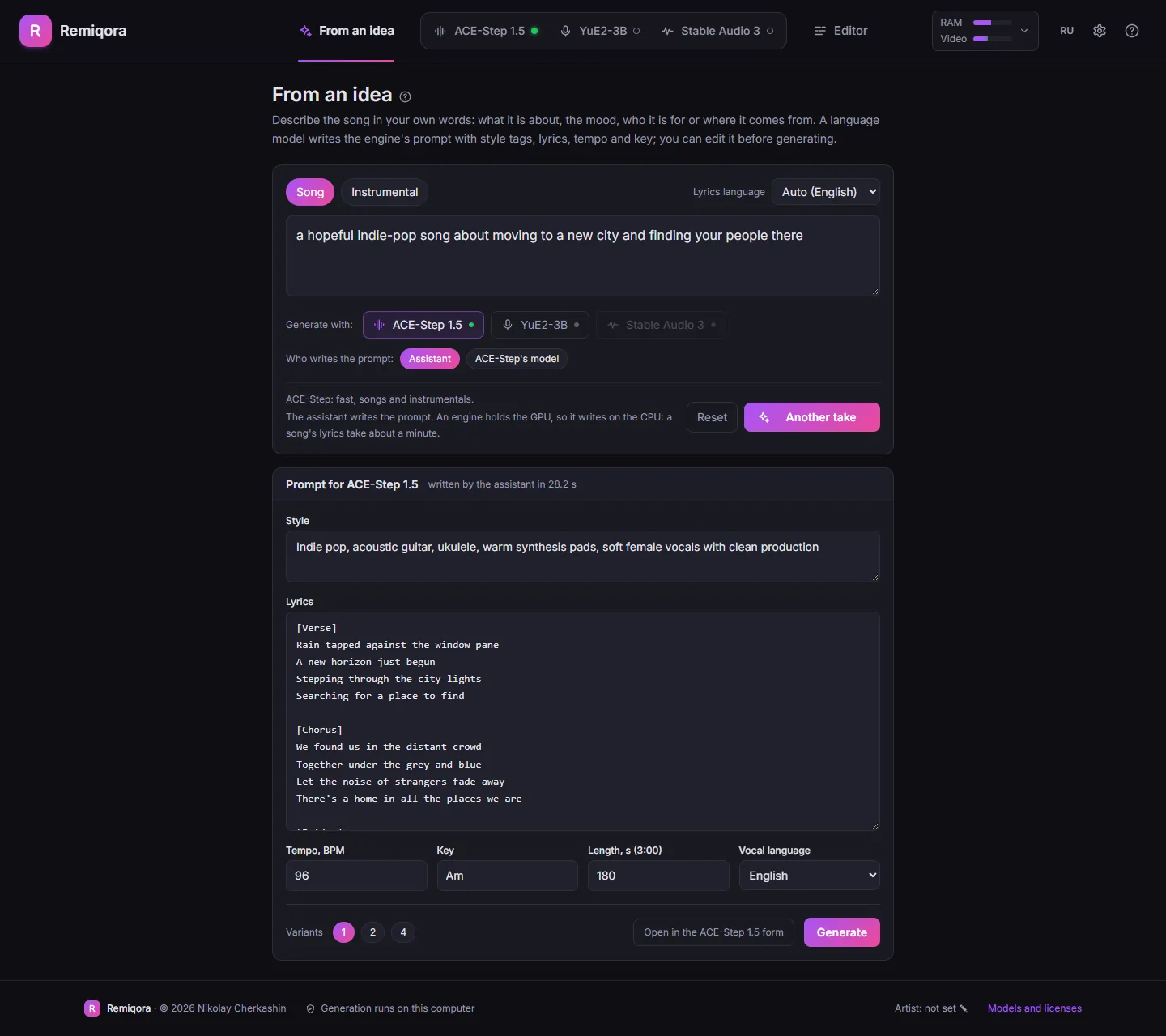
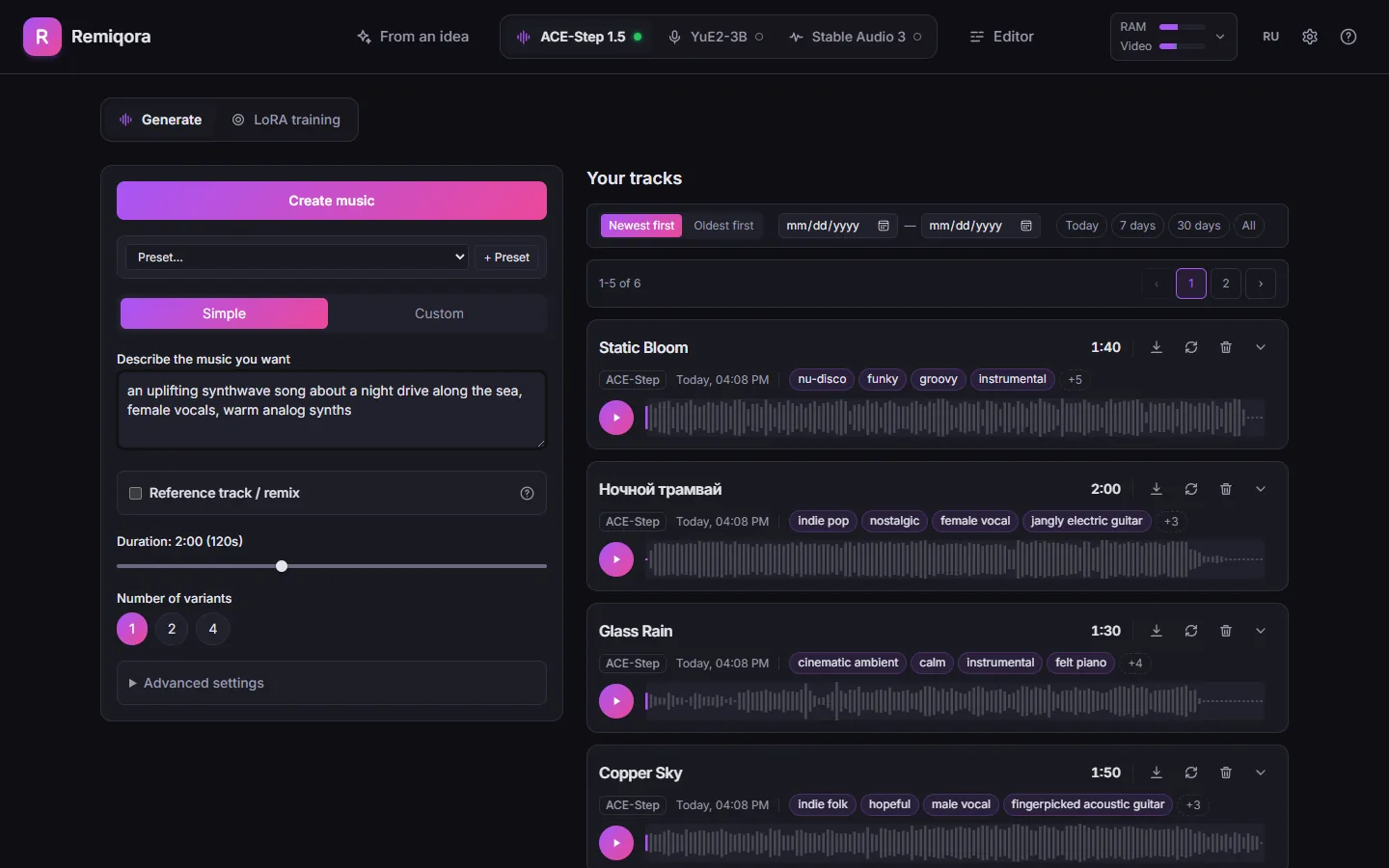
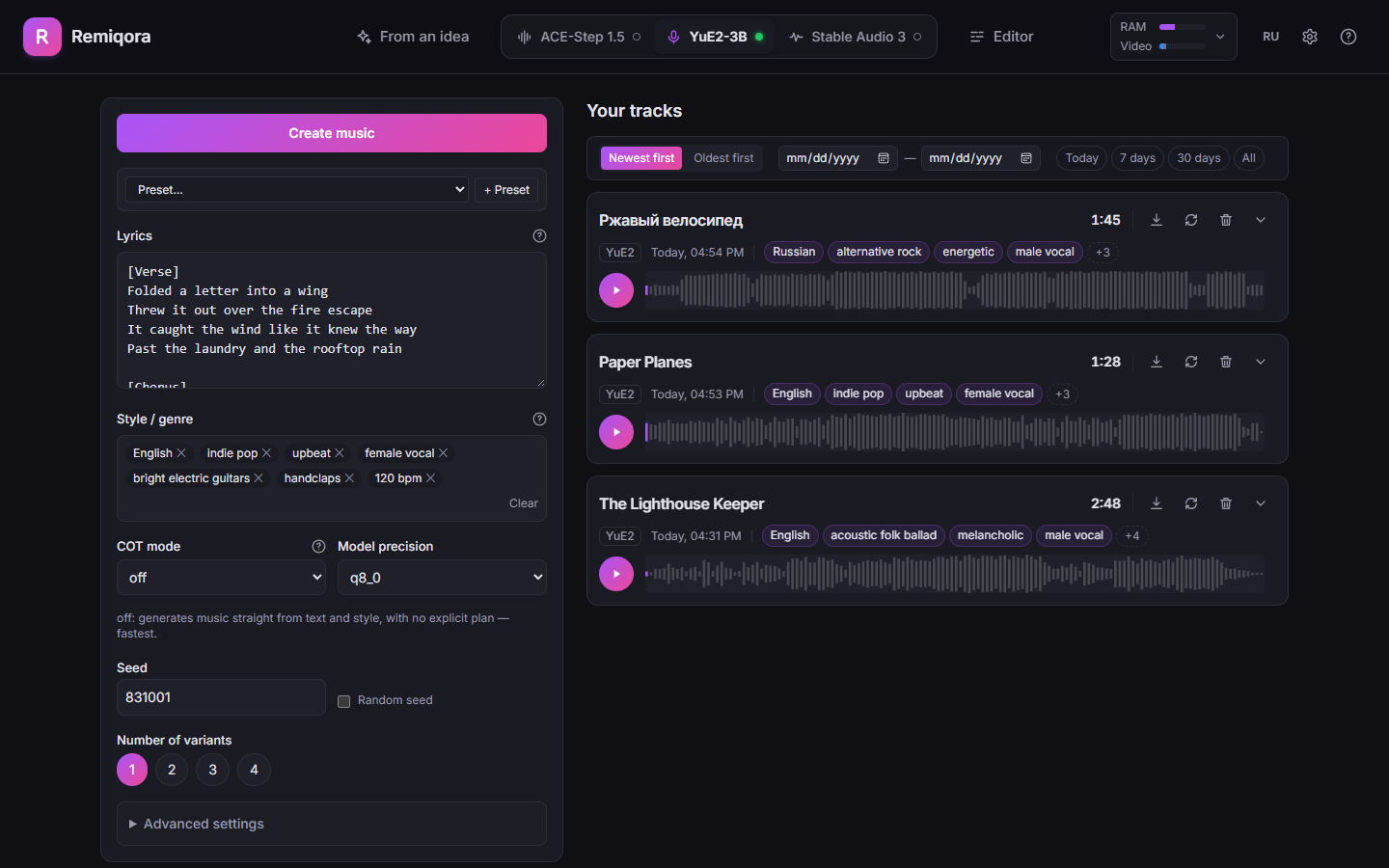
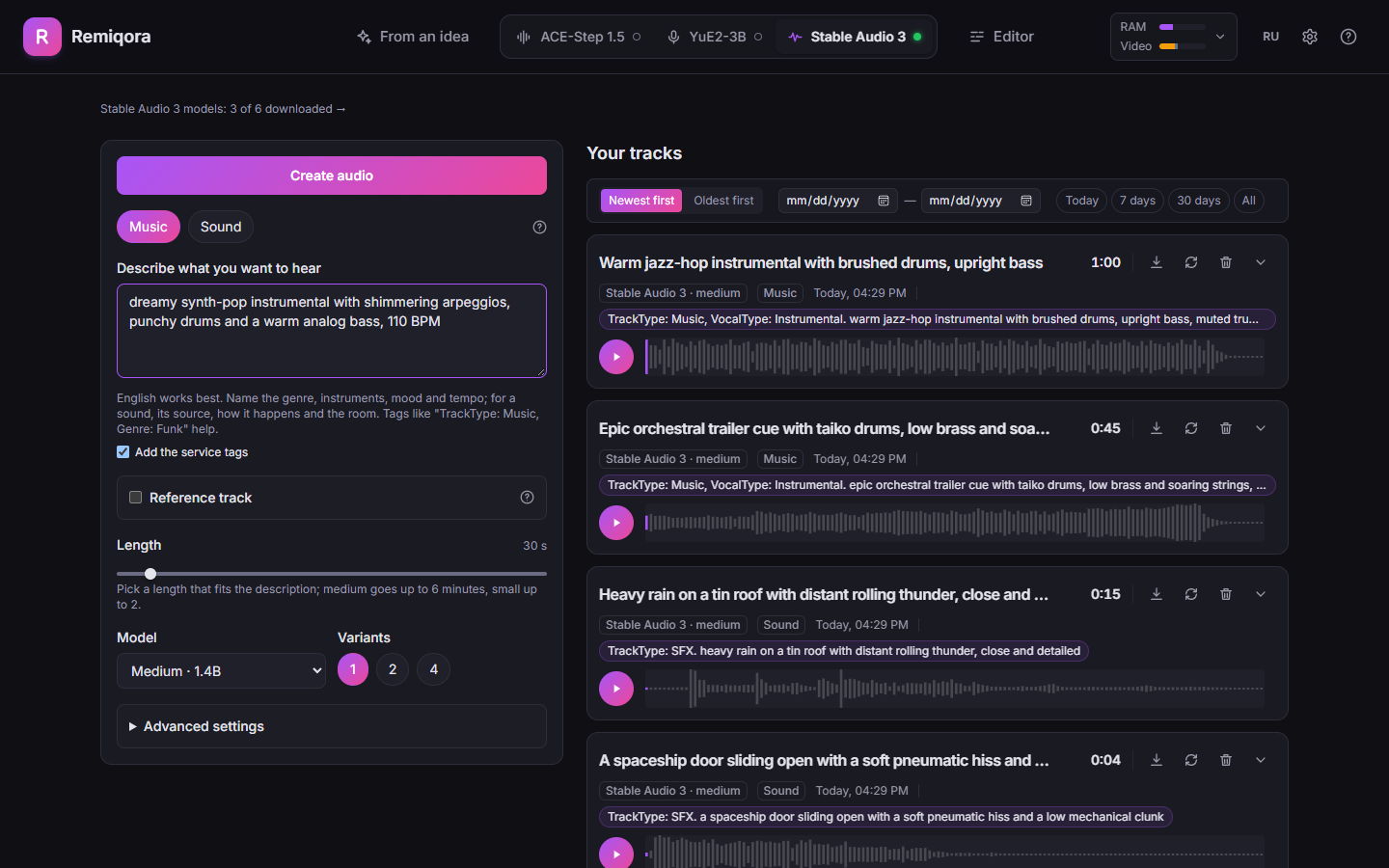
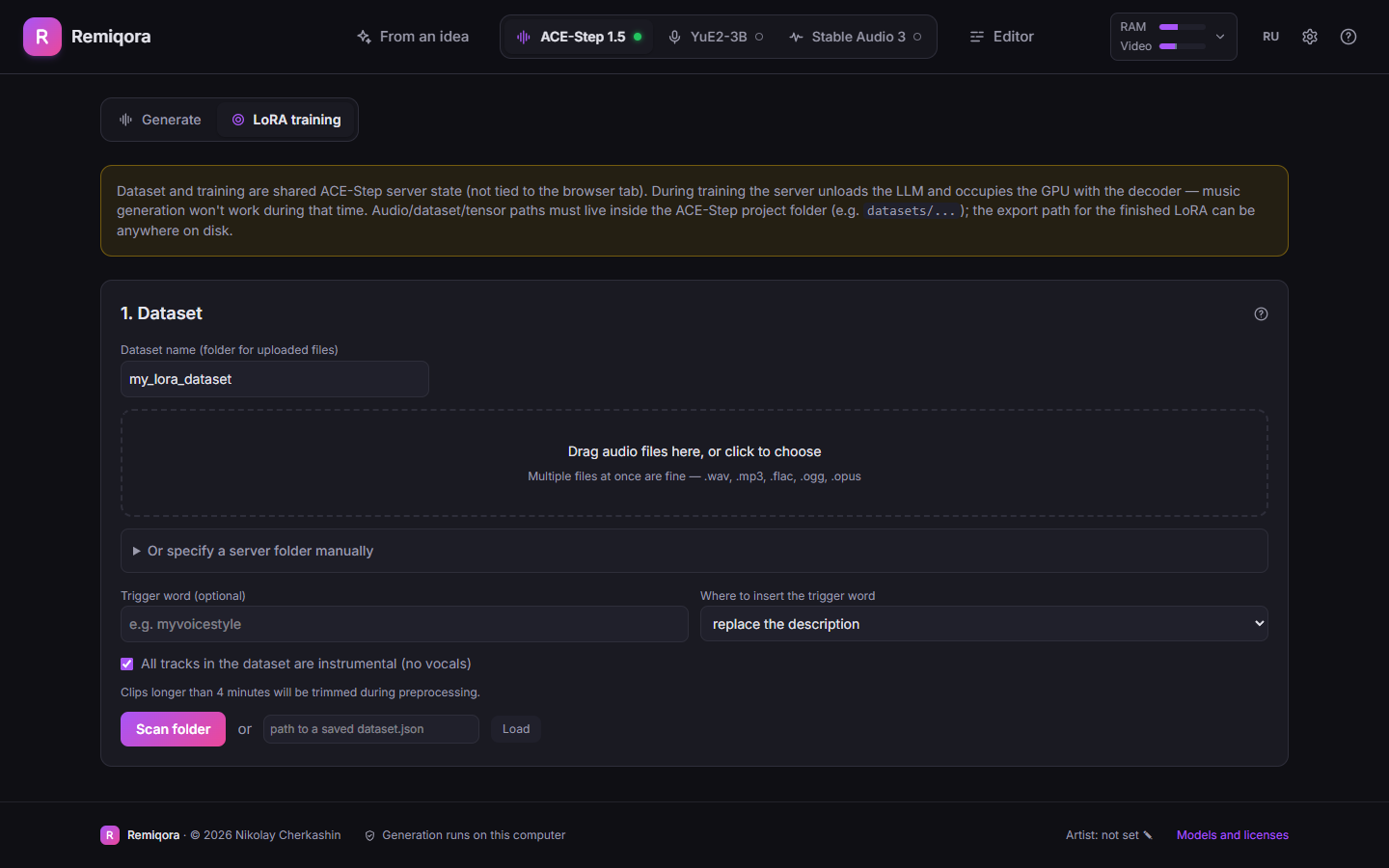
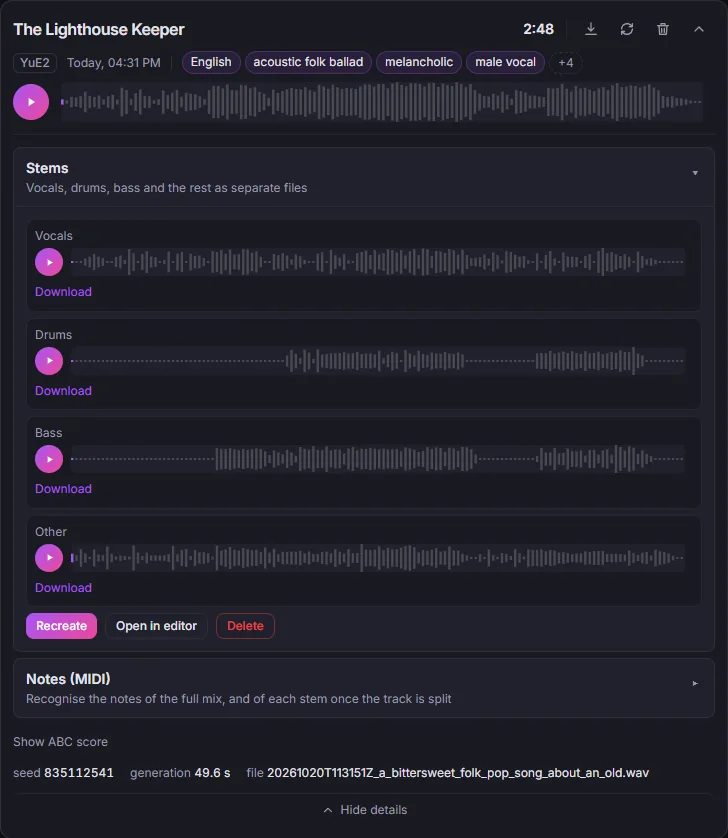
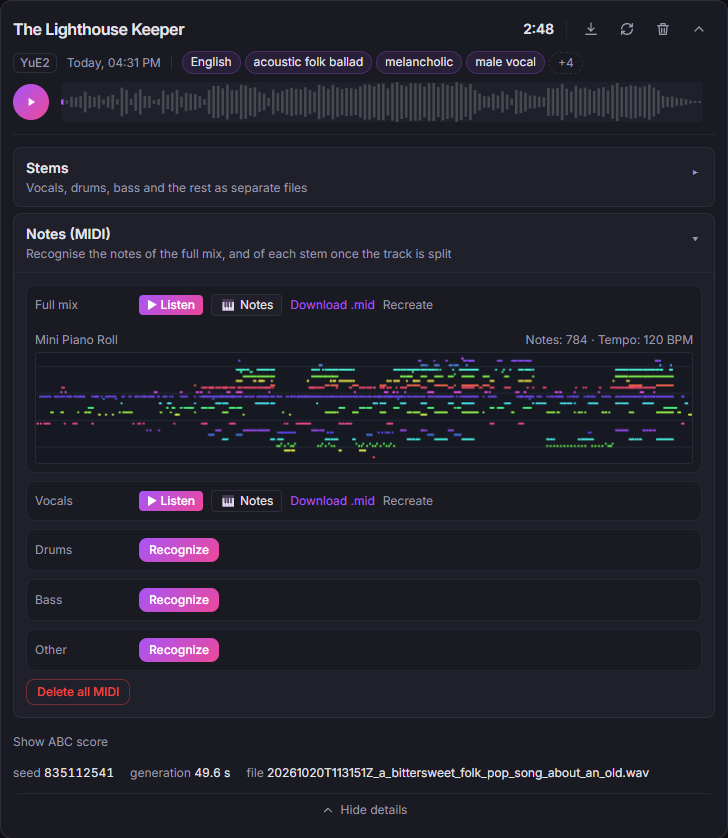
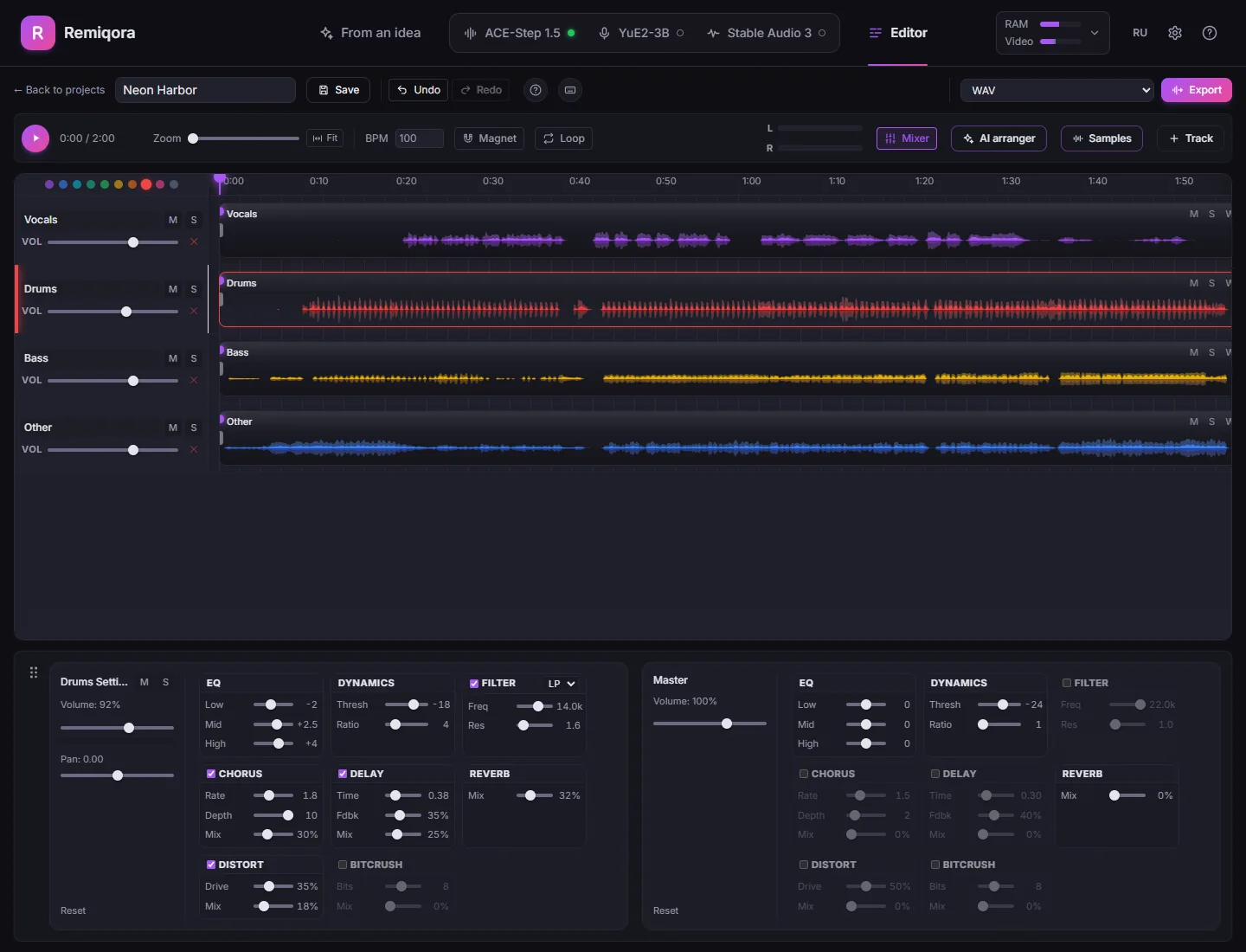
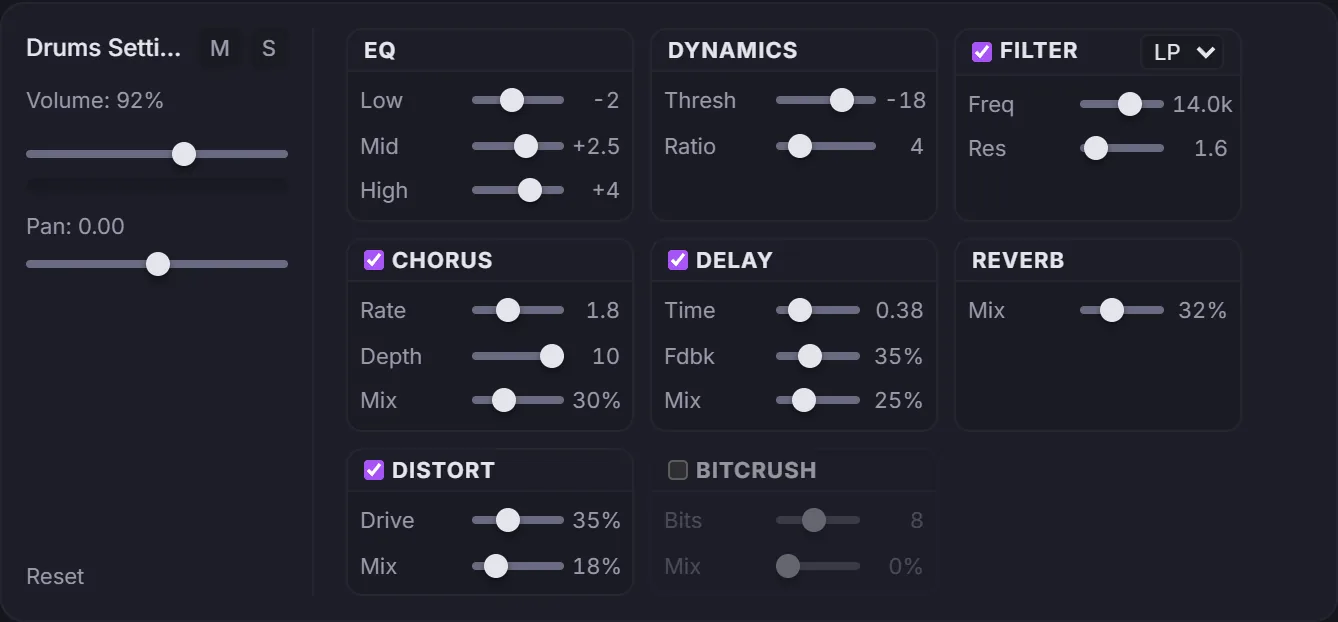
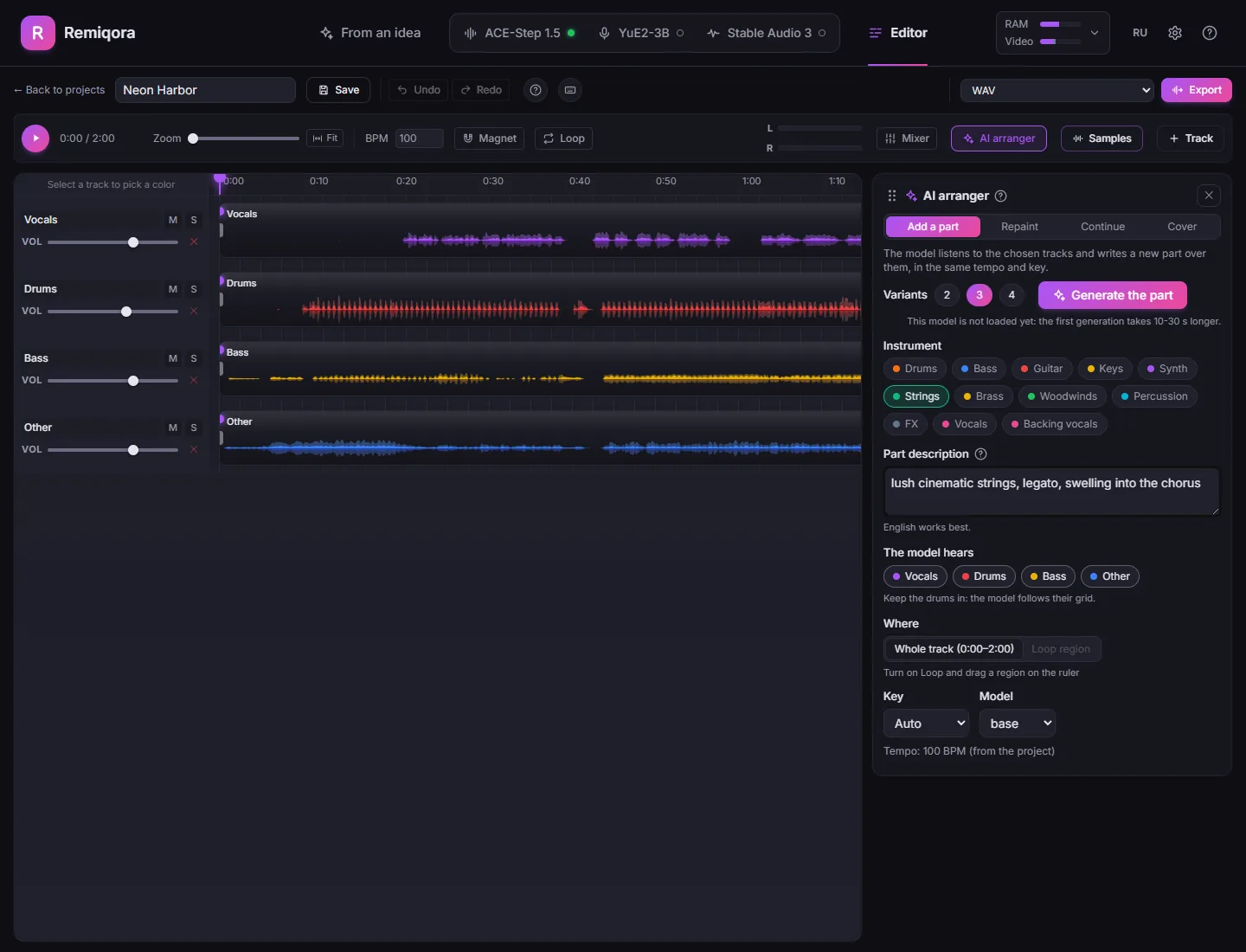
Remiqora is a local AI music generation and production studio that unifies multiple open-weight music models — ACE-Step 1.5 for fast text-to-music with style tags and lyrics, YuE2-3B for full-length songs with chain-of-thought symbolic planning, and Stable Audio 3 for instrumentals and sound effects — behind a single web interface. It includes a built-in multitrack DAW with an 8-effect rack per channel, an AI arranger that composes parts by listening to existing lanes, Demucs stem separation into four stems, MuScriptor MIDI transcription, SheetSage2 melody extraction, and a full ACE-Step LoRA training pipeline. A local language model (Qwen3.5) can write prompts from a single phrase. The desktop installer for Windows and macOS handles model downloads and Python environments automatically; Linux users run setup scripts. All processing runs on the user's GPU (NVIDIA CUDA or Apple Metal) with no cloud dependency after initial model downloads. The project is in active development with pre-release versions.
Should you self-host Remiqora?
Remiqora scores 43/100 on selfhost.directory (how scoring works) and ranks #91 of 125 in AI. It has 189 GitHub stars.
It shipped 8 stable releases in the past year. The latest, v0.5.0, came out on 27 October 2026. New versions land roughly every 5 days.
Setup is advanced: plan for several services and some ongoing maintenance. It is MIT-licensed and written mostly in Typescript.
Its closest alternative on selfhost.directory is ACE-Step (77/100, 14 117 stars). It scores higher overall, so compare the two before you pick. See Remiqora vs ACE-Step side by side.
Features
- AI arranger
- Bilingual UI (English/Russian)
- Desktop installerExperimental, unsigned installers
- Export to DAW formats
- LoRA Training
- Melody extraction
- MIDI transcriptionRequires YuE2 to be the active model
- Multitrack DAW
- Mutually-exclusive model orchestration
- Prompt assistant (From an idea)
- Real-time effects rack
- Sample generation
- Shared track library
- Stem separation
- Text-to-music generation
Remiqora README
FAQ
Does it run on Mac and Linux?
Macs with Apple Silicon get a desktop installer; Intel Macs are not supported. Linux with NVIDIA GPU runs from source via setup scripts; no Linux installer yet.
How is it different from Suno or Udio?
Suno and Udio are cloud services with proprietary models. Remiqora runs open models locally: no credits, no queue, nothing uploaded. You get stems, a multitrack editor, and AI arranger to build songs part by part and finish in your own DAW.
Can I use the music commercially?
Depends on the model: ACE-Step 1.5 (MIT) allows commercial use. YuE2-3B weights are CC BY-NC 4.0 (non-commercial only). Stable Audio 3 allows commercial use under $1M annual revenue with free Stability AI registration; above that requires a separate license.
What hardware do I need?
Windows or Linux with an NVIDIA GPU, or a Mac with Apple Silicon. Tested on RTX 4080 16 GB and M5 Mac 24 GB. YuE2 q4_0 works on 8 GB VRAM, q8_0 needs ~9 GB, XL base needs 16 GB. Plan 18 GB disk for ACE-Step alone, up to ~80 GB for everything.
Does it work offline?
After the one-time model downloads, all generation, stem separation, AI arranger, and editor run locally without internet. Remiqora has no telemetry and your prompts/tracks never leave your machine.
Is Remiqora free?
Yes, Remiqora is open source under the MIT license with no account, subscription, or generation limits. It runs on your own hardware so the only cost is electricity.
More in Audio
 RewindRewind is a self-hosted, open-source web app that generates a visual, stories-style year-in-review of your Navidrome listening history with playable music.
 SpeachesSelf-hosted OpenAI Audio API server for transcription, translation, and speech synthesis using faster-whisper, piper, and Kokoro models.
 spotify-saverSelf-hosted tool to download Spotify tracks, albums, and playlists from YouTube Music with full metadata for Jellyfin libraries, featuring a web UI, CLI, and REST API.
 TagrA self-hosted web application for managing music metadata through a browser-based three-panel interface with integrated audio playback.
 tidaloaderA self-hosted, open-source web app that downloads music from Tidal in multiple quality tiers and imports playlists from Spotify and ListenBrainz.
 tunesynctooltunesynctool is a self-hosted, open-source web app that transfers and syncs playlists between Spotify, Deezer, YouTube Music, and Subsonic-compatible servers.
 whisper-asr-webserviceSelf-hosted, open-source speech-to-text webservice wrapping OpenAI Whisper, Faster Whisper and WhisperX behind a REST API with Swagger docs.
 YouCastYouCast is a self-hosted desktop app that converts YouTube channels and playlists into podcast feeds for any podcatcher, running a local server on port 22703.
 YuE-GPYuEGP is a self-hosted tool for generating full songs from lyrics using YuE models, optimized for consumer GPUs with 10+ GB VRAM.
 ACE-StepSelf-hosted, open-source AI music generator: full songs in seconds from text, lyrics or reference audio, with covers, stem separation and LoRA training on consumer GPUs.
 audio.cppSelf-hosted C++ framework running 100+ audio models locally with CUDA, Vulkan, Metal, CPU backends, built-in WebUI, no Python deps.
 AudioserveSimple personal server to serve audiofiles files from folders. Intended primarily for audio books, but anything with decent folder structure will do.
0 comments