
Self-host Opik
2.2.143LLM observability platform with tracing and evaluation
- Stars
- 23 441
- Ports
- 5173 (Frontend web UI), 3003 (Backend OpenAPI specification), 8000 (Python backend), 5000 (Guardrails backend)
ghcr.io/comet-ml/opik/opik-frontend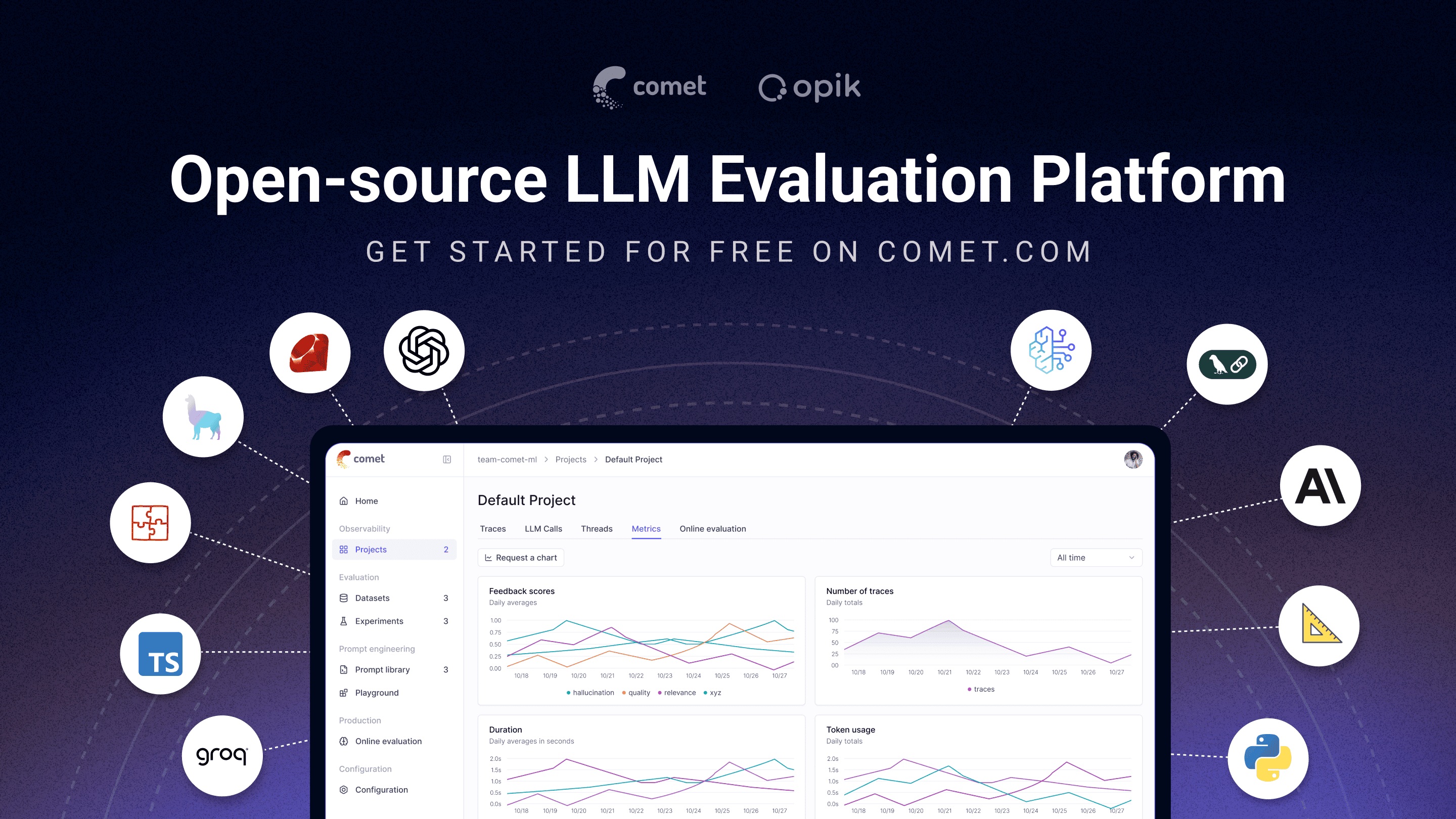
What is Opik?
Opik is an LLM observability and evaluation platform built by Comet. It provides end-to-end AI agent tracing, LLM evaluation with datasets and experiments, LLM-as-a-judge metrics for hallucination detection and RAG assessment, prompt management with version control, and production monitoring with online evaluation rules. The platform supports 50+ integrations with popular frameworks like LangChain, LlamaIndex, Autogen, and OpenAI. It can be self-hosted via Docker Compose for local development or Kubernetes/Helm for production deployments, with all features including the backend, web UI, tracing, evaluation, and optimization components available under Apache-2.0 license. The self-hosted version lacks user management features (SSO, RBAC) which are Enterprise-only.
Opik alternatives
 Open ResponsesA self-hosted, open-source server implementing the OpenAI Responses API specification with support for multiple LLM providers and the Agents SDK.CompareOpen Responses with Opik
 difyDify is a self-hosted, open-source LLM app platform with visual workflows, RAG pipelines, agents, and model management for taking AI apps from prototype to production.Comparedify with Opik
 Big-AGISelf-hosted, open-source AI workspace for experts: run 2 to 24 models in parallel with Beam, personas, image generation, voice and BYO API keys via Docker.CompareBig-AGI with Opik
 llm-gatewaySelf-hosted open-source API gateway routing 250+ LLM models from 40+ providers via unified OpenAI-compatible API with cost tracking, caching, and failover.Comparellm-gateway with Opik
 TaskingAIAn open-source, self-hosted BaaS stack for building LLM agents: unified model APIs, RAG, built-in tools and an admin console, deployed with Docker Compose.CompareTaskingAI with Opik
 inference-gatewaySelf-hosted gateway that routes requests to 16+ LLM providers through a single OpenAI-compatible endpoint with MCP tools, A2A agents, guardrails, and observability.Compareinference-gateway with Opik
 Onyx Community EditionOpen-source, self-hosted AI enterprise search and chat: connectors index 50+ apps with permissions, then RAG search, custom agents and LLM chat run on any provider.CompareOnyx Community Edition with Opik
 latitudeThe open-source AI agent observability platform that groups failing traces into signals and dispatches coding agents; self-hosted via Docker Compose or Helm.Comparelatitude with Opik
All self-hosted alternatives to Braintrust → All self-hosted alternatives to LangSmith → All self-hosted alternatives to Weights & Biases Weave →
Should you self-host Opik?
Opik scores 82/100 on selfhost.directory (how scoring works) and ranks #4 of 68 in AI Chat. It has 23 441 GitHub stars, +900 in the last 30 days.
It shipped 180 stable releases in the past year. The latest, 2.2.143, came out on 6 November 2026. New versions land roughly every 1 days.
Setup is moderate: expect some configuration beyond a single command. An official Docker image is available. It is Apache-2.0-licensed and written mostly in Python.
Its closest alternative on selfhost.directory is Langfuse (85/100, 37 474 stars). It scores higher overall, so compare the two before you pick. See Opik vs Langfuse side by side.
Features
- Agent Optimizer
- AI Agent Tracing
- Annotation Queues
- CI/CD Evaluation
- Cost Tracking
- Data Export
- Distributed Tracing
- LLM Evaluation
- MCP Server
- Online Evaluation Rules
- OpenTelemetry Support
- Opik Guardrails
- Production Monitoring
- Prompt Management
- Prompt Playground
Opik README

Opik is the open-source LLM observability and evaluation platform for AI agent tracing, LLM evaluation, prompt management, and production monitoring. Built by Comet. Apache-2.0 licensed, free to self-host the full platform, with 20,000+ GitHub stars.

Website • Slack Community • Twitter • Changelog • Documentation
Last updated: 2026-07-17
FAQ
What is Comet Debugger Mode?
A hidden diagnostic feature in the Opik web app (Ctrl+Shift+.) that displays real-time network status with RTT latency and the current Opik version for troubleshooting.
Why am I getting a 413 (payload too large) error?
The request exceeded Opik's ingestion size limit. Log only top-K results or summaries instead of full documents, move large content to attachments, or upgrade to the latest SDK which truncates oversized fields client-side.
What if Opik doesn't support my preferred framework or tool?
You can open an issue on GitHub to request the integration, or manually log LLM interactions using the SDK's core logging functions.
Can my coding agent use Opik?
Yes, Claude Code, Cursor, VS Code Copilot, Codex, opencode and any other MCP client can read traces, score outputs and run evaluations through the Opik MCP server.
Is there a limit on how large a trace or span can be?
Yes, Opik caps per-field size of input/output and per-request payload size. Oversized requests are rejected with 413. Large content should be logged as attachments instead.
Where can I find my Opik API key?
The Opik API key is found in your Account settings or user menu on Opik Cloud. For self-hosted Opik, you configure it via `opik configure` command instead of using API keys.
Is Opik tied to a specific agent framework?
No, Opik is framework-agnostic and supports its SDK, OpenTelemetry, and framework-specific integrations.
Does Opik support LLM evaluation?
Yes, Opik supports datasets, experiments, code-based metrics, LLM-as-a-judge evaluation, and online evaluation.
Does Opik support AI agent tracing?
Yes, Opik captures multi-step traces containing LLM calls, tool executions, retrieval steps, and other agent activity.
Can I self-host Opik?
Yes, Opik can be deployed locally or in your own infrastructure using the documented self-hosting options.
Is Opik open source?
Yes, Opik is licensed under Apache 2.0 and its server, web application, and core observability and evaluation capabilities can be self-hosted without a commercial license.
More in AI Chat
 Oriveo Community EditionA self-hosted, open-source AI chat app for mobile and web that lets you use fifteen-plus model providers with your own API keys — no account required.
 os1OS1 is a self-hosted, open-source AI platform with autonomous agents, deep research, real-time collaborative chats, and a PWA workspace. Full data control, extensible.
 OuroborosA locally-run AI agent that preserves its identity across sessions, spawns specialist sub-agents, and rewrites its own codebase.
 OvertChatSelf-hosted AI chat with local models, bundled voice/search, multi-user accounts, native mobile/desktop apps, and portable SQLite database.
 OwlySelf-hosted AI support agent unifying WhatsApp, Email, and Phone with cross-channel identity, knowledge base, automation, and tickets.
 parlantOpen-source, self-hosted conversational harness for customer-facing AI agents: guidelines, journeys, canned replies and tools matched per turn by a FastAPI server.
 PerplexiBotPerplexiBot is a self-hosted Discord bot for AI web research using GPT 3.5 or Ollama models with SearXNG. Runs via Docker Compose.
 PHOBOSSelf-hosted AI OS running LLMs, image/video generation, web browsing, audio, and tasks locally with no cloud.
 pinchchatA self-hosted webchat UI for OpenClaw agents with real-time tool call visualization, live streaming, and a GPT-like session sidebar.
 PocketRisuPocketRisu is a self-hosted, open-source AI roleplay chat platform that runs on your hardware and connects to multiple LLM providers via a web browser.
 PrivateDocBotPrivateDocBot is a self-hosted, open-source chatbot for querying PDF documents locally using LLMs like Llama 2 via Chainlit.
 profclawRun AI agents on your hardware with this open-source engine. 35 model providers, 72 tools, 22 chat services. Three sizes from tiny to full-featured.
0 comments