
Self-host issue-status
issue-status@0.2.1Static status page generator using GitHub or GitLab issues
- Stars
- 429
What is issue-status?
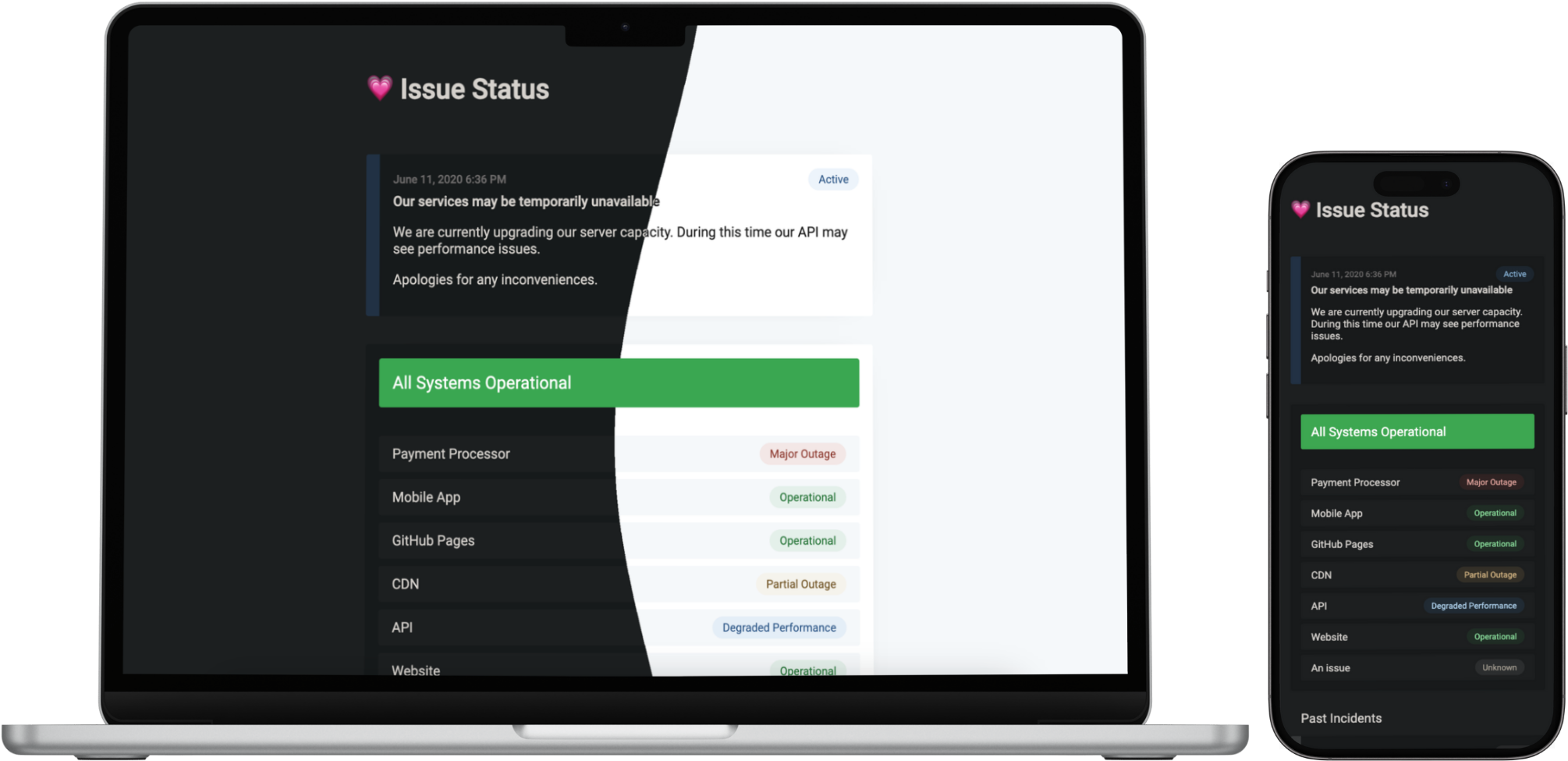
issue-status generates a static status page from issue trackers. Providers pull data from GitHub Issues, GitLab Issues, or a static config file, then render a site with component status, incident timelines, scheduled maintenance windows, and postmortems. You scaffold a repo with pnpm create issue-status, develop locally, then deploy the built output to any static host such as GitHub Pages, Cloudflare Pages, Netlify, or Vercel. Incident templates and Markdown support are included. The GitHub and GitLab providers rely on specific labels to categorize components and incidents, and they cache responses in the browser to stay within API rate limits. The codebase is MIT licensed and under active development.
Should you self-host issue-status?
issue-status scores 47/100 on selfhost.directory (how scoring works) and ranks #31 of 51 in Monitoring & observability. It has 429 GitHub stars.
There was no stable release in the past 12 months, so check the repository's recent activity before you rely on it.
Setup is easy: most people get it running in one sitting. It is MIT-licensed and written mostly in Typescript.
Its closest alternative on selfhost.directory is GoAccess (75/100, 21 093 stars). It scores higher overall, so compare the two before you pick. See issue-status vs GoAccess side by side.
Features
- Browser-side caching
- Component health status
- GitHub Issues provider
- GitLab Issues provider
- Incident Management
- Markdown Support
- Pre-built incident templates
- Static data provider
- Static Site Generation
- Subcomponents support
issue-status README
More in Monitoring & observability
 ITOps Agent PlatformSelf-hosted multi-agent AIOps platform automating incident lifecycle from alert to remediation with AI root cause analysis and human-in-the-loop approval.
 JaegerJaeger is an open-source distributed tracing platform from Uber and CNCF. It monitors complex distributed systems by mapping request flows across microservices.
 JellydashJellydash is a self-hosted, open-source dashboard for Jellyfin that shows live streams, records play history, provides viewing statistics, and sends push notifications.
 KapacitorA self-hosted time series data processing engine for monitoring and alerting. Works with InfluxDB using TICKscript DSL, sends notifications to Slack, VictorOps.
 keepOpen-source, self-hosted AIOps and alert management platform: deduplication, correlation, enrichment, YAML workflow automation and 110+ monitoring integrations.
 KibitzrKibitzr is a self-hosted, open-source web monitoring tool that checks pages for changes and sends notifications via email, Slack, Telegram, and more.
 kiteSelf-hosted, open-source Kubernetes workspace for multi-cluster management: RBAC, LDAP/OAuth login, Prometheus monitoring, Helm, audit logs, and an AI assistant.
 KlaxonKlaxon is a self-hosted, open-source tool that monitors websites for changes and sends email, Slack, or Discord alerts — built for newsrooms to track newsworthy updates.
 Knock-KnockA self-hosted honeypot that captures live bot attacks across many protocols with a real-time dashboard and threat intel feeds.
 KomariLightweight self-hosted server monitoring via web interface and agents. Collects CPU, RAM, disk metrics every second with SQLite default.
 KrawlKrawl is a self-hosted web honeypot with AI-generated deception pages to detect and track malicious crawlers. Features a real-time dashboard and firewall integration.
 kubetailSelf-hosted, open-source Kubernetes logging tool that tails multiple pod logs in real-time via CLI or web dashboard, using your cluster's API directly.
0 comments