
Self-host ohmycaptcha
YesCaptcha-style captcha solver API in FastAPI
- Stars
- 898
- Port
- 8000 (FastAPI HTTP API bind port (binds SERVER_HOST, default 0.0.0.0); can be overridden, e.g. 7860 on Hugging Face Spaces)
- Requires
- Chromium (installed via Playwright)
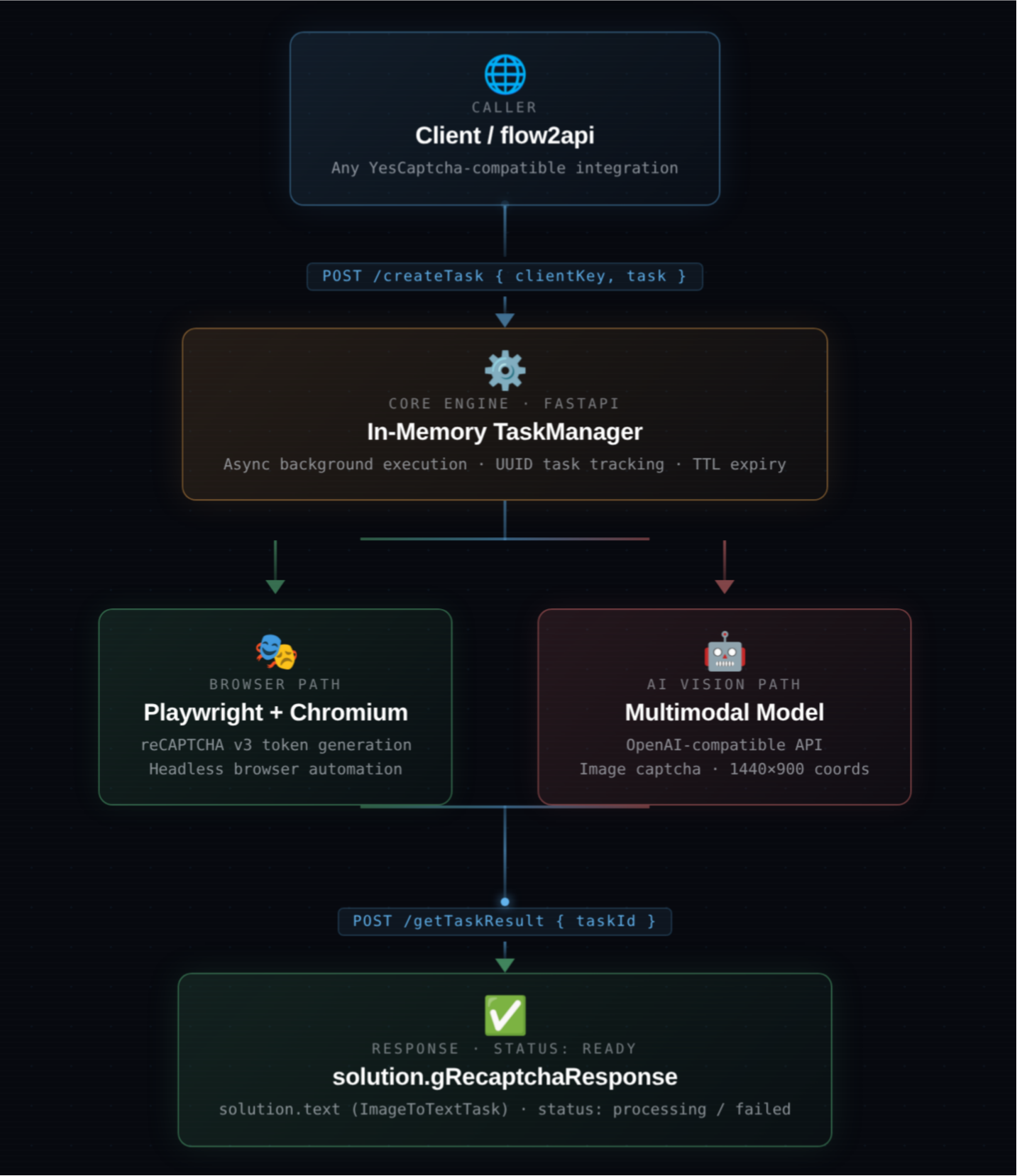
What is ohmycaptcha?
OhMyCaptcha is an open-source captcha-solving service you run yourself, built on FastAPI and Playwright. It speaks the async protocol familiar from YesCaptcha — task submission, result polling and a balance call — so consumers such as flow2api can point straight at it. Nineteen task types are covered: token generation inside a real browser for reCAPTCHA v2 and v3 (Enterprise variants included), hCaptcha and Cloudflare Turnstile, plus multimodal-model work on base64 images for reading text-style captchas and answering image grids from hCaptcha, reCAPTCHA v2, FunCaptcha and AWS challenges. Vision requests can go to a locally served OpenAI-compatible engine (SGLang or vLLM running a Qwen checkpoint) or to a hosted provider, chosen with separate environment variables. Caveats the docs state plainly: submitted work is held only in process RAM and drops off after ten minutes, the minScore field is taken in but ignored, the balance endpoint hands back a hard-coded compatibility number, and outcomes depend on IP reputation and how the target page behaves. Deployment routes are a Python 3.10+ virtualenv with Playwright's Chromium, the Dockerfile.render and render.yaml files bundled in the repo, or step-by-step guides for Render and Hugging Face Spaces. It carries the MIT licence, and the authors stress it is meant for authorised research and testing rather than getting around protections on someone else's site.
Should you self-host ohmycaptcha?
ohmycaptcha scores 38/100 on selfhost.directory (how scoring works) and ranks #67 of 78 in Security. It has 898 GitHub stars.
There was no stable release in the past 12 months, so check the repository's recent activity before you rely on it.
Setup is moderate: expect some configuration beyond a single command. It is MIT-licensed and written mostly in Python.
Its closest alternative on selfhost.directory is pentagi (83/100, 32 629 stars). It scores higher overall, so compare the two before you pick. See ohmycaptcha vs pentagi side by side.
Features
- Async in-memory task queueTask state is not persistent.
- Client key authentication
- Cloudflare Turnstile solving
- hCaptcha solving
- Headless browser automation
- Health endpoint
- Image CAPTCHA recognition
- Image grid classificationAccuracy depends on the vision model used.
- Local model inference support
- reCAPTCHA v2 solving
- reCAPTCHA v3 solving
- YesCaptcha-compatible solving APINot full vendor parity: only the 19 task types implemented in the repo.
ohmycaptcha README
FAQ
What affects reCAPTCHA v3 results?
IP quality, browser fingerprint, the target site's behaviour, correct pageAction values and the runtime environment all influence results.
Is task state persistent?
No, tasks are kept in memory and removed once the configured TTL window passes.
Does ImageToTextTask return plain OCR text?
Not necessarily; the implementation returns structured recognition output serialized into solution.text.
Can I use local or self-hosted multimodal models?
Yes, provided the backend exposes an OpenAI-compatible chat-completions API that accepts image input.
Does minScore guarantee a target reCAPTCHA score?
No. The field is accepted for compatibility, but the solver does not do score targeting.
Does this fully replace YesCaptcha?
No. It only reimplements the YesCaptcha-style API surface for the task types the repository supports, and the docs warn against claiming parity with the vendor.
More in OCR
 PaddleOCROpen-source, self-hosted OCR and document-parsing toolkit: scanned PDFs and photos come out as Markdown or JSON for RAG pipelines, across 100+ languages.
 PaddleOCR LocalSelf-hosted document parsing workbench that converts PDF, images, and Office documents to Markdown using five OCR models with a WebUI, CLI, and Apple Silicon support.
 Paperless-GPTOpen-source, self-hosted AI companion for paperless-ngx: suggests titles, tags, correspondents and dates, and runs LLM vision OCR for searchable scans.
 Paperless-ngxSelf-hosted open-source document management system that turns paper documents into a searchable digital archive with OCR, AI features, and multi-user support
 pdfscanexplorerSelf-hosted web app for previewing, renaming, and organizing scanned PDFs using OCR and optional AI, lightweight for NAS or server.
 ReadurSelf-hosted OCR document management system with multi-language support, full-text search, and S3/WebDAV sync for individuals and teams.
 Receipt Parser ServerSelf-hosted, open-source receipt parser server that uses Tesseract OCR to extract structured data from receipt images via a REST API with token authentication.
 sist2Self-hosted, open-source file indexer and search tool: scans directories, extracts text, thumbnails and metadata, and serves a web UI over Elasticsearch or SQLite.
 SnapOtterOpen-source, self-hosted file-processing suite with 200+ image, video, audio, PDF and document tools, local AI, a REST API and pipelines.
 unstructuredSelf-hosted open-source REST API for document partitioning into structured elements as JSON/CSV. Supports PDF, images, OCR, table extraction, chunking.
 Apache TikaOpen-source toolkit that extracts text and metadata from 1000+ file types, with a self-hosted REST or gRPC server for search indexing and LLM/RAG pipelines.
 DeepSeek OCR AppThis self-hosted, open-source OCR web app runs DeepSeek-OCR on an NVIDIA GPU to read images and multi-page PDFs, exporting Markdown, HTML, DOCX or JSON.
0 comments