Self-host Oh My Subagents
v0.3.2Local AI agent orchestration for Codex and Claude
- Stars
- 190
- Port
- 18125 (Web console and HTTP API)
What is Oh My Subagents?
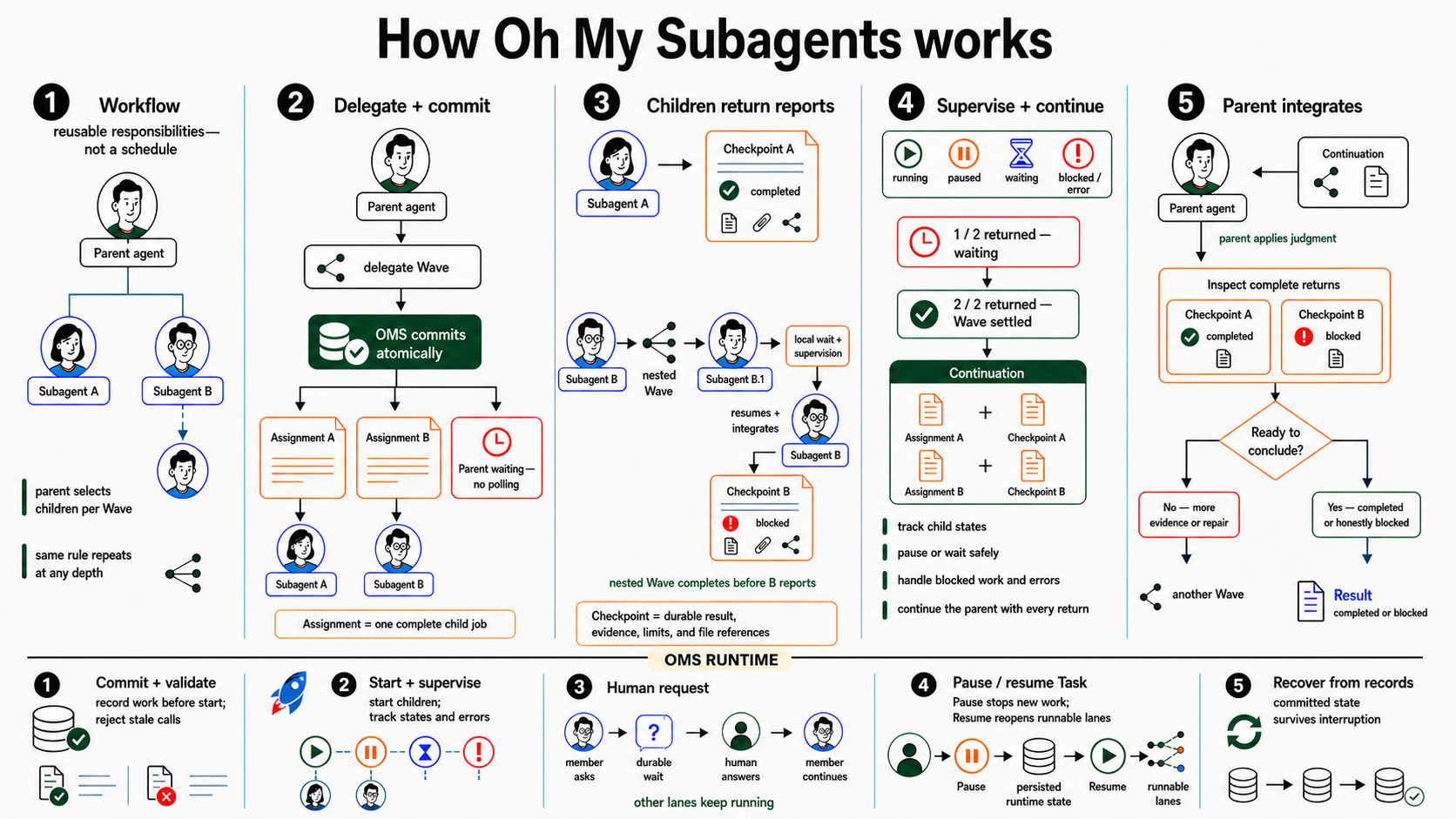
This tool runs AI subagents from Codex and Claude on your own machine. Instead of manually spawning temporary agents, you build reusable workflows as responsibility trees, publish stable versions, and assign a lead agent a specific mission. The controller saves every delegation, wait, and returned checkpoint so that closing the browser, provider interruptions, or controller restarts never lose accepted work. A visual console displays the live team, current plans, activity, human requests, and the final result with links to workspace files. A separate conversational operator provides the same operations through chat. SQLite works out of the box with no external server; PostgreSQL is optional. The core uses MIT licensing while the console uses the Sustainable Use License from n8n.
Should you self-host Oh My Subagents?
Oh My Subagents scores 43/100 on selfhost.directory (how scoring works) and ranks #153 of 209 in AI Agents. It has 190 GitHub stars.
It shipped 10 stable releases in the past year. The latest, v0.3.2, came out on 30 August 2026. New versions land roughly every 3 days.
Setup is moderate: expect some configuration beyond a single command. It is MIT-licensed and written mostly in Python.
Its closest alternative on selfhost.directory is Orca (91/100, 108 815 stars). It scores higher overall, so compare the two before you pick. See Oh My Subagents vs Orca side by side.
Features
- Accountable result
- Adaptive execution patterns
- Background service
- Capability-based security
- CLI automation
- Conversational Operator
- Durable task state persistence
- HTTP API
- Interruption recovery
- Reusable workflow definitions
- Run studio with live activity
- Starter workflows
- Steering
- Visual workflow studio
- Workspace file references
Oh My Subagents README
More in AI Automation
 omadiaSelf-hosted, open-source agentic OS for running multi-agent AI teams on your own infrastructure with privacy controls and audit trails.
 OmnaraOpen-source, self-hosted managed agent platform: run AI agents through one REST API with durable state, tool approvals, and any model or machine.
 OmniOmni is a self-hosted, open-source AI agent connecting to workplace tools like Google Workspace, Microsoft 365, Slack, and Jira to gather context and execute tasks.
 OmniParseSelf-hosted OmniParse converts documents, multimedia, and web content into structured markdown optimized for LLM apps like RAG. Open-source solution with Docker.
 Open FlowOpen-source AI workflow automation platform where AI agents build workflows connecting 1,600+ apps, with visual Workbench for inspection and human approval.
 openlegionSelf-hosted platform for isolated AI agent teams with credential vaulting, spend limits, and a web dashboard — free for internal use under a source-available license.
 Open-Poe-AIOpen AI Agents Hub is a self-hosted, open-source platform for building and chatting with AI agents — LLM chat and media generation from one web interface.
 OrbiOrbi is an open-source, self-hosted software delivery system that turns labeled GitHub Issues into independently reviewed, merged PRs and tagged releases using AI agents.
 os1OS1 is a self-hosted, open-source AI platform with autonomous agents, deep research, real-time collaborative chats, and a PWA workspace. Full data control, extensible.
 OtoDockOtoDock is a self-hosted platform for AI agents with departments, RBAC, phone, apps, and sandboxed execution — free for 5 users.
 Paperless-GPTOpen-source, self-hosted AI companion for paperless-ngx: suggests titles, tags, correspondents and dates, and runs LLM vision OCR for searchable scans.
 PawFlow-AgentsPawFlow is an open-source, self-hosted AI agent runtime connecting agents to real files and desktops via relays with durable context and deterministic workflows.
0 comments