
Self-host Node RED
4.1.17Visual flow editor for event-driven app automation
sudo npm install -g node-red- Stars
- 23 850
- Port
- 1880 (Editor UI and Admin API (also serves HTTP In node routes and static content))
- Requires
- Node.js
nodered/node-red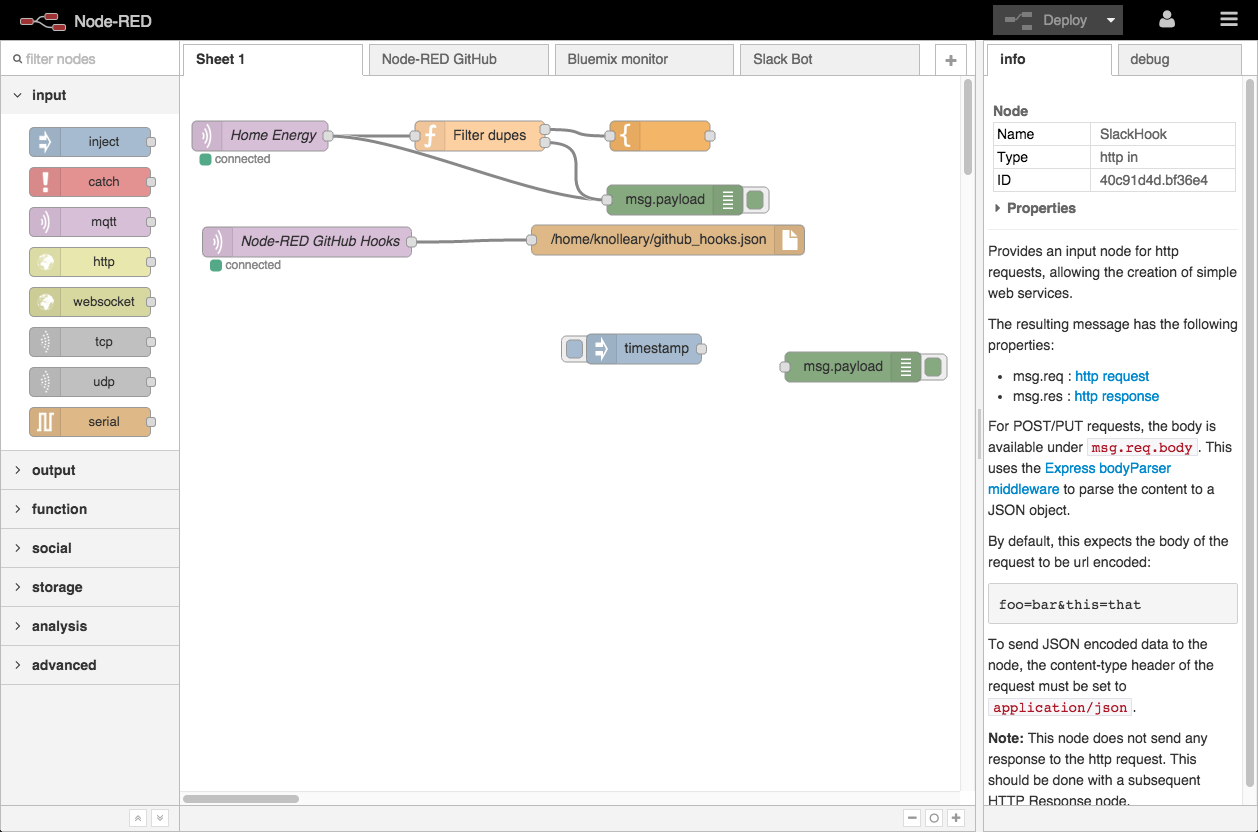
What is Node RED?
Aged but active, Node-RED lets people build event-driven applications by wiring nodes together on a browser canvas instead of writing whole programs. It began life in 2013 as an IBM side-project, went open-source later that year, and today sits under the OpenJS Foundation with an Apache 2.0 licence. The runtime is Node.js based, so the same install works on a low-cost Raspberry Pi at the network edge or on cloud hardware. Core nodes cover message brokers over MQTT, HTTP endpoints, TCP and serial sockets, scheduled injections and debug output, with inline JavaScript logic in Function nodes; over 5,000 community nodes extend the palette further. Flows are plain JSON you import, export and publish to the shared flow library, a built-in library stores reusable functions and templates, and the projects feature keeps flows in a git repository. You install it with one npm command, run the nodered/node-red container with a volume for /data, use the Snap package or the Raspberry Pi script; guides also exist for Windows, BeagleBone boards, Android through Termux, and AWS or Azure. Out of the box the editor is unsecured on your network, so you add a login through adminAuth, enable TLS with your own key and certificate, and set credentialSecret to protect stored node credentials. Version 5.x expects Node.js 22 or newer.
Node RED alternatives
 ioBrokerSelf-hosted, open-source IoT and smart-home platform: wire devices, protocols and online services together through adapters, then script, log and visualise the data.CompareioBroker with Node RED
 FlowForgeConnect, Collect, Build, and Scale with FlowFuseCompareFlowForge with Node RED
 FlowFuseSelf-hosted platform for building industrial applications at scale using Node-RED with AI-assisted development, team collaboration, and DevOps pipelines.CompareFlowFuse with Node RED
 ThingsboardSelf-hosted source-available IoT platform for device management, data processing, and visualization with rule engine and multi-protocol support.CompareThingsboard with Node RED
 Zigbee2MQTTOpen-source, self-hosted Zigbee-to-MQTT bridge that replaces proprietary vendor hubs, controlling thousands of devices via one USB coordinator and any MQTT broker.CompareZigbee2MQTT with Node RED
 WebThings GatewayAn open-source, self-hosted Web of Things smart home hub: control Zigbee and Z-Wave devices from one web UI, automate with drag-and-drop rules, and chart sensor logs.CompareWebThings Gateway with Node RED
 Redis CommanderSelf-hosted, open-source web app to view, edit and manage Redis databases across standalone, Sentinel and Cluster setups, with a browser Redis CLI and tree key view.CompareRedis Commander with Node RED
 JeedomSelf-hosted open-source home automation centralizing devices with multi-protocol support, scenarios, and plugins. Runs on Debian Linux.CompareJeedom with Node RED
Should you self-host Node RED?
Node RED scores 81/100 on selfhost.directory (how scoring works) and ranks #2 of 26 in Automation. It has 23 850 GitHub stars, +113 in the last 30 days.
It shipped 21 stable releases in the past year. The latest, 4.1.17, came out on 21 October 2026. New versions land roughly every 4 days.
Setup is easy: most people get it running in one sitting. An official Docker image is available. It is Apache-2.0-licensed and written mostly in JavaScript.
Its closest alternative on selfhost.directory is Huginn (82/100, 50 553 stars). It scores higher overall, so compare the two before you pick. See Node RED vs Huginn side by side.
Features
- Built-in asset library
- Customisable editor theme
- Custom nodes / plugin system
- Encrypted credential storage
- HTTP endpoints / webhooks
- HTTPS Support
- Import / Export
- Inline JavaScript functions
- MQTT messaging
- Pluggable context storage
- REST API
- Subflows
- User roles and permissions
- Visual flow editor
Node RED README
Check out https://nodered.org/docs/getting-started/ for full instructions on getting started.
sudo npm install -g --unsafe-perm node-rednode-red- Open http://localhost:1880
FAQ
How do I interact with Raspberry Pi GPIO?
The GPIO nodes that used to ship in the Raspberry Pi install were dropped from the Node-RED 1.0 Docker images; the docs now point to node-red-node-pi-gpiod talking to a PiGPIOd daemon.
What versions of Node.js are supported?
Node-RED 5.x needs at least Node.js 22, and the project currently recommends Node 24.x, targeting Active and Maintenance LTS releases.
What is the history of the project?
It began as an IBM side-project in 2013, was open-sourced that September, and is now part of the OpenJS Foundation.
Why is the project called Node-RED?
The FAQ points to the project's About/history page for the origin of the name.
More in Automation
 OctoBotFree self-hosted crypto trading bot running AI, grid, and DCA strategies on 15+ exchanges with web dashboard, mobile apps, backtesting, and paper trading.
 OfeliaAn open-source cron replacement for Docker hosts: schedule jobs as container labels or INI entries and run them via exec, new containers, or Swarm.
 OliveTinOliveTin turns shell commands into safe web buttons. Lightweight open-source tool for home labs and admins needing simple command execution without SSH access.
 openalgoSelf-hosted, open-source (AGPL-3.0) algo trading platform: one unified API across 37 broker plugins, plus charting, no-code Flow, options analytics and sandbox.
 openaseOpenASE is a self-hosted, open-source platform turning tickets into working code via AI agents with full traceability and a Kanban control plane in a single Go binary.
 openclawA self-hosted, open-source AI assistant that operates on your own machines and plugs into 20+ messaging services with persistent memory and zero vendor lock-in.
 OpenClaw SetupOpenClaw Setup is a self-hosted, open-source web dashboard that automates deploying AI assistants on Telegram, Zalo, and Facebook Messenger using Docker and 9Router.
 opencrowSelf-hosted open-source system for AI agents on messaging apps and web UI with many tools, autonomous scrapers, semantic memory, and scheduled tasks.
 OpenDotsOpen-source, self-hosted template for persistent AI agent coworkers: each agent gets its own computer, tools and permissions, with Spaces for editable pages.
 OpengeniOpengeni is an open-source, self-hostable agentic service for AI agents with durable sessions and human approvals.
 openhandsSelf-hosted AI agent platform running autonomous coding agents on local, remote, and cloud backends with integrations for Slack, GitHub, Jira, and Linear.
 OpeniLink HubSelf-hosted WeChat Bot platform (iLink) with 20+ app integrations. Multi-bot management, WebSocket/Webhook/AI routing, message tracing, Passkey auth.
0 comments