
Self-host neokikoeru
v3.30.1Streaming media server for DLsite ASMR voice works
brew install vscodev/tap/neokikoeru- Stars
- 636
- Port
- 5233 (Web UI and server API)
vscodev/neokikoeru




What is neokikoeru?
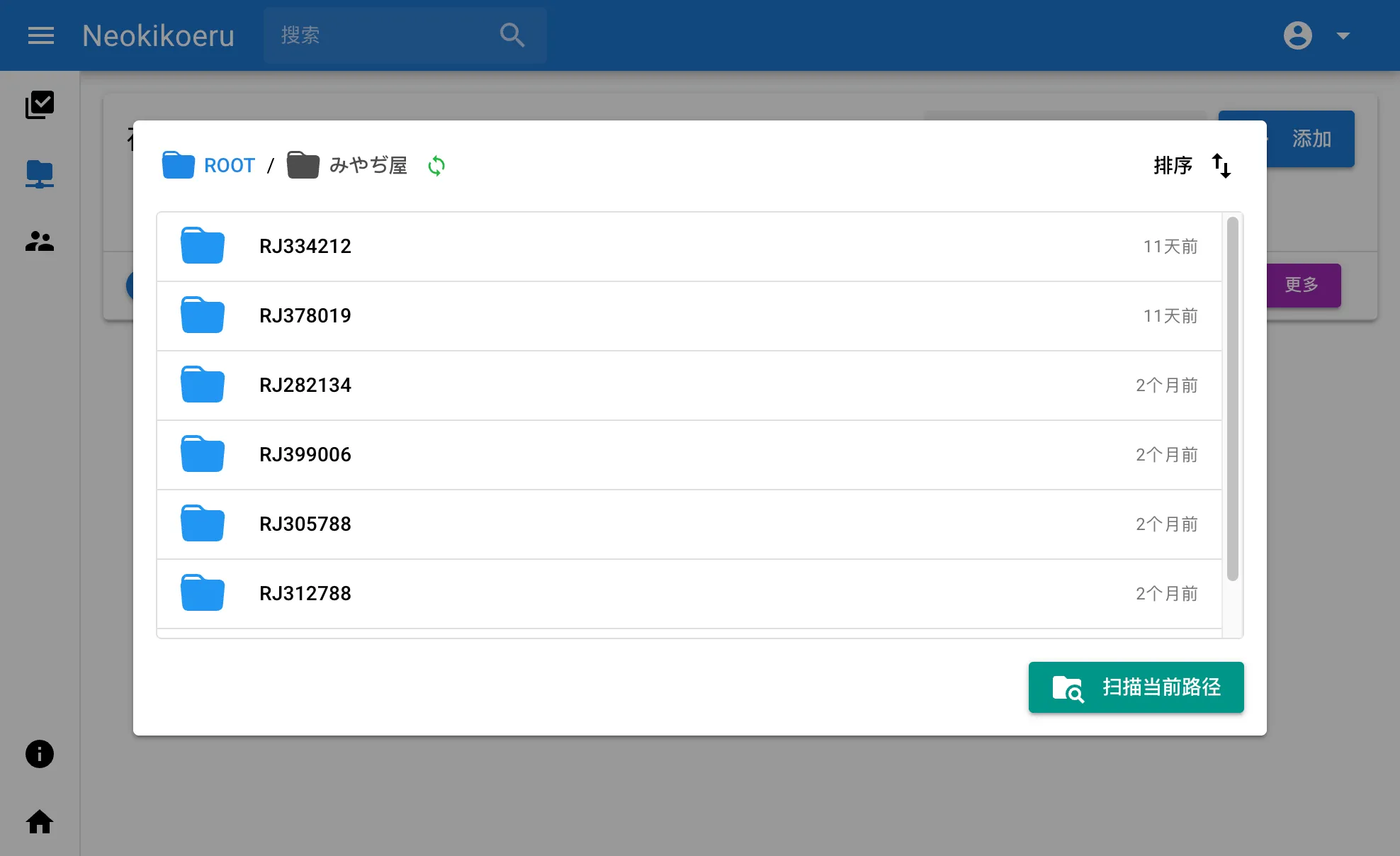
Neokikoeru is a paid, proprietary media server built for DLsite voice and ASMR works, written in Go with a Vue.js front end and positioned as an alternative to Kikoeru. It pulls work metadata from DLsite automatically using multithreaded, incremental scraping, and it indexes media held on local disks, WebDAV mounts, or a dozen cloud drives such as Baidu Netdisk, OneDrive, Google Drive, Aliyun Drive, 115, 123 Pan, Dropbox, Box, Yandex Disk and pCloud. Search handles several keywords and tags at once, offers progressive narrowing from the context menu plus an advanced filter panel, and can also match files. The player shows LRC/VTT/SRT/ASS lyrics with offset control and picture-in-picture, and keeps listening history so you can resume anywhere. A file vault encrypts media on disk and decrypts it transparently while playing, and a read-only WebDAV endpoint lets third-party clients browse your library. Deployment is a single cross-platform binary (or Homebrew/Scoop packages, or the vscodev/neokikoeru Docker image via a small compose file) started with neokikoeru serve; the first launch prints auto-generated admin credentials. Note that unlocking streaming requires activating a purchased license key, the software ships no content itself, and some DLsite tags are only scrapeable through a Japan-IP proxy.
Should you self-host neokikoeru?
neokikoeru scores 40/100 on selfhost.directory (how scoring works) and ranks #99 of 118 in Media Server. It has 636 GitHub stars.
It shipped 12 stable releases in the past year. The latest, v3.30.1, came out on 23 October 2026. New versions land roughly every 1 days.
Setup is easy: most people get it running in one sitting. An official Docker image is available. It is Proprietary-licensed.
Its closest alternative on selfhost.directory is Jellyfin (88/100, 58 737 stars). It scores higher overall, so compare the two before you pick. See neokikoeru vs Jellyfin side by side.
Features
- Advanced search
- Automatic metadata scraping
- File vault (encryption)
- Kikoeru favorites syncExperimental; only works for DLsite works not fully delisted.
- License activationPaid proprietary software; a trial demo site exists.
- Lyrics/subtitle display
- Multiple Storage Backends
- Playback history and resume
- Single cross-platform binary
- WebDAV ServerRead-only; requires an activated license, otherwise the server refuses connections.
- Windows service mode
neokikoeru README
FAQ
Can works other than the Voice/ASMR category be imported?
Yes, the program does not restrict categories; any work sold on DLsite can be imported.
Can works in the library get a subtitle badge?
No. For compatibility with third-party cloud storage and performance, Neokikoeru loads folder contents on demand and does not know at scan time whether a work has subtitles.
Why can some works not be scraped, with a 'product not found' error?
Some DLsite tags are restricted to Japanese IPs; if a work carries such tags you need to switch your proxy to a Japan node.
Why does scraping keep reporting network errors?
Your network cannot reach DLsite directly; set the HTTP_PROXY and HTTPS_PROXY environment variables to your proxy address.
Why is my media library empty?
Neokikoeru is a self-hosted server that ships no content; you must import your own media by adding storages.
What do I do if the program fails to start after an update?
Occasionally updates break compatibility; run `neokikoeru prune` to wipe app data and reinitialize (deactivate your license first). Windows users can instead delete the neokikoeru folder under %AppData%.
More in Audio Streaming
 NodeLinkSelf-hosted, open-source Lavalink alternative written in Node.js with worker-based architecture, real-time audio filters, and 15+ music sources.
 noisedashSelf-hosted web app for creating custom ambient soundscapes with generated tones, uploaded samples, filters, and user profiles.
 Nostr NestsNests is a self-hosted, open-source platform for live audio conversations — podcasts, group chats, music jams, and conferences — built on Nostr with MoQ.
 NymphCastSelf-hosted, open-source audio and video casting: stream media files, URLs and AngelScript-based apps to a Raspberry Pi or PC receiver attached to your TV or speakers.
 pipedOpen-source, self-hosted alternative front end for YouTube: no ads or tracking, with subscription feeds, playlists, SponsorBlock and audio-only playback.
 PodFetchSelf-hosted, open-source podcast manager in Rust and React with GPodder integration, full-text transcript search, and AI-generated transcripts via Whisper API.
 ResonusResonus is a self-hosted music player for Android/iOS connecting to Navidrome, Jellyfin, Ampache with offline mode, downloads, synced lyrics, casting.
 SnapcastSnapcast is an open-source, self-hosted multiroom audio system that syncs playback across clients with sub-millisecond precision.
 SpodcastSpodcast is a self-hosted, open-source tool that converts Spotify podcasts into RSS feeds for any podcast player, with local caching and a web UI.
 STR (SoundTouch Reborn)STR restores internet radio, Spotify Connect, preset buttons, multiroom, and local media to Bose SoundTouch speakers after the cloud shutdown.
 subplayerSubplayer is a self-hosted, open-source web music player for Subsonic backends like Navidrome, with playback, playlists, search, and dark mode theming.
 supysonicSelf-hosted, open-source Subsonic-compatible music streaming server with transcoding, scrobbling, jukebox mode, and internet radio support.
0 comments