
Self-host Musicseerr
v3.0.0Music request engine with native download pipeline
- Stars
- 1 561
- Port
- 8688 (Web UI and API)
droppedneedle/droppedneedle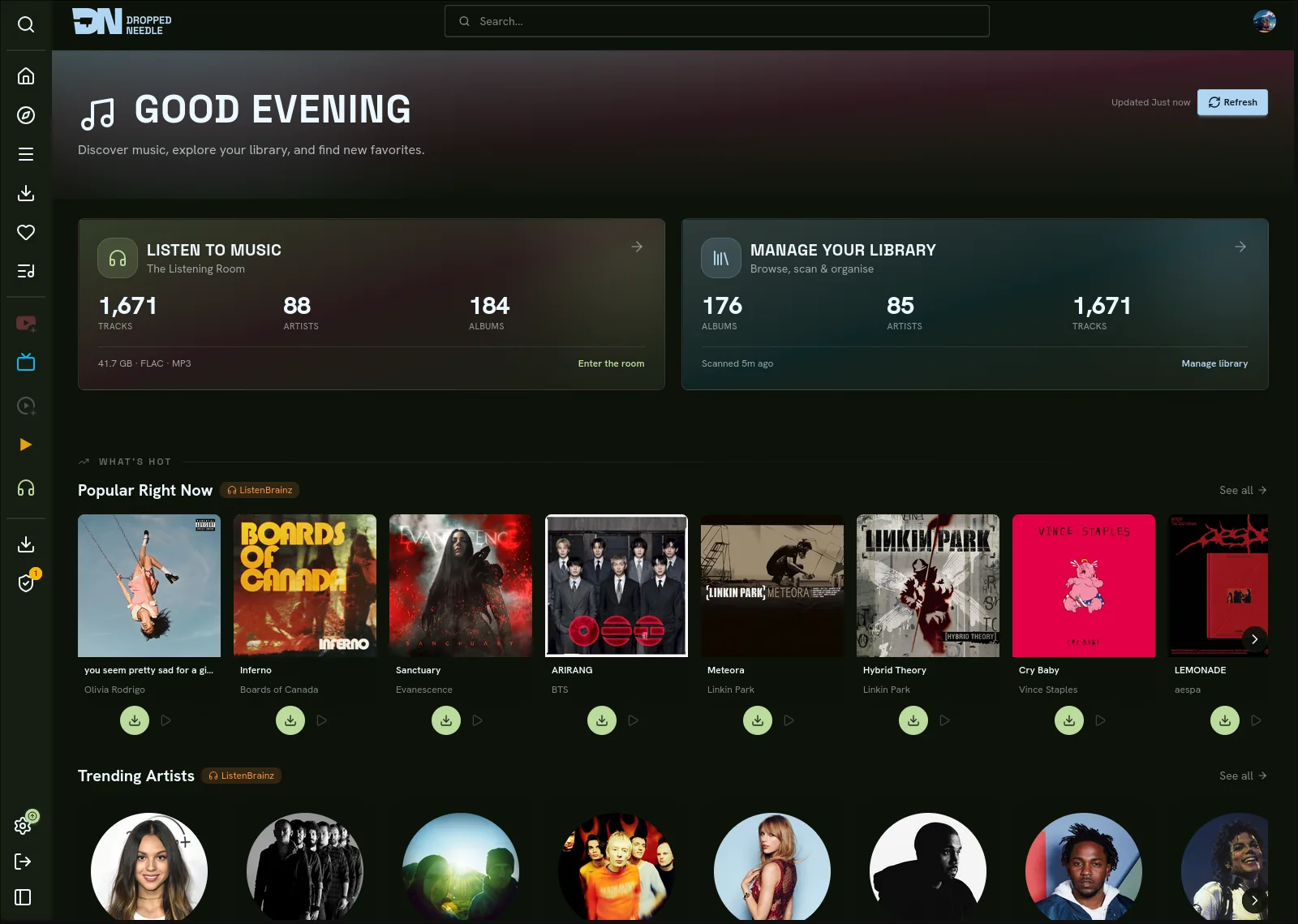
What is Musicseerr?
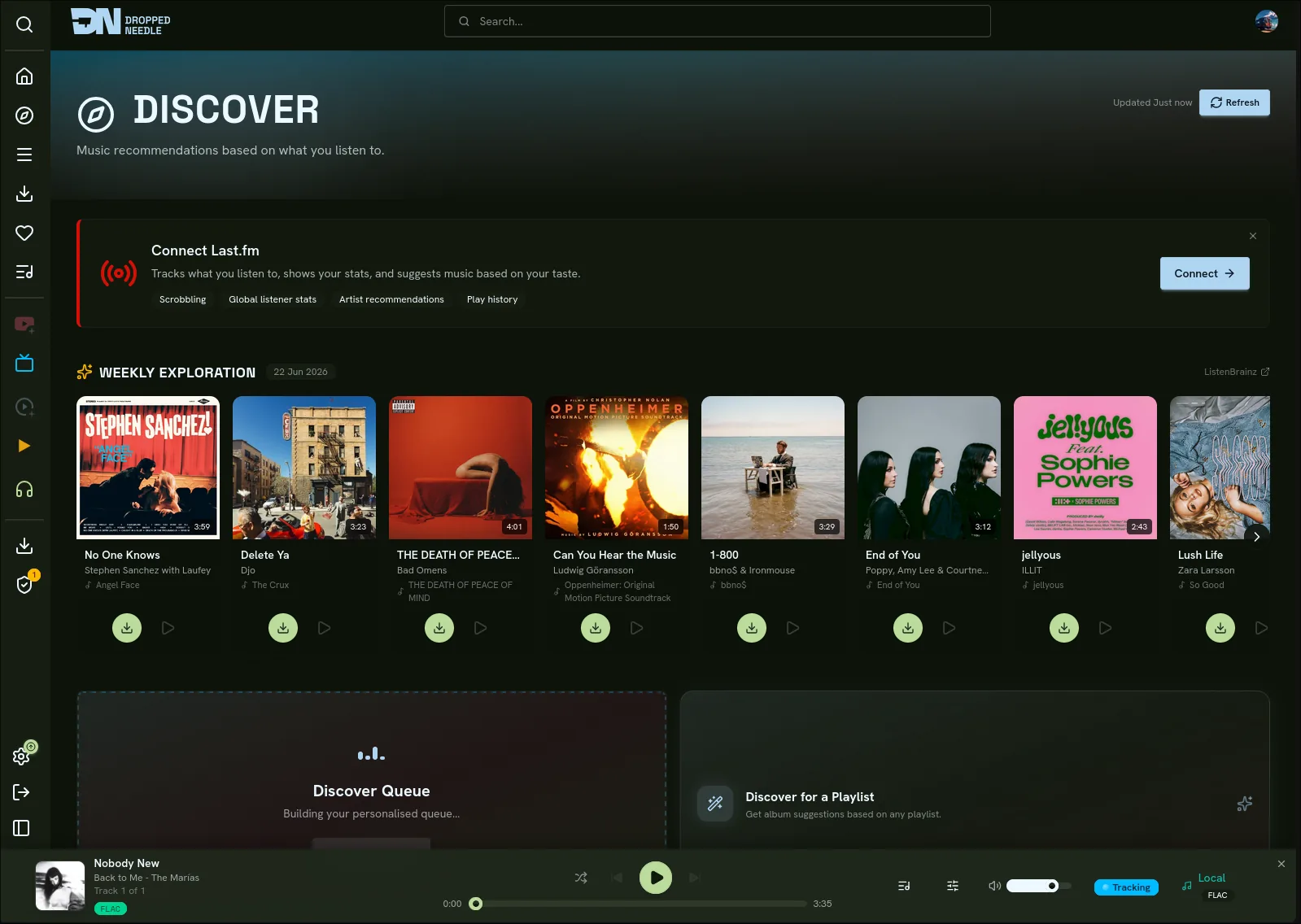
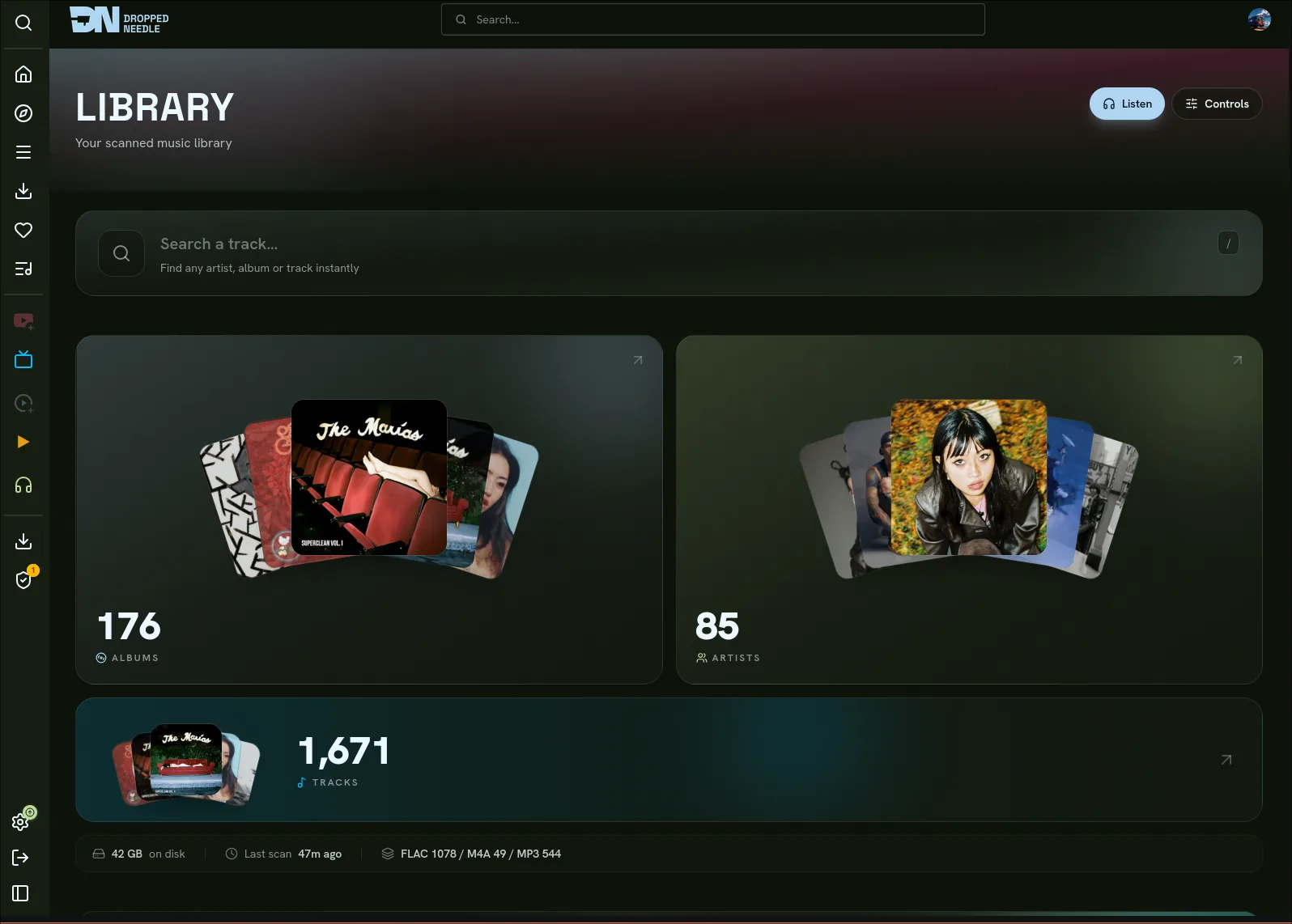
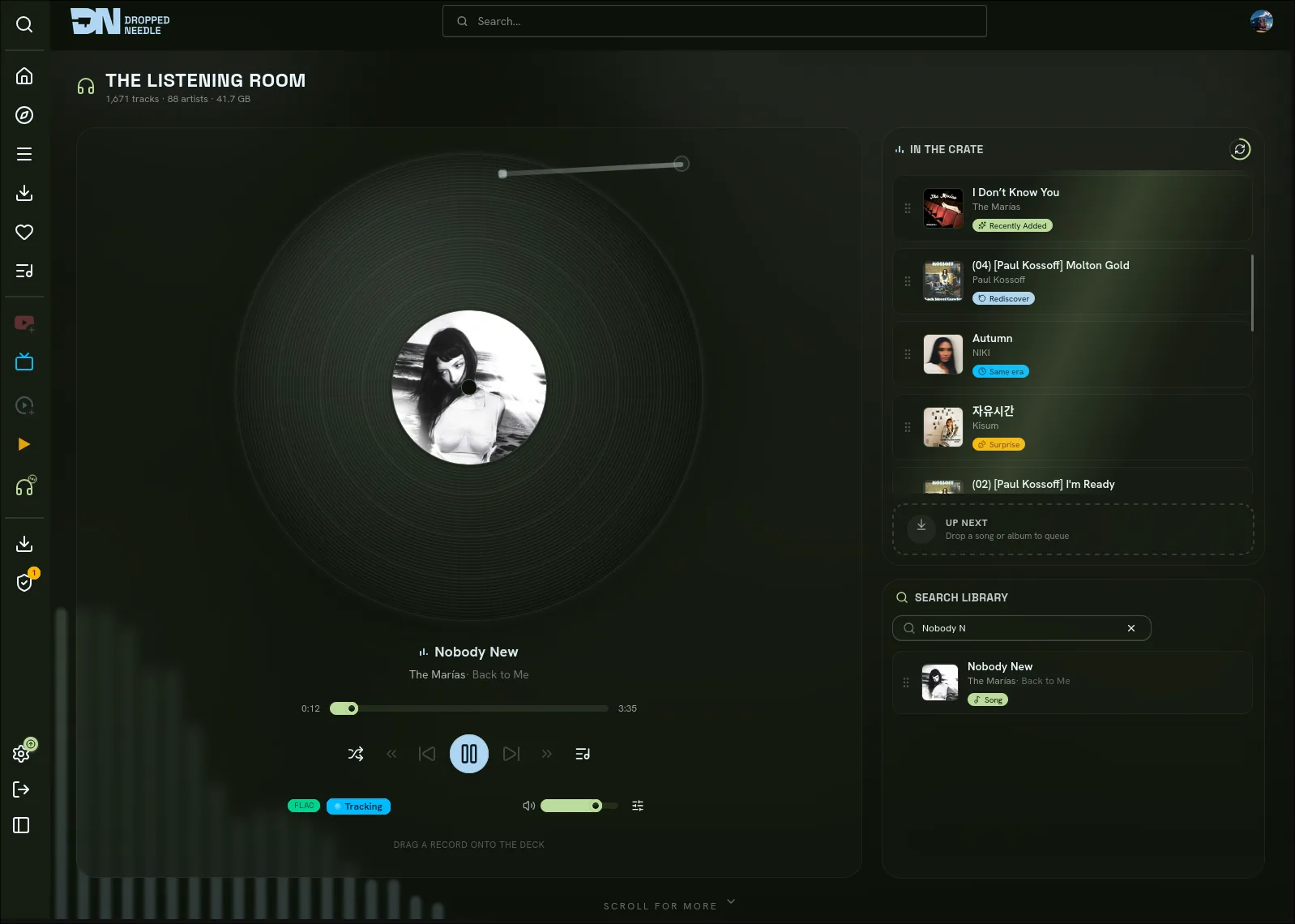
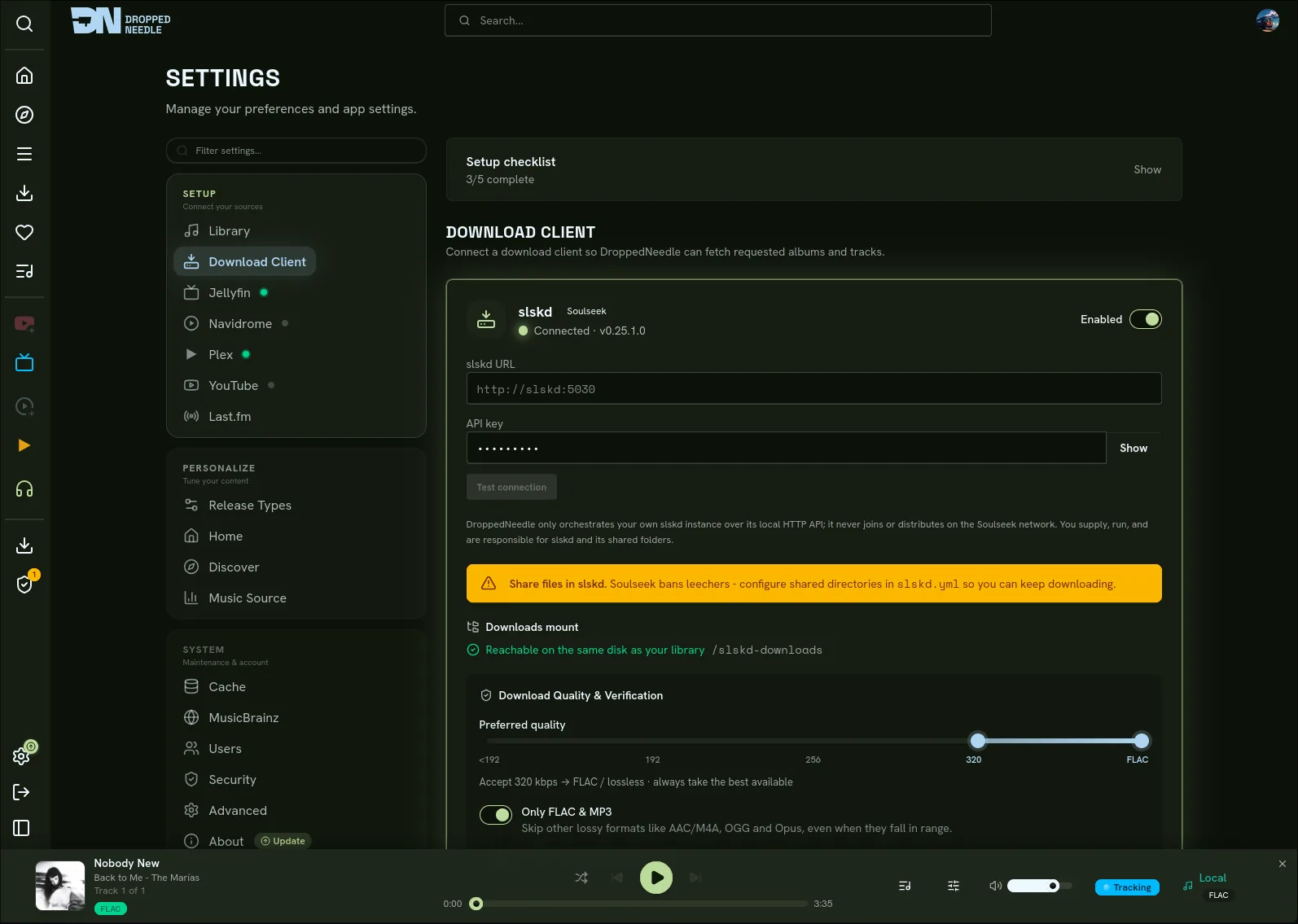
DroppedNeedle is a self-hosted music request and discovery application. Users search the MusicBrainz database and request albums or individual tracks. The software then controls your personal slskd or SABnzbd instance to retrieve files. Every downloaded file is verified using AcoustID fingerprinting, tagged with MusicBrainz metadata, and organized into your collection. A built-in web player offers playback queue, shuffle, a 10-band equalizer, and real-time now-playing updates. Discovery features include personalized recommendations based on ListenBrainz and Last.fm history, automatic tracking of new releases with optional downloading, and concert notifications from Ticketmaster and Skiddle. Multi-user access uses Admin, Trusted, and User roles with authentication options including local accounts, Jellyfin, Plex, or any OIDC identity provider. The library streams to several media servers and local files, while any OpenSubsonic or Jellyfin-compatible client can connect directly. Deployment is a single Docker container configured through the web interface. Licensed under AGPL-3.0 with no paid tiers or telemetry.
Musicseerr alternatives
 PlaylistPillarPlaylistPillar is a self-hosted, open-source music archival tool that transforms streaming playlists into durable local libraries with embedded ID3 tags and album art.ComparePlaylistPillar with Musicseerr
 ExploSelf-hosted, open-source take on Spotify's Discover Weekly: Explo turns ListenBrainz recommendations into playlists on Jellyfin, Plex, Emby, MPD or Subsonic servers.CompareExplo with Musicseerr
 auddly-serverAuddly is an open-source, self-hosted music streaming server with a REST API for your personal library, playlists, Last.fm scrobbling, and Spotify artist images.Compareauddly-server with Musicseerr
 MediaManagerSelf-hosted, open-source media manager for TV and movie libraries: discover releases, score them, hand downloads to qBittorrent or SABnzbd, with OIDC sign-in.CompareMediaManager with Musicseerr
 TagrA self-hosted web application for managing music metadata through a browser-based three-panel interface with integrated audio playback.CompareTagr with Musicseerr
Should you self-host Musicseerr?
Musicseerr scores 64/100 on selfhost.directory (how scoring works) and ranks #8 of 59 in Music Streaming. It has 1 561 GitHub stars, +83 in the last 30 days.
It shipped 35 stable releases in the past year. The latest, v3.0.0, came out on 14 November 2026. New versions land roughly every 1 days.
Setup is moderate: expect some configuration beyond a single command. An official Docker image is available. It is AGPL-3.0-licensed and written mostly in Rust.
Its closest alternative on selfhost.directory is Mediarium (60/100, 321 stars). Musicseerr scores higher overall. See Musicseerr vs Mediarium side by side.
Features
- Built-in web player
- Cross-source playlists
- Discovery and recommendations
- Drop imports
- Free music from Internet Archive
- Gig alerts
- Library management with Picard-style tags
- Multi-user with roles
- MusicBrainz catalogue search
- Native download pipeline
- New-release radar
- OIDC Authentication
- OpenSubsonic/Jellyfin API
- Quality floors and upgrades
- Wanted watcher with auto-retry
Musicseerr README

Request music. Own everything.
DroppedNeedle is a self-hosted music request and discovery app for you and the people you share a server with. Search MusicBrainz, request an album or a single track, and it fetches it through your own slskd or SABnzbd, checks every file and files it in your library. Then play it in the browser, or in Symfonium, Finamp, Feishin and other Subsonic or Jellyfin apps.
One container. No Lidarr.


FAQ
Is it really free?
Yes. Open source under AGPL-3.0, with no paywall, lock-in or telemetry.
Can more than one person use it?
Yes. Admin, trusted and standard roles, with login via username, Jellyfin, Plex or any OIDC provider.
Can I point my own music app at it?
Yes. DroppedNeedle speaks the OpenSubsonic and Jellyfin APIs, so clients like Symfonium, Finamp or Feishin can play your library directly. Turn it on in Settings > Connect Apps and create a revocable app-password.
Where can I play and scrobble?
Stream from Jellyfin, Navidrome, Plex or local files, with YouTube previews for what you haven't downloaded. Scrobble to ListenBrainz and Last.fm, per user.
Can it follow artists and find gigs?
Follow an artist and DroppedNeedle watches for new releases, with the option to auto-download them as they land. Connect Ticketmaster and Skiddle, pick your cities, and it lists upcoming concerts for the artists you follow.
Does it manage quality and disk space?
Yes. Set a minimum quality per format and anything below it is rejected. When a better copy of an album you own turns up, the engine swaps it in and keeps the originals in a recycle bin. A global storage cap and per-user quotas stop the library filling the disk.
Why must slskd's downloads folder share a filesystem with my library?
Imports are atomic moves. A cross-filesystem mount can't be renamed in place, so bind-mount slskd's downloads directory read-write on the same filesystem as your music.
What do I need to run it?
Docker, a music folder, and at least one download client you run: slskd (0.25.0 or newer) with a shared folder and an API key, or SABnzbd with Newznab indexers. Everything else is configured from the web UI.
Can I use Usenet instead of slskd?
Yes. DroppedNeedle downloads from Usenet through SABnzbd with Newznab indexers, from your own slskd, or from both at once. A source-priority setting decides which is tried first.
Do I still need Lidarr?
No. The native engine replaces it entirely: scanning, identification, downloading, fingerprinting, tagging and organising are all built in.
Does DroppedNeedle download from Soulseek?
No. It talks to your own running slskd over slskd's local HTTP API and imports the results. It has no Soulseek protocol code itself. You run, and are responsible for, slskd and its shared folders.
More in Music Streaming
 musikatSelf-hosted open-source music downloader that searches Deezer or Spotify, fetches audio from YouTube, tags files, and saves to Navidrome or local downloads.
 myMPDmyMPD is a self-hosted, open-source web-based MPD client written in C with a PWA frontend, offering jukebox mode, smart playlists, and Lua scripting.
 Navidrome Music Server🎧 Your Personal Streaming Service
 nomercy-media-serverSelf-hosted media server with automatic encoding, hardware transcoding (NVIDIA/Intel/AMD), and a polished web app plus mobile PWA for streaming movies, shows, and music.
 Octo-FiestaA self-hosted, open-source Subsonic API proxy that fills gaps in your Navidrome library by pulling in tracks from streaming services you already subscribe to.
 owntoneSelf-hosted, open-source audio server streaming your library and radio to AirPlay multiroom speakers, Chromecast, Roku and local output, with web and MPD control.
 PlexistSelf-hosted tool syncing playlists from Spotify, Apple Music, Deezer, Tidal, Qobuz into Plex with multi-service sync support.
 PolarisSelf-hosted, open-source music streaming server aimed at collections of 100,000+ songs, with a web player, multi-user playlists, FLAC/MP3/Opus support and mobile apps.
 qm-musicQM-Music is a self-hosted, open-source music server built on Subsonic. It runs in Docker with ~150MB RAM and works with Feishin and StreamMusic clients.
 ResonusResonus is a self-hosted music player for Android/iOS connecting to Navidrome, Jellyfin, Ampache with offline mode, downloads, synced lyrics, casting.
 RewindRewind is a self-hosted, open-source web app that generates a visual, stories-style year-in-review of your Navidrome listening history with playable music.
 sonerezhSelf-hosted open-source web app to stream your music library from any browser. Auto-imports MP3, MP4, OGG, FLAC metadata with a beautiful web UI.
0 comments