
Self-host LoomFlow
v0.1.11AI workflow builder: natural language to runnable API
- Stars
- 136
- CPU
- 1 CPU
- RAM
- 1 GB RAM
- Port
- 5000 (LoomFlow application HTTP server)
What is LoomFlow?
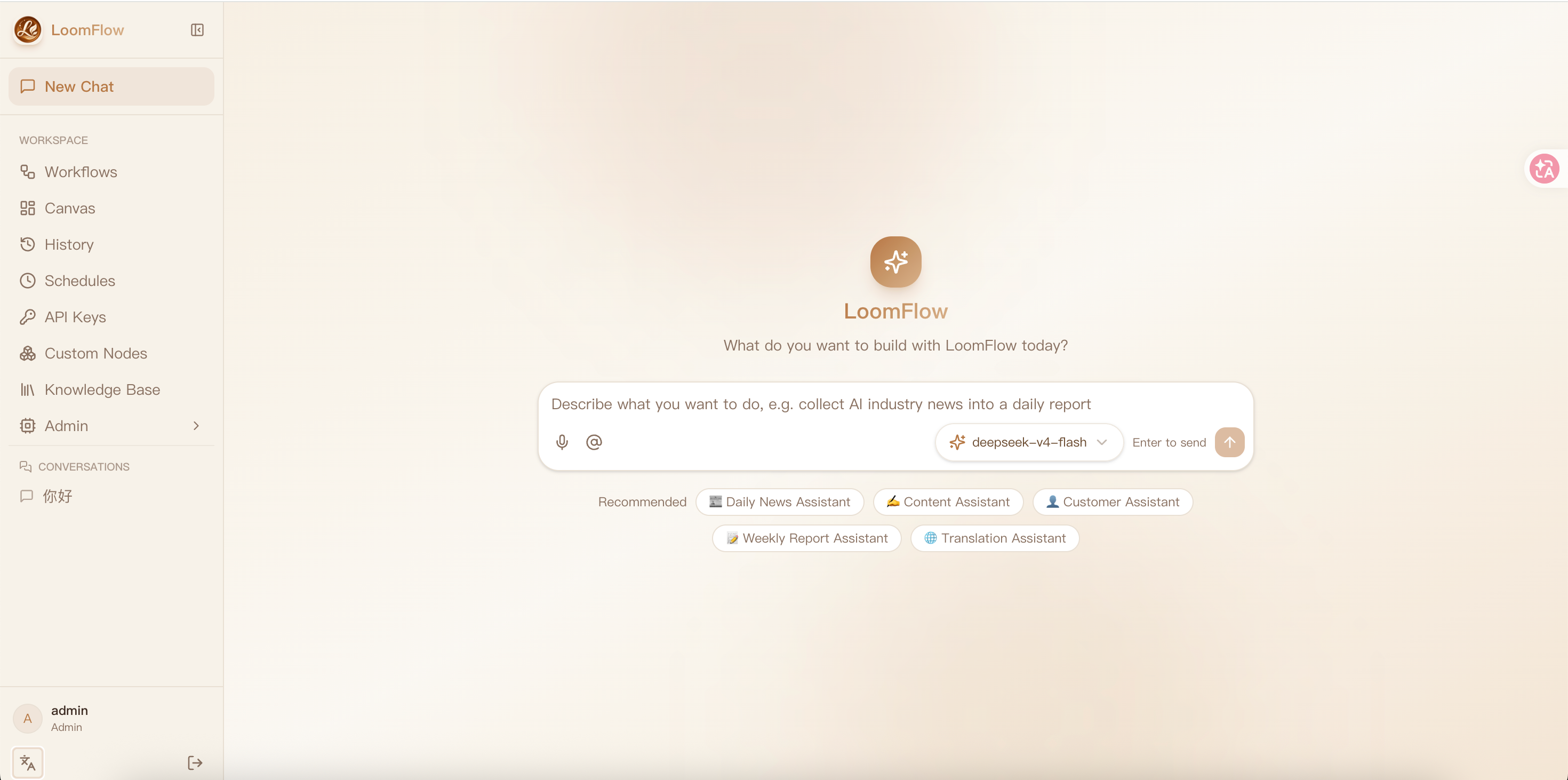
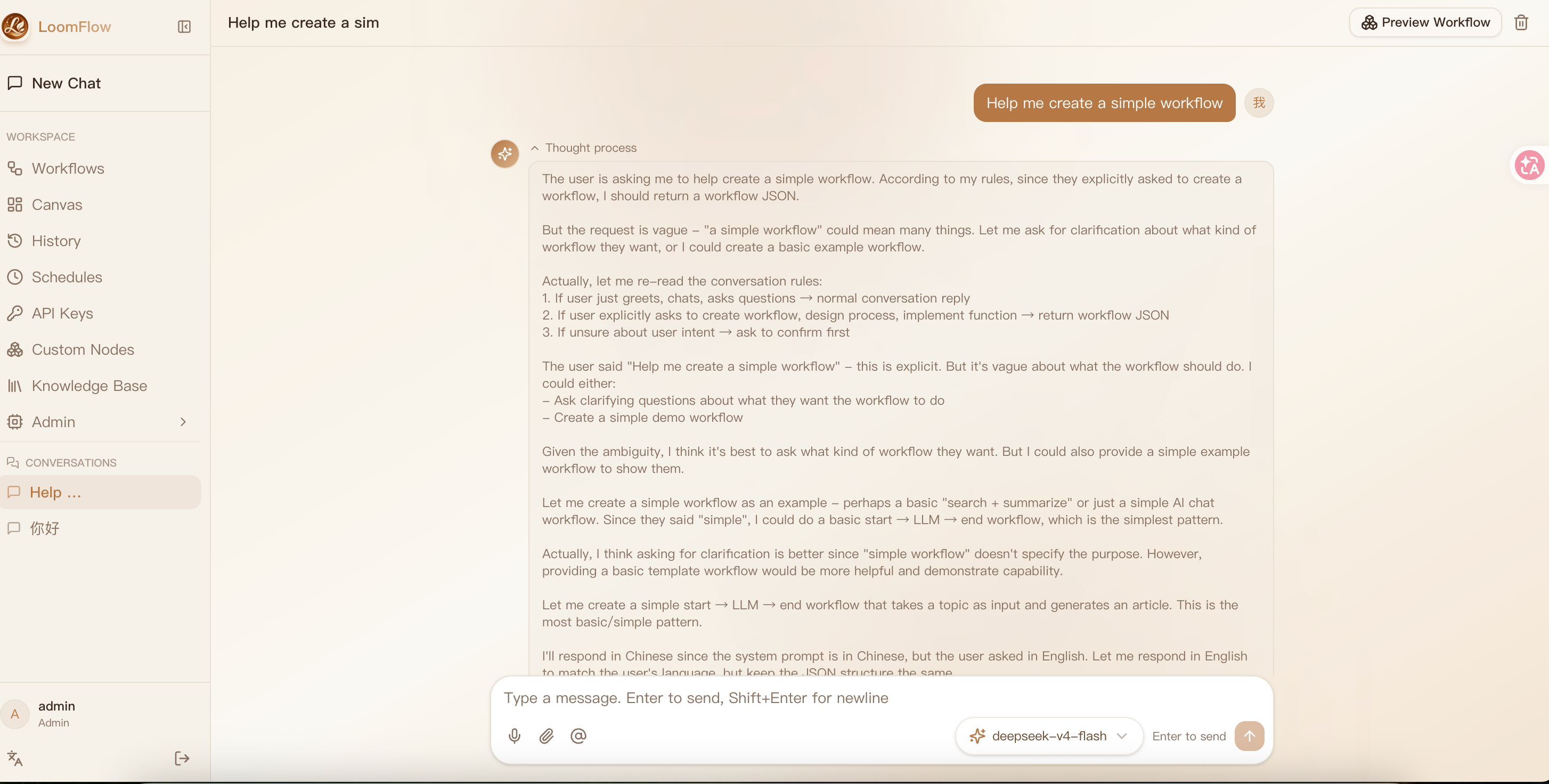
LoomFlow is a lightweight AI-native workflow platform for individuals and small teams. Users write a plain-language description and the AI produces an executable workflow on a visual canvas with 12 node types. Workflows can be adjusted visually, versioned, and published as secured HTTP endpoints with a single global API key per user. Public share links let anyone run a workflow without an account. The platform includes an admin dashboard for user management, audit logs, and usage statistics; a canvas AI assistant that can modify workflows from chat; execution traces with per-node timing and token usage; and an automated evolution engine that spots performance regressions and suggests improvements. Models are configured at runtime via the admin UI with any OpenAI-compatible endpoint. Search providers (Tavily, Exa, Google) and S3-compatible object storage are integrated. Deployment is a single Docker Compose command that brings up the Next.js app, PostgreSQL 16, PostgREST, and Nginx — fully self-contained. Minimum server requirements are 1 CPU and 1 GB RAM on Ubuntu 20.04+. The project is MIT-licensed and positions itself as a simpler, AI-first alternative to Dify and n8n.
Should you self-host LoomFlow?
LoomFlow scores 44/100 on selfhost.directory (how scoring works) and ranks #5 of 7 in AI Workflows. It has 136 GitHub stars.
It shipped 9 stable releases in the past year. The latest, v0.1.11, came out on 2 September 2026. New versions land roughly every 2 days.
Setup is moderate: expect some configuration beyond a single command. It is MIT-licensed and written mostly in Typescript.
Its closest alternative on selfhost.directory is Activepieces (81/100, 25 259 stars). It scores higher overall, so compare the two before you pick. See LoomFlow vs Activepieces side by side.
Features
- Admin Dashboard
- Bring your own model
- Canvas AI assistant
- Execution trace & debug assistant
- Extensible Node System
- Internationalization
- Natural language to workflow
- S3-compatible object storage
- Search provider integration
- Shareable workflow pages
- Team & permissions
- Visual workflow canvas
- Workflow as API
- Workflow evolution engine
- Workflow notes (Brew Notes)
LoomFlow README
More in AI Workflows
 Manor AISelf-hosted AI workspace for small teams to run governed agents with bring-your-own keys, workflows, tools, and human approvals.
 markusSelf-hosted open-source AI workforce platform running autonomous agent teams locally with your own API keys.
 self-hosted-ai-starter-kitThis open-source Docker Compose template spins up a self-hosted AI stack with n8n, Ollama, Qdrant and PostgreSQL, auto-pulling Llama3.2 for local workflows.
 SimOpen-source, self-hosted AI workspace for teams designing, launching and observing agent workflows, with 1,000+ app connectors, tables, knowledge bases and run logs.
 1flowbaseAn open-source AI Gateway and app runtime you host yourself, unifying model access with PostgreSQL storage, workflows, APIs, and React apps via MCP.
 AgentaOpen-source, self-hosted workspace where teams build AI agents by chatting, run them in Slack, Telegram or WhatsApp, and schedule automations on any LLM.
 bifrostOpen-source, high-performance AI gateway that works as your LLM gateway, MCP gateway and agent gateway. One OpenAI-compatible API for 10,000+ models, with failover, load balancing, semantic caching, virtual keys, budgets and MCP Code Mode. Works with any SDK or agent and adds under 200µs of overhead at 5k RPS.
 bishengAn Apache-2.0, self-hosted LLM devops platform for enterprise AI: GenAI workflows, RAG knowledge bases, agents, model management, evaluation, SFT and OCR.
 DEEIX ChatDEEIX Chat is a self-hosted, open-source AI workspace unifying model routing, multimodal chat, RAG, MCP tools, billing, and identity into one deployable platform.
 deer-flowAn open-source long-horizon SuperAgent harness that researches, codes, and creates. With the help of sandboxes, memories, tools, skill, subagents and message gateway, it handles different levels of tasks that could take minutes to hours.
 difyDify is a self-hosted, open-source LLM app platform with visual workflows, RAG pipelines, agents, and model management for taking AI apps from prototype to production.
 duragraphDuraGraph is a self-hosted, open-source control plane for durable AI agent workflows. It uses event sourcing and CQRS to make every run replayable and crash-safe.
0 comments