
Self-host Kestra
v1.3.47Event-driven orchestration for data, AI, and infra flows
- Stars
- 30 237
- CPU
- 2 vCPUs
- RAM
- 4 GiB
- Port
- 8080 (Kestra UI and web server/API)
kestra/kestra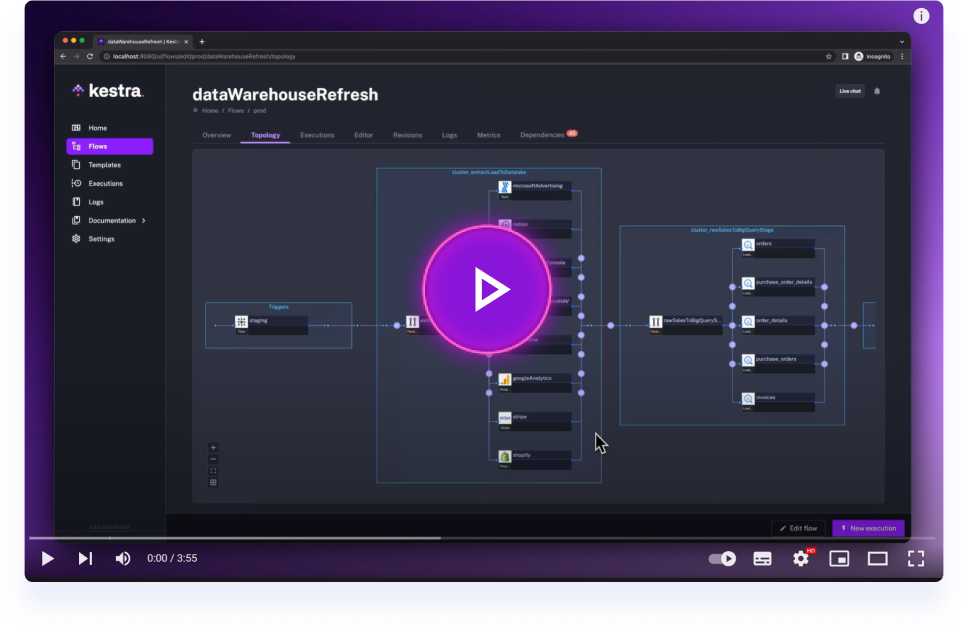
What is Kestra?
Kestra is an event-driven orchestration and scheduling engine for data engineers, software engineers and platform teams who want their jobs described declaratively. A flow is a YAML file, but the very same flow can be assembled in the UI's code editor with auto-completion, dragged together block by block in the No-Code editor, or written for you by the built-in AI Copilot. Beyond cron-style schedules, backfills and event triggers, flows can react in real time to files landing or messages arriving on brokers such as Kafka, Redis, Pulsar, MQTT or AWS SQS, and to custom events raised by your own systems. Task code runs in Python, Node.js, R, Go or Shell, inside Docker containers or Kubernetes jobs, and a catalogue of more than 2,200 plugins reaches databases, cloud storage and APIs. Version 2.0 added AI agents and RAG pipelines as task types, an MCP server that turns flows into tools for coding agents, draft revisions, checks and quotas, plus a gRPC worker-controller splitting control plane from data plane; the design targets high availability and millions of executions. To run it yourself, start one container with docker run on port 8080 using the slim image, use the shipped docker-compose.yml backed by PostgreSQL, install the official Helm chart on Kubernetes, or run the standalone executable JAR on a VM (AWS CloudFormation and GCP Terraform templates exist too). OIDC single sign-on, LDAP, SCIM, RBAC, Policies and the kestra-ee registry image sit in the paid Enterprise Edition, and Kestra Cloud is the managed alternative.
Kestra alternatives
 heymHeym is a self-hosted platform for building and running agentic AI workflows with a visual canvas, human-in-the-loop, RAG, MCP, and full observability.Compareheym with Kestra
 cronstablecronstable is a self-hosted, open-source job scheduler and workflow orchestrator with retries, alerts, DAG workflows, and web/terminal/iOS dashboards.Comparecronstable with Kestra
 monoscopeOpen-source, self-hosted observability that keeps logs, metrics and traces in your own S3 buckets, with plain-English queries, scheduled AI agents and session replay.Comparemonoscope with Kestra
 SoulFlow-OrchestratorSelf-hosted AI agent runtime with 9 LLM backends, 141-node workflow engine, HITL gates, AES-256-GCM vault, Slack/Telegram/Discord/web chat. All data on your server.CompareSoulFlow-Orchestrator with Kestra
 kiteSelf-hosted, open-source Kubernetes workspace for multi-cluster management: RBAC, LDAP/OAuth login, Prometheus monitoring, Helm, audit logs, and an AI assistant.Comparekite with Kestra
 reflyThe first open-source agent skills builder. Define skills by vibe workflow, run on Claude Code, Cursor, Codex & more. Build Clawdbot 🦞· APIs for Lovable · Bots for Slack & Lark/Feishu · Skills are infrastructure, not prompts.Comparerefly with Kestra
 deer-flowAn open-source long-horizon SuperAgent harness that researches, codes, and creates. With the help of sandboxes, memories, tools, skill, subagents and message gateway, it handles different levels of tasks that could take minutes to hours.Comparedeer-flow with Kestra
 openlegionSelf-hosted platform for isolated AI agent teams with credential vaulting, spend limits, and a web dashboard — free for internal use under a source-available license.Compareopenlegion with Kestra
All self-hosted alternatives to Apache Airflow → All self-hosted alternatives to Prefect →
Should you self-host Kestra?
Kestra scores 79/100 on selfhost.directory (how scoring works) and ranks #5 of 31 in Workflow Automation. It has 30 237 GitHub stars, +711 in the last 30 days.
It shipped 63 stable releases in the past year. The latest, v1.3.47, came out on 10 November 2026. New versions land roughly every 1 days.
Setup is moderate: expect some configuration beyond a single command. An official Docker image is available. It is Apache-2.0-licensed and written mostly in Java.
Its closest alternative on selfhost.directory is prefect (80/100, 24 162 stars). It scores higher overall, so compare the two before you pick. See Kestra vs prefect side by side.
Features
- AI agent and RAG workflows
- AI CopilotGemini-based Copilot ships in the open-source edition; agentic Copilot on any LLM is Enterprise.
- CLI Tooling
- Cron scheduling and backfills
- Declarative YAML workflows
- Event-driven triggers
- Git version control integration
- High availability scaling
- MCP Server
- Namespaces and subflows
- No-code visual editor
- Plugin Ecosystem2,200+ plugins, most available in both editions.
- REST API and SDKs
- Terraform Provider
FAQ
Are there additional costs associated with the Enterprise Edition?
Yes, Enterprise has licensing fees that depend on organization size and the features required.
How can I get access to the Kestra Enterprise Edition?
Contact the team through their Slack channel or book a demo, and they will guide you through the setup.
What additional features does the Kestra Enterprise Edition offer?
Enterprise adds better scalability, encryption, access control, SSO, fine-grained permissions, audit logs, a customizable dashboard, user management and dedicated support.
Are there any costs associated with using Kestra?
The open-source edition is free; costs can come from hosting, infrastructure and third-party services you integrate with.
Is Kestra open-source?
Yes, the source code is on GitHub under the Apache 2.0 license.
Is there a community or support forum for Kestra?
Yes, there is a Kestra Slack channel where users and developers ask questions and share experience.
How to install Kestra?
The docs give step-by-step instructions for several platforms, including Docker, Kubernetes and Helm.
How do I get started with Kestra?
Follow the Getting Started guide on the Kestra website, which covers installation, configuration and creating your first flows.
What languages are supported in Kestra flows?
Flows are defined in YAML, while tasks can run scripts in languages such as Python, R, Node.js, Julia, Ruby, Shell or PowerShell, and Docker lets you use any language.
Can I create custom plugins for Kestra?
Yes, developers can write custom plugins that add new tasks and integrations to Kestra.
What are some of the key features of Kestra?
Built-in code editor for flow creation, parallel and retried task execution, a large plugin ecosystem, monitoring with metrics, logs and notifications, and an extensible architecture.
Who can benefit from using Kestra?
Data engineers, developers, data scientists and anyone orchestrating workflows across multiple systems.
What are the advantages of a declarative orchestrator?
Declarative flows are easier to read, modify and maintain, and can be extended as requirements change without heavy refactoring, while the platform handles execution, errors and parallelism.
What is a declarative orchestrator?
It is a system where you describe the desired end state of a workflow in a high-level language instead of exact steps; Kestra uses YAML for flows made of tasks and triggers.
What is Kestra?
Kestra is an open-source declarative orchestration platform that brings Infrastructure as Code practices to workflows, from mission-critical pipelines to simple automations, managed through YAML and an API-first design.
More in Workflow Automation
 LeastActionLeastAction is a self-hosted data workflow platform where an AI operator runs and repairs pipelines end-to-end against your stack with a shared team catalog.
 LivebookOpen-source, self-hosted interactive notebooks for Elixir with realtime collaboration, smart cells, .livemd files, custom runtimes, and one-click app deploys.
 local-ai-toolkitSelf-hosted AI toolkit bundling an LLM proxy, visual workflow builder, and chat UI backed by PostgreSQL. Deploy with Docker Compose or Helm charts.
 LoomFlowSelf-hosted AI workflow builder: write a prompt, get a runnable flow on a canvas, expose it as an API. Single Docker command to deploy.
 LoonflowSelf-hosted, open-source ticket and process automation system with drag-and-drop workflow and form designers, plus an MCP ticket server for AI clients.
 MachinaOSSelf-hosted open-source AI organisation with six specialised employees owning business functions end-to-end. Token budget, bring your own model keys.
 mattermostMattermost is a self-hosted collaboration platform with channels, threads, file sharing, voice calls and playbooks for DevSecOps, IT service desk and incident response.
 MCP MoiraMCP Moira is a self-hosted, open-source engine that lets AI agents run structured workflows over the Model Context Protocol with JSON Schema validation.
 mitsheRun AI coding agents in isolated Docker containers per task — self-hosted with terminal, browser, git, and workflow automation.
 mixarrSelf-hosted music discovery for Lidarr connecting to Spotify, TIDAL, Last.fm and 9 more services with 56 subscription types, review queue, and AI recommendations.
 model-composemodel-compose is a self-hosted, open-source tool for building AI pipelines in YAML with local/cloud models, streaming, Gradio UI, and Docker deployment.
 n8nn8n is a self-hosted, source-available workflow automation platform with visual building, custom code, 1500+ integrations, and native AI agents.
0 comments