
Self-host jump
v1.4.1Startpage and live status board for your homelab links
helm install my-jump djjudas21/jump -f values.yaml- Stars
- 604
- Port
- 8080 (HTTP port the Jump container serves the startpage on (mapped to a host port such as 8123))
daledavies/jump
What is jump?
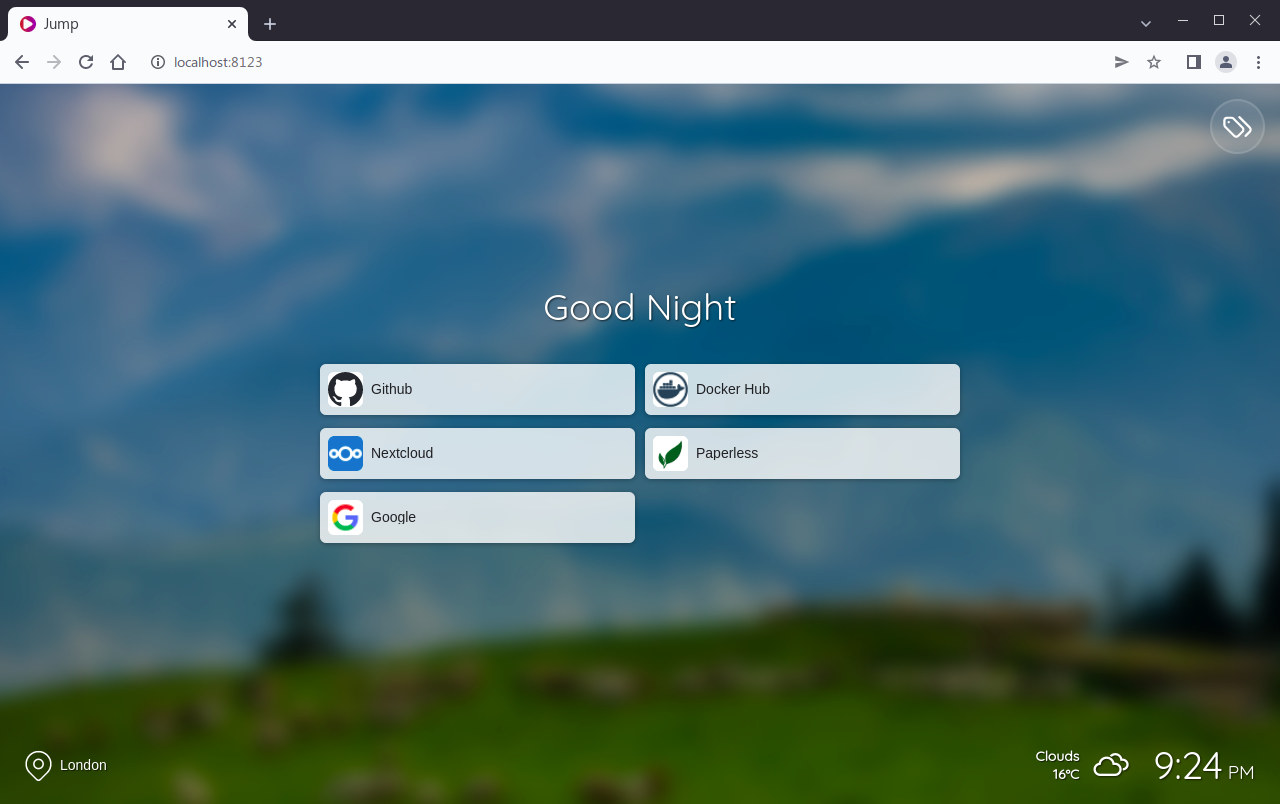
Jump puts your homelab links on one page and keeps watching them for you. Written in PHP, it deliberately ships without user accounts or an admin screen: you describe sites in a sites.json file (or let it read containers from your Docker host through labels) and tune everything else with environment variables or config.php. Sites can carry descriptions, tags, custom icons from the Dashboard Icons set or an automatic favicon, plus per-site status-check options such as an alternate check URL, GET instead of HEAD, extra allowed status codes and skipping SSL verification. Availability is polled continuously so the page works as a live status board, and a keyboard-invoked search box queries names, tags and URLs against your own list of search engines. Optional extras include local time and weather from Open Weather Map, a clock, greetings, random Unsplash backgrounds or your own images, several layouts and eight translations. Run it via Docker Compose, docker run, the community Helm chart, or by copying the jumpapp folder onto a PHP web server; the container listens on 8080. Latest tagged release is v1.4.1 from April 2024.
Should you self-host jump?
jump scores 50/100 on selfhost.directory (how scoring works) and ranks #17 of 44 in Dashboard. It has 604 GitHub stars.
There was no stable release in the past 12 months, so check the repository's recent activity before you rely on it.
Setup is easy: most people get it running in one sitting. An official Docker image is available. It is MIT-licensed and written mostly in PHP.
Its closest alternative on selfhost.directory is Homepage by gethomepage (84/100, 33 416 stars). It scores higher overall, so compare the two before you pick. See jump vs Homepage by gethomepage side by side.
Features
- Clock and greeting display
- Custom icons and automatic favicons
- Fast search with keyboard shortcut
- Local time and weather display
- Multi-language UI
- Multiple layout options
- No user accounts or admin interface
- Random Unsplash backgrounds
- Real-time site status monitoring
- Search-engine hiding (noindex)
- Tag-based categorisation across pages
jump README
More in Bookmarks & Link Sharing
 KarakeepOpen-source, self-hosted app for saving links, notes, images and PDFs, with LLM auto-tagging, semantic search, offline mobile reading, and page archives.
 karakeep-homedashSelf-hosted dashboard for KaraKeep bookmarks with masonry layout, real-time search, and drag-and-drop reordering. Runs in browser via SQLite WASM.
 karakeep-syncSelf-hosted tool that syncs Hacker News upvotes, Reddit saves, GitHub stars, and Pinboard bookmarks to your Karakeep instance.
 LinkAceA self-hosted, open-source bookmark manager that archives links, monitors them for breakage, and offers tags, lists, multi-user SSO and a REST API.
 linkdingA self-hosted, open-source bookmark manager with tags, multi-user sharing, automatic metadata, site archiving and a REST API.
 links-as-codeLinks as Code is a self-hosted, open-source bookmark manager storing links in a version-controlled YAML file, served as a searchable web page via Docker.
 linksnapperLinkSnapper is a self-hosted, open-source bookmark manager and sticky notes app with a Catppuccin Mocha dark theme, flat-file storage, and a REST API for homelab use.
 LinkWardenOpen-source, self-hosted bookmark manager that keeps a screenshot, PDF and HTML copy of every saved page, with reader annotations and shared team collections.
 LynxSelf-hosted open-source page builder for creating link-in-bio pages, portfolios, venue menus, and event pages with visual editing, analytics, and newsletter features.
 MARKMARK is a self-hosted, open-source image bookmarking tool for personal use that saves images via bookmarklet or drag-and-drop into a file-based collection.
 NeonLinkNeonLink is a simple, open-source, self-hosted bookmark service with tags, search, auto metadata fetching, and customizable backgrounds — ideal for Raspberry Pi.
 OmnivoreSelf-hosted, open-source read-it-later app with highlights, notes, labels, RSS feeds, newsletter email import, PDF support and native iOS and Android apps.
0 comments