
Self-host helix
2.12.42AI agent fleet orchestration with GPU-accelerated desktops
- Stars
- 824
- CPU
- 8 vCPU
- RAM
- 24 GiB RAM
- Storage
- 100 GiB
- Ports
- 8081 (frontend development server), 2224 (SSH proxy for agent sandbox connections)
- Requires
- Chrome/Chromium, PostgreSQL
ghcr.io/helixml/helix-sandbox
What is helix?
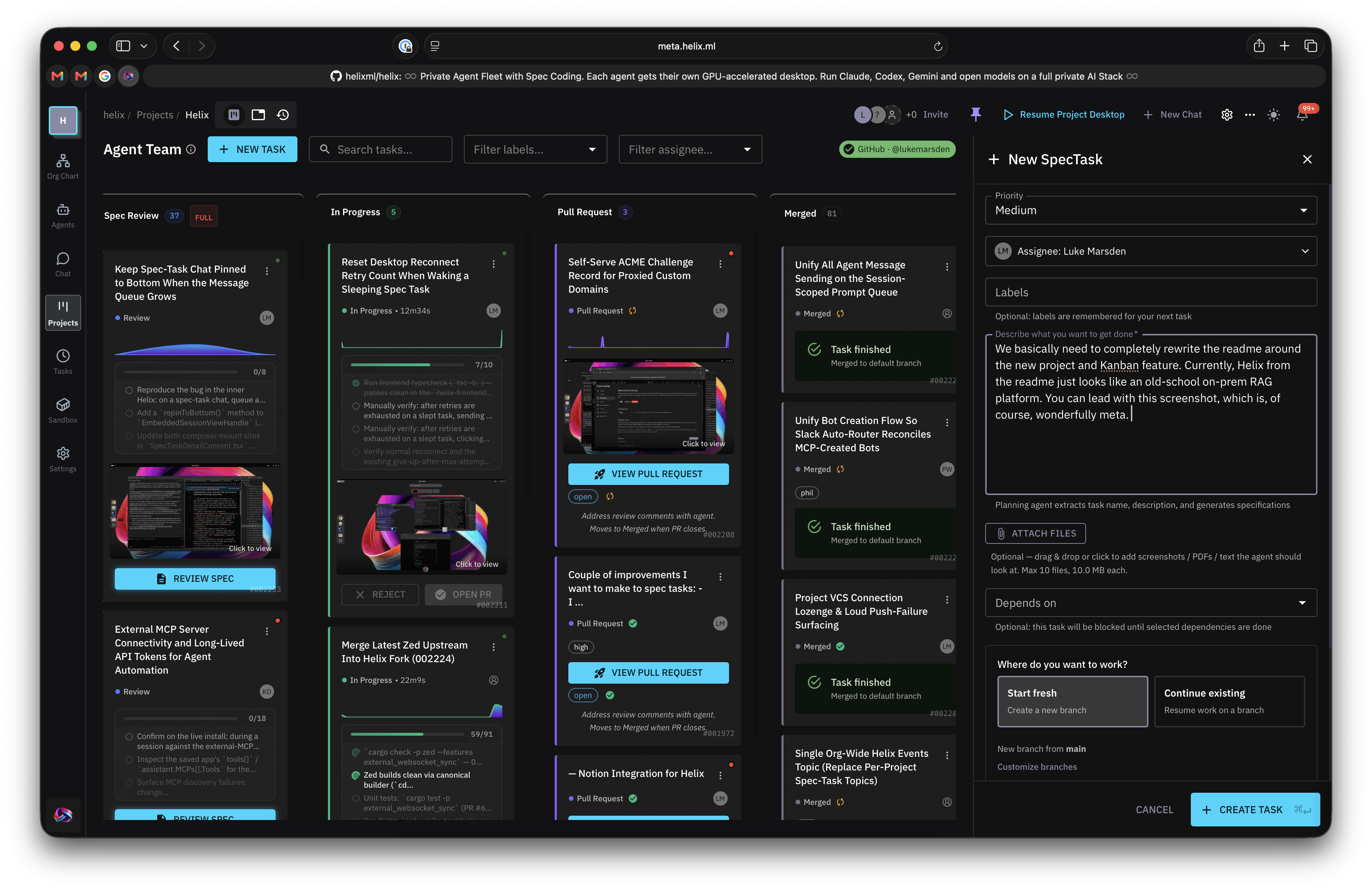
Helix runs fleets of AI coding agents on your infrastructure. Each agent gets an isolated GPU-accelerated Linux desktop with browser, terminal, and GUI apps. Work flows through a spec-driven Kanban board: describe the outcome, a planner writes a spec, you approve, an implementer codes in its sandbox and opens a PR. Multiple agents run in parallel; teammates can watch, steer, or hand off across time zones. Integrates with Claude Code, Codex, Gemini, Qwen, Goose, Zed, and any ACP agent. Supports hosted and self-hosted LLMs via vLLM, Ollama, or OpenAI-compatible endpoints. Includes RAG, MCP tools, tracing, OIDC SSO, billing, automation, and Slack/Discord/email notifications. Deploy via Docker, Kubernetes Helm, Mac app, or Sovereign Server appliance. Source-available license: free for personal, educational, and small business; paid for larger commercial use.
Should you self-host helix?
helix scores 52/100 on selfhost.directory (how scoring works) and ranks #86 of 209 in AI Agents. It has 824 GitHub stars.
It shipped 38 stable releases in the past year. The latest, 2.12.42, came out on 28 October 2026.
Setup is advanced: plan for several services and some ongoing maintenance. An official Docker image is available. It is Other-licensed and written mostly in Go.
Its closest alternative on selfhost.directory is Orca (91/100, 108 642 stars). It scores higher overall, so compare the two before you pick. See helix vs Orca side by side.
Features
- Agent fleet orchestration
- Automation via cron and webhooks
- Billing and metering
- Follow-the-sun handoff
- GPU-accelerated agent desktops
- Live agent observation and pair programming
- MCP server compatibility
- Multi-agent harness support
- Multi-agent parallel execution
- Multi-tenancy with RBAC and OIDC SSO
- Notifications
- RAG with multiple backends
- Self-hosted LLM support
- Spec-driven Kanban board
- Tracing and observability
helix README
FAQ
How much does Helix cost?
The Mac App is $299/year for individuals. Helix for Linux starts at $199/year. Helix Cloud is $499 per user per month. Enterprise deployment on your own Kubernetes cluster starts at $75K for an 8-week production pilot. The turnkey Sovereign Server is a one-time $175K purchase.
Can the Sovereign Server run air-gapped, with no internet?
Yes. It is designed to operate with no outbound internet access after initial setup: all inference runs on the local GPUs and all data stays on the hardware.
What is the Helix Sovereign Server?
A 4U rack server with 8× NVIDIA RTX PRO 6000 Blackwell Server Edition GPUs (768 GB total VRAM), delivered with the full Helix stack pre-installed for air-gapped operation. One-time purchase at $175,000 with no token metering.
Which AI agents and models work with Helix?
Helix supports Claude Code, OpenAI Codex, Gemini CLI, Qwen Code, Goose, and Zed Agent. Models route through configured providers — Anthropic, OpenAI, Google, or fully local open-weight models (Llama, Qwen, DeepSeek, Mistral) via Ollama or vLLM.
Does Helix run on your own infrastructure?
Yes, that is the default architecture. Helix runs as a Mac App ($299/year), on Linux/Kubernetes (developer licenses from $199/year, enterprise from $75K), fully air-gapped for regulated environments, or as a turnkey Sovereign Server shipped to your data centre.
What is HelixML?
HelixML builds Helix, an AI agent orchestration platform that sandboxes coding agents in isolated streaming Linux desktops, orchestrates fleets of them, and puts every change through spec review and human-approved pull requests.
More in Code Management
 ModoModo is an open-source AI IDE forked from Void adding spec-driven development, steering files, agent hooks, and parallel chat. Runs locally as a desktop app.
 OpenGUIOpenGUI is a self-hosted, open-source AI coding agent for desktop and web that edits files in your folders using its own built-in harness — no external CLI or Git needed.
 OperantOperant is a self-hosted AI agent runtime for macOS/Linux that lets multiple LLMs collaborate on coding with hierarchical approval, memory, and a visual workflow editor.
 pomeloAn open-source platform for running coding contests with sandboxed code execution, real-time scoreboards, and support for multiple programming languages.
 pylonPylon IDE is a self-hosted, open-source web-based IDE forked from Cloud9 v2, featuring the ACE editor, built-in terminal, and plugin system on Node.js 22+.
 QA-PilotQA-Pilot is a self-hosted, open-source chat app that helps developers understand GitHub code repositories using local or cloud LLMs with code graph visualization.
 RoomoteSelf-hosted AI coding agent that runs in sandboxes, connects to chat apps, writes code, opens PRs with screenshots and live previews.
 SeaGOATOpen-source semantic code search you self-host: vector embeddings plus ripgrep regex, local server with an HTTP API, and optional Ollama LLM enhancement.
 sniboxSnibox is a self-hosted, open-source snippet manager built with Ruby on Rails and Vue.js for developers to collect, organize, and search code snippets.
 snippet-boxSnippet Box is a self-hosted, open-source application for organizing and managing code snippets with built-in search, tagging, syntax highlighting, and Markdown support.
 sturdySturdy is an open-source, self-hosted version control platform for real-time code collaboration, letting teams discover work-in-progress code instantly.
 zedexzedex is a self-hosted, open-source proxy server for the Zed editor that caches extensions, serves releases, and provides edit prediction via OpenAI-compatible backends.
0 comments