
Self-host DashClaw
platform-v5.38.0Remote approval system for unattended AI agents
- Stars
- 313
- Port
- 3000 (HTTP server)
- Requires
- PostgreSQL
What is DashClaw?
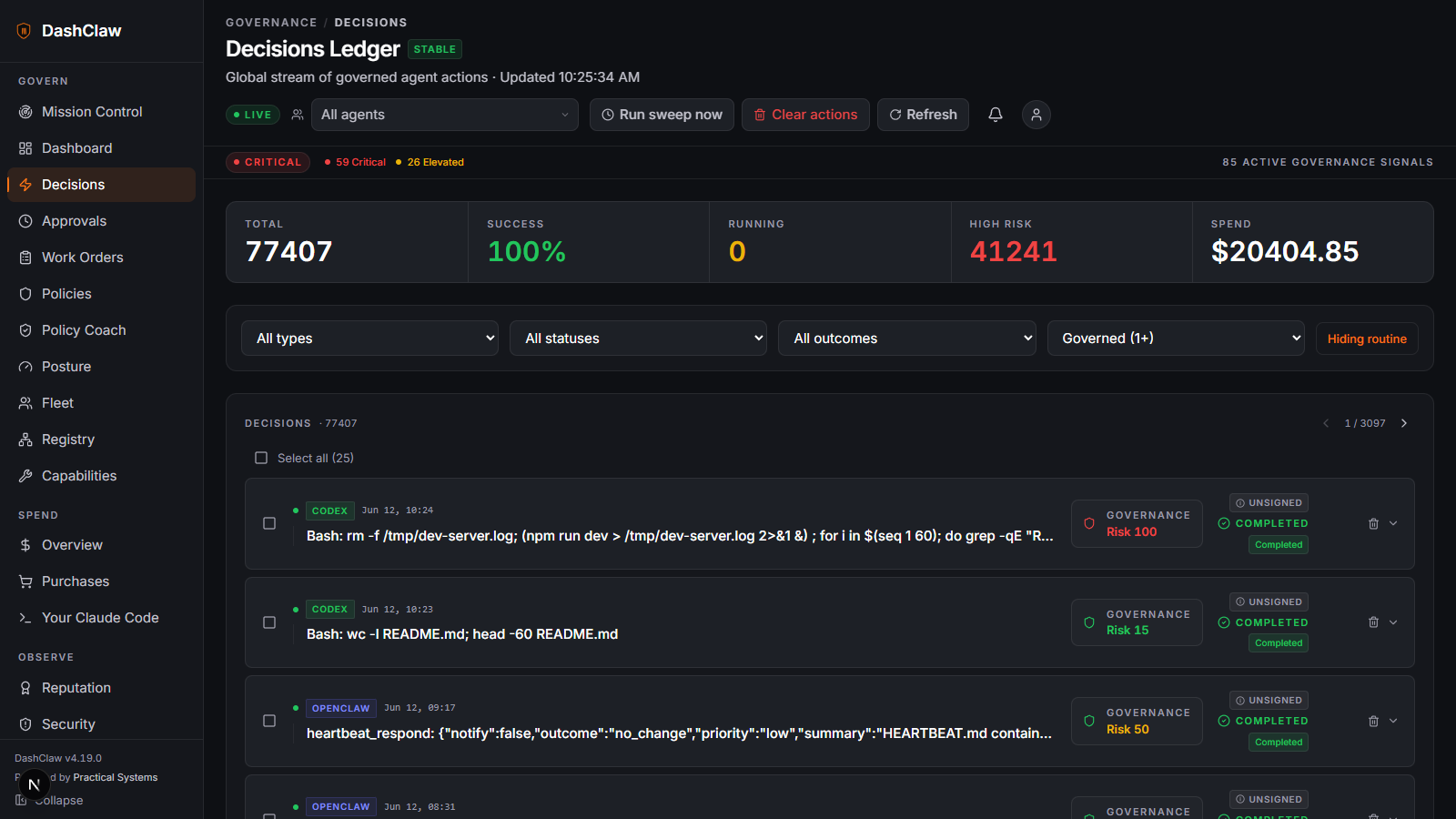
DashClaw is a governance control plane for unattended AI agents. It evaluates agent tool calls against declarative policies before execution, either allowing, warning, containing, requiring human approval, or blocking them. Mechanical enforcement works at the hook seam for several coding agents (fail-closed, exit-2 on block), while SDKs, MCP server, and REST API integrations are cooperative — the caller must honor the verdict. Approvals can be resolved from a web dashboard, CLI, mobile PWA, Telegram, or Discord. The system includes a calibrated interruption controller that learns from approve/deny verdicts to reduce false interruptions with a proven bound, an enforcement liveness probe that tests whether the installed hook seam actually holds actions, prompt-injection scanning on by default, and Ed25519-signed receipts for decision records. It runs on Node 20+ with PostgreSQL (Docker or Neon serverless), defaults to port 3000, and can be deployed locally via npx dashclaw up or to Vercel with a Neon database. The project is MIT-licensed, maintained by an AI agent under a human-held charter (Practical Systems), and has near-daily releases since February 2026.
Should you self-host DashClaw?
DashClaw scores 47/100 on selfhost.directory (how scoring works) and ranks #123 of 209 in AI Agents. It has 313 GitHub stars.
It shipped 13 stable releases in the past year. The latest, platform-v5.38.0, came out on 26 September 2026. New versions land roughly every 3 days.
Setup is moderate: expect some configuration beyond a single command. It is MIT-licensed and written mostly in Typescript.
Its closest alternative on selfhost.directory is Orca (91/100, 108 642 stars). It scores higher overall, so compare the two before you pick. See DashClaw vs Orca side by side.
Features
- Calibrated interruption controller
- Containment verdicts
- Durable execution finality
- Enforcement liveness probe
- External decision provider
- MCP server with 17 governance tools
- Mechanical enforcement at hook seam
- Multi-runtime support
- Plan authorization and attestation
- Policy packs and AI generator
- Prompt-injection scanning
- Remote approval inbox
- Signed decision receipts
- Standing grants (Allow, don't ask again)
DashClaw README
More in Security
 DatabunkerSecure Vault for Customer PII/PHI/PCI/KYC Records
 Databunker ProDatabunker is an open-source, self-hosted vault for tokenizing and encrypting personal records (PII, PHI, KYC) with a REST API, web UI, and GDPR compliance.
 Deadend CLIDeadend CLI is a self-hosted, open-source CLI for autonomous web app pentesting using feedback-driven AI with any LiteLLM model, achieving ~80% on XBOW.
 deceptifeedSelf-hosted honeypot server running SSH, HTTP, TCP, UDP services with threat feed in multiple formats for firewall integration.
 dmarcguardSelf-hosted tool for parsing DMARC aggregate reports into a SQLite database with a web UI, Prometheus metrics, and MCP server for AI access.
 DMARC Report ViewerSelf-hosted open-source tool fetching DMARC and SMTP TLS reports via IMAP with a responsive web UI, charts, and export. Runs as a single binary or small Docker image.
 D-NETSelf-hosted network tool automating DDNS, dynamic CDN, port forwarding, reverse proxy, and ACME SSL certificates via web UI.
 dnsboxDNSBox is a self-hosted DNS server that issues Let's Encrypt SSL certs for any public IP without a domain, enabling instant HTTPS for servers and IoT devices.
 docker-cyberchefDaily-built Docker image running GCHQ CyberChef, a browser tool for crypto, encoding, compression, and data inspection.
 docker-openvpnSelf-hosted OpenVPN Docker image with auto PKI, client management, dual-stack IPv4/IPv6, and modern ciphers.
 docker-registry-uiSelf-hosted web UI for Docker registries with Trivy scanning, bulk cleanup, and multi-registry management.
 domain-watchdogSelf-hosted open-source domain monitor using RDAP to track history, alert on changes, and auto-backorder expiring domains via registrar APIs.
0 comments