
Self-host brainrotguard
v1.33.0YouTube approval system for kids via Telegram
- Stars
- 396
- Port
- 8080 (web UI)
ghcr.io/ghjj123/brainrotguard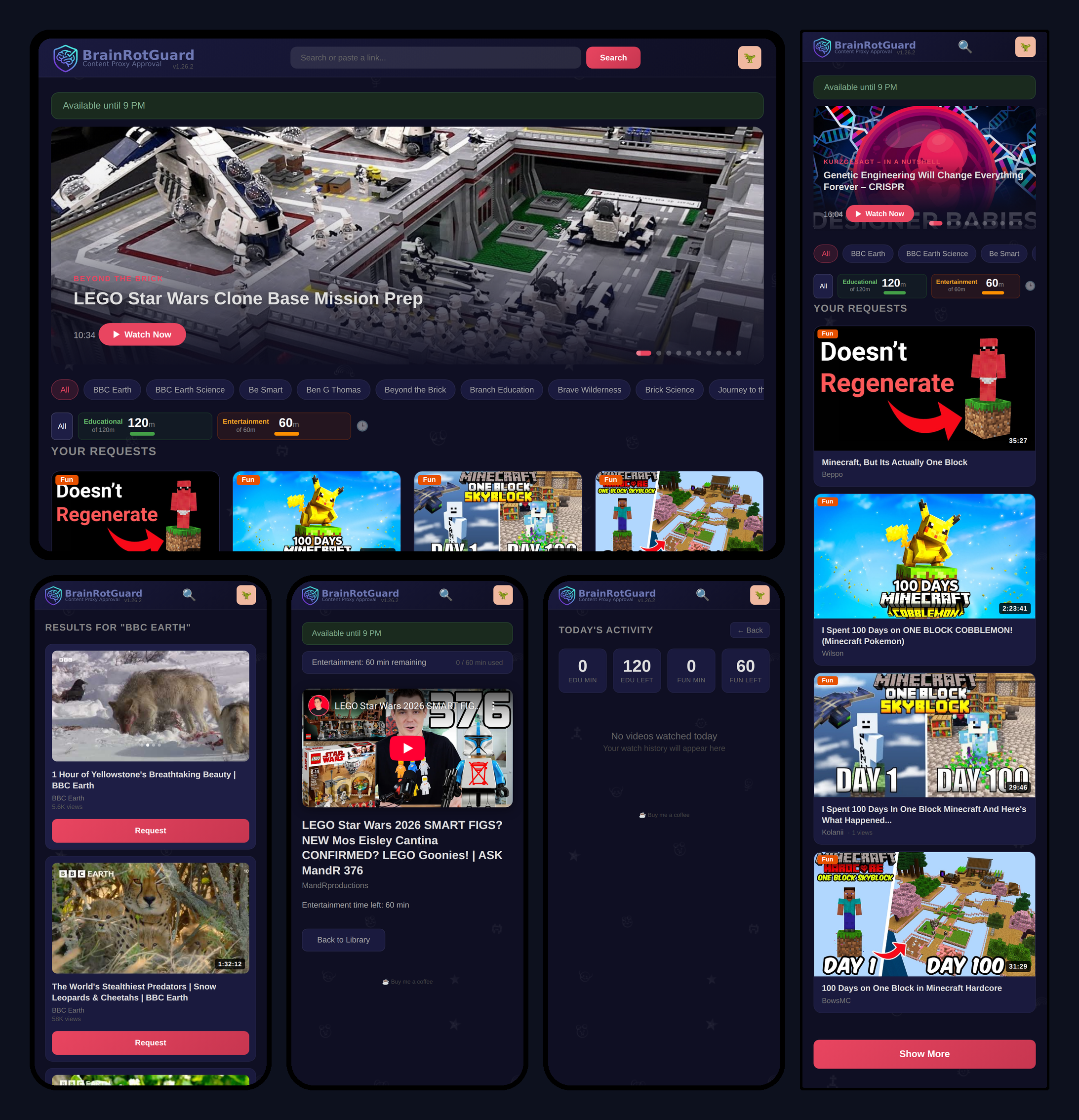
What is brainrotguard?
BrainRotGuard lets parents control what their children watch on YouTube. Kids search for videos on a tablet web page and send requests. Parents get a Telegram notification showing the video details and tap Approve or Deny. Approved videos play right away on the child's device. The software uses yt-dlp to fetch YouTube data without an API key and embeds videos from youtube-nocookie.com. It supports multiple child profiles, each with a PIN, separate watch history, and time budgets. Content can be labeled as educational or entertainment with different daily limits. Viewing schedules can be set per day of the week. Channels can be allowlisted for automatic approval or blocked entirely. Word filters hide videos with specific terms in the title. A Telegram bot provides a setup wizard and commands for managing everything. The app runs in Docker with pre-built images for amd64 and arm64, or directly with Python 3.11+. All data lives in one SQLite file. It is MIT licensed and has an Unraid template.
Should you self-host brainrotguard?
brainrotguard scores 49/100 on selfhost.directory (how scoring works) and ranks #10 of 22 in Home Server. It has 396 GitHub stars.
It shipped 12 stable releases in the past year. The latest, v1.33.0, came out on 29 September 2026. New versions land roughly every 4 days.
Setup is moderate: expect some configuration beyond a single command. An official Docker image is available. It is MIT-licensed and written mostly in Python.
Its closest alternative on selfhost.directory is CasaOS (76/100, 37 389 stars). It scores higher overall, so compare the two before you pick. See brainrotguard vs CasaOS side by side.
Features
- Channel allow/block lists
- Daily screen time limits
- Educational vs entertainment categories
- Guided setup wizard
- Multi-child profiles
- PIN lock for web UI
- Scheduled viewing hours
- Search History
- Search-off mode
- Telegram-based approval workflow
- Update Notifications
- Watch activity log
- Word filters
- YouTube Shorts control
brainrotguard README
More in Home Server
 CasaOSSelf-hosted personal cloud OS for Linux machines: a friendly web dashboard, an app store with one-click Docker installs, drive and file management, and remote access.
 ClipCascadeOpen-source clipboard sync for Windows, macOS, Linux and Android: text, images and files relayed by a self-hosted server or peer-to-peer, end-to-end encrypted.
 DakosysSelf-hosted tool for Plex users that automates Trakt lists and Kometa overlays for anime episode types, TV show status, and file sizes with a web dashboard.
 DashySelf-hosted homelab dashboard and startpage with status checks, dozens of widgets, themes, icon packs, multi-user auth and SSO, plus a live UI config editor.
 DebNASDebNAS turns a minimal Debian 12/13 install into a home NAS with Cockpit UI, Portainer, VMs, SMB, RAID, and security hardening via one script.
 deqHomelab control plane with native Android app, Wear OS, and Android Auto. SSH-based control from a dashboard. Single Python file. Zero dependencies. Dynamic config. No YAML.
 docker-cupsdSelf-hosted CUPS printing server as a Docker image with many printer drivers. Exposes IPP port 631 for network printing from any device.
 docker-pi-holeSelf-hosted, open-source Docker image of Pi-hole: network-wide DNS ad blocking with a web dashboard, query log, blocklists, built-in DHCP server and a REST API.
 DropserverSelf-hosted application platform for running personal web services with sandboxed apps, multi-user appspaces, and Tailscale integration.
 dumpstoreSelf-hosted, open-source NAS management UI for ZFS on Linux/FreeBSD — manages pools, datasets, snapshots, SMB/NFS/iSCSI sharing without containers or databases.
 dynamiXdynamiX automates Plex collection pinning by time blocks and seasons, plus manages seasonal pre-roll videos. Self-hosted via Docker or Python with PWA UI on port 1166.
 easy-gateSelf-hosted dashboard parsing services from config files in real-time with IP-based user groups for tailored access.
0 comments