
Self-host agenttier
v0.8.1Kubernetes-native sandbox platform for AI agents
- Stars
- 52
- Ports
- 80 (Web UI (nginx)), 8080 (Router API)
- Requires
- CNI with NetworkPolicy support, CSI storage driver, Helm, Kubernetes
ghcr.io/agenttier/controller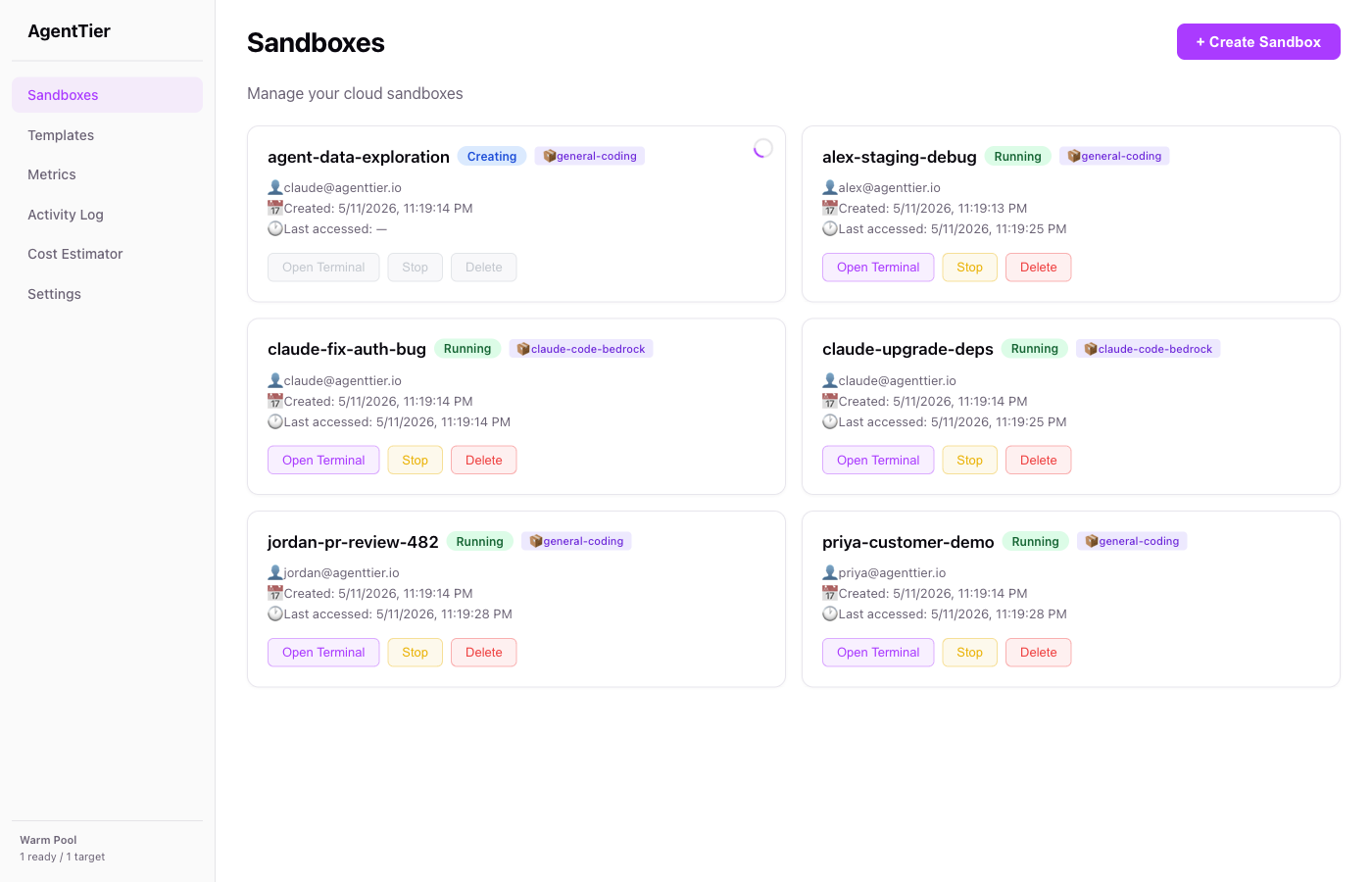

What is agenttier?
This Kubernetes platform provisions isolated, persistent sandbox environments for AI agents and developers. Each sandbox runs as a pod with dedicated persistent storage, network policies, and a browser-based terminal. The system includes a web dashboard, REST API, WebSocket terminal server, and Python/Go SDKs. Capabilities include running AI coding agents securely, on-demand developer environments, optional gVisor kernel isolation, multi-agent workflows, warm pod pools for fast startup, sandbox stop/resume/clone via CSI snapshots, and OIDC authentication with API keys. Deployment uses a single script for local clusters or AWS EKS with Terraform, plus a Helm chart for pre-built images. Licensed Apache-2.0, it requires Kubernetes 1.27+, a CNI with NetworkPolicy support, and a CSI storage driver.
Should you self-host agenttier?
agenttier scores 40/100 on selfhost.directory (how scoring works) and ranks #134 of 166 in Developer Tools. It has 52 GitHub stars.
It shipped 10 stable releases in the past year. The latest, v0.8.1, came out on 30 June 2026.
Setup is advanced: plan for several services and some ongoing maintenance. An official Docker image is available. It is Apache-2.0-licensed and written mostly in Go.
Its closest alternative on selfhost.directory is openhands (87/100, 92 086 stars). It scores higher overall, so compare the two before you pick. See agenttier vs openhands side by side.
Features
- AI agent sandbox templates
- API Key Authentication
- Browser-based PTY terminal
- Go CLI for agent mode
- gVisor kernel isolationOptional, requires gVisor-enabled nodes
- Multi-Agent Workflows
- Observability StackOptional components
- OIDC Authentication
- Python SDK and CLI
- Sandbox cloning
- Sandbox stop/resume
- Scheduled backup snapshotsOptional component
- Warm pod pool
- Web Dashboard
agenttier README
More in Containers
 beamA self-hostable, open-source platform for running serverless AI workloads with GPU inference, code sandboxes, and background task queues.
 cadvisorSelf-hosted, open-source cAdvisor daemon tracks CPU, memory, network and disk usage of running containers, exposing a web UI, REST API and Prometheus metrics.
 Cloud in a BottleOpen-source personal cloud OS: install web apps from Git repos on your own Ubuntu server or VM, with subdomain routing, HTTPS, sandboxed containers, backups and a CLI.
 CoderCoder is an open-source, self-hosted control plane for remote dev environments and AI coding agents, with Terraform-defined workspaces and WireGuard-secured access.
 dockgeA self-hosted, open-source web UI for Docker Compose stacks: create, edit and deploy compose.yaml files, with a live web terminal and multi-host agents.
 frappe_dockerOpen-source Docker images and Compose setups to self-host Frappe apps such as ERPNext, CRM and Helpdesk, from demo installs to production deployments.
 hiveboxSelf-hosted Linux sandbox isolating AI agents with kernel namespaces and cgroups, featuring a REST API, MCP bridge, and built-in web dashboard.
 konarrKonarr is a self-hosted, open-source SCA platform for monitoring container dependencies and vulnerabilities using Syft, Grype, and Trivy.
 LXCSelf-hosted, open-source low-level Linux container runtime for privileged and unprivileged system containers, driven by dotted lxc.* config keys and a stable C API.
 OfeliaAn open-source cron replacement for Docker hosts: schedule jobs as container labels or INI entries and run them via exec, new containers, or Swarm.
 Red Hat QuaySelf-hosted, open-source container image registry that stores OCI artifacts, scans with Clair, and runs standalone on Podman or on Kubernetes via the Quay Operator.
 swarm-cronjobOpen-source, self-hosted cron scheduler for Docker Swarm that turns services into recurring jobs via labels, with automatic discovery and time-zone support.
0 comments