
Self-host addon-influxdb
v6.0.0InfluxDB 1.x with Chronograf & Kapacitor for Home Assistant
- Stars
- 203
- Ports
- 8086 (InfluxDB HTTP API), 8088 (InfluxDB RPC service for backup and restore), 8089 (InfluxDB UDP listener)
What is addon-influxdb?
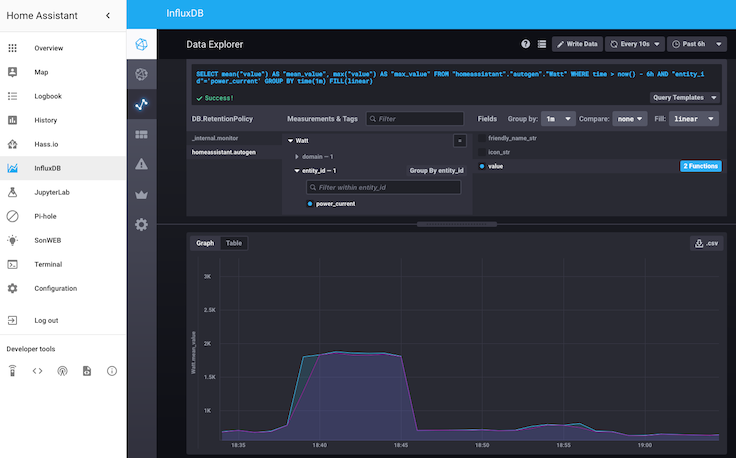
InfluxDB v1 is a Home Assistant Community Add-on that packages the InfluxDB 1.x time-series database along with Chronograf for web-based database administration and Kapacitor for stream processing. It is designed to run on Home Assistant OS or Supervised installations via the Home Assistant Supervisor. The add-on exposes the InfluxDB HTTP API on port 8086 for use with the Home Assistant InfluxDB integration (api_version: 1), Grafana, and other clients. Chronograf provides a web UI for managing databases, users, and retention policies, accessible via Home Assistant Ingress or directly on port 80. Kapacitor's HTTP API is available on port 9092 for external task management. The add-on supports SSL for the Chronograf interface, optional authentication, and configurable logging. Data persists in the Home Assistant data directory and is included in regular Home Assistant backups. This is specifically the InfluxDB 1.x series (InfluxQL), not InfluxDB 2 or 3.
Should you self-host addon-influxdb?
addon-influxdb scores 55/100 on selfhost.directory (how scoring works) and ranks #30 of 40 in Database Management. It has 203 GitHub stars.
It shipped 1 stable release in the past year. The latest, v6.0.0, came out on 17 September 2026.
Setup is easy: most people get it running in one sitting. It is MIT-licensed and written mostly in Jinja.
Its closest alternative on selfhost.directory is supabase (92/100, 114 252 stars). It scores higher overall, so compare the two before you pick. See addon-influxdb vs supabase side by side.
Features
- Backup and Restore
- SSL for web interfaceDoes not apply to InfluxDB API on port 8086
- Time Series Database
- UDP listenerDisabled by default, enabled via envvars
- User Authentication
- Web administration UI
addon-influxdb README
More in Database Management
 AdminerAdminer is a self-hosted PHP database tool supporting seven systems natively and more via plugins. Single-file deployment makes it a lightweight phpMyAdmin alternative.
 agxagx is a self-hosted, open-source desktop app for SQL analytics with AI-assisted queries and ClickHouse backend. Runs natively via Tauri or as a web interface via Docker.
 Apache DruidApache Druid: a high performance real-time analytics database.
 autobaseOpen-source MIT DBaaS for PostgreSQL: Patroni-based HA clusters, backups, failover and upgrades driven from a web console, Ansible collection or GitOps.
 AzimuttOpen-source, self-hosted database explorer and Next-Gen ERD: design schemas with AML, document tables and columns, browse data and lint large, messy databases.
 BaserowA self-hosted, open-source Airtable alternative: no-code databases with forms, automations and an app builder, MIT-licensed core with paid Premium tiers.
 bkndbknd is a self-hosted, open-source backend-as-a-service with REST APIs, admin dashboard, auth, media, and workflows — a lightweight Firebase/Supabase alternative.
 BusabaseSelf-hosted open-source workspace where AI agents and people share typed records, documents, reusable skills, and internal tools with built-in review workflows.
 BytebaseSelf-hosted, open-source database governance: reviewed schema changes, SQL review rules, RBAC, masking, audit logs and an MCP server across 20+ engines.
 ChartDBOpen-source database diagram editor that visualizes schemas with a single query, supports major databases, exports SQL, and self-hosts via Docker.
 chmonitorchmonitor is a self-hosted, open-source operational advisor for ClickHouse that reads system tables for real-time monitoring and AI-driven schema recommendations.
 clinSelf CLI provisions a production-ready backend — PostgreSQL, Hasura GraphQL, Auth, Nginx — on your own server in minutes via Docker. MIT licensed with 171 plugins.
0 comments