
Self-host prometheus-qbittorrent-exporter
1.7.1Prometheus exporter for qBittorrent metrics
- Stars
- 197
- Port
- 8000 (Prometheus metrics endpoint)
- Requires
- qBittorrent
ghcr.io/esanchezm/prometheus-qbittorrent-exporter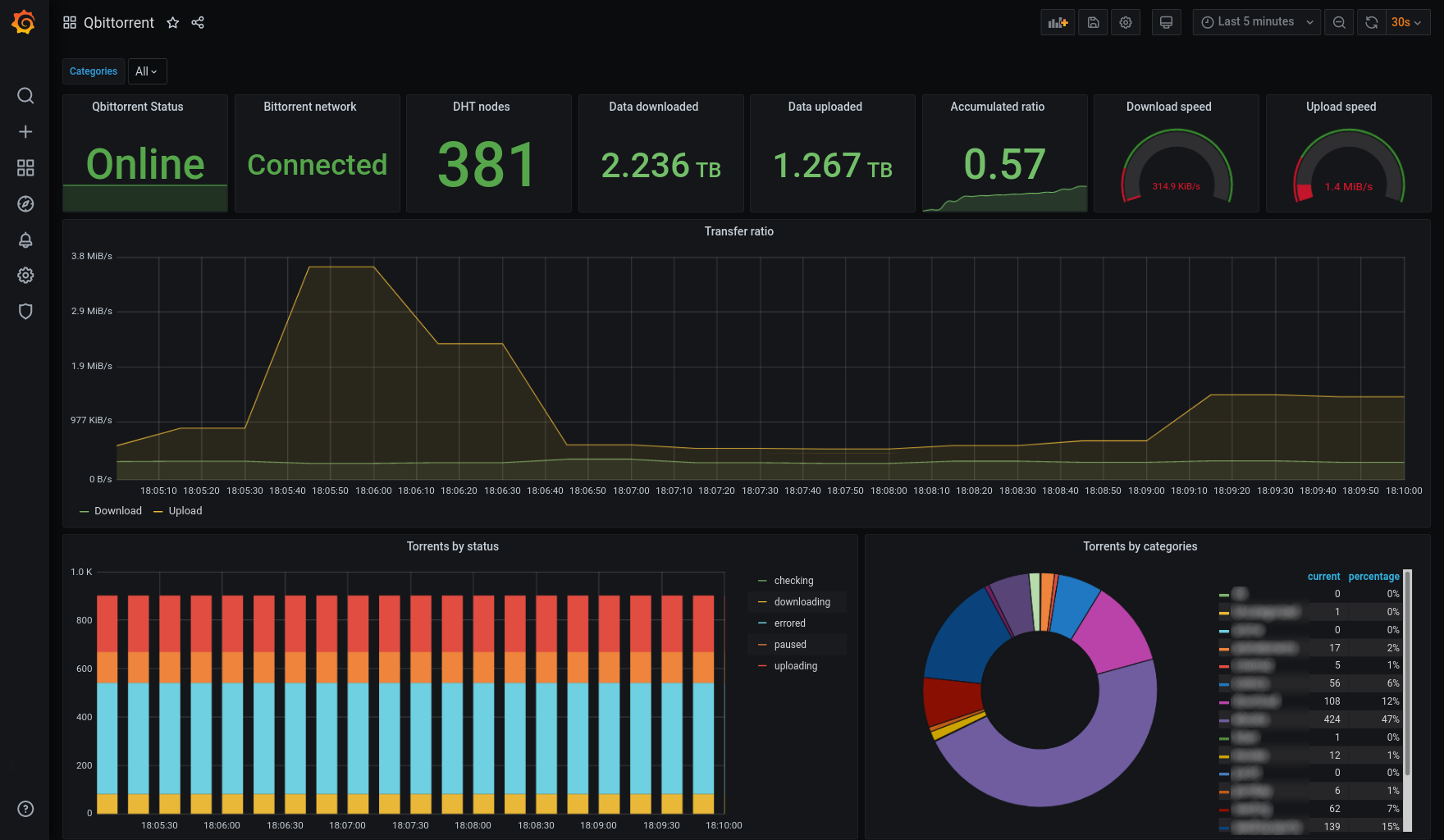
What is prometheus-qbittorrent-exporter?
prometheus-qbittorrent-exporter is a Python-based Prometheus exporter that connects to a qBittorrent server and exposes its metrics in Prometheus format. It collects data such as torrent counts by category and status, download/upload statistics, DHT nodes, peer connections, and server connectivity status. The exporter can be installed via pip or run as a Docker container from ghcr.io. Configuration is done through environment variables for the qBittorrent connection details, exporter listening address and port, log level, and metrics prefix. It requires a running qBittorrent instance with WebUI enabled. The project is licensed under GPL-3.0 and includes a Grafana dashboard for visualization.
Should you self-host prometheus-qbittorrent-exporter?
prometheus-qbittorrent-exporter scores 46/100 on selfhost.directory (how scoring works) and ranks #73 of 104 in Monitoring & observability. It has 197 GitHub stars.
It shipped 2 stable releases in the past year. The latest, 1.7.1, came out on 25 October 2026. New versions land roughly every 5 months.
Setup is easy: most people get it running in one sitting. An official Docker image is available. It is GPL-3.0-licensed and written mostly in Python.
Its closest alternative on selfhost.directory is grafana (90/100, 77 568 stars). It scores higher overall, so compare the two before you pick. See prometheus-qbittorrent-exporter vs grafana side by side.
Features
- API Key Authentication
- Configurable log level
- Configurable metrics prefix
- Grafana Dashboard
- Network connectivity metrics
- Prometheus metrics export
- SSL/TLS support
- Torrent statistics
prometheus-qbittorrent-exporter README
More in Infrastructure Monitoring
 proxcenter-uiSelf-hosted, open-core platform for managing Proxmox VE clusters and PBS — a VMware vCenter alternative with multi-cluster monitoring, automation, and multi-tenancy.
 proxmox-datacenter-managerSelf-hosted open-source platform centralizing management of Proxmox VE clusters and Backup Server instances with unified dashboard, live migration, and enterprise auth.
 ProxPadProxPad is a self-hosted web UI turning tablets into Proxmox VM control centers with macros, media controls, and resource conflict prevention.
 PulseOpen-source, self-hosted ops dashboard for Proxmox, Docker, Kubernetes, vSphere and TrueNAS, with buffered alerts, metric history and scheduled AI patrols.
 PVE-UPSSelf-hosted UPS monitor that shuts down Proxmox VE/Backup Server via API tokens. Browser wizard, SNMP/NUT support, no agents or config files.
 racktablesRackTables current development repository
 RackulaRackula is a self-hosted, open-source rack layout designer using real NetBox device images. Plan server racks, export to PNG/PDF/SVG/YAML, and share via URL or QR code.
 ruptimeruptime is a self-hosted, open-source reimplementation of classic Unix r-commands with client-server architecture and encrypted traffic for multi-network monitoring.
 SenchoSelf-hosted, open-source control plane for managing Docker Compose stacks across multiple nodes with a web UI, real-time logs, and fleet-wide orchestration.
 sensu-goSelf-hosted, open-source monitoring with auto-discovery for cloud environments, using service checks and an observability pipeline to collect and transform telemetry.
 ShinkenShinken is a self-hosted, open-source monitoring framework compatible with Nagios config and plugins. Written in Python with distributed architecture.
 skyfloDeprecated open-source AI agent that runs in your Kubernetes cluster to automate infrastructure via a deterministic approval-gated control loop.
0 comments