
Self-host openHop Repeater
1.1.4Lightweight Python MeshCore repeater for LoRa mesh networks
- Stars
- 298
- CPU
- 2 cores (Proxmox LXC default)
- RAM
- 1024 MB (Proxmox LXC default)
- Storage
- 4 GB (Proxmox LXC default)
- Port
- 8000 (Web dashboard and REST API (CherryPy))
openhop/openhop-repeater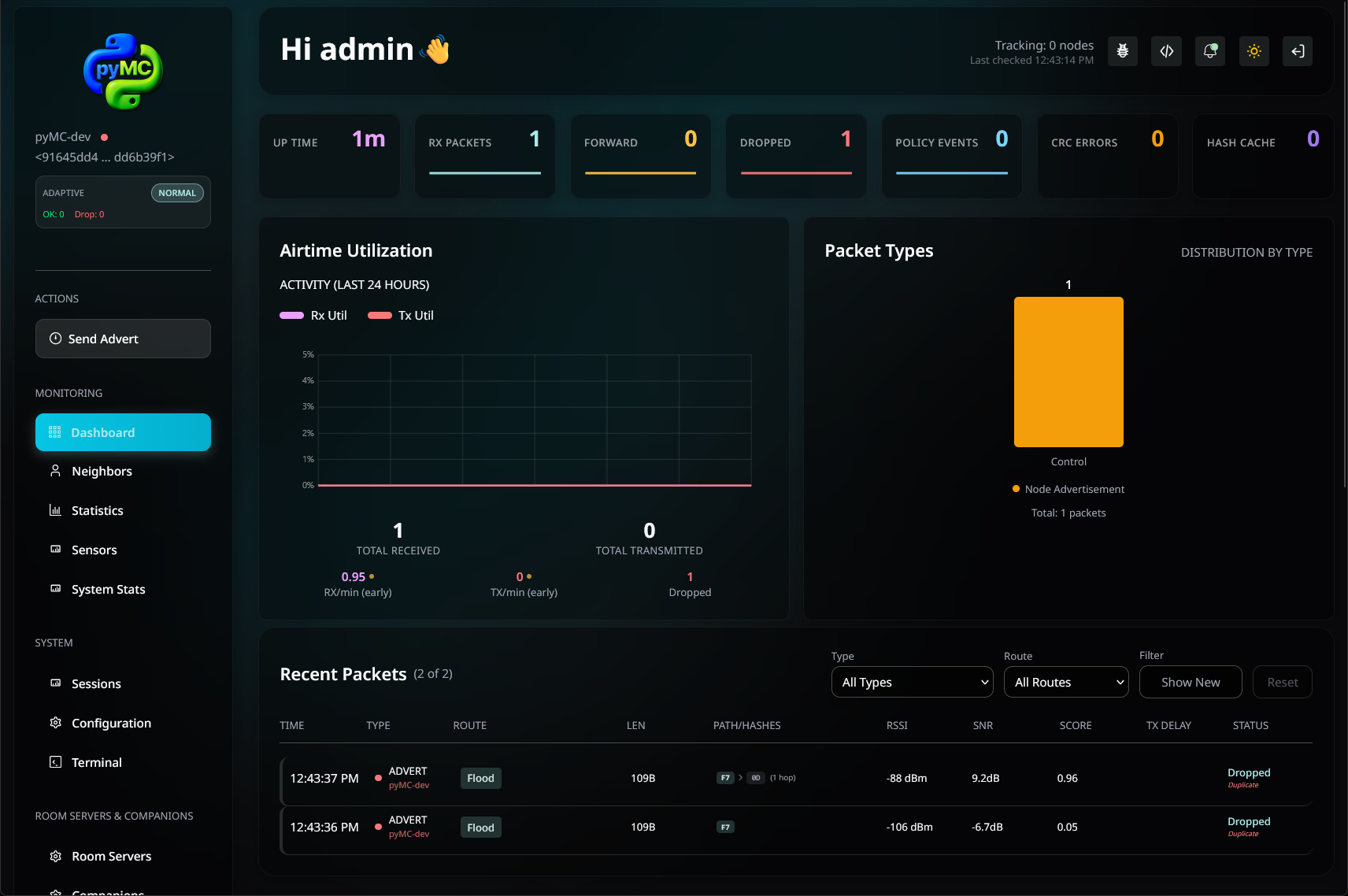

What is openHop Repeater?
A MeshCore infrastructure node that forwards LoRa packets and provides a web dashboard with REST API for configuration. It includes a policy engine for packet rules and supports multiple radio backends: native SX1262 SPI, CH341 USB-to-SPI, openHop Modem TCP/USB, KISS serial, and a no-radio test mode. Runs on Raspberry Pi, Proxmox LXC, or Docker. Features sensor manager, GPS, MQTT/LetsMesh publishing, plugin system, CAD calibration, and Home Assistant integration. MIT licensed.
Should you self-host openHop Repeater?
openHop Repeater scores 51/100 on selfhost.directory (how scoring works) and ranks #2 of 10 in Network. It has 298 GitHub stars.
It shipped 1 stable release in the past year. The latest, 1.1.4, came out on 8 September 2026.
Setup is advanced: plan for several services and some ongoing maintenance. An official Docker image is available. It is MIT-licensed and written mostly in Python.
Its closest alternative on selfhost.directory is scanopy (64/100, 5 913 stars). It scores higher overall, so compare the two before you pick. See openHop Repeater vs scanopy side by side.
Features
- CAD Calibration
- GPS Support
- Home Assistant IntegrationSeparate integration/add-on
- MQTT & LetsMesh Integration
- Multi-radio RF Fabric
- Plugin System
- Policy Engine
- REST API
- Sensor Manager
- Web Dashboard
openHop Repeater README
More in Network
 OpenSMTPDOpenSMTPD is a free, open-source SMTP server for Linux, BSD, and macOS with TLS and privilege separation.
 proxvn_tunnel_fullProxVN Tunnel is a self-hosted Go tunneling tool exposing local services via HTTPS subdomains, TCP, UDP, and WebDAV — with a free public server and no session limits.
 scanopyNetwork diagrams that update themselves
 SimpleXSimpleXMQ is an open-source, self-hosted message broker implementing the SimpleX Messaging Protocol for private communication without user IDs.
 socks5-proxy-serverA self-hosted SOCKS5 proxy server with optional authentication and a Telegram bot for user management, deployed via Docker Compose with Redis backend.
 traefik-crowdsec-bouncerSelf-hosted HTTP service that integrates CrowdSec decisions with Traefik v2 ForwardAuth middleware to block malicious IPs before they reach your services.
 Traefik-Koptraefik-kop is an open-source agent that reads Docker labels and publishes them to Redis for Traefik, enabling multi-host routing without Swarm or Kubernetes.
 tunwgTunwg is a self-hosted, open-source ngrok alternative creating encrypted WireGuard tunnels with automatic HTTPS certificates and custom domains.
 webrtc_turnOpen-source TURN relay for AndroMeld that relays encrypted WebRTC traffic when P2P fails. Deploy via Docker on your VPS or one-click Cloudflare Worker.
 WireGuard EasyThe easiest way to run WireGuard VPN + Web-based Admin UI.
 aiwayaiway is a self-hosted transparent SNI proxy that routes AI service traffic through your VPS using DNS and SNI routing, no VPN needed.
 Apt-Cacher NGapt-cacher-ng is a self-hosted, open-source caching proxy that shares downloaded packages across a local network, supporting Debian, Ubuntu, Arch, and openSUSE.
0 comments