
Self-host Numa
v0.25.0Portable DNS resolver with ad blocking and .numa domains
- Stars
- 1 952
- Ports
- 53 (DNS (UDP/TCP)), 5380 (HTTP dashboard/API), 853 (DNS-over-TLS listener), 80 (HTTP proxy for .numa services), 443 (HTTPS proxy for .numa services), 8765 (Mobile API)
ghcr.io/razvandimescu/numa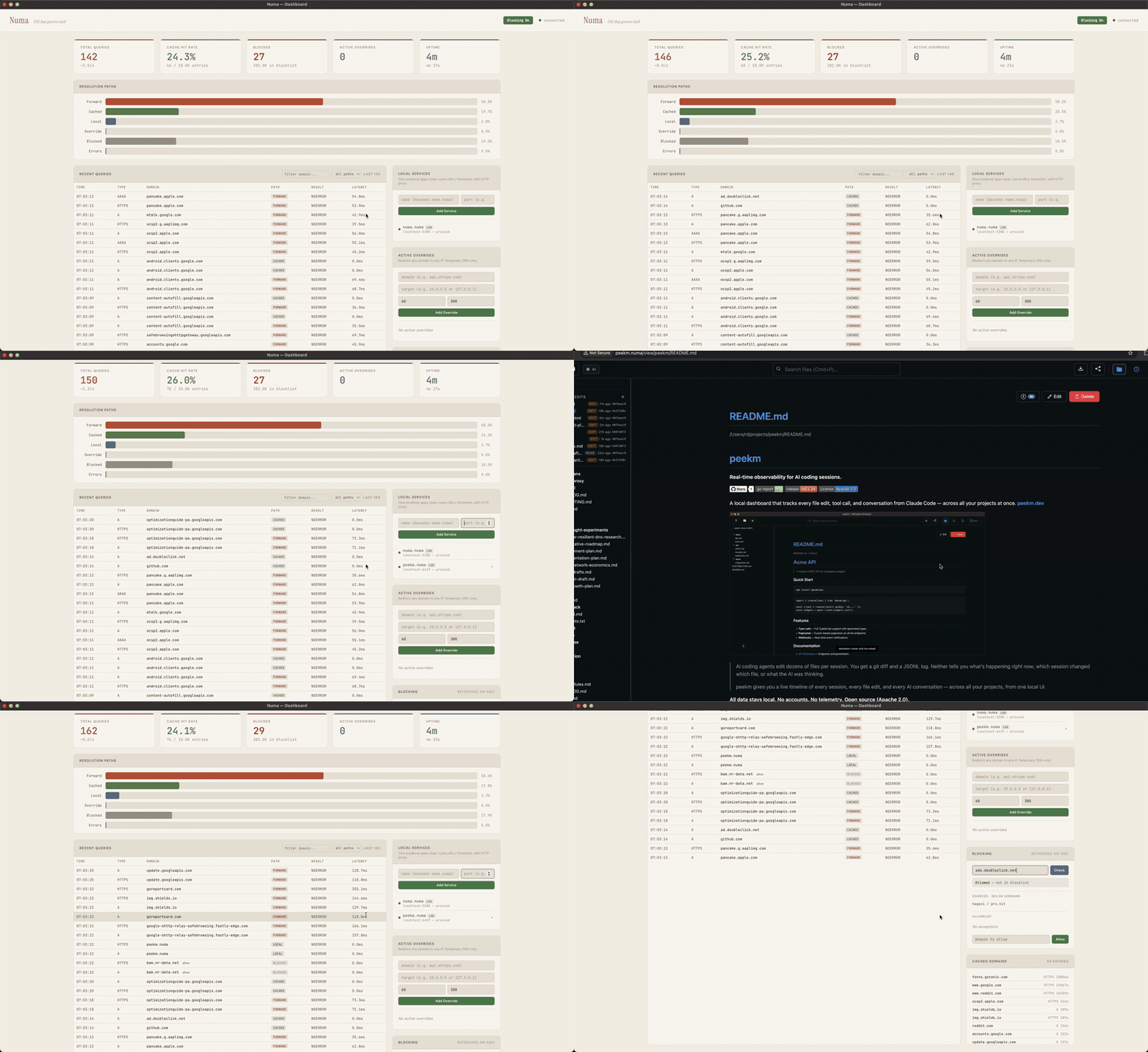
What is Numa?
Numa is a portable DNS resolver written in Rust that runs as a single ~8MB binary on macOS, Linux, and Windows. It caches DNS queries, blocks ads and trackers using Hagezi Pro lists, and offers three resolution modes: forward (proxy to existing DNS), recursive (resolve from root servers with full DNSSEC), and auto (probe roots, fall back to DoH). It creates local .numa domains for dev services with automatic HTTPS and WebSocket support, enables LAN service discovery via mDNS, and provides a REST API for DNS overrides. Numa includes a DNS-over-TLS listener (RFC 7858) for encrypted clients like iOS Private DNS, an Oblivious DoH client and relay (RFC 9230), and a web dashboard. Install via Docker, Homebrew, cargo, install script, or native packages (Arch, Nix). Runs as a system service and can configure system DNS automatically.
Should you self-host Numa?
Numa scores 57/100 on selfhost.directory (how scoring works) and ranks #16 of 41 in DNS. It has 1 952 GitHub stars.
It shipped 10 stable releases in the past year. The latest, v0.25.0, came out on 23 October 2026. New versions land roughly every 2 weeks.
Setup is moderate: expect some configuration beyond a single command. An official Docker image is available. It is MIT-licensed and written mostly in Rust.
Its closest alternative on selfhost.directory is AdGuard Home (84/100, 37 798 stars). It scores higher overall, so compare the two before you pick. See Numa vs AdGuard Home side by side.
Features
- Ad and tracker blocking
- Conditional forwarding
- Developer DNS overrides
- DNS Caching
- DNS-over-HTTPS upstream
- DNS-over-TLS listener
- DNSSEC Validation
- LAN service discovery
- Local .numa service domains
- Mobile onboarding
- Oblivious DoH (ODoH)
- Recursive DNS resolution
- Request hedging
- REST API
- Web Dashboard
Numa README
More in Network
 openHop RepeaterSelf-hosted, open-source MeshCore repeater with web dashboard, policy engine, multiple radio backends, and MQTT/LetsMesh/Home Assistant integration.
 OpenSMTPDOpenSMTPD is a free, open-source SMTP server for Linux, BSD, and macOS with TLS and privilege separation.
 proxvn_tunnel_fullProxVN Tunnel is a self-hosted Go tunneling tool exposing local services via HTTPS subdomains, TCP, UDP, and WebDAV — with a free public server and no session limits.
 scanopyNetwork diagrams that update themselves
 SimpleXSimpleXMQ is an open-source, self-hosted message broker implementing the SimpleX Messaging Protocol for private communication without user IDs.
 socks5-proxy-serverA self-hosted SOCKS5 proxy server with optional authentication and a Telegram bot for user management, deployed via Docker Compose with Redis backend.
 traefik-crowdsec-bouncerSelf-hosted HTTP service that integrates CrowdSec decisions with Traefik v2 ForwardAuth middleware to block malicious IPs before they reach your services.
 Traefik-Koptraefik-kop is an open-source agent that reads Docker labels and publishes them to Redis for Traefik, enabling multi-host routing without Swarm or Kubernetes.
 tunwgTunwg is a self-hosted, open-source ngrok alternative creating encrypted WireGuard tunnels with automatic HTTPS certificates and custom domains.
 webrtc_turnOpen-source TURN relay for AndroMeld that relays encrypted WebRTC traffic when P2P fails. Deploy via Docker on your VPS or one-click Cloudflare Worker.
 WireGuard EasyThe easiest way to run WireGuard VPN + Web-based Admin UI.
 aiwayaiway is a self-hosted transparent SNI proxy that routes AI service traffic through your VPS using DNS and SNI routing, no VPN needed.
0 comments