
Self-host Monero
v0.18.5.4Private, untraceable cryptocurrency node and CLI wallet
docker run -d --user $(id -u):$(id -g) -v /path/to/bitmonero:/.bitmonero -p 127.0.0.1:18080:18080 -p 127.0.0.1:18081:18081 monerod- Stars
- 10 997
- Storage
- about 280 GB (full blockchain) / about 95 GB (pruned)
- Ports
- 18080 (P2P traffic between nodes), 18081 (Daemon RPC interface)
What is Monero?
This repository holds Monero's reference codebase - the monerod network daemon that downloads and verifies the chain, together with the command-line wallet, the RPC wallet and utilities such as monero-blockchain-import and monero-blockchain-prune. Every transfer stays private by default thanks to ring signatures, RingCT and stealth addresses, and the software is designed so ordinary computers can run a validating node. You build it with CMake on Linux, macOS, Windows (MSYS2), FreeBSD, OpenBSD, NetBSD or a Raspberry Pi, install distribution packages from Debian, Arch, NixOS, Guix, Alpine or Homebrew, or compile the repository's own Dockerfile into a monerod image; a sample systemd unit and daemon config cover always-on operation. Peer traffic arrives on 18080 and the daemon RPC on 18081, with --restricted-rpc called a must for public remote nodes; Tor or I2P transport and Trezor or Ledger devices are also supported. Expect roughly 280 GB of disk for a complete chain, or about 95 GB when pruning. Funding comes entirely from the community, master is treated as a staging branch, and tagged releases are the safer choice for production use.
Monero alternatives
 Groestlcoin CoreSelf-hosted, open-source full node wallet for Groestlcoin (GRS). Validates blocks and transactions, includes a graphical wallet, and serves as the network backbone.CompareGroestlcoin Core with Monero
 Bitcoin KnotsSelf-hosted Bitcoin full node with wallet and GUI option, based on Bitcoin Core with extra features. Run on Linux, Windows, or macOS to validate the blockchain yourself.CompareBitcoin Knots with Monero
 bitcoindBitcoin Core is the reference Bitcoin full node validating all transactions. Includes wallet, optional GUI, pruning to 10GB, reproducible builds under MIT license.Comparebitcoind with Monero
 Bitcoin CoreBitcoin Core integration/staging treeCompareBitcoin Core with Monero
 bitcoin-full-node-with-dockerSelf-hosted, open-source Docker stack running a Bitcoin full node with Electrs, block explorer, Tor, and optional I2P — all built locally from verified sources.Comparebitcoin-full-node-with-docker with Monero
 GridcoinSelf-hosted, open-source Gridcoin node and wallet that pays GRC for BOINC volunteer computing, with staking, researcher beacons, on-chain voting and RPC control.CompareGridcoin with Monero
 nethermind-ethereumSelf-hosted Ethereum execution client on .NET featuring rapid snap sync, plugin architecture, and configurable history storage. Compatible with Linux, Windows, and macOS.Comparenethermind-ethereum with Monero
 Chia NetworkOpen-source, self-hosted reference client for the Chia blockchain: run a full node, farmer, harvester, wallet, or timelord with a GUI, CLI, and JSON-RPC API.CompareChia Network with Monero
Should you self-host Monero?
Monero scores 76/100 on selfhost.directory (how scoring works) and ranks #3 of 44 in Cryptocurrency. It has 10 997 GitHub stars, +78 in the last 30 days.
It shipped 13 stable releases in the past year. The latest, v0.18.5.4, came out on 15 October 2026.
Setup is advanced: plan for several services and some ongoing maintenance. It is Other-licensed and written mostly in C++.
Its closest alternative on selfhost.directory is Freqtrade (87/100, 56 902 stars). It scores higher overall, so compare the two before you pick. See Monero vs Freqtrade side by side.
Features
- ASIC-resistant proof of work
- Built-in minerFrequently flagged by antivirus software.
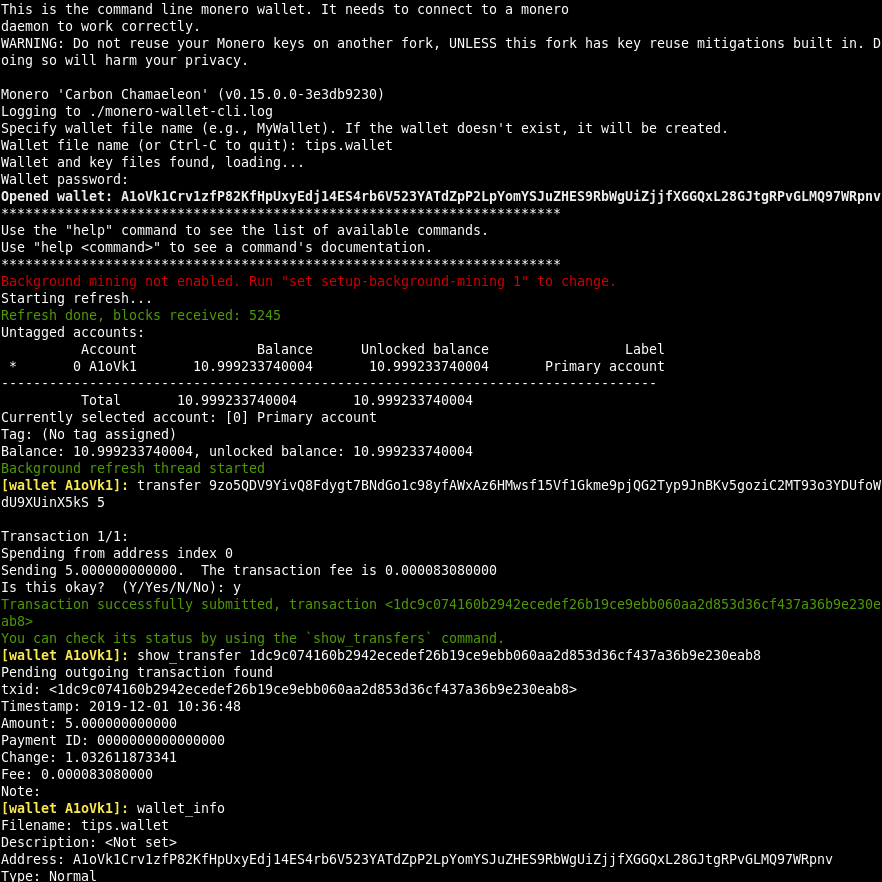
- Command-line wallet
- Full node validation
- Hardware wallet support
- Mnemonic seed backup
- Private transactions by default
- Pruned blockchainA pruned chain only serves part of the historical data to other peers.
- Reproducible Guix builds
- RPC APIUse --restricted-rpc when hosting a public remote node.
- Scheduled network upgrades
- Tor / anonymising-network transportDescribed by the project as new and still experimental.
Monero README
FAQ
How big is the Monero blockchain?
It keeps growing; as of 2024 a full chain was around 225 GB and a pruned one about 86 GB.
How do I decide if I should run a full node or a pruned node?
A full node needs much more storage and time to sync; a pruned node keeps only a fraction of non-essential data while retaining the complete transaction history and still helps the network.
What is ASIC resistance? Why is it important?
ASICs concentrate mining power in few hands, so Monero uses RandomX, which makes specialised hardware unprofitable and lets ordinary computers mine competitively.
Is Monero magic and protects my privacy no matter what I do?
No - revealing your identity, weak passwords, leaked keys or cloud-stored seeds still compromise your privacy.
How is Monero's privacy different from other coins?
Ring signatures, RingCT and stealth addresses hide the sender, amount and receiver, and every transaction on the network must be private.
Is Monero a mixer or mixing service?
No, privacy comes from a non-interactive, non-custodial and automatic process built into every transaction rather than an opt-in mixing service.
Does Monero have a block size limit?
There is no hard cap; block size grows or shrinks with demand, limited by a growth rate to keep the chain from ballooning.
Are there videos I can watch to learn about Monero?
Yes, the site hosts a series of explanatory videos meant to be watched in sequence, covering stealth addresses, ring signatures, RingCT, tail emission, nodes and RandomX.
Is it true that Monero has a hard fork every 6 months?
No; the developers consider the protocol stable enough that regular biannual forks are unnecessary, and upgrades now come at a looser cadence of roughly 9-12 months.
Why is Monero called 'Monero'?
Monero is the Esperanto word for 'coin'; the project dropped 'bit' from its original name 'Bitmonero' when it forked from the initial maintainer.
How is Monero different from Bitcoin?
Monero is built on the CryptoNote protocol rather than Bitcoin's code, hides transaction data, has dynamic block size and fees, uses ASIC-resistant RandomX proof of work and a tail emission.
How can I get Monero?
Buy it on an exchange or from an individual, or mine it for the block reward; trading directly against national currencies is possible now.
How can I contribute?
Monero is run by volunteers and community-funded contributors; contact a workgroup that matches your interest or contribute the skills you already have.
What's the meaning of [technical word]?
Look terms up in the Moneropedia, the project's glossary of Monero concepts such as node, fungibility, view key and pruning.
More in Cryptocurrency
 monero-lwsSelf-hosted Monero light-wallet server implementing the MyMonero API with LMDB backend and ZeroMQ block notifications for real-time scanning.
 monero-nodeboardSelf-hosted Docker project bundling a Monero node and web dashboard for running a remote node with browser UI on your own server.
 Monero P2PoolMonero P2Pool is a self-hosted, decentralized mining pool using a separate blockchain for zero-fee PPLNS payouts. Requires a Monero node and optionally XMRig miner.
 NMController_webSelf-hosted web dashboard that monitors NMMiner and NMAxe devices via UDP broadcast, showing real-time hashrate, temperature, RSSI, and Bitcoin mining statistics.
 nostr-wallet-connectSelf-hosted, open-source NIP-47 implementation that lets Nostr clients like Damus or Amethyst connect to your Lightning node (LND or Alby) over Nostr relays.
 OctoBotFree self-hosted crypto trading bot running AI, grid, and DCA strategies on 15+ exchanges with web dashboard, mobile apps, backtesting, and paper trading.
 OpenChartsSelf-hosted trading terminal with charting, drawing tools, 8 indicators, and paper trading — runs in browser with no backend.
 OpenSignerOpen-source, self-hosted key management for embedded wallets using Shamir's Secret Sharing across Ethereum and Solana.
 phoenixdphoenixd is a self-hosted, self-custodial Lightning daemon for developers to send/receive payments via HTTP API with automated liquidity and zero config.
 public-poolSelf-hosted open-source Bitcoin stratum mining server built on NestJS; supports mainnet and testnet and pairs with the public-pool-ui web interface.
 raspiblitzRaspiBlitz is a self-hosted, open-source Bitcoin and Lightning node for Raspberry Pi 4/5 with optional LCD. Pre-built SD card images; supports BTCPay, LNbits, Specter.
 Ride The Lightning (Core Lightning)Self-hosted web UI for managing Lightning nodes (LND, Core Lightning, Eclair) with dashboards, channel management, submarine swaps, multi-node support, 2FA, and SSO.
0 comments