
Self-host Duckle
v0.7.4Visual ETL platform that compiles to DuckDB SQL
- Stars
- 1 532
- Port
- 8080 (web console and API)
What is Duckle?
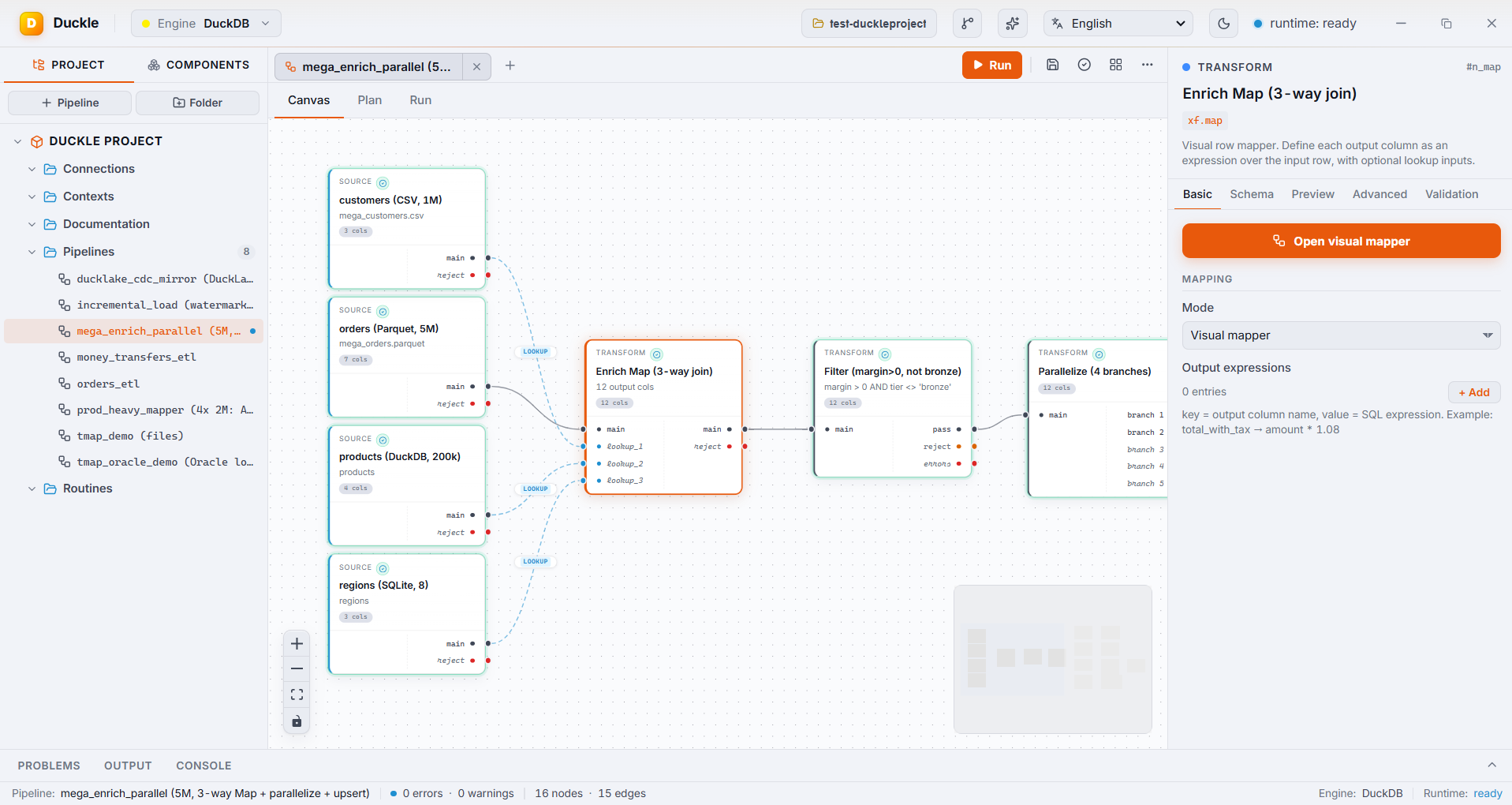
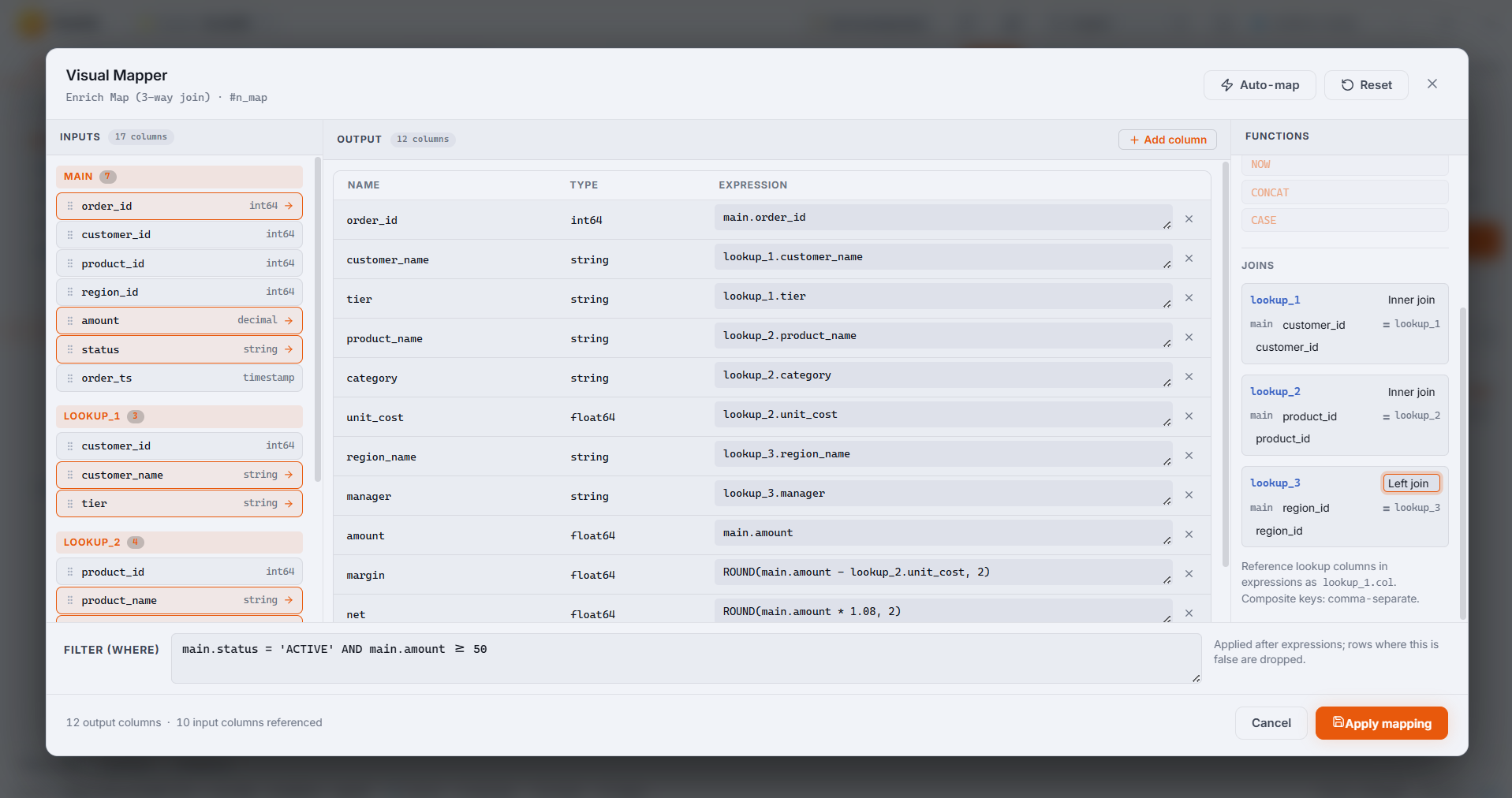
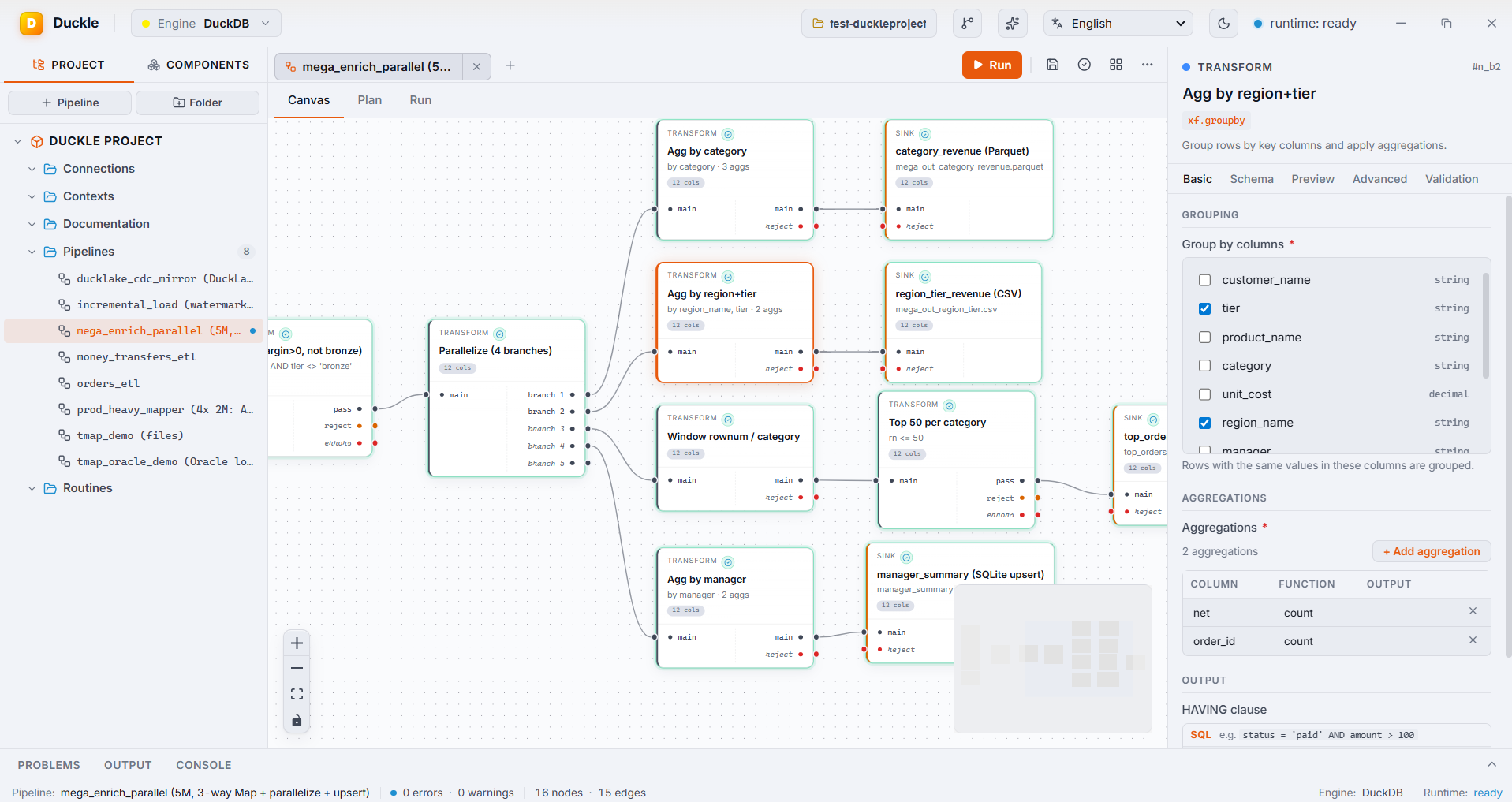
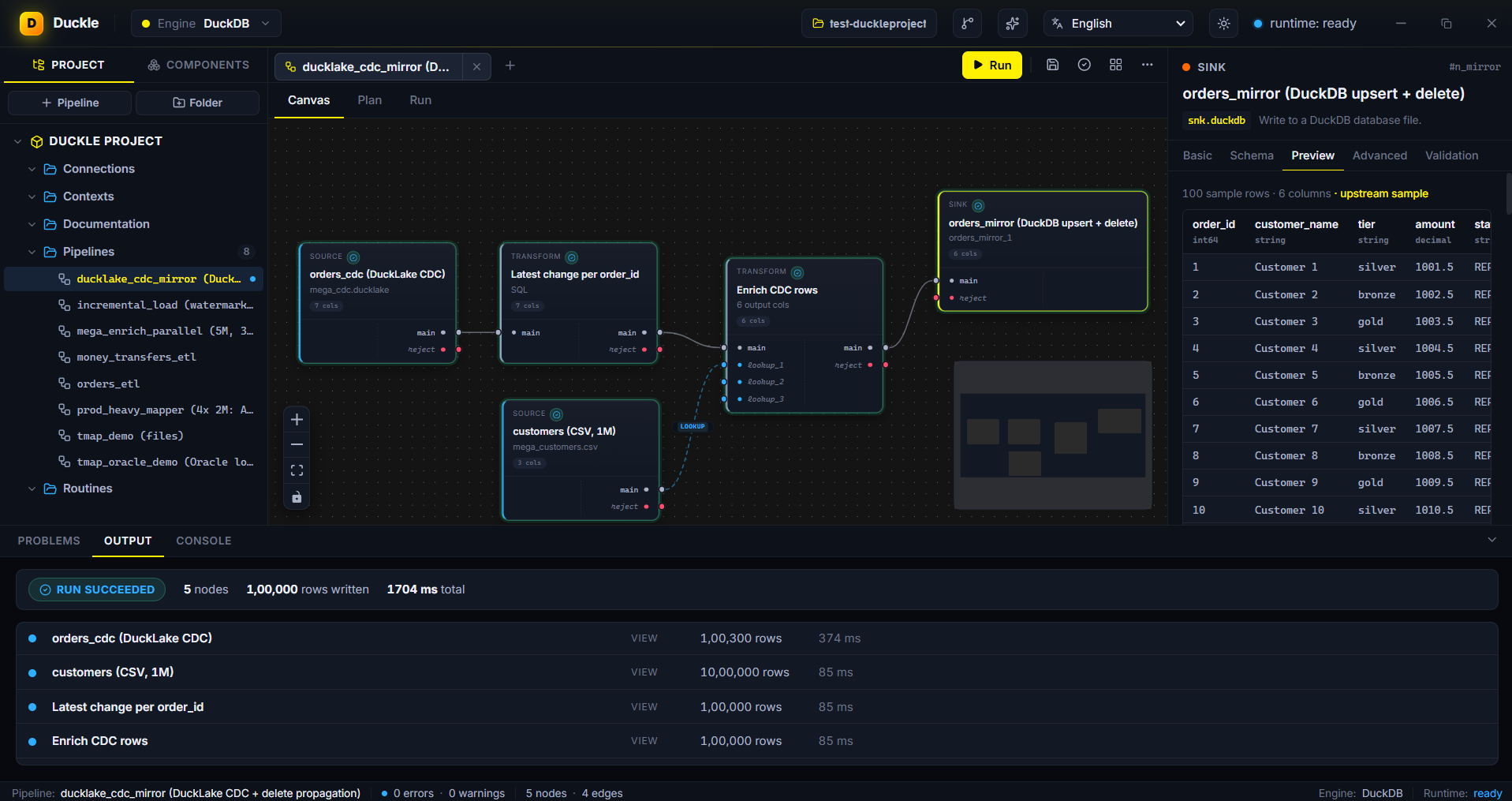
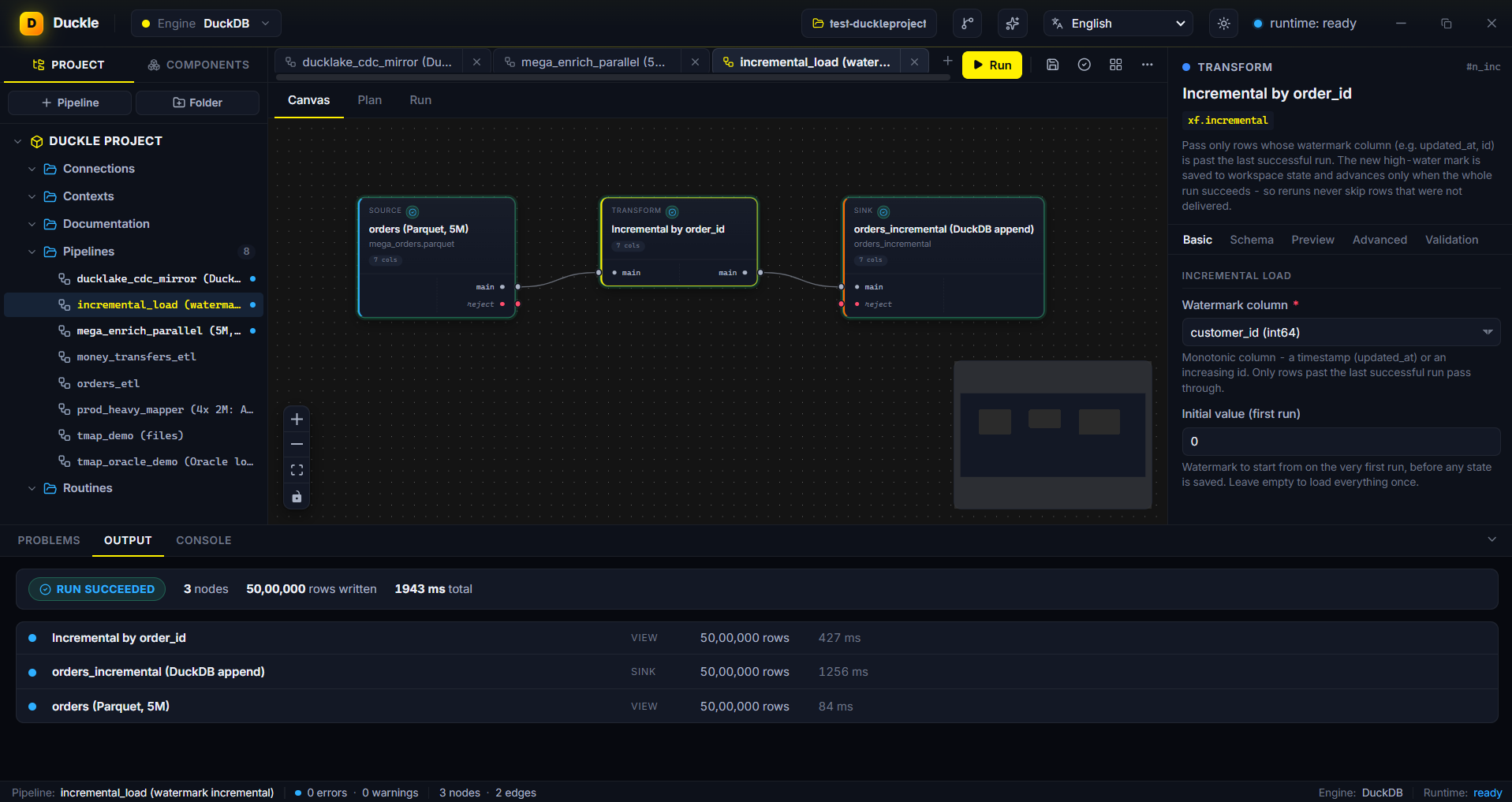
This open-source ETL platform lets teams run data pipelines on their own hardware. You design pipelines on a visual canvas, in Python, or in SQL, and the tool compiles them to SQL that runs on the embedded DuckDB engine. The same pipeline file works on a laptop, a server, in Docker, or as a standalone executable from the Build Pipeline feature. The headless runner (duckle-runner serve) adds a web console with cron scheduling, role-based access, audit logging, and alerting. The project ships 385+ components for sources (databases, warehouses, SaaS APIs, files, streaming), transforms (joins, aggregates, CDC, AI, data quality), and sinks. It also runs dbt on DuckDB, includes an on-device AI assistant (Duckie) that generates pipelines from natural language, and provides an MCP server for AI agents. Authentication supports built-in accounts and OIDC. Licensed under MIT OR Apache-2.0.
Should you self-host Duckle?
Duckle scores 56/100 on selfhost.directory (how scoring works) and ranks #5 of 8 in Data Pipeline. It has 1 532 GitHub stars.
It shipped 10 stable releases in the past year. The latest, v0.7.4, came out on 25 September 2026. New versions land roughly every 8 days.
Setup is moderate: expect some configuration beyond a single command. It is Apache-2.0-licensed and written mostly in Rust.
Its closest alternative on selfhost.directory is sequin (61/100, 2 219 stars). It scores higher overall, so compare the two before you pick. See Duckle vs sequin side by side.
Features
- Data quality validators
- dbt on DuckDB
- Headless server with web console
- MCP server for AI agents
- Native DuckDB execution
- OIDC AuthenticationOptional; disabled unless oidc.json exists
- PostgreSQL CDC
Duckle README
FAQ
Does the Duckie panel need internet after install?
No. Once llama.cpp and the Qwen GGUF are downloaded, Duckie needs no network. It can also use your own OpenAI-compatible endpoint instead of running in-process.
Is the Duckie AI assistant any good?
For 90% of common pipelines (read source -> simple transforms -> sink), yes. For complex pipelines, iterate by describing halves. You can also swap the model by pointing xf.ai.llm at GPT-4 or Claude.
Can I run pipelines headlessly / from CI?
Yes. Build Pipeline produces a single self-contained executable for servers/CI. The embedded duckle-runner can also run a workspace pipeline JSON directly (duckle-runner --pipeline pipeline.json).
Can multiple people collaborate on the same workspace?
Via Git, yes — check the workspace into a repo and use standard branch/PR flows, and deploy to a shared server with roles and audit log. No real-time multiplayer canvas.
Where does my pipeline data live?
In the workspace folder you pick on first launch. Pipelines are plain JSON files you can commit to Git, diff, branch, and review.
Can I use OpenAI / Cohere / Voyage instead of the local Duckie?
Yes. The AI transforms (xf.ai.embed, xf.ai.llm, xf.ai.classify) accept a baseUrl prop pointing to any OpenAI-compatible endpoint with an apiKey.
How big is the binary, exactly?
73-110 MB depending on platform (macOS 73-88 MB, Linux 74-100 MB, Windows 98-110 MB). It embeds the headless runner and MCP server; DuckDB and AI engine download separately.
Do I need DuckDB installed first?
No. Duckle downloads DuckDB (~30 MB with common extensions) on first launch automatically.
How big are pipelines this works well on?
Bigger than people assume — the ceiling is the instance you provision. The same pipeline that runs on a laptop sample runs on a large server without changes. Reference: 96M rows from Postgres to Parquet in 39.9s.
Does Duckle send my data anywhere?
No. Duckle makes no outbound calls of its own. The only network calls are those your pipelines explicitly do (e.g., reading from S3, calling OpenAI for embeddings). The built-in AI assistant runs locally with no API key.
How is Duckle different from Airbyte, dbt, or Talend?
Airbyte focuses on hosted extract-and-load; dbt focuses on SQL transformation; Talend is a heavyweight GUI suite (Open Studio discontinued). Duckle is a single open engine that does extract, transform, and load together, compiles to DuckDB SQL, and runs dbt on DuckDB inside the same tool.
Can I run ETL pipelines without the cloud or a data warehouse?
Yes. Duckle executes on the embedded DuckDB engine, so there is no vendor warehouse to buy, no vendor platform to sign up to, and no account. You run it where you choose: a server, VM, container, or workstation.
Is Duckle an open-source alternative to Fivetran or Airbyte?
Duckle covers similar ground — moving data across 190 sources and destinations — but runs locally with nothing to host and no per-row, per-connector, or per-seat billing. The trade-off is scope: Duckle does not split one query across a cluster.
Is Duckle free? What's the license?
Yes, Duckle is free and open source, dual-licensed under MIT OR Apache-2.0. You can use it commercially, fork it, and sell what you build with it. No usage limits, no telemetry.
More in ETL
 EMQXThe most scalable and reliable MQTT broker for AI, IoT, IIoT and connected vehicles
 frankframeworkFrank!Framework is a self-hosted, open-source low-code integration platform for exchanging messages between systems via XML config.
 GlassFlow ClickHouse ETLSelf-hosted, open-source stream processor that ingests data from Kafka and OTLP into ClickHouse with deduplication, filtering, and temporal joins.
 KestraSelf-hosted, open-source (Apache-2.0) engine that schedules and chains data, AI and infrastructure jobs from YAML or a visual editor, with 2,200+ plugins.
 llm-appOpen-source, self-hosted template collection that streams your files, Google Drive or S3 into live RAG, vector-store and enterprise-search APIs.
 logstashAn open-source server-side data pipeline that ingests, transforms and routes events with 200+ plugins; self-hosted via Docker, deb/rpm packages or tar/zip downloads.
 multiwovenSelf-hosted, open-source Reverse ETL platform syncing data from Snowflake, BigQuery, Redshift to 50+ tools like Salesforce, HubSpot, Slack. AGPL-3.0 licensed.
 PeerDBSelf-hosted, open-source (AGPL-3.0) ETL tool streaming Postgres to ClickHouse and other warehouses via CDC, with a web UI and a Postgres-compatible SQL interface.
 rudderstackAn open-source, Segment-alternative customer data platform: run the self-hosted Go/React event pipeline and route data to 90+ warehouse and tool destinations.
 superglueAI-agent integration platform: agents build connectors, migrate data and sync ERPs, CRMs, databases. Source-available, self-hosted with Docker Compose or on Kubernetes.
 airbyteAirbyte is a self-hosted data movement platform with hundreds of connectors for ELT pipelines and AI agents, deployable via Docker, Kubernetes, and abctl CLI.
 Apache HopApache Hop is a self-hosted, open-source data integration platform for visual pipelines that run on local, Hop Server, Spark, Flink, and Dataflow without rewriting.
0 comments