
Self-host TITAN
v8.0.0Local-first AI agent framework with autonomous specialists
- Stars
- 19
- CPU
- Any modern CPU
- Port
- 48420 (Mission Control web dashboard (React 19 SPA) and API gateway)
ghcr.io/djtony707/titan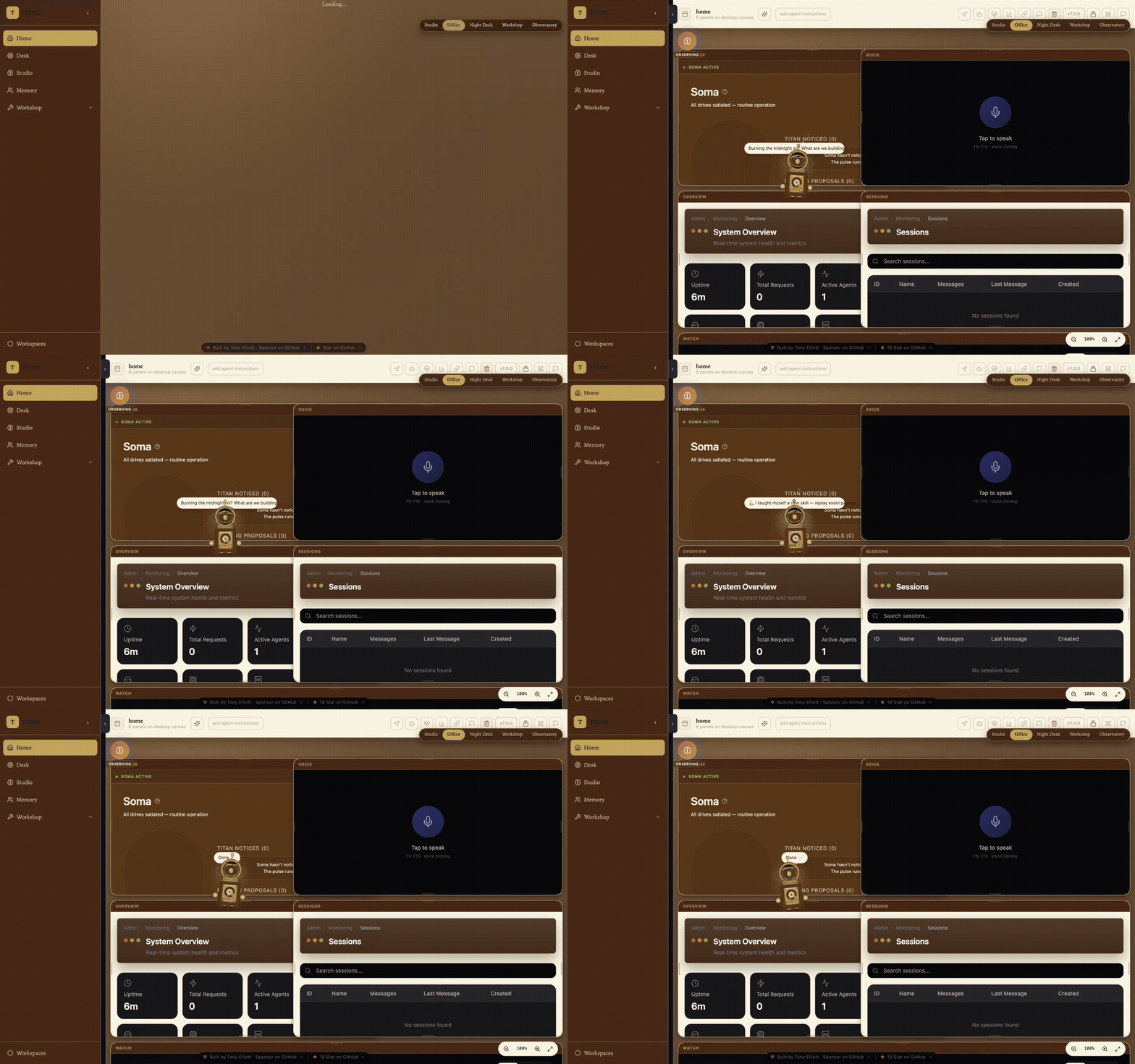
What is TITAN?
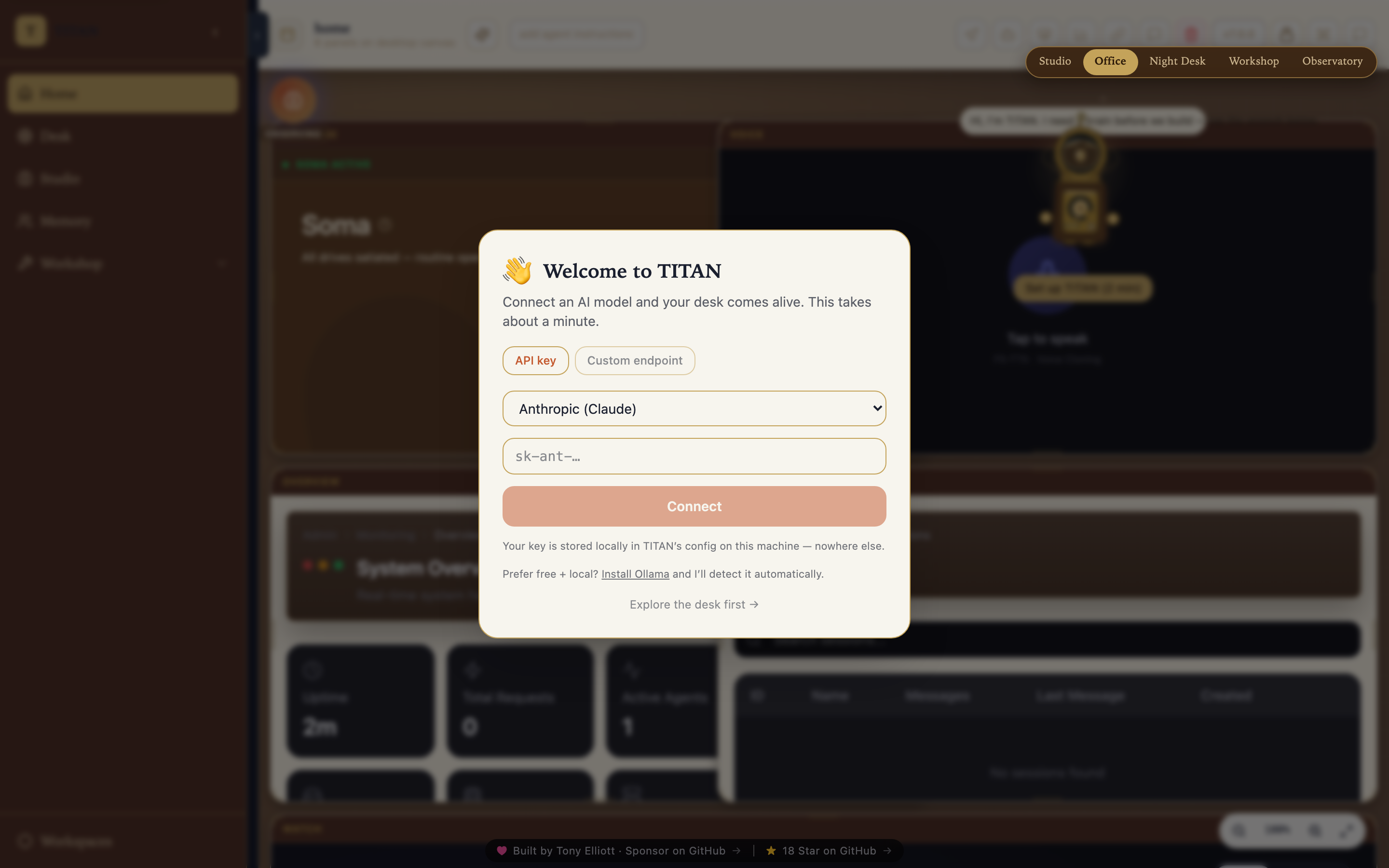
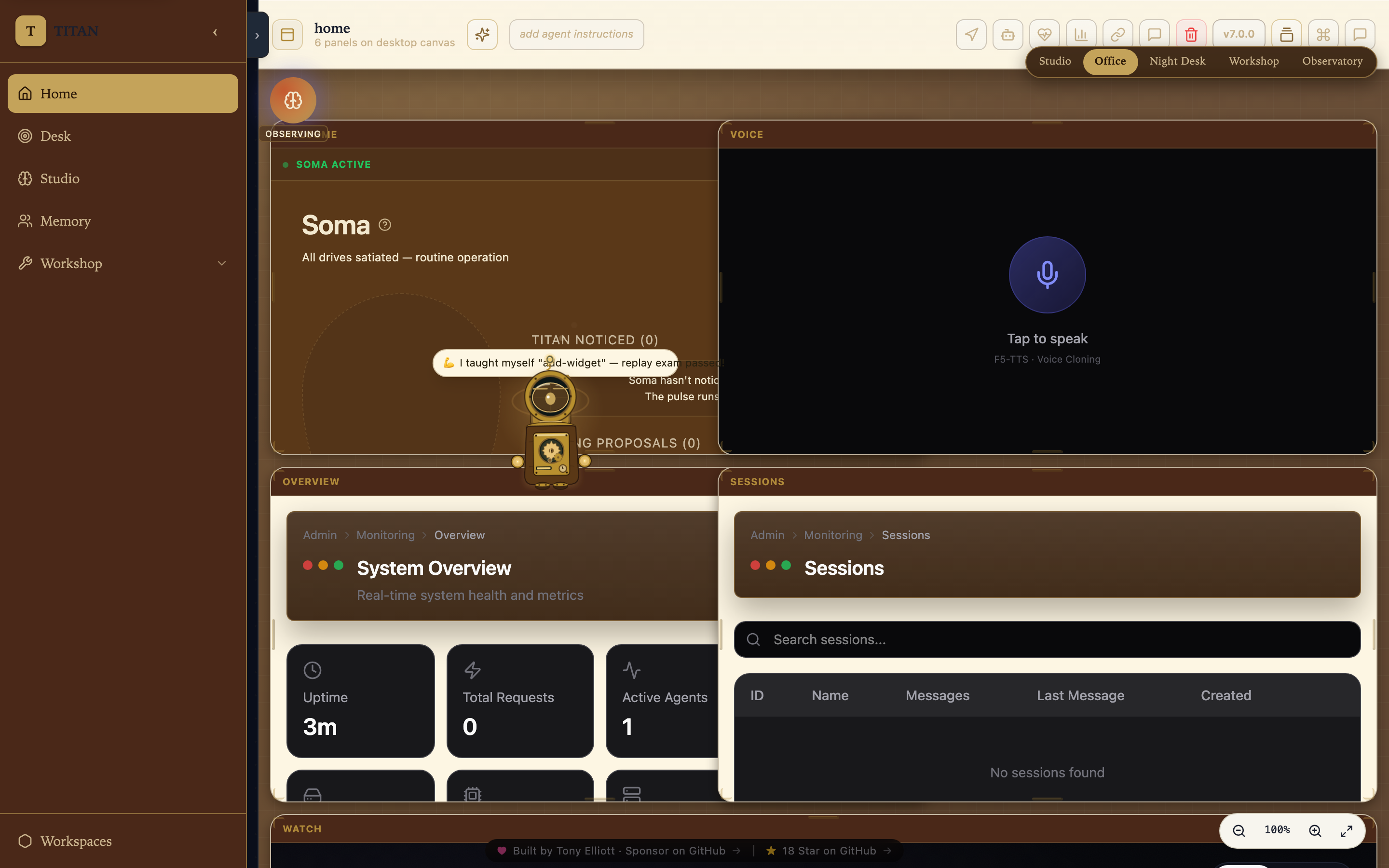
TITAN is a local-first AI agent framework built in TypeScript that runs entirely on your hardware with your chosen models. It operates as a company of AI specialists — Scout for research, Builder for code, Writer for content, Analyst for data, and Sage for review — that share a cryptographically signed memory pool and earn autonomy through a self-compiling loop that proves equivalence before replaying learned skills. The framework includes Mission Control, a React 19 single-page app served on port 48420, providing a Live Studio to watch agents work in real-time with step timelines and file diffs. TITAN supports 36 LLM providers including Anthropic, OpenAI, Google, and Ollama, plus 32 OpenAI-compatible options. It also offers 19 communication channels like Discord, Telegram, Slack, and Matrix, MCP for interoperability with Hermes Agent and OpenClaw, Home Assistant integration, and voice mode via LiveKit WebRTC and F5-TTS. It uses SQLite FTS5 for local shared memory with zero config, requires Node ≥ 22, and is MIT licensed.
Should you self-host TITAN?
TITAN scores 40/100 on selfhost.directory (how scoring works) and ranks #167 of 209 in AI Agents. It has 19 GitHub stars.
It shipped 12 stable releases in the past year. The latest, v8.0.0, came out on 16 August 2026. New versions land roughly every 1 days.
Setup is moderate: expect some configuration beyond a single command. An official Docker image is available. It is MIT-licensed and written mostly in Typescript.
Its closest alternative on selfhost.directory is Orca (91/100, 108 642 stars). It scores higher overall, so compare the two before you pick. See TITAN vs Orca side by side.
Features
- 19 Communication Channels
- AI Agent Team
- Home Assistant Integration
- Live Studio (Watch It Work)
- Local-First with 36 LLM Providers
- MCP (Model Context Protocol) Support
- Mesh Networking
- Mission Control Dashboard
- Mixture of Agents (/moa)
- Model-Agnostic Harness
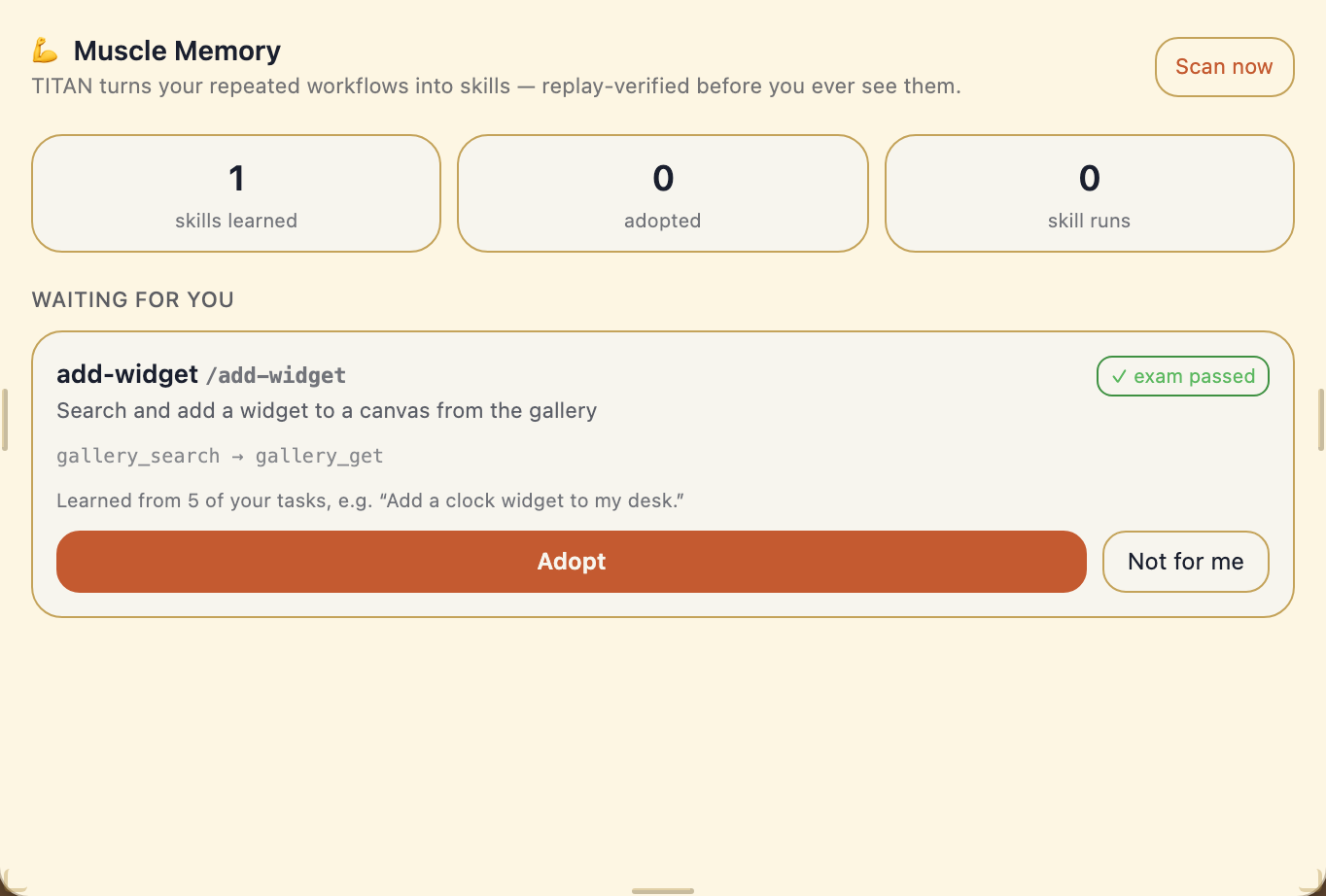
- Muscle Memory (Self-Improvement)
- Self-Compiling Loop (Earned Autonomy)
- Shared Cryptographic Memory
- TITAN-Soma Homeostatic Drives
- Voice Mode
TITAN README
More in AI Automation
 TrinityTrinity is a self-hosted, open-source platform for running AI agents in production with human approval gates, git-native state, and audit trails.
 trypostSelf-hosted social media scheduler with MCP for AI agents — publish to 13 networks, visual calendar, approvals, analytics, all features included.
 VisionClaw-Agent-Public-ReleaseSelf-hosted AI operations platform where specialist agents collaborate through hundreds of tools to deliver real business assets on your infrastructure.
 z8runSelf-hosted visual flow engine for automation and AI pipelines. Rust + React, drag-and-drop editor, 39 nodes, 12 AI nodes, WASM plugins, single binary with SQLite.
 ZimaOS-BlueZimaOS Blue is an open-source, self-hosted AI agent runtime in Go that runs locally on any device with voice, browser automation, deep research, and 20+ IM integrations.
 5dive5dive runs persistent AI agents as systemd services on your Linux server with a shared SQLite task queue and human-in-the-loop approval via Telegram/Discord.
 aci-devACI.dev is an open-source tool-calling platform you self-host as a backend and dev portal, wiring 600+ SaaS integrations into AI agents via function calls or unified MCP.
 action-syncSelf-hosted open-source tool using Claude AI to analyze meetings, search GitLab codebases, and create detailed Jira tickets automatically.
 agentgatewayOpen-source, self-hosted HTTP and gRPC gateway routing LLM, MCP, A2A and service traffic in one binary, with auth, policy, guardrails, cost controls and observability.
 agentic-chatopsSelf-hosted agentic ChatOps platform with 3-tier AI architecture that triages alerts, predicts remediation impact via causal graph, and auto-resolves routine issues.
 Agentic SignalSelf-hosted visual workflow automation with local AI via Ollama. Drag-and-drop nodes for data, APIs, RAG — no cloud dependencies.
 agentsInkeep Agents lets teams build AI assistants and workflows via drag-and-drop builder or TypeScript code with full sync. Self-host via Docker or Vercel.
0 comments