
Self-host terrapod
v1.11.2Open-source Terraform Enterprise replacement for teams
- Stars
- 264
- Ports
- 8000 (API server), 3000 (Web UI (BFF)), 8081 (Listener health probes)
- Requires
- Kubernetes, Object storage (S3, Azure Blob, GCS), PostgreSQL, Redis
ghcr.io/mattrobinsonsre/terrapod-api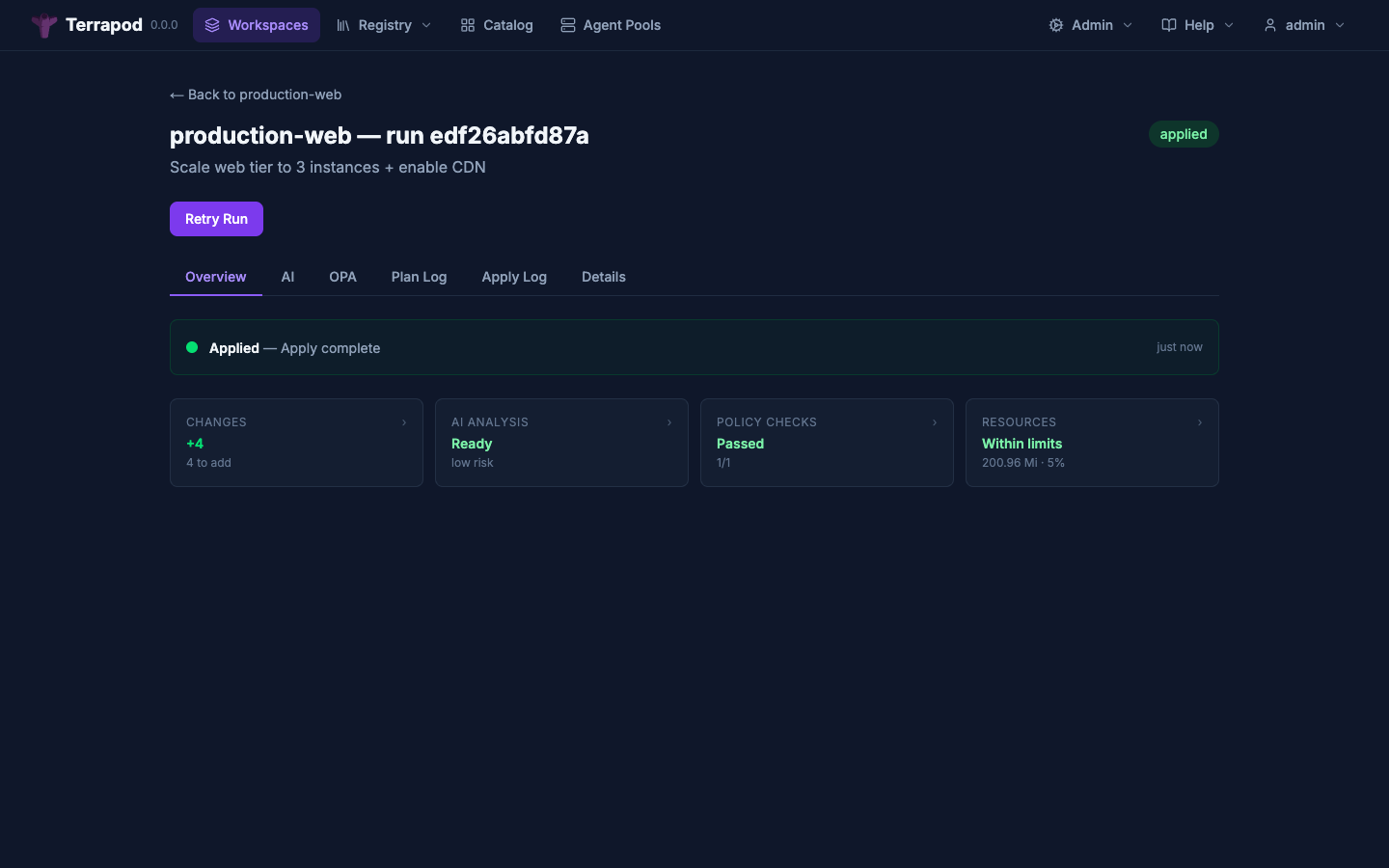
What is terrapod?
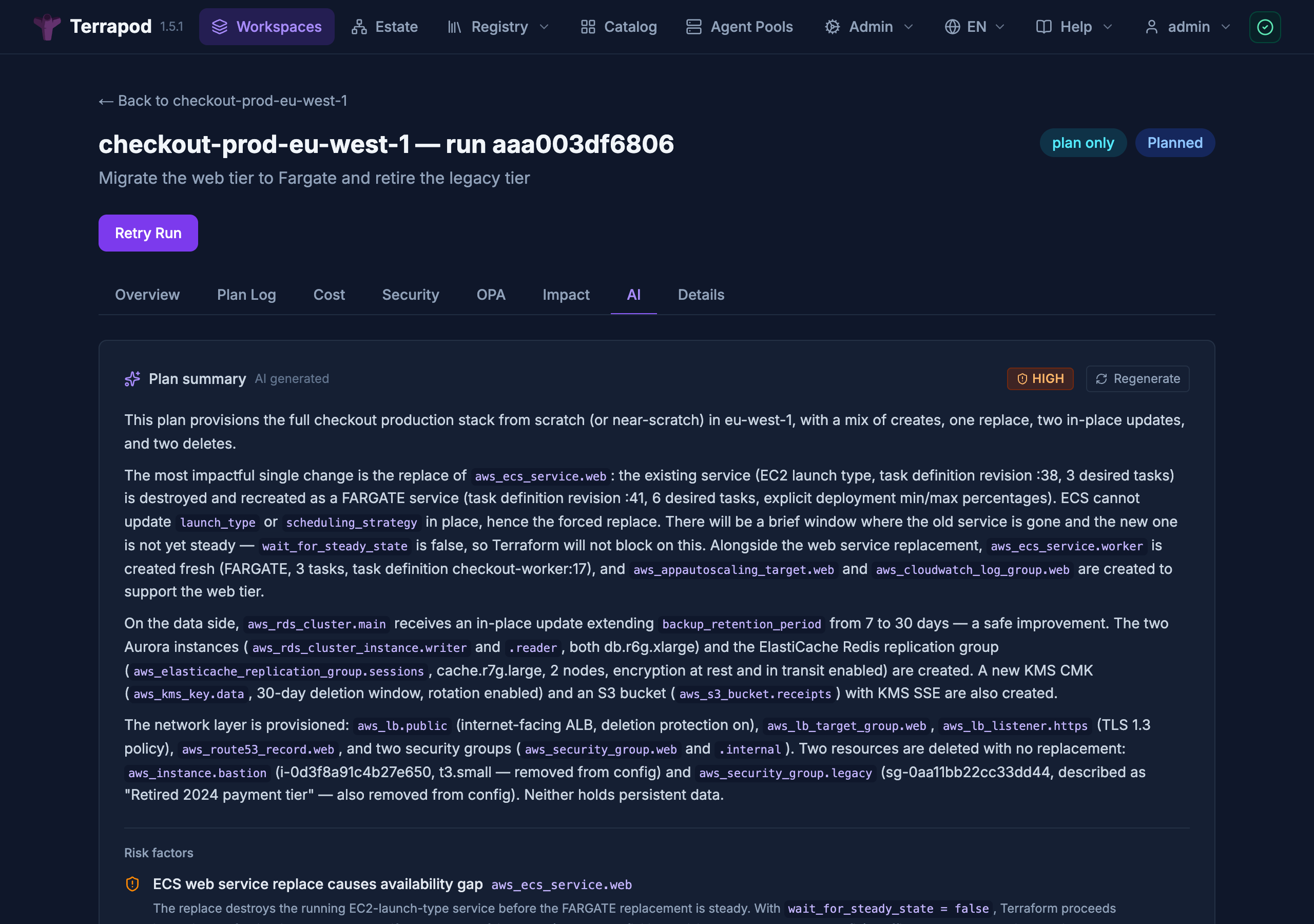
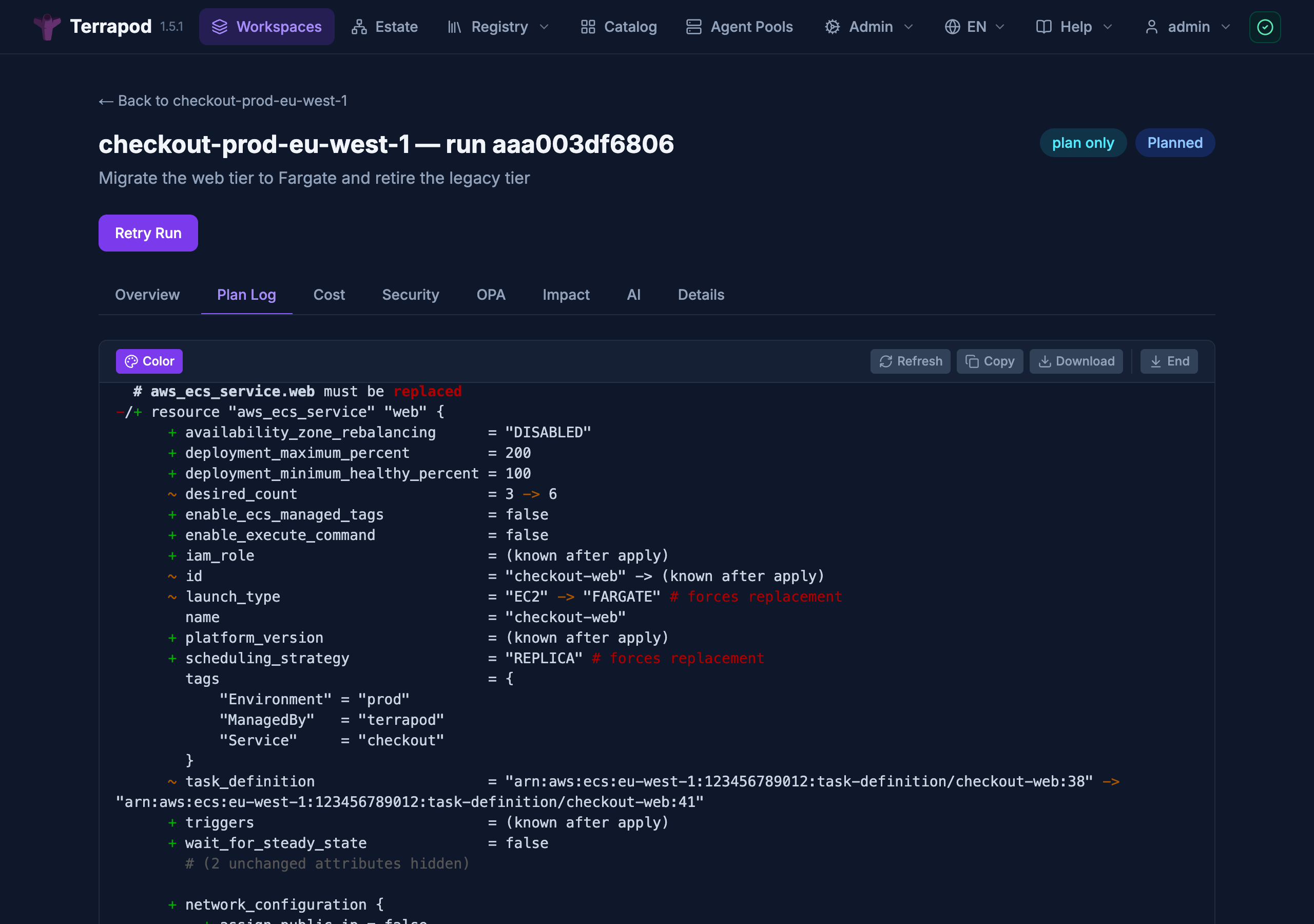
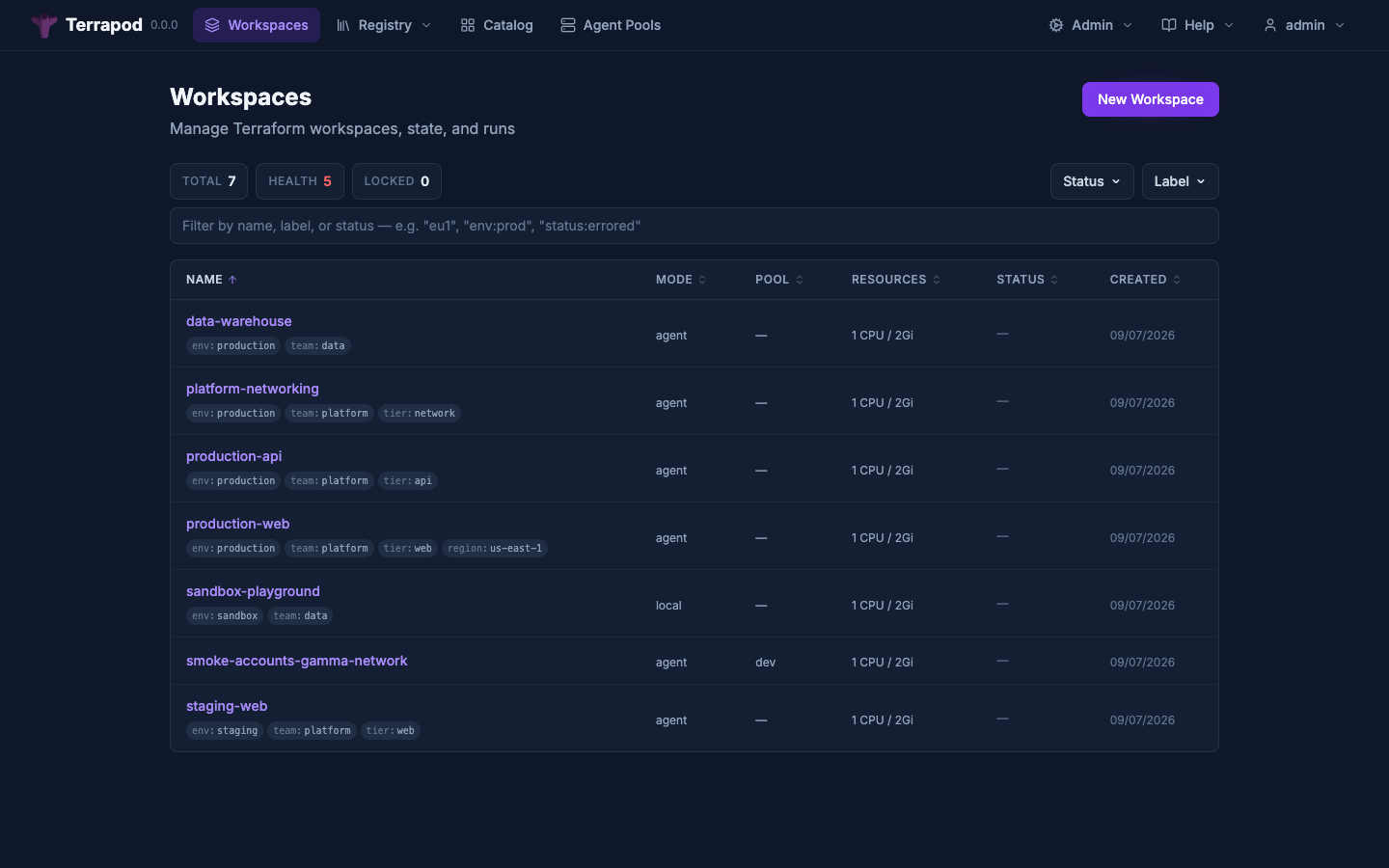
Terrapod is a self-hosted platform that replaces Terraform Enterprise and Terraform Cloud. It orchestrates Terraform, OpenTofu, and Terragrunt as execution backends rather than forking them, implementing the TFE V2 API subset that the CLI actually consumes so existing cloud blocks work with minimal changes. The platform provides versioned remote state with locking and rollback in your own PostgreSQL and object storage, an internal module and provider registry with GPG signing, label-based RBAC, OPA/Rego policy-as-code, cost estimation with a native pricing engine, drift detection, run triggers, and an optional AI review layer for plan summaries, risk assessment, and chat. It runs on Kubernetes via a single Helm release — a single-node k3s VM is sufficient to start — and uses outbound-only runners that create ephemeral Kubernetes Jobs, enabling execution in isolated VPCs, air-gapped environments, or behind egress-only firewalls. Authentication supports local passwords, OIDC (Auth0, Okta, Azure AD), SAML, OAuth2 PKCE for terraform login, and long-lived API tokens. The project is licensed under MPL-2.0 with no commercial edition, open-core split, or paid tiers planned.
Should you self-host terrapod?
terrapod scores 51/100 on selfhost.directory (how scoring works) and ranks #8 of 8 in DevOps. It has 264 GitHub stars.
It shipped 43 stable releases in the past year. The latest, v1.11.2, came out on 28 October 2026.
Setup is advanced: plan for several services and some ongoing maintenance. An official Docker image is available. It is MPL-2.0-licensed and written mostly in Python.
Its closest alternative on selfhost.directory is Gitea Runner (74/100, 58 743 stars). It scores higher overall, so compare the two before you pick. See terrapod vs Gitea Runner side by side.
Features
- Label-based RBAC
- OPA/Rego policy-as-code
- Package proxies (PyPI, npm, etc.)
- Plan and apply lifecycle
- Private module registry
- Private provider registry
- Pulumi and Ansible supportLimited by each engine's capabilities
- Remote State Management
- Run Tasks
- VCS integration
terrapod README
FAQ
What does Terrapod cost to run?
The software is free. You pay only for the infrastructure it runs on (Kubernetes cluster, PostgreSQL, Redis, object storage) — no license, no per-resource fee.
How is Terrapod different from Atlantis or Digger?
Atlantis and Digger are PR/CI-centric automation tools. Terrapod is a full platform with its own state store, run lifecycle, registry, RBAC, and UI, running execution on its own outbound-only Kubernetes runners.
Does Terrapod estimate infrastructure costs?
Yes, cost estimation is built in and on by default with no third-party service. Every run shows the monthly cost delta and each workspace shows its current monthly total, priced by a native engine over a self-generated pricesheet for AWS, Azure, and GCP.
Do I need Kubernetes to run Terrapod?
Yes, Kubernetes is the only supported deployment target, but a single-node k3s VM (~512MB RAM) is sufficient. You do not need a managed cloud cluster or dedicated platform team.
Is Terrapod production-ready and stable?
Yes, Terrapod passed 1.0 and is on the 1.x line with a SemVer compatibility contract enforced in CI across every public surface.
Can Terrapod run in an air-gapped or firewall-restricted environment?
Yes for execution clusters and inbound — runners connect outbound only, VCS integration is polling-first, and a pull-through provider mirror with air-gap sealed mode lets runners resolve providers/binaries with no upstream internet. The API itself needs outbound access to fill caches.
Does Terrapod support Terragrunt?
Yes, a per-workspace flag runs agent-mode runs under Terragrunt with pull-through binary cache and local-backend reconciliation while Terrapod owns state and the run lifecycle.
Does Terrapod support OpenTofu?
Yes, tofu is a first-class execution backend alongside terraform. You choose the engine and version per workspace.
Will my existing Terraform/OpenTofu code and CI work with Terrapod?
Yes, with minimal change. Terrapod is API-compatible with the terraform/tofu cloud/remote backend — you repoint the hostname in your cloud block and run plan/apply as usual.
Is Terrapod free and open source? Will it always be?
Yes, Terrapod is MPL-2.0 licensed with no per-resource, per-run, or per-seat pricing. There is no commercial edition, open-core split, paid enterprise tier, or plan to introduce one.
What is Terrapod?
Terrapod is a free, open-source, self-hosted platform replacement for Terraform Enterprise and HCP Terraform that provides collaboration, governance, state management, and a UI layer around Terraform or OpenTofu as pluggable execution backends.
More in DevOps
 terrateamOpen-source Terraform and OpenTofu orchestration that plans every pull request and applies on merge, self-hosted with Docker Compose against PostgreSQL.
 TraceloopOpen-source observability for your GenAI or LLM application, based on OpenTelemetry
 TuleapTuleap is an all-in-one, open-source ALM (Application Lifecycle Management) platform for Agile project management, DevOps, and software development. It centralizes requirements, development, testing, and documentation, with support for Scrum, Kanban, SAFe, and traceability for compliance.
 unleashOpen-source feature management platform: flags, canary rollouts, kill switches and A/B tests from a web UI with 25+ SDKs. Self-hosted via Docker plus PostgreSQL.
 WebhookSelf-hosted, open-source webhook server written in Go that exposes HTTP endpoints to run configured shell commands, guarded by trigger rules.
 Websoft9Self-hosted PaaS panel in a single Docker container that one-click deploys hundreds of open-source web apps, with domains, SSL, backups and monitoring. Open-source.
 whats-up-dockerKeep your containers up-to-date!
 Zot Registryzot - A scale-out production-ready vendor-neutral OCI-native container image/artifact registry (purely based on OCI Distribution Specification)
 µTaskSelf-hosted, open-source automation engine from OVH that runs YAML-defined task workflows on a Postgres-backed, horizontally scalable Go server with a dashboard.
 aapanelSimple but Powerful web-based Control Panel
 Argo CDOpen-source, self-hosted GitOps CD for Kubernetes that keeps clusters in sync with Kustomize, Helm, Jsonnet or YAML manifests in Git, with web UI, CLI, SSO and RBAC.
 artifact-keeperSelf-hosted artifact registry with 45+ formats, security scanning, peer replication, Artifactory migration. MIT licensed, no feature gates or per-user fees.
0 comments