
Self-host rconfig
core-8.2.19Open-source NCM for automated network config backups
- Stars
- 221
- CPU
- 2 cores (64-bit x86 or ARM)
- RAM
- 4GB minimum
- Storage
- 100GB minimum
- Port
- 80 (HTTP web interface)
- Requires
- Apache, MariaDB/MySQL, Redis
rconfig/rconfig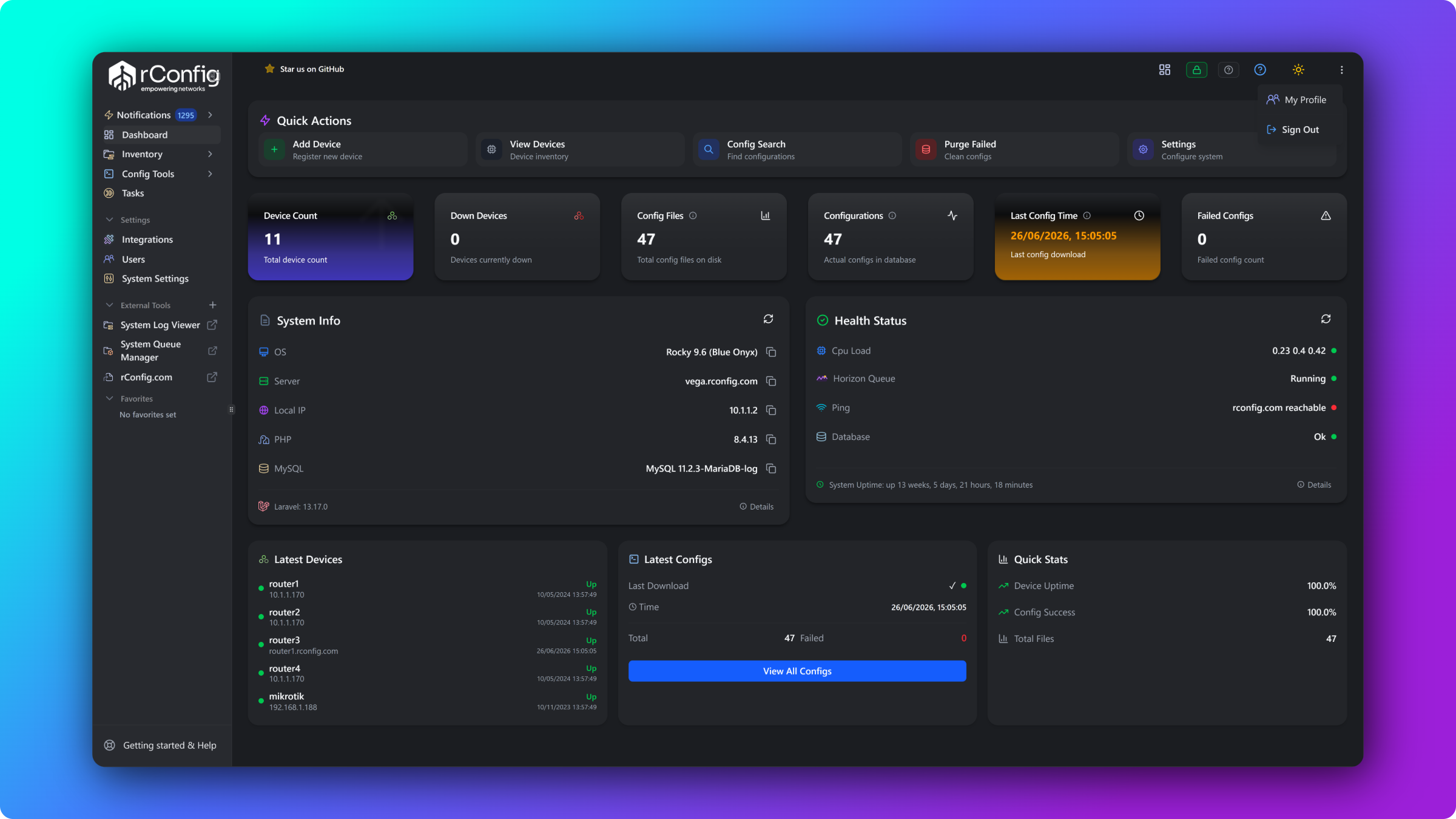


What is rconfig?
This Network Configuration Management platform automates backups across diverse vendor equipment. It works with many manufacturers using SSH and Telnet. Core capabilities include scheduled backups, configuration versioning with visual diffs, multi-term search, a REST API for automation, and secure credential handling. The software runs on Linux distributions such as Rocky, CentOS, RHEL, Ubuntu, Alma, and AWS Linux, deployable through Docker Compose or a guided native installer. External dependencies are MariaDB/MySQL and Redis. A paid Pro edition adds compliance policies, change alerts, advanced workflows, single sign-on, and priority support.
Should you self-host rconfig?
rconfig scores 49/100 on selfhost.directory (how scoring works) and ranks #21 of 34 in Network Management. It has 221 GitHub stars.
It shipped 29 stable releases in the past year. The latest, core-8.2.19, came out on 27 October 2026. New versions land roughly every 1 days.
Setup is moderate: expect some configuration beyond a single command. An official Docker image is available. It is GPL-3.0-licensed and written mostly in PHP.
Its closest alternative on selfhost.directory is oxidized (65/100, 3 631 stars). It scores higher overall, so compare the two before you pick. See rconfig vs oxidized side by side.
Features
- Config Compare
- Configuration Backup
- Configuration Search
- Config Versioning & Diff
- Data Import (Oxidized, RANCID, NetMRI, SolarWinds)
- Multi-vendor Support
- Notifications
- REST API (v1 & v2)
- Scheduled Tasks
- SSO (SAML/OIDC/OAuth)Available in Core per env configuration; Pro adds priority support
- Unlimited Devices
rconfig README
FAQ
What does a typical V8 Core deployment look like?
V8 Core runs on Linux and can be deployed quickly using the guided installation process from the GitHub repository. Administrators add devices, organize infrastructure using tags and groups, schedule backup jobs, and begin collecting configurations. Most teams implement automated backups within the first day.
Does V8 Core have an API for automation and integration?
Yes, V8 Core includes a REST API that enables teams to automate backups, retrieve configurations, manage devices, and integrate with existing operational workflows and popular automation tools.
Where does V8 Core store configuration backups?
All device credentials, configuration files, and backup data remain within your own environment. Deployments can be hosted on-premises, in private cloud, or in air-gapped networks. No data is transmitted to rConfig or third-party cloud services.
Can V8 Core replace RANCID, Oxidized, or homegrown backup scripts?
Yes, V8 Core was designed as a modern alternative to legacy tools such as RANCID, Oxidized, Kiwi CatTools, and custom Python or Netmiko-based backup scripts, replacing fragile script-based workflows with a dedicated NCM platform.
How is V8 Core different from rConfig V8 Pro?
V8 Core provides free, open-source network configuration backup and management. V8 Pro builds on the same architecture and adds enterprise features: configuration compliance policies, change detection alerts, advanced automation workflows, single sign-on (SSO), and priority support.
What kinds of devices can V8 Core back up in multi-vendor environments?
V8 Core uses CLI-based collection through SSH and Telnet and supports a wide range of vendors including Cisco, Juniper, Aruba, Fortinet, Palo Alto, MikroTik, HP, Ubiquiti and many others. It can back up routers, switches, firewalls, wireless controllers, and OT devices.
Is rConfig V8 Core really free and open source?
Yes, V8 Core is fully open source and free to use with no license keys, per-device limits, or mandatory paid add-ons. It aligns with the Open Source Definition and can be deployed on-premises, in private cloud, offline, or in air-gapped networks.
More in Configuration Management
 rudderRudder is a self-hosted, open-core infrastructure security automation platform for configuration, patching, and compliance across Linux and Windows.
 Self Host BlocksSelfHostBlocks is an opinionated NixOS server management system with modular blocks for self-hosting services with unified config, LDAP/SSO, backup, and monitoring.
 Semaphore UISelf-hosted, open-source automation server: run Ansible playbooks, Terraform/OpenTofu and Bash, PowerShell or Python scripts from a web UI and REST API.
 shelveOpen-source, self-hosted secrets manager for dev teams: keep API keys and .env values in an encrypted vault with team roles, activity logging, scoped tokens and a CLI.
 zookeeperApache ZooKeeper
 adagiosAdagios is a self-hosted, open-source web UI for Nagios/Naemon/Icinga with modern status view, REST APIs, and audit trails — no database needed.
 ARAOpen-source Ansible reporting tool: ara records playbook and ad-hoc runs into SQLite, MySQL or PostgreSQL, browsable via a self-hosted web UI, REST API and CLI.
 BuildarrSelf-hosted tool automating *Arr stack configuration via YAML. Idempotent updates, TRaSH-Guides sync, scheduled daemon mode.
 CaliberOpen-source CLI that syncs CLAUDE.md, Cursor rules, AGENTS.md and MCP config across Claude Code, Cursor and Codex, running fully self-hosted on your own API keys.
 clonarrSelf-hosted web app to sync and customize TRaSH Guides profiles for Radarr and Sonarr with visual UI, auto-sync, and rollback.
 collinsCollins is a self-hosted, open-source CMDB from Tumblr for tracking servers, switches, and racks with REST API, CLI, IPAM, power management, and multi-datacenter support.
 ConfigarrConfigarr is a self-hosted, open-source tool that automates configuration for Sonarr, Radarr, and other *arr apps by syncing custom formats from TRaSH-Guides.
0 comments