
Self-host QuickVoice
Open-source AI phone agent platform for voice automation
- Stars
- 495
- Ports
- 3000 (Customer console), 3001 (Marketing site), 5000 (Express API server), 5555 (AI API service)
- Requires
- LiveKit, PostgreSQL, Qdrant, Redis
What is QuickVoice?
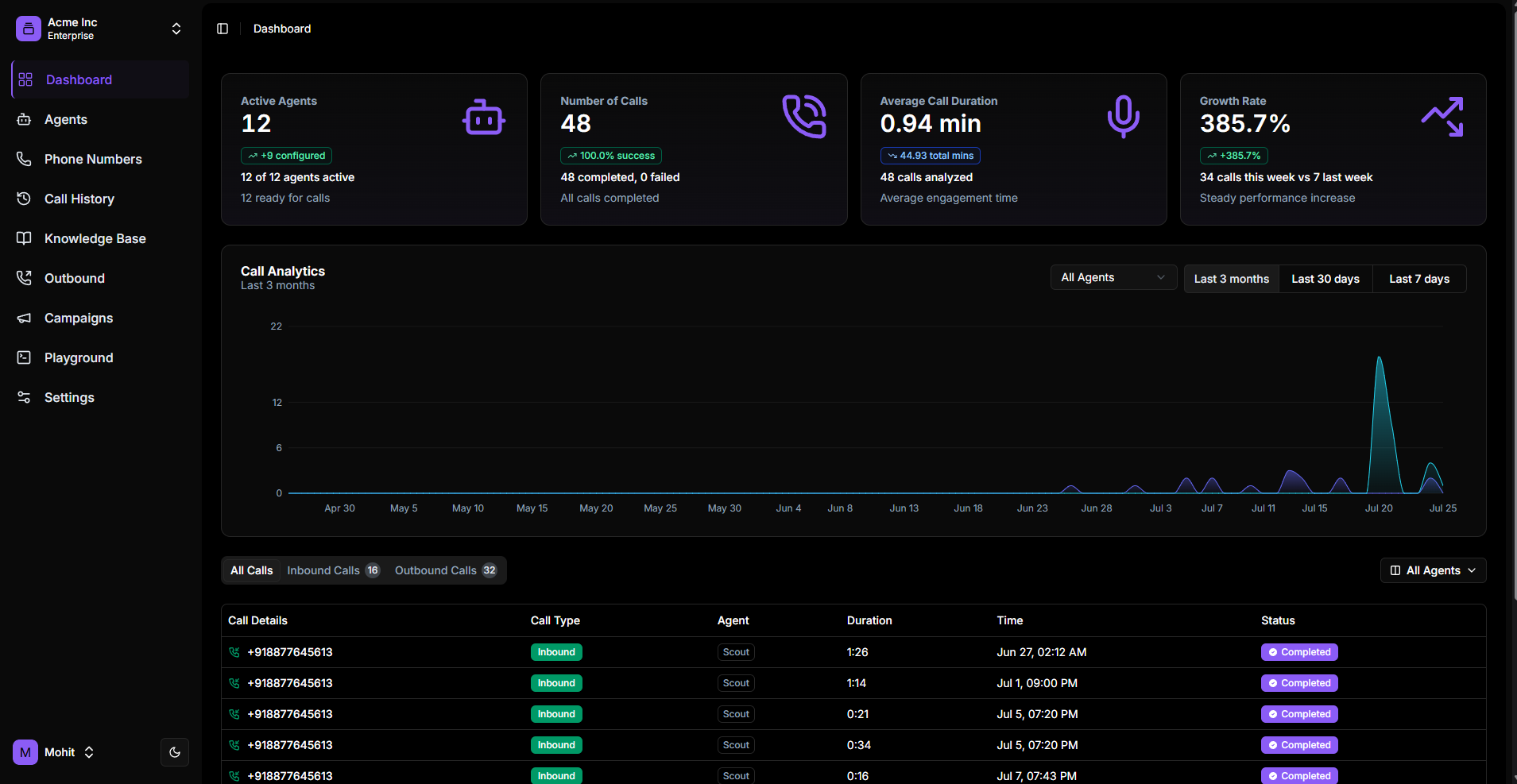
QuickVoice lets teams run their own AI phone agents for inbound and outbound calls. The codebase includes a marketing site, a customer console, an Express API server, and a LiveKit-based AI worker, all orchestrated with Docker Compose and Go Task. It integrates with Twilio and Telnyx for telephony, uses PostgreSQL and Redis for data, adds Qdrant for vector search, and supports Stripe billing, Pinecone knowledge retrieval, and MCP tool calls. Privacy features include PII redaction, zero-PII retention modes, encrypted secrets, and automated cleanup jobs. The stack runs on Linux, macOS, or Windows via WSL2. Real calls require LiveKit credentials and a telephony provider. The project is MIT-licensed and positioned as an open-source alternative to hosted voice-agent APIs.
Should you self-host QuickVoice?
QuickVoice scores 47/100 on selfhost.directory (how scoring works) and ranks #123 of 209 in AI Agents. It has 495 GitHub stars.
There was no stable release in the past 12 months, so check the repository's recent activity before you rely on it.
Setup is advanced: plan for several services and some ongoing maintenance. It is MIT-licensed and written mostly in Typescript.
Its closest alternative on selfhost.directory is dograh (70/100, 5 970 stars). It scores higher overall, so compare the two before you pick. See QuickVoice vs dograh side by side.
Features
- AI phone agents
- Billing and subscriptions
- Call logging and recording
- Customer console
- Knowledge bases
- Local development tooling
- MCP tool connections
- Multi-provider voice catalog
- Outbound campaigns
- Per-call runtime control
- Privacy Controls
- REST API
- Telephony integrations
- Vector database (Qdrant)
QuickVoice README
FAQ
How do we evaluate whether it works for us?
Start with one call type, representative test calls, a named implementation owner, and a clear definition of success. Review incorrect answers, action failures, and human handoffs alongside cost and completion rates.
What should we include in the budget?
Budget for AI and telephony usage, phone numbers, hosting, implementation, monitoring, and human follow-up. Hosted usage pricing and self-hosted operating costs are explained on the pricing page.
What happens when a caller needs a person?
Plan an explicit escalation path for each workflow. Depending on your configured telephony and business systems, that may involve a transfer or a request for staff follow-up. Test availability, failed transfers, and after-hours calls before a pilot.
Can an agent book appointments or update my business systems?
These actions depend on the integrations you implement. An appointment request is not a confirmed booking until your scheduling system accepts it. Your team defines verification, permissions, and fallback when an action cannot be completed.
What can I explore in a demo?
Bring a call type your team handles today: reception, appointment requests, support, or sales follow-up. The demo discusses the caller journey, information needed, and implementation work for a focused pilot.
Can we host QuickVoice ourselves?
Yes, QuickVoice is MIT-licensed self-hostable software. Your technical team operates the deployment and connects provider accounts. Real phone calls require LiveKit and a configured telephony provider such as Twilio or Telnyx.
More in Customer Support
 ResolveHQA Cloudflare Worker helpdesk for small teams with shared inbox, proper email threading, automation, SLA tracking, knowledge base, and optional AI drafting.
 ScooldSelf-hosted, open-source Q&A platform and team knowledge base with voting, full-text search, LDAP and OAuth2 login, run in Docker next to a Para backend.
 tiledeskSelf-hosted open-source live chat with AI chatbots, multichannel support, visual design studio, RAG knowledge base, and human-in-the-loop escalation.
 TwentySelf-hosted, open-source CRM platform for technical teams to build custom solutions with AI agents, workflows, and extensible data models.
 TypebotSelf-hosted, fair-source chatbot builder with a visual block editor, web and WhatsApp delivery, webhooks, result analytics, and Docker images for builder and viewer.
 UVdesk HelpdeskOpen-source service desk for support teams: email-to-ticket mailboxes, workflows, saved replies, knowledgebase. Self-hosted via Composer, Docker or an AWS image.
 webwhizSelf-hosted, open-source AI chatbot that trains on your website data to provide instant customer support with 100+ language support and GDPR compliance.
 WhatomateSelf-hosted WhatsApp Business Platform with calling, visual IVR, S3 recordings, chatbot, campaigns, and team inbox — all on your infrastructure.
 ZammadZammad is a self-hosted, open-source ticketing system that consolidates customer support across email, chat, phone, and social media into one web-based platform.
 AI Native Call CenterSelf-hosted open-source call center where AI agents answer every call by default, with seamless human handoff on FreeSWITCH and PostgreSQL.
 AnswerA self-hosted, open-source Q&A platform for community forums, help centers and team knowledge bases, with tags, voting, reputation and plugins.
 AtriumA self-hosted portal for agencies to manage projects, files, invoices, and client communication under their own brand.
0 comments