
Self-host AI Native Call Center
v0.7.1AI-native call center where AI answers every call first
- Stars
- 441
- CPU
- 4 CPUs
- RAM
- 4 GiB
- Ports
- 8080 (HTTP API, event stream and web interface), 5060 (SIP signalling (UDP/TCP)), 5066 (Browser phone WebSocket transport), 6060 (AI bot SIP endpoint), 18021 (FreeSWITCH ESL connection), 9090 (Metrics listener (/metrics, /healthz, /readyz)), 8090 (Transcription audio stream listener), 40000 (AI bot RTP media range start), 40999 (AI bot RTP media range end), 16384 (FreeSWITCH RTP media range start)
- Requires
- FreeSWITCH, PostgreSQL
rasonyang/ai-native-callcenter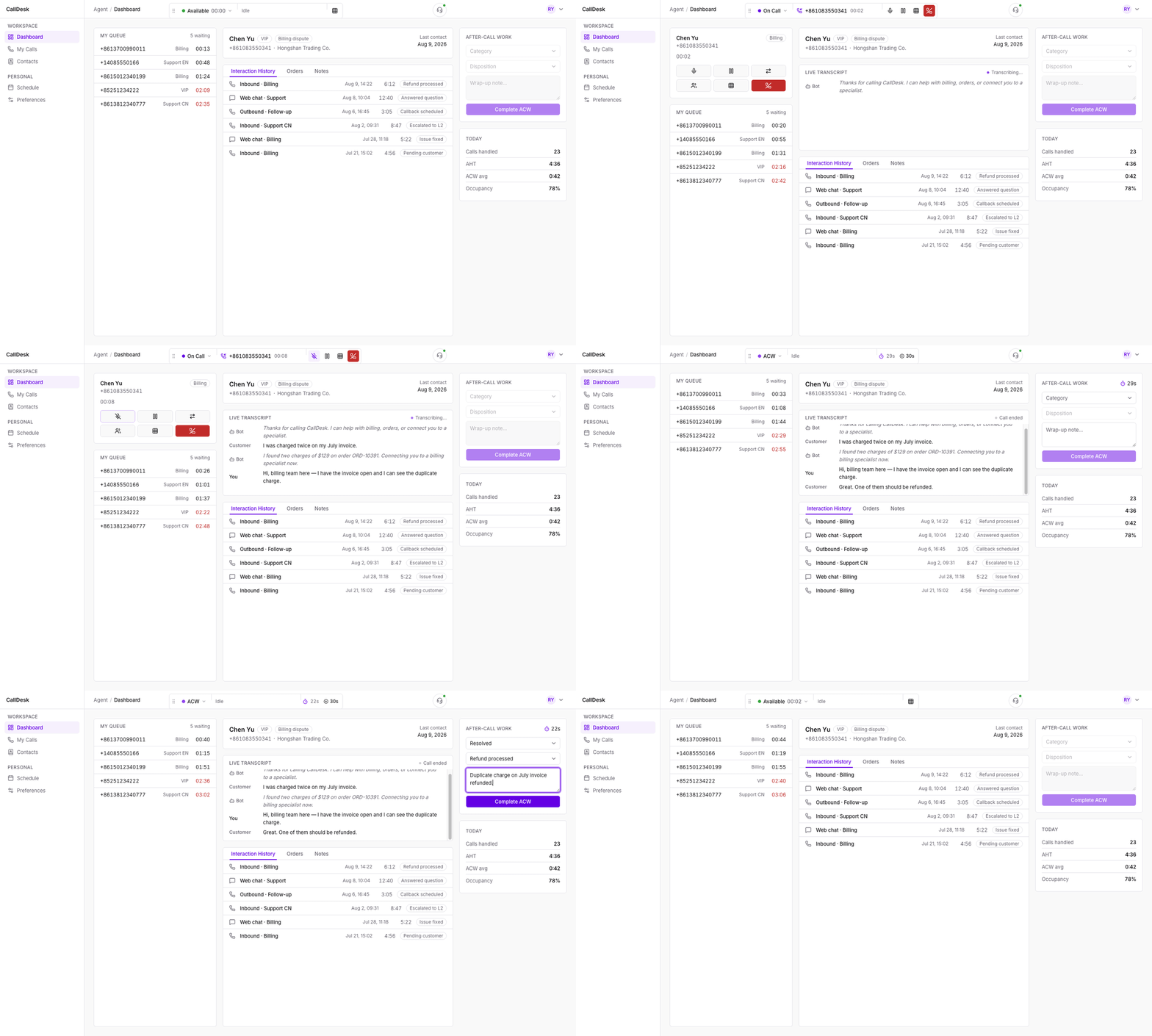
What is AI Native Call Center?
AI Native Call Center is a self-hosted call center platform where AI voice agents answer every incoming call by default. The AI leg runs as a SIP endpoint inside the Go application, bridged by FreeSWITCH, with audio passed directly to realtime speech-to-speech providers (OpenAI, Grok, Qwen, Doubao, or a compatible gateway). A flow engine steers conversations through phases and tools, and transfers to human agents in mod_callcenter queues when needed — the agent's browser screen pops with the transcript before the phone rings. Agents use a companion Chrome extension (web-sip-phone) for audio. Every call produces a single CDR with transcript and recording, stored on the filesystem or any S3-compatible backend. The stack runs as three containers (PostgreSQL 18, FreeSWITCH 1.11, and the Go application with embedded SPA) via Docker Compose, with a one-line installer for Linux and macOS. Minimum 4 CPUs and 4 GiB RAM. Licensed Apache-2.0.
Should you self-host AI Native Call Center?
AI Native Call Center scores 48/100 on selfhost.directory (how scoring works) and ranks #10 of 14 in Customer Support. It has 441 GitHub stars.
It shipped 9 stable releases in the past year. The latest, v0.7.1, came out on 28 October 2026. New versions land roughly every 5 days.
Setup is advanced: plan for several services and some ongoing maintenance. An official Docker image is available. It is Apache-2.0-licensed and written mostly in Go.
Its closest alternative on selfhost.directory is chatwoot (84/100, 38 470 stars). It scores higher overall, so compare the two before you pick. See AI Native Call Center vs chatwoot side by side.
Features
- AI Voice Agents
- Bilingual support
- Call Queues
- Call Recording
- CDR & Webhooks
- Chrome Extension PhoneSeparate repository, installed from Chrome Web Store
- Flow Engine
- Human handoff
- Live transcriptionOptional, requires additional configuration
- Multiple Voice ProvidersOne provider per deployment, chosen at startup
- Outbound AI Campaigns
- Post-call TranscriptionOptional, requires Qwen ASR
- REST API
- Server-Sent Events
- Web Agent Desktop
AI Native Call Center README
More in VoIP
 AIReceptionistSelf-hosted AI receptionist using OpenAI Realtime API for natural voice calls via SIP, replacing costly SaaS alternatives with FAQ, transfers, and messages.
 AsteriskAsterisk is a self-hosted, open-source PBX and telephony toolkit written in C for business telephone systems with VoIP/SIP, PSTN, and APIs (AMI, ARI, AGI).
 AVA CoreOpen-source, self-hosted AI voice agent for Asterisk/FreePBX telephony with realtime providers or modular STT-LLM-TTS pipelines, managed from a web Admin UI.
 avhost/docker-matrixSelf-hosted Docker image for running a Matrix Synapse homeserver with integrated Coturn TURN/STUN server for federated chat and VoIP.
 CoturnOpen-source TURN and STUN server relaying WebRTC and VoIP media through NAT; self-hosted via apt or Docker, with Prometheus metrics and SQL/Redis user databases.
 flexisipFlexisip is a self-hosted, open-source SIP server suite in C++20 providing proxy, presence, conference, B2BUA, and push notifications for real-time communications.
 fluxerSelf-hosted, open-source instant messaging and VoIP platform with channels, voice and video calls, search and an admin dashboard, plus web, desktop and mobile clients.
 fonosterOpen-source, self-hosted voice-agent platform for real phone calls: Autopilot agents defined in YAML, SIP trunks and numbers, transfer, recording, webhooks.
- FreepbxFreePBX is an open-source web-based graphical user interface (GUI) that manages Asterisk, the world's most popular open-source IP PBX. It provides users with the tools to build a phone system tailored to their needs.
 FreeSBCFreeSBC is a self-hosted, open-source SBC in Go that keeps FreeSWITCH/Asterisk off the public internet with SIP proxying, RTP/SRTP media anchoring, WebRTC gateway.
 FreeSWITCHOpen-source self-hosted softswitch replacing proprietary telecom hardware: SIP PBX with dialplan, voicemail, conferencing, WebRTC and an ESL control API.
 FusionPBXFusionPBX is a self-hosted, open-source PBX web interface for FreeSWITCH providing multi-tenant VoIP, call center, and device provisioning for businesses.
0 comments