
Self-host Pictaria Server
v1.2.1AI photo intelligence and curation for Immich libraries
- Stars
- 196
- Port
- 4080 (HTTP web UI and API)
- Requires
- Immich
ghcr.io/pictaria-ai/pictaria-server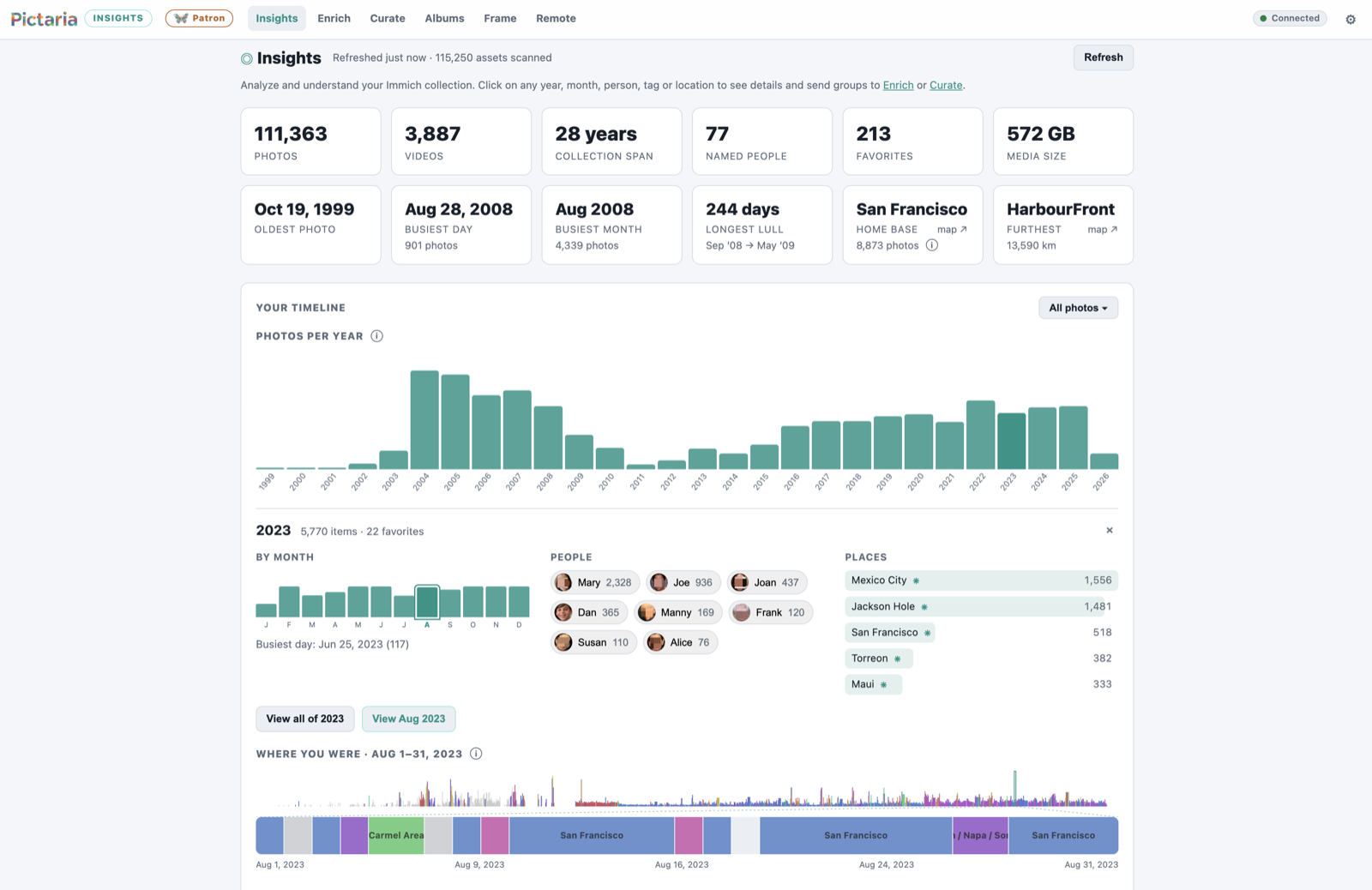
What is Pictaria Server?
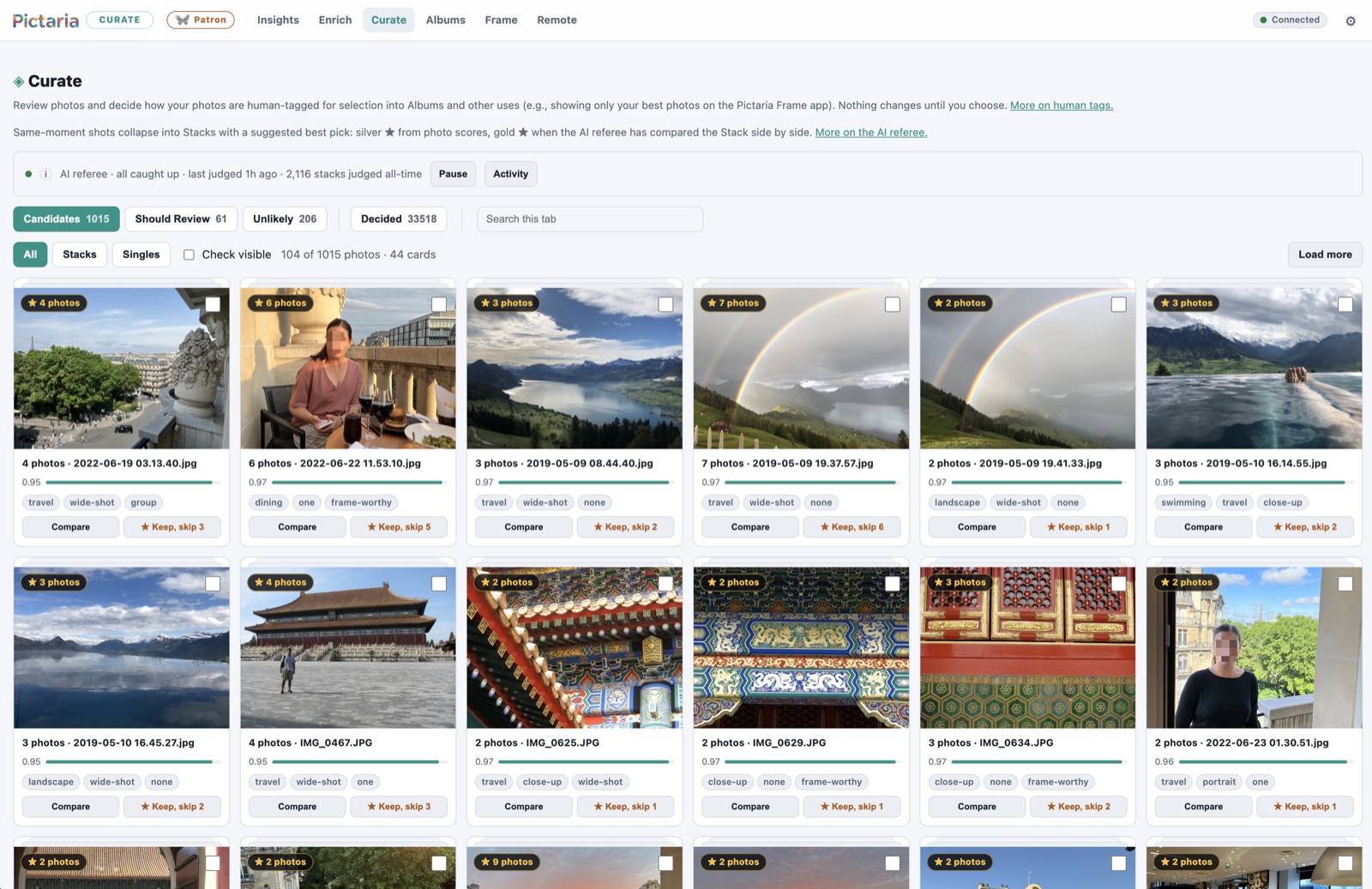
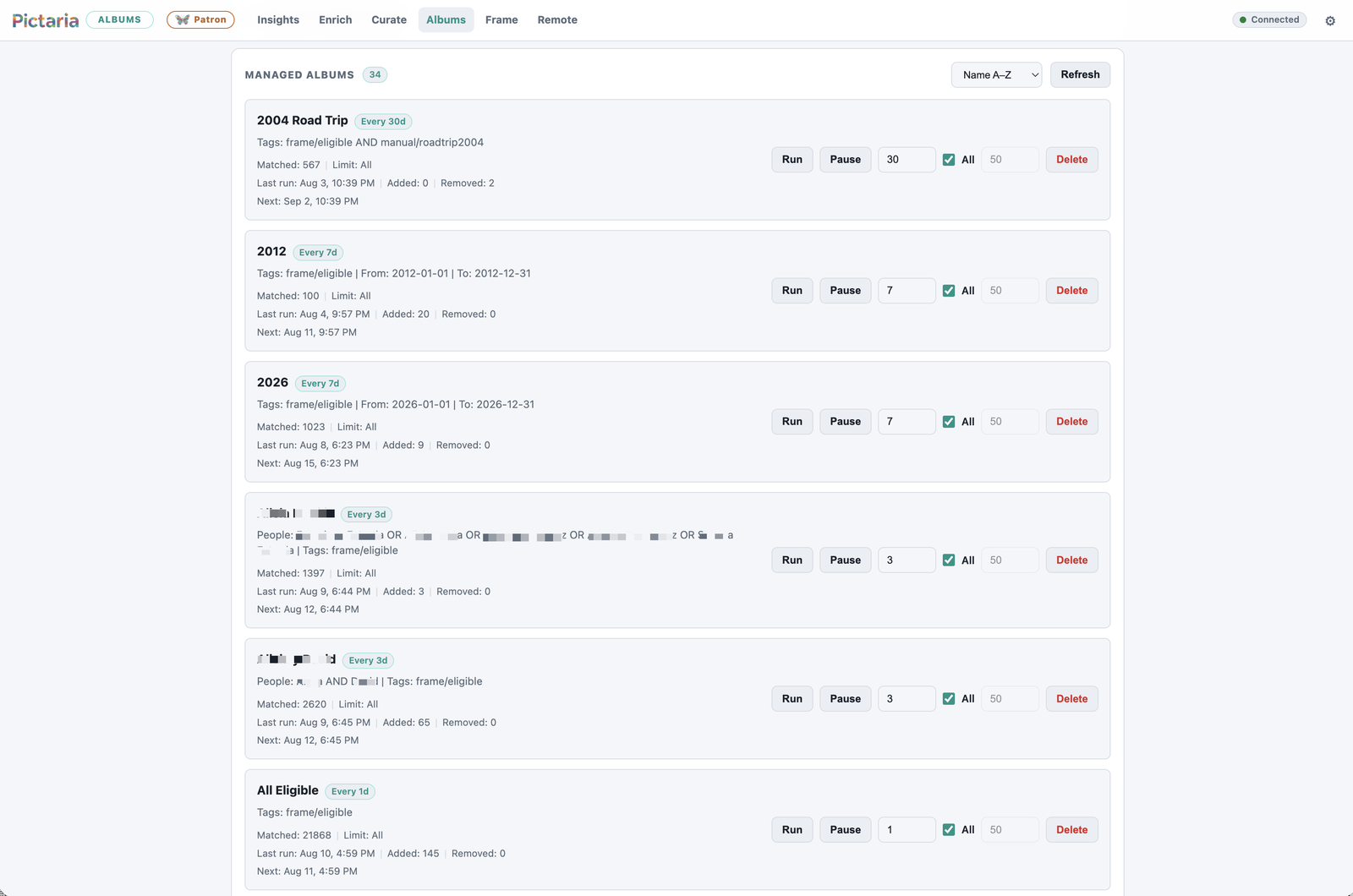
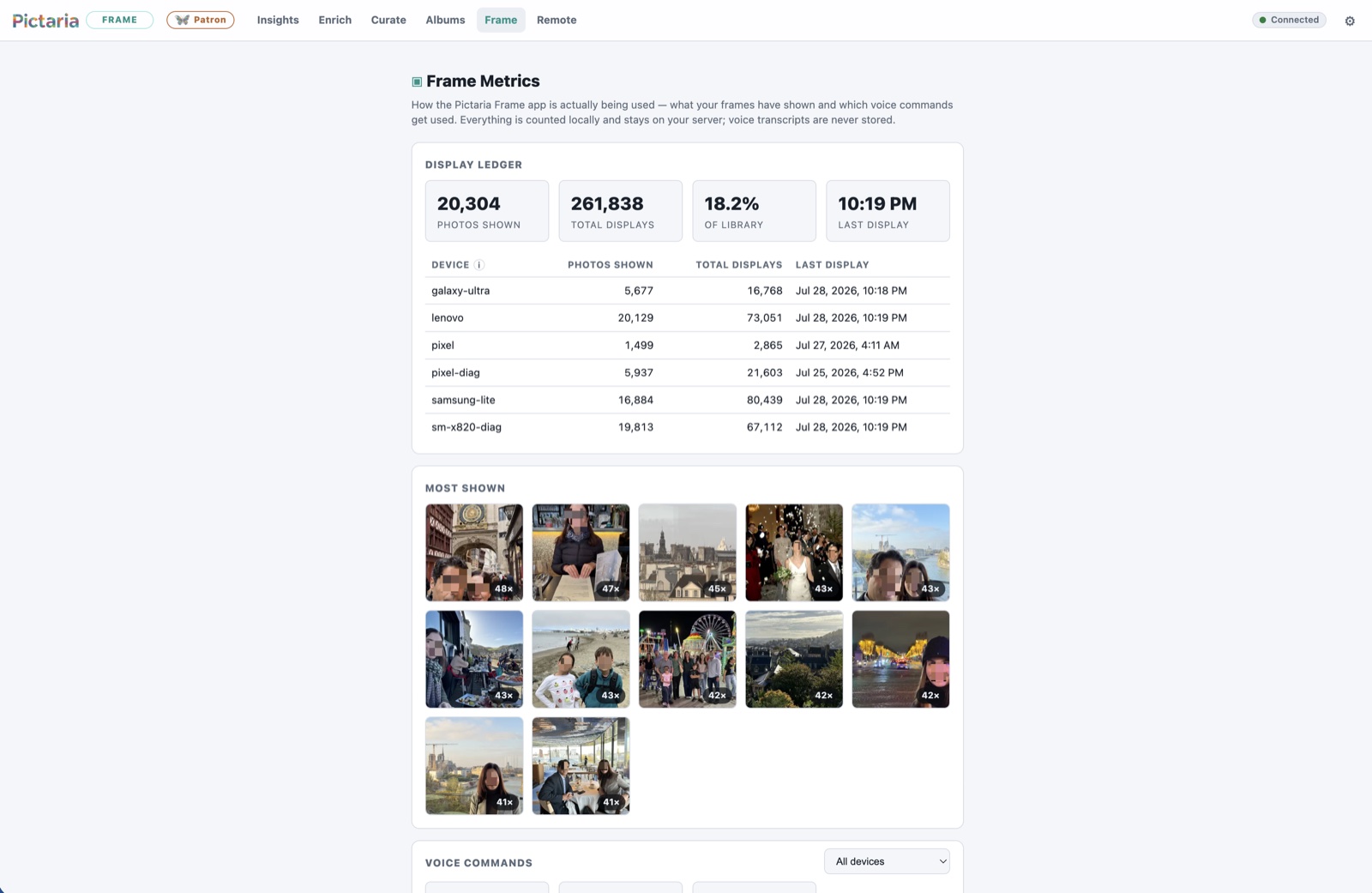
Pictaria Server is a self-hosted web application that connects to your Immich photo library to provide deep insights, AI-powered enrichment, and curation tools. It runs as a single Node.js process (Docker or bare metal) with zero npm dependencies. Key capabilities include: Insights for collection statistics and timeline exploration; Enrich for AI photo classification using local models (Ollama, LM Studio, llama.cpp) or cloud providers (OpenAI, OpenRouter, Venice); Curate for human review of photo stacks with AI-assisted keeper suggestions; Smart Albums that keep real Immich albums synchronized to saved search rules; Frame Remote for live control of Pictaria Frame devices; Voice features for photo Q&A and text-to-speech; and Activity logging for audit trails. All configuration is managed through a web UI with runtime changes, no restart required. The server uses SQLite for local state and requires an Immich 2.0+ instance. Licensed under AGPL-3.0-only.
Should you self-host Pictaria Server?
Pictaria Server scores 48/100 on selfhost.directory (how scoring works) and ranks #25 of 41 in Photo Management. It has 196 GitHub stars.
It shipped 5 stable releases in the past year. The latest, v1.2.1, came out on 12 September 2026. New versions land roughly every 3 days.
Setup is moderate: expect some configuration beyond a single command. An official Docker image is available. It is AGPL-3.0-licensed and written mostly in JavaScript.
Its closest alternative on selfhost.directory is Ente (81/100, 29 693 stars). It scores higher overall, so compare the two before you pick. See Pictaria Server vs Ente side by side.
Features
- Activity Log
- AI Enrichment
- Ambient Display
- Automatic Backups
- Frame Metrics
- Frame Remote
- Human Curation
- Insights
- Runtime Settings
- Smart Albums
- Voice assistant
Pictaria Server README
More in Photo Management
 PiGallery 2PiGallery2 is a self-hosted, open-source photo gallery that organizes images by your existing folder structure, optimized for low-end hardware like a Raspberry Pi.
 PiwigoSelf-hosted, open-source photo gallery and DAM web app for organisations, teams and individuals, with a large extensions catalogue and Docker or LAMP install.
 Plant-itOpen-source Android gardening app that logs plant care (watering, fertilizing), stores photos and sends care reminders, installed as an APK or via F-Droid.
 SharedMomentsSelf-hosted web app for couples, families, and friends to capture and relive shared memories with photos, videos, timelines, and AI-assisted descriptions.
 snsSNS is a self-hosted, open-source photo-sharing social network similar to Instagram, Flickr, Dribbble, and Behance, built with AngularJS and PHP REST API.
 spisSelf-hosted image/video gallery server, lightweight and database-free. Runs on Raspberry Pi, offers PWA with endless scroll, favorites, slideshows, custom commands.
 StashSelf-hosted, open-source media organizer in Go that indexes, tags and streams your video and image collection, with scraper metadata, plugins and DLNA.
 timelinizeTimelinize is a self-hosted, open-source personal archival suite that imports data from many sources into a unified timeline on your computer.
 UguuSelf-hosted, open-source temporary file host where visitors drop, paste or upload files with no account; it offers a JSON/CSV/text upload API and configurable expiry.
 WeddingShareSelf-hosted, open-source photo and video galleries (formerly WeddingShare) that guests view and fill via share links or printed QR codes, with an admin panel.
 A-EyeA self-hosted photo application that runs AI vision models on your own hardware to automatically organize and find pictures without any cloud service.
 AfilmorySelf-hosted, open-source photo gallery platform for photographers: syncs S3, B2, GitHub or local photos, with an HDR-aware GPU viewer, EXIF, maps and a native iOS app.
0 comments