
Self-host Pad
v0.18.1Project management for developers and AI agents
- Stars
- 198
- Port
- 7777 (HTTP API and embedded web UI)
ghcr.io/perpetualsoftware/pad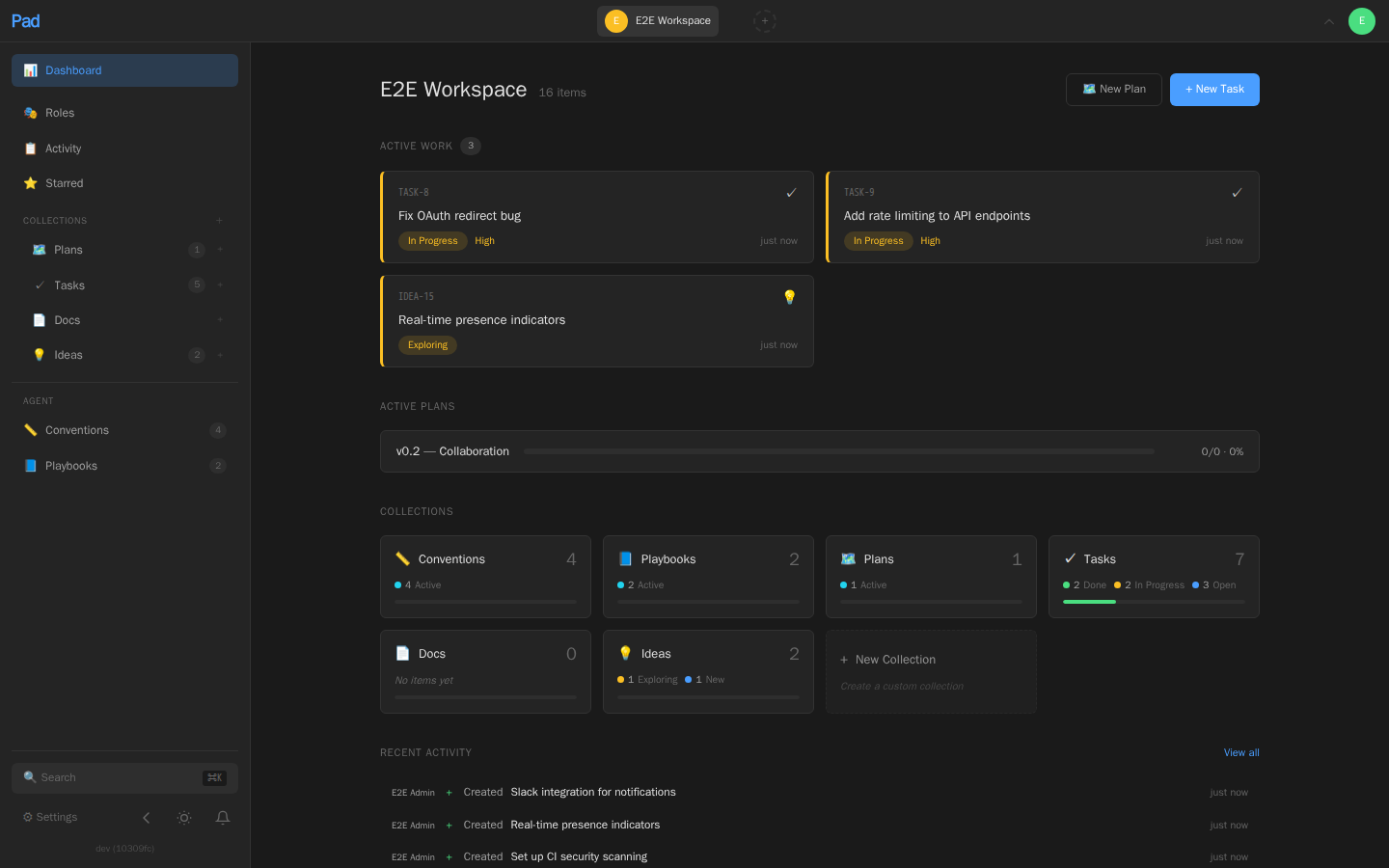
What is Pad?
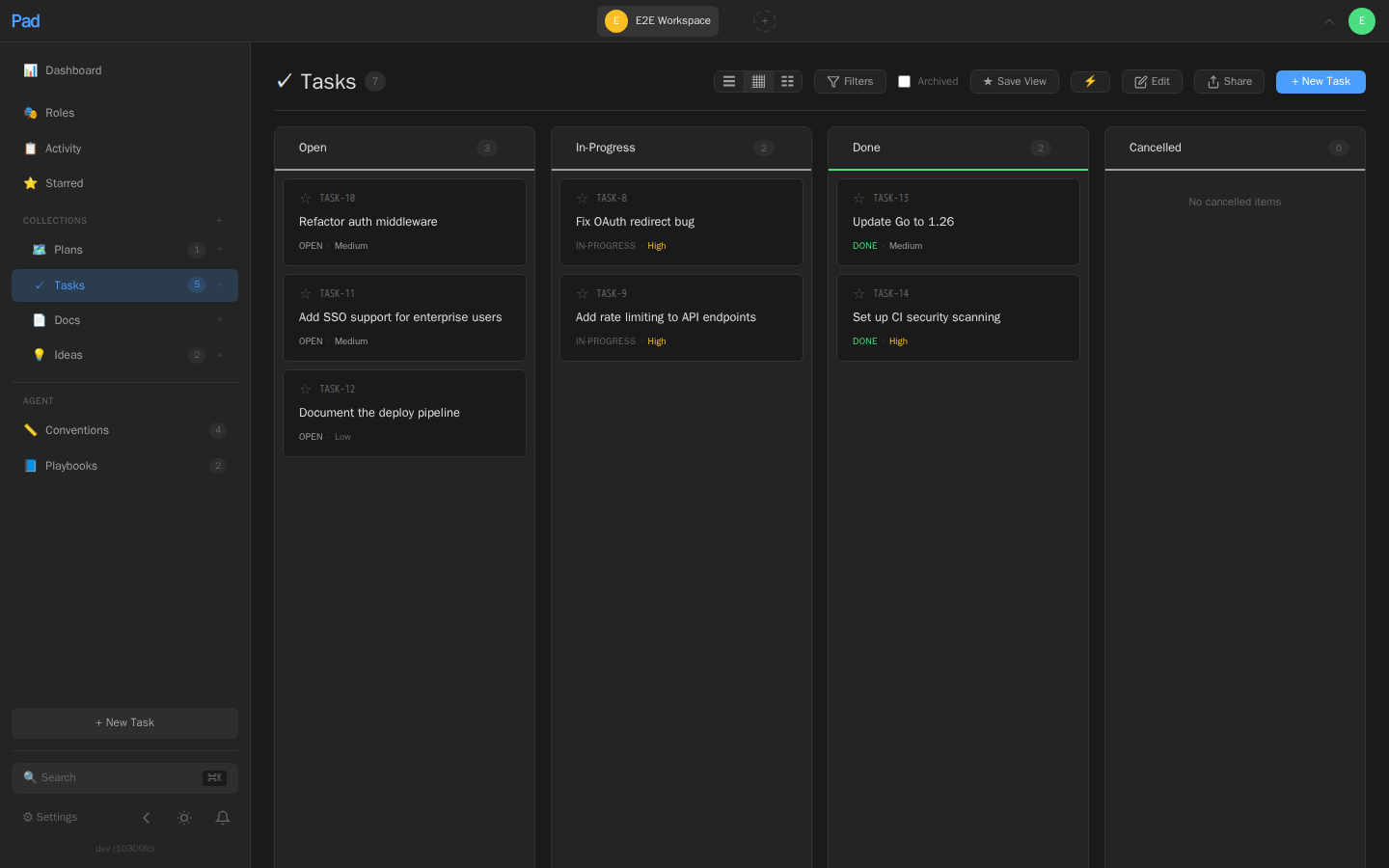
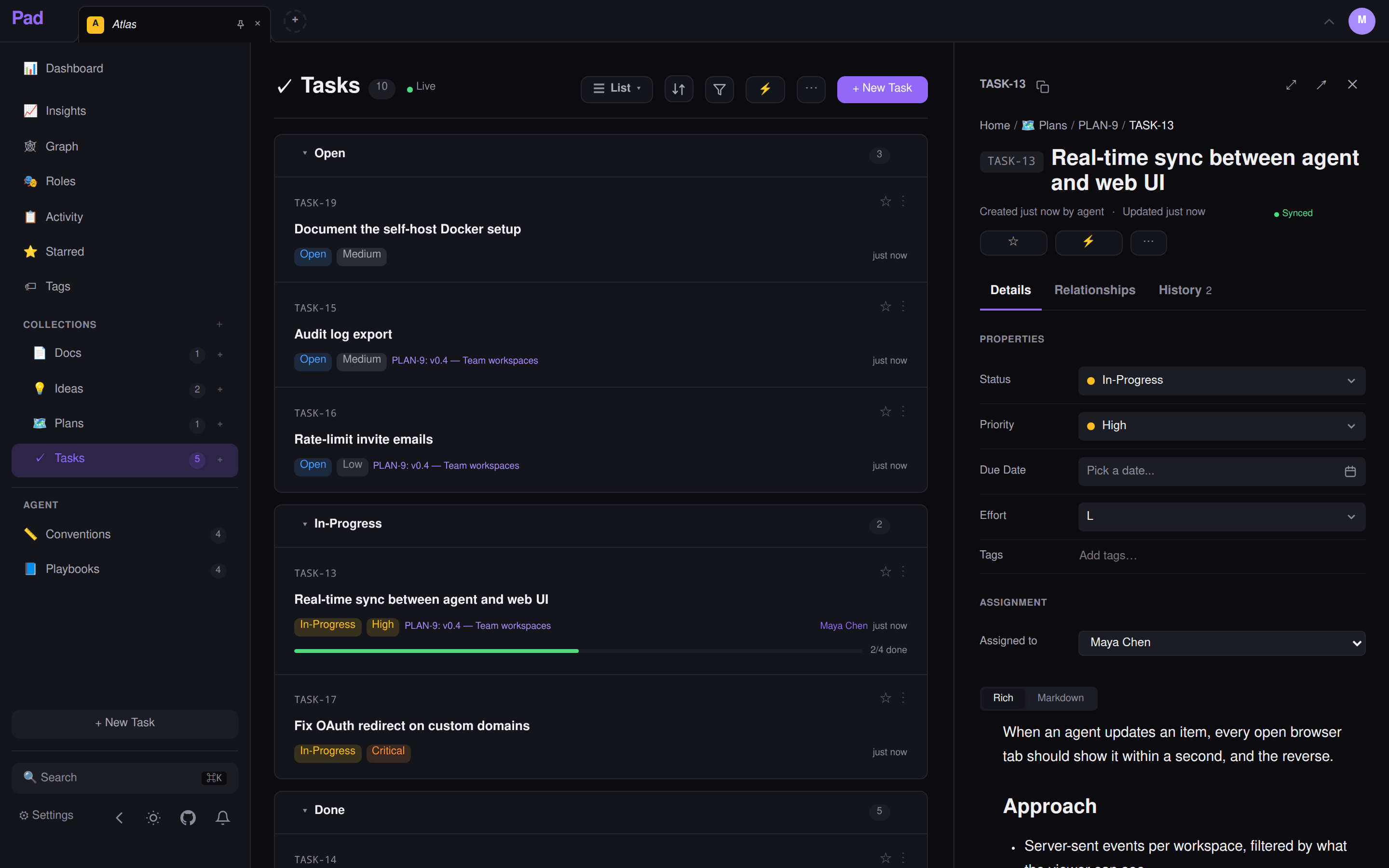
This tool helps developers and AI coding agents manage projects together. It packages a SvelteKit web interface, a command-line interface, and a natural-language skill named /pad into one Go binary. The skill works with popular AI assistants like Claude Code, Cursor, Windsurf, Codex, and others. Work gets organized into groups — Tasks, Ideas, Plans, Docs, Conventions, Playbooks — each supporting custom fields. Conventions set trigger-based rules for agents, while playbooks define multi-step workflows they can run. By default, data stays in a local SQLite file for fully offline use with zero telemetry; PostgreSQL and Redis can be added for clustered deployments. The self-hosted edition is free under Apache 2.0, and a managed cloud version adds sync, backups, and team features. You can install it via Homebrew, Docker, Docker Compose, direct binary download, Nix, or by compiling from source.
Should you self-host Pad?
Pad scores 49/100 on selfhost.directory (how scoring works) and ranks #33 of 45 in Project Management. It has 198 GitHub stars.
It shipped 9 stable releases in the past year. The latest, v0.18.1, came out on 18 October 2026. New versions land roughly every 7 days.
Setup is moderate: expect some configuration beyond a single command. An official Docker image is available. It is Apache-2.0-licensed and written mostly in Go.
Its closest alternative on selfhost.directory is Plane (86/100, 61 608 stars). It scores higher overall, so compare the two before you pick. See Pad vs Plane side by side.
Features
- Agent onboarding (/pad onboard)
- AI agent skill (/pad)
- API tokens
- CLI-first project management
- Conventions and playbooks
- Custom collections and fields
- Decision provider (optional)Off by default, requires Typesafe API key
- Embedded Web UI
- Local-first with SQLite
- MCP Server
- Real-Time Collaboration
- Role-based Access Control
- Webhooks
- Workspace templates
Pad README
FAQ
Where can I get help?
GitHub Discussions for questions and ideas, GitHub Issues for bugs and feature requests, and email for Pad Cloud account questions.
Does Pad work in a multi-user team?
On Pad Cloud, yes — that's its primary use case. Self-hosted supports multi-user via accounts, workspace invitations, and roles, but operating it for a team is the operator's responsibility.
How do AI agents work with Pad?
Pad ships a /pad skill that major AI coding agents can install via 'pad agent install'. Agents then manage projects through natural language commands like '/pad what should I work on next?'.
What's the license?
Apache 2.0 — you can use, modify, and distribute Pad freely including for commercial use.
Is Pad Cloud the same product as self-hosted Pad?
Same engine and features, but Pad Cloud adds managed PostgreSQL, encrypted backups, OAuth sign-in, team billing, and no operator burden. Self-hosted is supported for solo use; teams are directed to Pad Cloud.
Can I migrate from Linear / Notion / Jira?
Pad accepts JSON workspace imports but has no first-party importers. Users typically export to CSV and script POST requests to the REST API.
How do I update Pad?
Update via Homebrew with 'brew upgrade PerpetualSoftware/tap/pad', download latest binary from GitHub Releases, or rebuild from source with 'git pull && make install'. Migrations run automatically on startup.
Does Pad collect telemetry or analytics?
Self-hosted Pad collects no telemetry, usage tracking, or crash reports. Pad Cloud only has standard server access logs for rate limiting and abuse detection.
Does it work offline?
Self-hosted Pad works fully offline with no network dependency. Pad Cloud requires an internet connection by definition.
Where does my data go?
Self-hosted Pad stores everything in a single SQLite database at ~/.pad/pad.db with no cloud, sync, telemetry, or analytics. Pad Cloud uses managed PostgreSQL with encrypted backups.
More in Project Management
 pejotaPeJota is a self-hosted, open-source ERP and CRM for freelancers to manage clients, projects, tasks, time tracking, invoices, and contracts.
- PhorgePhorge is a self-hosted software suite for issue tracking and project management, designed as a fork of Phabricator.
 plan42Collavre is a self-hosted, open-source workspace where every block is a document, task, discussion, and AI agent context in one. Built on Rails with MCP.
 PlanePlane is a self-hosted open-source project management platform combining work items, cycles, wiki docs, and AI agents as an alternative to Jira, Linear, and ClickUp.
 plankaElegant open source project tracking. Self-hosted Kanban for teams — free Community edition, with PLANKA Pro for organisations.
 planwiki-appPlanWiki is a self-hosted, open-source tool that turns PRDs into tasks and exports to Linear or Trello, with an MCP server for AI agents.
 Ploi RoadmapSelf-hosted open-source roadmapping software for collecting and prioritizing feature requests, with upvoting, comments, GitHub integration, and OAuth SSO.
 ProjeQtOrProjeQtOr is a fully open-source, self-hostable project management tool designed to replace multiple proprietary tools. It supports Agile, Waterfall, and Hybrid methodologies, offering features like Gantt charts, Kanban boards, time tracking, risk management, financial tracking, and REST API integration.
 rebacklogsRe:Backlogs is a self-hosted, open-source project management tool with Backlogs, Sprints, Kanban boards, theming, and real-time updates.
 RedmineRedmine is a self-hosted, open-source project management web app in Ruby on Rails with issue tracking, Gantt charts, time tracking, wikis, forums, and SCM integration.
 roadmapSelf-hosted open-source roadmapping software for collecting and prioritizing feature requests, bug reports, and feedback with upvoting, comments, and GitHub integration.
 Roundup Issue TrackerRoundup is a highly customizable issue-tracking system with command-line, web, REST, XML-RPC, and e-mail interfaces. It is designed to be easy to install and use, and can be adapted to various use cases.
0 comments