
Self-host Miniflux
2.3.5Minimal, keyboard-driven RSS and Atom feed reader
- Stars
- 9 943
- Port
- 8080 (HTTP(S) web UI and API, LISTEN_ADDR default 127.0.0.1:8080; the Docker examples publish it as "80:8080")
- Requires
- PostgreSQL
docker.io/miniflux/miniflux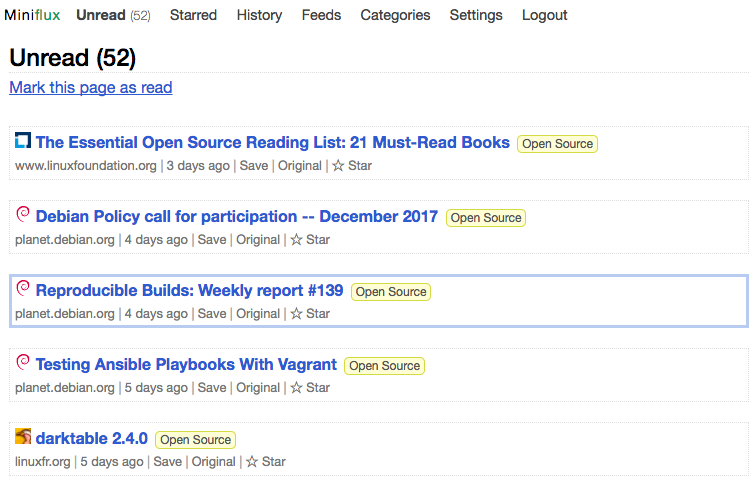


What is Miniflux?
Miniflux is a deliberately spare feed reader for people who want RSS aggregation running on hardware they control. It ingests the common RSS and Atom dialects along with JSON Feed, brings subscriptions in over OPML or by URL, sorts entries into categories, keeps bookmarks, and can download the source page to extract the readable part of an article with its built-in Readability parser, optionally guided by your own CSS selector and rewrite rules. A large part of the design is anti-tracking: tracking pixels are dropped, marketing query parameters are cleaned out of links, media are proxied so nothing loads from the publisher directly, and no referrer is forwarded. Polling runs from an internal scheduler or a classic cron job, saved entries are searchable through PostgreSQL full-text search, and the REST API together with Fever and Google Reader compatible endpoints lets phone apps use your instance. Sign-in works with a local account, passkeys, Google, any generic OpenID Connect provider, or a header set by a trusted reverse proxy. Running it yourself means one statically compiled binary plus PostgreSQL 11 or newer; there are also Debian and RPM packages, images on three container registries, pre-built binaries for several CPU architectures, optional automatic Let's Encrypt TLS, a Prometheus metrics endpoint and more than two dozen integrations for saving articles or pushing notifications. The project additionally sells hosted accounts for $15 a year, which run the same codebase, and deliberately refuses a plugin system and feature bloat.
Miniflux alternatives
 ReactfluxReactFlux is a self-hosted, open-source Miniflux web frontend with a modern responsive UI, dark mode, customizable layouts, keyboard shortcuts, multi-language support.CompareReactflux with Miniflux
 favedFree open-source bookmark manager with nested tags, automatic metadata fetching and browser/Raindrop/Pocket import, self-hosted as one Docker container.Comparefaved with Miniflux
 goelandGoeland is a self-hosted, open-source tool that turns RSS, Atom, and JSON feeds into beautiful HTML email digests with full-text extraction and composable filters.Comparegoeland with Miniflux
 openchangelogOpenchangelog transforms Markdown changelogs into a beautiful website with search, password protection, themes, RSS, and GitHub/GitLab/Forgejo/local integrations.Compareopenchangelog with Miniflux
 rss-readerA lightweight, self-hosted RSS feed reader in Go that aggregates multiple feeds with real-time WebSocket updates, auto-refresh, dark mode, and responsive design.Comparerss-reader with Miniflux
 ReadflowSelf-hosted open-source news reader with offline reading, PWA support, and webhook integrations for Pocket, Wallabag, and RSS feeds.CompareReadflow with Miniflux
 FeedReaderA self-hosted RSS and ATOM feed aggregator with a minimal web UI, Fever API compatibility for mainstream RSS clients, and OPML import/export.CompareFeedReader with Miniflux
 RSS MonsterRSS reader with smart folders, semantic events, and AI-powered recommendations. Supports SQLite/MySQL, Fever/Google Reader APIs, Docker and desktop app.CompareRSS Monster with Miniflux
Should you self-host Miniflux?
Miniflux scores 73/100 on selfhost.directory (how scoring works) and ranks #3 of 86 in Feed Reader. It has 9 943 GitHub stars, +150 in the last 30 days.
It shipped 9 stable releases in the past year. The latest, 2.3.5, came out on 2 November 2026. New versions land roughly every 4 weeks.
Setup is easy: most people get it running in one sitting. An official Docker image is available. It is Apache-2.0-licensed and written mostly in Go.
Its closest alternative on selfhost.directory is RSSHub (86/100, 47 049 stars). It scores higher overall, so compare the two before you pick. See Miniflux vs RSSHub side by side.
Features
- Categories and bookmarks
- Content rewriting rules
- CSS selector scraper rules
- Fever and Google Reader API compatibility
- Full-Text Search
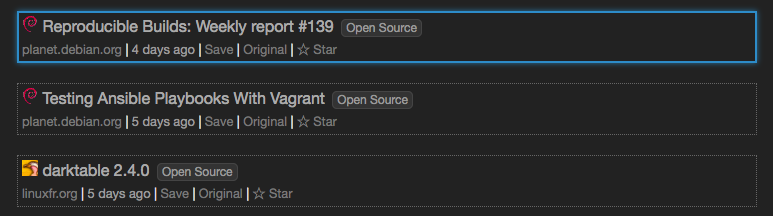
- Keyboard Shortcuts
- Media proxy
- OPML import and export
- Original content fetching
- Podcast and media enclosures
- Public article sharing
- Regex entry filters
- REST API
- RSS/Atom/JSON Feed Support
- Tracking protection
Miniflux README
Miniflux is a minimalist and opinionated feed reader. It's simple, fast, lightweight and super easy to install.
Official website: https://miniflux.app
- Supported feed formats: Atom 0.3/1.0, RSS 1.0/2.0, and JSON Feed 1.0/1.1.
- OPML file import/export and URL import.
- Supports multiple attachments (podcasts, videos, music, and images enclosures).
- Plays videos from YouTube directly inside Miniflux.
- Organizes articles using categories and bookmarks.
- Share individual articles publicly.
- Fetches website icons (favicons).
- Saves articles to third-party services.
- Provides full-text search (powered by Postgres).
- Available in 20 languages: Portuguese (Brazilian), Chinese (Simplified and Traditional), Dutch, English (US), Finnish, French, German, Greek, Hindi, Indonesian, Italian, Japanese, Polish, Romanian, Russian, Taiwanese POJ, Ukrainian, Spanish, and Turkish.
FAQ
Why aren't SQL migrations executed automatically?
Running them automatically caused problems, since only one process should touch the schema at a time and multiple containers can conflict; set RUN_MIGRATIONS=1 to have them applied at startup.
Which Docker architecture should I use?
Pulling latest or a pinned version tag downloads the correct image for your machine automatically; multi-architecture images exist since Miniflux 2.0.12.
Which binary should I use on Scaleway ARM machines?
The armv6 binary for a C1 server and the armv8 binary for ARM64 machines.
Which Debian package architecture should I use for my Raspberry Pi?
armhf for Pi 2 and 3, arm64 for Pi 3 and 4; the older A/B/Zero models are not supported by the Debian packages yet.
Which binary should I use on my Raspberry Pi?
Model A/A+/B/B+/Zero take the armv6 binary, Pi 2 and 3 the armv7 one, and Pi 3/4 the arm64 build.
What does "Save this article" mean?
It pushes the entry to a configured external service such as Pinboard or Instapaper.
Why is there no plugin system?
The project keeps a minimalist approach: a plugin system would add complexity, and plugins tend to be abandoned by their authors over time.
How can I create themes for Miniflux 2?
External stylesheets are not loaded, so themes are compiled into the binary; a new official theme has to arrive as a pull request that you then keep maintained, otherwise it gets removed.
Why does Miniflux store favicons in the database?
Because it follows Twelve-Factor App principles: nothing is written to the local filesystem, so the application can run in ephemeral containers without persistent storage.
Why is Feature X missing in Miniflux v2?
Version 2 does not try to re-implement everything from version 1; minimalism was taken further, so missing features must be contributed within that philosophy.
Why are you not developing my feature request?
Development time is limited on a free open-source project, the feature set is intentionally small, and improving what already exists comes before adding new things; users who want a feature are encouraged to contribute it.
Why are you not merging my pull request?
Pull requests are declined when they change too much to review, introduce breaking changes or regressions, add dependencies, slow the software down, conflict with its philosophy, are poorly written, depend on another PR, or radically alter the interface.
More in Feed Reader
 miniflux-indexerSelf-hosted CLI tool that indexes Miniflux feed entries using sego for Chinese text segmentation, enabling better full-text search. Requires PostgreSQL 9.6+.
 miniflux-phpMiniflux is a minimalist, self-hosted, open-source RSS reader with a clean web interface, multiple user support, themes, and API access for mobile apps.
 mkfdSelf-hosted, open-source tool that builds RSS feeds from websites, email inboxes, APIs and other sources without native feeds. Runs in Docker or via Bun.
 morssMorss is a self-hosted, open-source tool that expands truncated RSS feeds by fetching full articles from source websites.
 MyTubeOpen-source and self-hosted: grab videos from yt-dlp's 1000+ sites (YouTube, Bilibili, Twitch included), build collections, watch in-browser, auto-download subscriptions.
 nebulapickerA self-hosted RSS tool that collects feeds, applies custom filters, and outputs curated feeds. Offers Wallabag connection for saving full articles.
 news2readerSelf-hosted OPDS catalog that fetches articles from Hacker News, Tildes, and Karakeep, converts them to EPUB, and serves them to e-reader software like KOReader.
 NewsBlurNewsBlur is a personal news reader that brings people together to talk about the world. A new sound of an old instrument.
 NewspipeNewspipe is a self-hosted, open-source news reader for RSS/Atom feeds with multi-user support, REST API, OPML import/export, search, bookmarks, notes, and LDAP auth.
 news_platformSelf-hosted, open-source news aggregator for RSS/YouTube with full-text fetching, dark mode, push notifications, and Raspberry Pi support.
 NextfluxNextflux is a self-hosted, open-source web client for Miniflux with dark mode, PWA support, multiple accounts, and advanced feed organization.
 NodeRSSBotNodeRSSBot is a self-hosted, open-source Telegram RSS bot with OPML import/export, HTTP caching, and multi-language support.
0 comments