
Self-host Convoy
v26.9.5Webhooks gateway for reliable event delivery at the edge
curl -fsSL https://getconvoy.io/install | bash- Stars
- 2 891
- Ports
- 5005 (HTTP port of the Convoy server component), 5006 (Port of the worker server component), 5008 (Port the agent server runs on), 5009 (Port of the ingest server)
- Requires
- PostgreSQL
getconvoy/convoy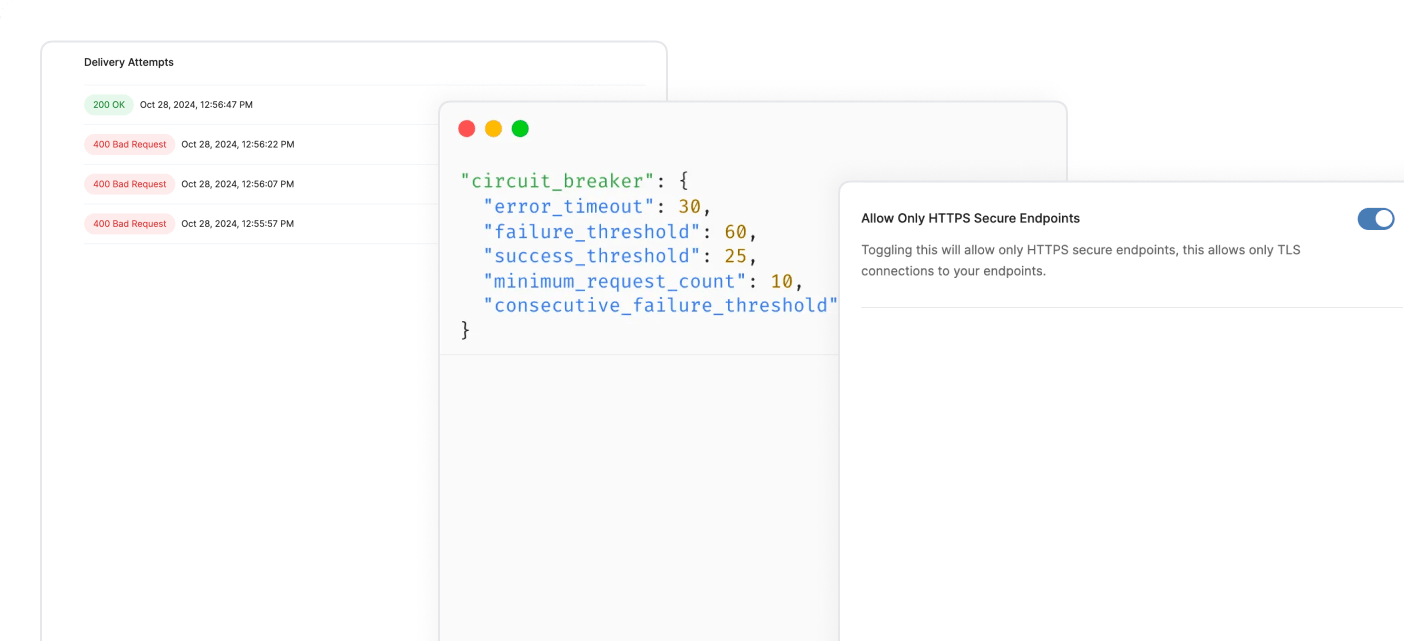
What is Convoy?
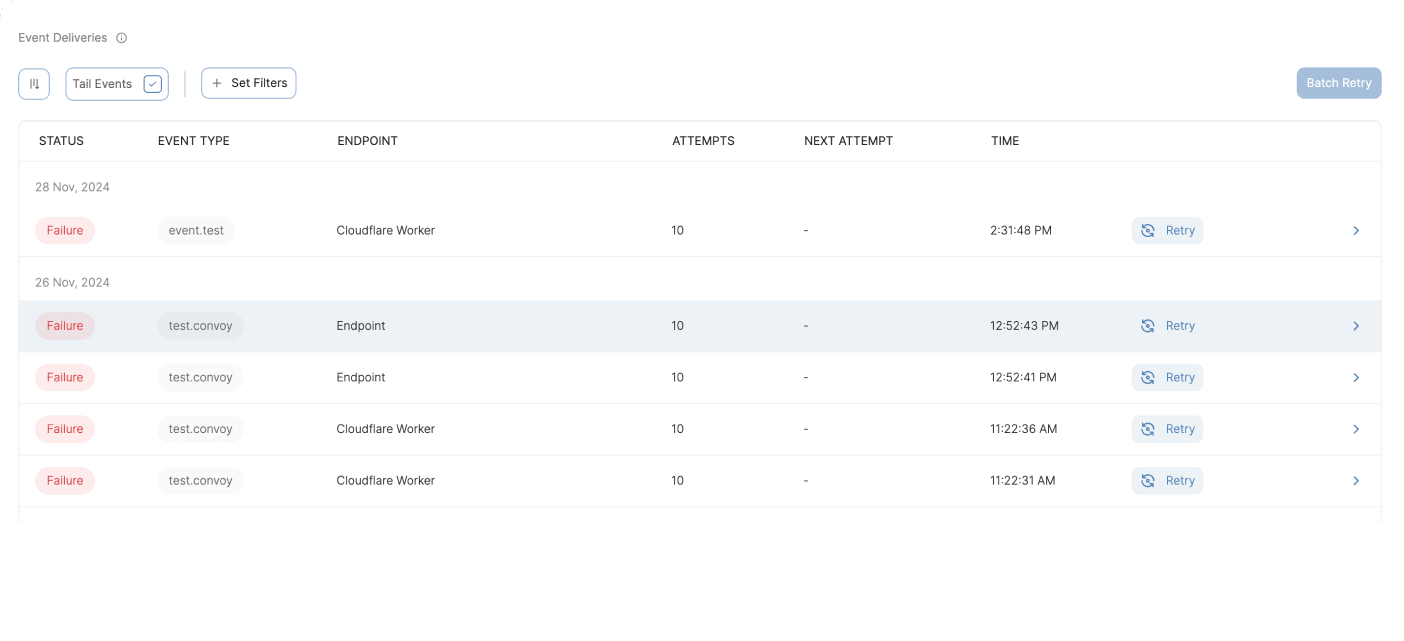
Convoy is an open-source webhooks gateway from frain-dev that sits between your services and the outside world: outbound events produced by your microservices are queued and delivered to your users' endpoints, while inbound webhooks from third-party providers are verified and forwarded inward, keeping back-end systems off the public internet. The delivery pipeline offers automatic retries (constant delay or exponential backoff with jitter), manual batch retries, per-endpoint throughput caps, fan-out to many destinations, payload filtering with optional JavaScript rewriting, URL-template dynamic endpoints, and a circuit breaker that pauses and probes dead consumers. Security options include signed payloads, rolling secrets, bearer-token or OAuth2 authenticated endpoints, mTLS, and fixed source IPs for locked-down firewalls. Operators get event search by id, type, source or payload content, embedded customer-facing webhook dashboards, and email, Slack or Teams alerts when endpoints die. It scales horizontally as separate server and agent processes, with Redis as the default queue (an experimental Postgres-based queue also needs a license). Under the Elastic License 2.0, the free Community tier is limited to just one user account, a lone organisation and two projects; a $999/month Premium license key adds portal links, role-based access control, Google SSO/SAML, circuit breaking, Prometheus metrics and JS transforms, with an Enterprise tier for at-scale self-managed deployments. Install it with the curl one-liner, Docker Compose (which brings Postgres, PgBouncer and Redis), or the project's Helm chart; a fresh instance logs in with the default credentials stated in the docs.
Convoy alternatives
 WebHookSelf-hosted webhook server that runs commands on HTTP triggers with HMAC auth, rate limits, Prometheus metrics, and adnanh/webhook compatibility.CompareWebHook with Convoy
 AppwriteThe open-source cloud for agents & devs. Including Auth, Databases, Storage, Functions, Messaging, Hosting, Realtime, WAF and moreCompareAppwrite with Convoy
 deliverantDeliverant is a self-hosted, open-source webhook reliability layer ensuring at-least-once delivery, deduplication, deterministic retries, and full visibility.Comparedeliverant with Convoy
 hook0Self-hosted open-source webhook server with dashboard, HMAC signatures, retries, and delivery monitoring — alternative to Svix and Hookdeck.Comparehook0 with Convoy
 openlegionSelf-hosted platform for isolated AI agent teams with credential vaulting, spend limits, and a web dashboard — free for internal use under a source-available license.Compareopenlegion with Convoy
 OutpostSelf-hosted open-source platform for outbound webhooks and event delivery with multi-tenancy, a customer portal, and support for 11+ destination types.CompareOutpost with Convoy
 corootSelf-hosted, open-source APM and observability platform where eBPF agents capture every telemetry signal without code changes, with service maps and SLO alerting.Comparecoroot with Convoy
 laudspeakerSelf-hosted, open-source customer engagement platform for building visual onboarding journeys and sending event-triggered email, SMS, push and webhook messages.Comparelaudspeaker with Convoy
Should you self-host Convoy?
Convoy scores 61/100 on selfhost.directory (how scoring works) and ranks #12 of 38 in API Gateway. It has 2 891 GitHub stars, +13 in the last 30 days.
It shipped 30 stable releases in the past year. The latest, v26.9.5, came out on 12 November 2026. New versions land roughly every 4 days.
Setup is moderate: expect some configuration beyond a single command. An official Docker image is available. It is Elastic-2.0-licensed and written mostly in Go.
Its closest alternative on selfhost.directory is Kong Gateway (82/100, 44 381 stars). It scores higher overall, so compare the two before you pick. See Convoy vs Kong Gateway side by side.
Features
- Automatic Retries
- Batch retries
- Circuit BreakingComparison table shows circuit breaking is included with the Premium license, not Community.
- Dynamic endpoints
- Embedded customer-facing dashboardPortal Links are a Premium feature on self-hosted editions.
- Event filtering
- Event search
- Fan-out routing
- Incoming & outgoing webhooks
- JS payload transformationListed as a Premium (paid license) feature in self-hosted editions.
- OAuth2 & mTLS endpoint auth
- Payload signing & rolling secrets
- Rate Limiting
- SDKs
- Static IP egress
Convoy README


- Website: https://getconvoy.io
- Forum: Convoy Community
- Documentation: docs.getconvoy.io
- Deploy: Install Convoy
FAQ
How does API versioning work?
The server defaults to the newest version but clients can keep older behaviour by pinning: via api_version in convoy.json, CONVOY_API_VERSION env var, or the X-Convoy-Version request header, with headers taking highest precedence.
What is the difference between an incoming and an outgoing webhooks project?
Incoming projects act as a reliable ingress for webhooks consumed via HTTP source URLs and need no portal; outgoing projects act as an egress for API providers, ingest events through the REST API or PubSub systems, and give each consumer a portal for their logs.
More in API Gateway
 Copilot_ProxySelf-hosted proxy that converts GitHub Copilot API into OpenAI, Anthropic, and Gemini compatible endpoints with a WebUI for multi-account management and token handling.
 DreamFactoryDreamFactory is a self-hosted, open-source platform that instantly generates secure REST APIs from any database with RBAC, SSO, and MCP server for AI integration.
 FusioSelf-hosted, open-source API management platform: expose databases and services as REST APIs, with developer portal, SDK generation, MCP/AI agents, and monetization.
 gatewayLunarGate is a self-hosted, open-source AI gateway exposing an OpenAI-compatible endpoint with multi-provider routing, retries, fallbacks, and circuit breakers.
 gemini-web2api-goRun your own OpenAI-compatible endpoint for Google's free Gemini web UI — no API key, no paid tier. Single Go binary or Docker image with dashboard, cookie/proxy pools.
 GeoServerSelf-hosted, open-source Java server that publishes and edits geospatial data through OGC standards such as WMS, WFS, WCS and WMTS, from Shapefile to PostGIS.
 GetMCPGetMCP is a self-hosted Zero Trust proxy for AI agents that generates MCP servers from OpenAPI specs and enforces per-agent policies with tamper-evident audit logs.
 GoModelThis open-source, self-hosted AI gateway in Go unifies 34 LLM providers behind OpenAI-style and Anthropic-style APIs, adding budgets, caching, routing and audit logs.
 GPT-LoadAn open-source, self-hosted AI gateway routing one endpoint to 35 upstream channels — key credentials and subscription logins, with failover, logs and cost estimates.
 graviteeSelf-hosted, open-source API management: gateway, 50+ policies, developer portal and analytics for REST, GraphQL and gRPC APIs, run via Docker Compose or Helm.
 grokbuild-proxySelf-hosted proxy translating Anthropic and OpenAI API requests to Grok Build, letting you use your personal Grok account with Claude Code and compatible clients.
 HarnessRouterSelf-hosted, open-source gateway running Codex, Claude Code and other agent harnesses behind one OpenAI Responses-compatible API with sessions, streaming and files.
0 comments