
Self-host cftunnel
v0.4.4Tunneling CLI with Cloudflare and self-hosted relay modes
- Stars
- 360

What is cftunnel?
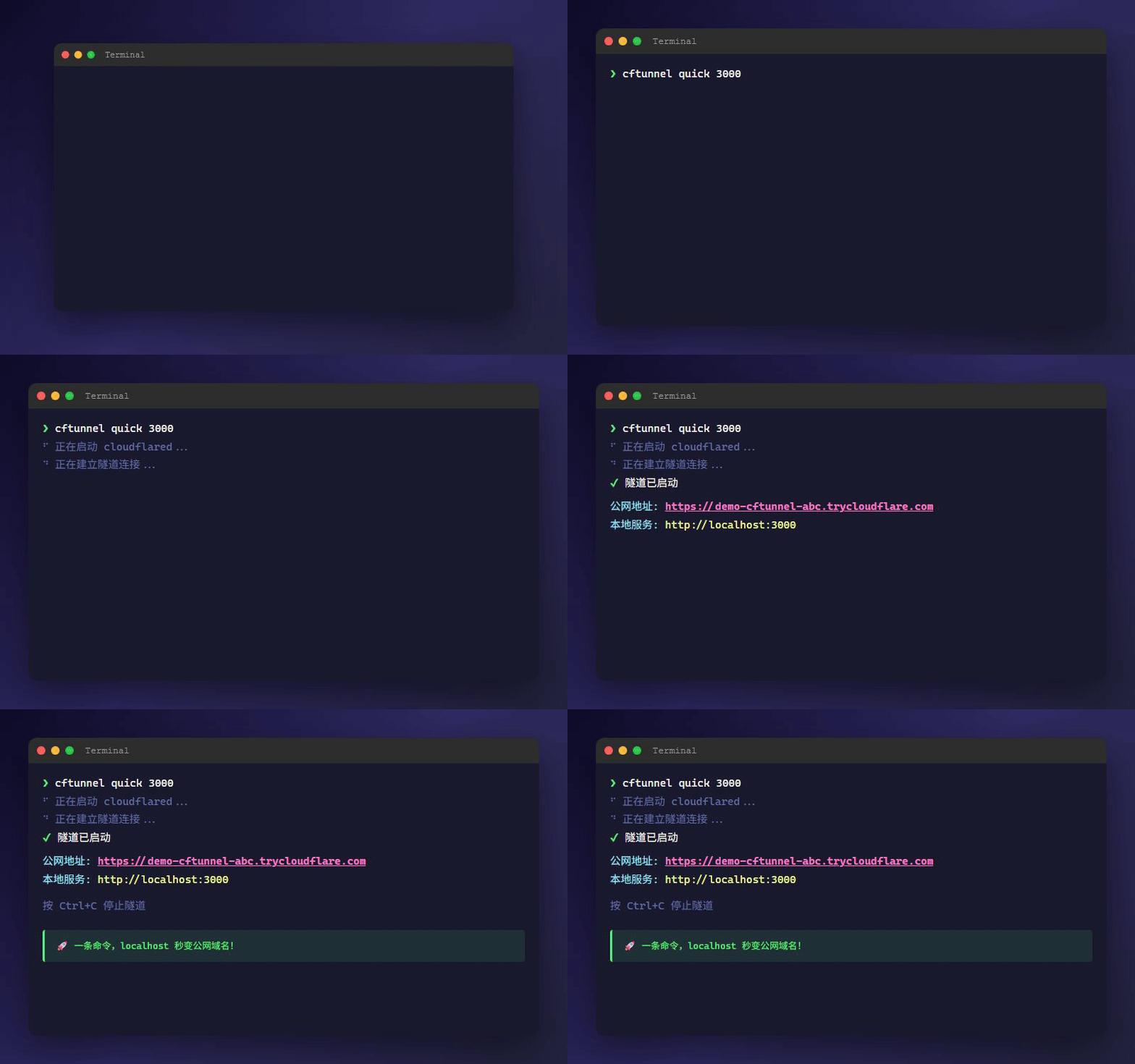
cftunnel is a cross-platform command-line utility that makes local services reachable from the internet. It bundles two separate tunneling engines: Cloud mode relies on Cloudflare Tunnel to give you free HTTPS and WebSocket tunnels with automatic TLS and a global CDN, needing only a free Cloudflare account. Relay mode uses frp to provide self-hosted TCP and UDP tunnels, which work well for gaming servers, databases, SSH access, and remote desktop. Both engines can operate together. The program handles configuration, fetches engine binaries on its own, registers as a system service (systemd, launchd, or Windows Service), and includes one-command quick tunnels, custom domain support, password protection, QR-code sharing, scenario presets, a portable mode, and a desktop GUI companion. It is written in Go and released under the MIT license.
Should you self-host cftunnel?
cftunnel scores 51/100 on selfhost.directory (how scoring works) and ranks #2 of 10 in Network. It has 360 GitHub stars.
It shipped 10 stable releases in the past year. The latest, v0.4.4, came out on 26 September 2026. New versions land roughly every 1 days.
Setup is moderate: expect some configuration beyond a single command. It is MIT-licensed and written mostly in Go.
Its closest alternative on selfhost.directory is scanopy (64/100, 5 913 stars). It scores higher overall, so compare the two before you pick. See cftunnel vs scanopy side by side.
Features
- AI assistant integration
- Auto-update
- Cloudflare Tunnel integration
- Cross-platform binaries
- Custom Domain Support
- Desktop GUI client
- Password Protection
- Portable mode
- Port history
- QR Code Sharing
- Real-time Logs
- Scenario presets
- Self-hosted TCP/UDP relay
- System service management
- Zero-config quick tunnels
cftunnel README
More in Network
 cloudflare-verified-ddnsSelf-hosted Cloudflare DDNS updater verifying DNS via DoH, adaptive polling, detailed telemetry. Python 3.13+, minimal Docker image.
 containernetwork-autofixContainerNetwork AutoFix auto-recreates Docker containers using --net=container: networking when the master container restarts, preserving state. For Unraid and Docker.
 copypartySelf-hosted file server with accelerated resumable uploads, deduplication, WebDAV, SFTP, FTP, TFTP, SMB, media indexing, thumbnails — all in one Python file.
 dhcp-netboot.xyzA self-hosted Docker container that runs a ProxyDHCP server to PXE boot installers and utilities from netboot.xyz on your local network.
 dnsweaverSelf-hosted DNS automation for homelabs: reads from 7 sources, writes to 12 providers with split-horizon DNS.
 docker-headscaleContainerized Headscale server for self-hosted Tailscale mesh VPN. Auto-generates config and auth keys, includes management script, enables MagicDNS hostname resolution.
 docker-openvpnSelf-hosted OpenVPN Docker image with auto PKI, client management, dual-stack IPv4/IPv6, and modern ciphers.
 electrumxElectrumX is a self-hosted, open-source Electrum server in Python. It connects to a Bitcoin full node and builds an index for quick address history queries.
 FireflyFirefly is a self-hosted WireGuard VPN server with web UI for managing clients. Runs as a single binary or Docker container, supports Let's Encrypt SSL and TCP relay.
 gluetunVPN client in a thin Docker container for multiple VPN providers, written in Go, and using OpenVPN or Wireguard, DNS over TLS, with a few proxy servers built-in.
 hass-otbr-dockerSelf-hosted Docker container running a stand-alone OpenThread Border Router for Home Assistant Thread/Matter support without Yellow or HassOS.
 IPFS Web UISelf-hosted, open-source browser UI for a local Kubo IPFS node. View status, manage files, explore IPLD data, visualize peers, and configure settings without the CLI.
0 comments