
Self-host ANAS
v0.4.4Storage panels for Proxmox: ZFS, Hybrid RAID, shares, iSCSI
- Stars
- 210
- Port
- 3000 (Internal gateway loopback port for pveproxy communication (configurable via --port))
- Requires
- Node.js, Proxmox VE, ZFS
What is ANAS?
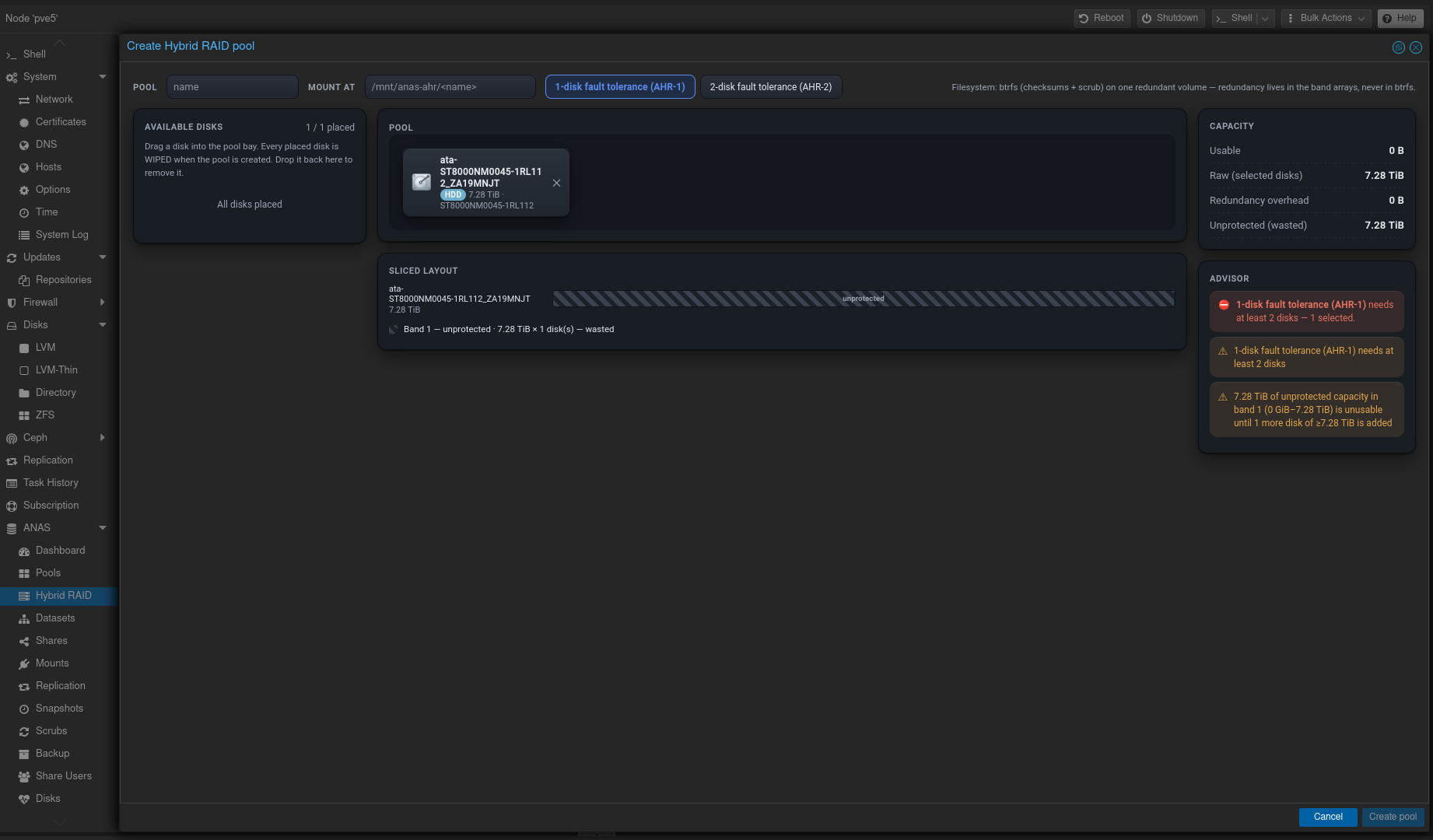
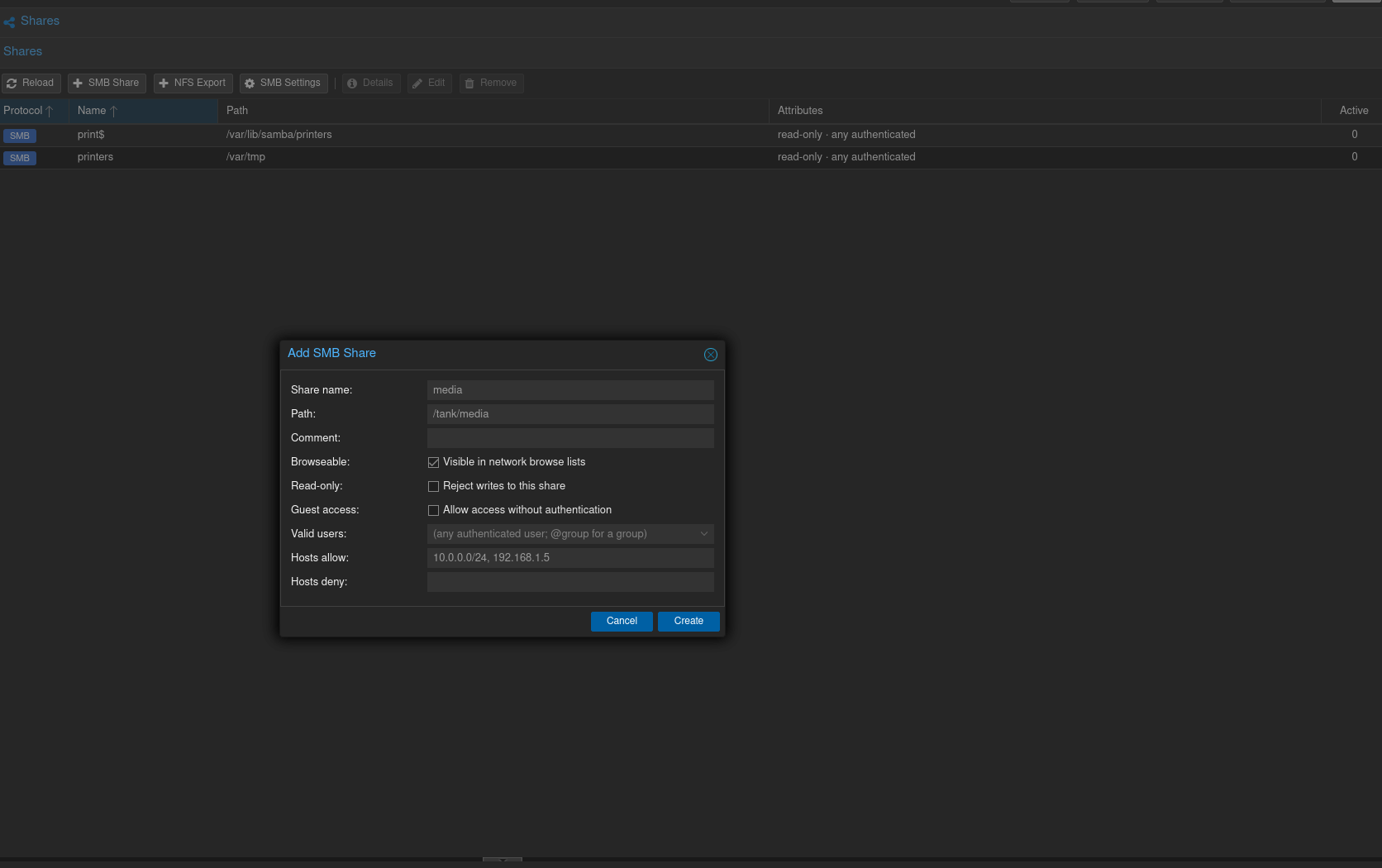
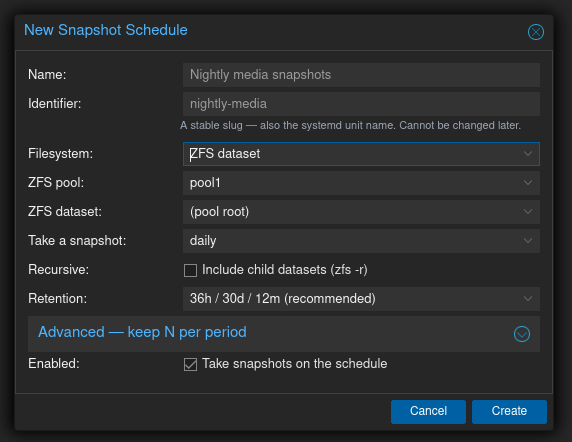
ANAS extends Proxmox VE with a complete storage management layer delivered as native ExtJS panels inside the existing PVE web UI. It manages ZFS pools with a drag-to-build vdev composer and advisory rules, and introduces Hybrid RAID (AHR) — Synology SHR-style pools that combine mismatched disk sizes by slicing drives into size-matched md RAID bands under a single btrfs filesystem, with live expansion and self-healing scrub. On top of pools it provides datasets, zvols, snapshot schedules with keep-N retention, zfs send/recv replication to local or remote peers (including TrueNAS), SMB and NFS shares with per-share ACLs and Previous Versions, an iSCSI target (LIO) serving zvols or raw images with CHAP and persistent LUN serials, and backup tasks to Proxmox Backup Server for both file and block sources. All operations are queued jobs with live progress, and unattended tasks report through PVE's notification system. ANAS installs via a transactional tarball installer that adds the daemon, UI panels, and required system packages (ZFS, mdadm, btrfs-progs, samba, nfs-kernel-server, targetcli) onto a stock PVE node; it uses PVE's authentication and certificates, adds no accounts of its own, and stores no shadow state — uninstalling removes only ANAS files. The project is pre-1.0 (v0.4.4) and actively developed on production clusters.
Should you self-host ANAS?
ANAS scores 43/100 on selfhost.directory (how scoring works) and ranks #4 of 5 in Storage. It has 210 GitHub stars.
It shipped 10 stable releases in the past year. The latest, v0.4.4, came out on 18 October 2026. New versions land roughly every 5 days.
Setup is advanced: plan for several services and some ongoing maintenance. It is AGPL-3.0-licensed and written mostly in Typescript.
Its closest alternative on selfhost.directory is RustFS (74/100, 35 480 stars). It scores higher overall, so compare the two before you pick. See ANAS vs RustFS side by side.
Features
- Backup to Proxmox Backup Server
- Client-side mounts
- Cloud Sync
- Dataset and zvol management
- Disk health monitoring
- Hybrid RAID (AHR)
- iSCSI target
- Job queue with progress
- Live dashboard
- NFS exports
- Replication
- Selective restore
- SMB shares
- Snapshot schedules
ANAS README
More in Storage
 automqSelf-hosted, open-source Apache Kafka fork with stateless brokers that store logs on S3 or MinIO and rebalance partitions in seconds.
 diskoverDiskover Community Edition is a self-hosted, open-source file indexer using Elasticsearch to catalog metadata, enabling search, analytics, and cost optimization.
 dumpstoreSelf-hosted, open-source NAS management UI for ZFS on Linux/FreeBSD — manages pools, datasets, snapshots, SMB/NFS/iSCSI sharing without containers or databases.
 GarageHQGarage is a lightweight, self-hostable, and geo-distributed S3-compatible object storage system designed for high resilience and simplicity.
 garage-s3-webuiOpen-source admin web UI for Garage, the self-hosted S3-compatible object store: health status, cluster layout, buckets, object browser and access keys.
 glusterfsGlusterFS is an open-source scale-out network filesystem pooling disks across Linux servers into one namespace, with replication, erasure coding and geo-replication.
 gluster-serverSelf-hosted Docker image packaging GlusterFS for Unraid and Raspberry Pi, enabling persistent storage for Kubernetes and Docker Swarm.
 minikvA self-hosted, open-source distributed key-value and object store written in Rust that achieves strong consistency through Raft consensus and two-phase commit.
 mos-releasesMOS is an open-source, self-hosted server operating system based on Devuan with a web UI for storage pools, SMB/NFS shares, Docker, LXC, VMs and a REST API.
 OpenMediaVaultopenmediavault is an open-source, self-hosted NAS solution built on Debian that shares files over SMB, NFS and FTP and manages disks, RAID and snapshots from a web UI.
 RustFSRustFS is an open-source, S3-compatible high-performance object storage system supporting migration and coexistence with other S3-compatible platforms such as MinIO and Ceph.
 s3-encryption-gatewaySelf-hosted transparent HTTP proxy adding client-side encryption to any S3-compatible storage without code changes, with envelope encryption via local or external KMS.
0 comments