
Self-host Agora Cosmica
v1.3.1Living library of 30 historical figures you can talk to
- Stars
- 149
- RAM
- 32 GB unified RAM on Apple Silicon, or 16 GB VRAM on NVIDIA for local LLM
- Ports
- 8080 (main web application), 8880 (Kokoro English TTS), 8000 (Whisper speech-to-text), 8887 (Qwen3-TTS German TTS (nvidia profile))
ghcr.io/chipmates/agoracosmica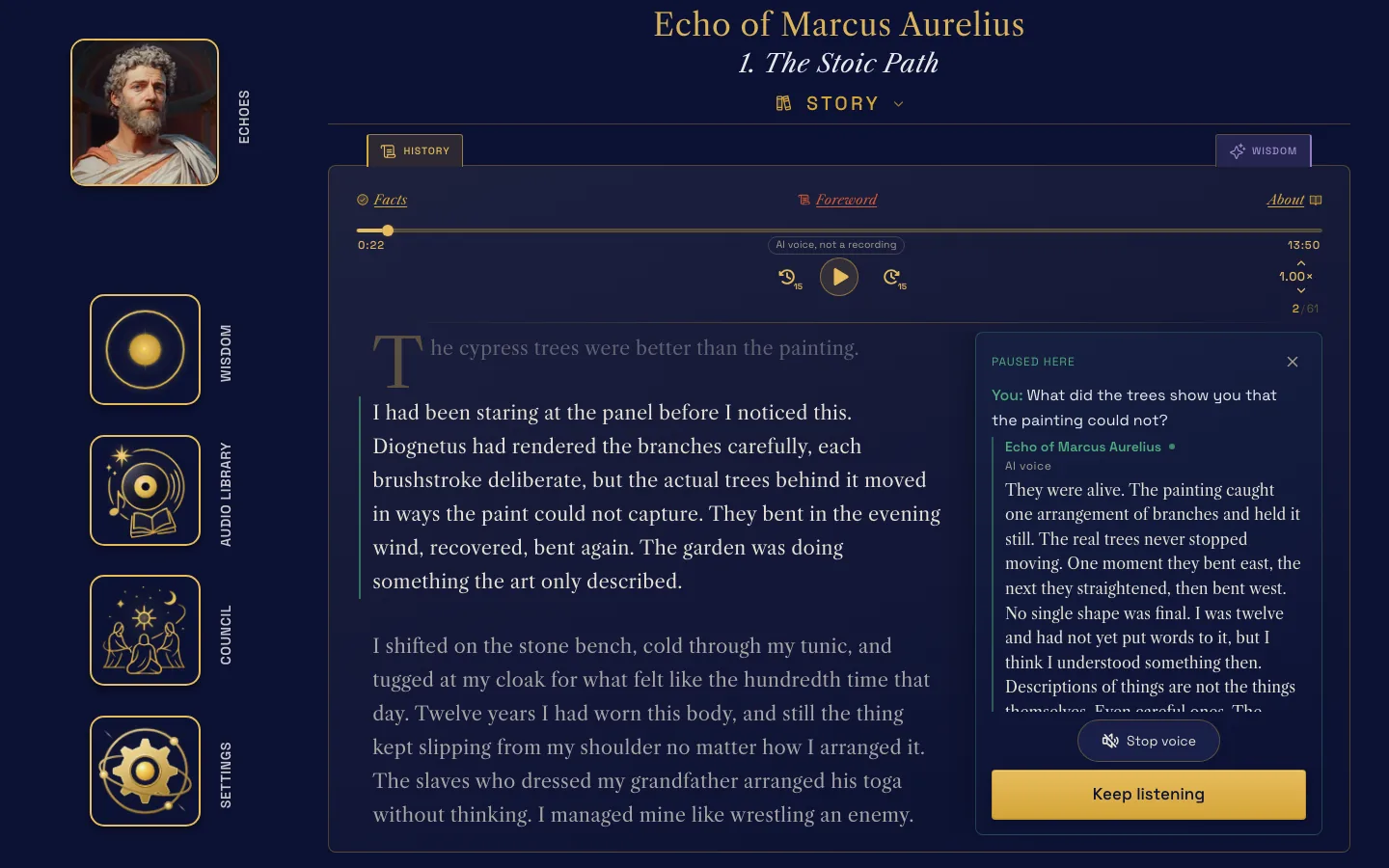
What is Agora Cosmica?
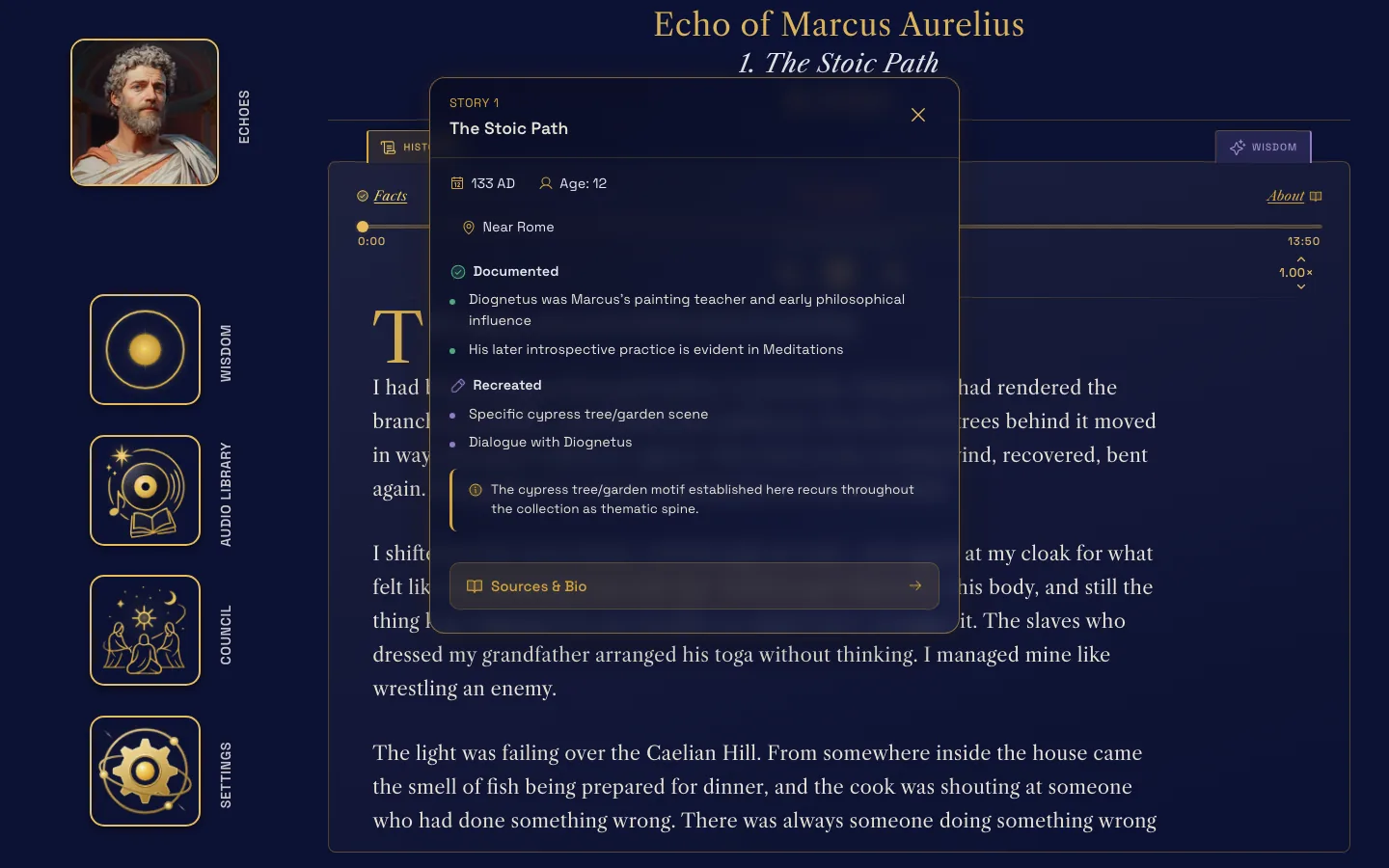
Agora Cosmica is a nonprofit, open-source education platform presenting 30 historical figures spanning 2,500 years. Each figure offers six learning formats: narrated Story chapters (~13 minutes each), Wisdom teachings for live conversation, Prism dialogues with three other thinkers, Quest Socratic challenges, Free Talk open conversation, and Council four-voice debates. All content is bilingual (English/German) with pre-recorded audio totaling nearly 80 hours in English and over 85 in German. The self-hosted Docker Compose stack includes the web app, Kokoro English TTS, Whisper transcription, and optional Qwen3-TTS for German. Operators can configure the app to use any OpenAI-compatible LLM (LM Studio, Ollama, vLLM, llama.cpp) so conversations never leave their hardware. User data stays in the browser's encrypted IndexedDB; no accounts, no tracking cookies. The code is AGPL-3.0; content moves to CC-BY 4.0 within 6-12 months after the May 2026 release.
Should you self-host Agora Cosmica?
Agora Cosmica scores 48/100 on selfhost.directory (how scoring works) and ranks #14 of 30 in Education. It has 149 GitHub stars.
It shipped 7 stable releases in the past year. The latest, v1.3.1, came out on 8 September 2026. New versions land roughly every 2 weeks.
Setup is moderate: expect some configuration beyond a single command. An official Docker image is available. It is AGPL-3.0-licensed and written mostly in Typescript.
Its closest alternative on selfhost.directory is CTFd (70/100, 6 893 stars). It scores higher overall, so compare the two before you pick. See Agora Cosmica vs CTFd side by side.
Features
- 30 Historical Figures
- Bilingual English/German
- Content Safety & Crisis Resources
- Fact-Check Panels
- Live AI Conversation (Echo)
- Local Mode (Offline LLM)
- Local Speech & Transcription
- Pre-recorded Audio Library
- Privacy-first architecture
- Six Learning Formats
- WCAG 2.2 AA Accessibility
Agora Cosmica README
FAQ
Is it available in German?
Yes. Everything is fully bilingual — English and German — across the content, the interface, and the audio.
Is it open source?
Yes. The code is open under AGPL-3.0, so anyone can read it, audit the privacy claims, contribute, or run their own copy. Content moves to CC-BY within 6-12 months.
How do you handle my privacy?
Conversations are stored only in your browser, never on servers. No tracking cookies, no third-party analytics, no profiles. If you bring your own key, it never touches the project's servers.
Can I run it entirely on my own machine?
Yes. Local Mode lets you point the app at any OpenAI-compatible LLM (LM Studio, Ollama, vLLM) and run the audio stack in Docker. With Local Mode and self-host, no conversation, voice, or text data leaves your machine.
Do I need an account to start?
No account needed. Open the app and start learning immediately with 30 free daily messages. No email or signup required.
Does it cost anything?
You get 30 free messages a day with no signup. For more, bring your own OpenRouter key. The platform is nonprofit and open source with no ads or paywalls.
Is this really the historical person speaking?
No. Every figure is an AI Echo — a voice shaped by their own writing and ideas. It draws on their real philosophy but stays an interpretation, never a recording or the actual person.
What is Agora Cosmica?
An education platform built as a living library where 30 historical figures teach through narrated life stories, core teachings, four-voice debates, and live AI conversation in English and German.
More in Local AI
 AI GridAI Grid is a self-hosted, open-source orchestrator that pools your computers into a single OpenAI-compatible endpoint for local LLM inference and training.
 airunnerSelf-hosted, open-source desktop AI engine: local LLM chat companions, Stable Diffusion art generation, TTS/STT voice, and a headless Ollama/OpenAI-compatible API.
 aixclSelf-hosted platform for running LLMs locally with Vault secrets, GPG-signed commits, and rootless Podman. Includes Open WebUI, pgAdmin, Grafana, and BYO app framework.
 AnyLoom-AnythingLLM-Local-AI-agentic-DyTopo-swarmSelf-hosted AI assistant with Qwen3-30B, hybrid RAG, multi-agent swarm, and AnythingLLM UI — all 100% local on your GPU.
 AnythingLLMAnythingLLM is a self-hosted, open-source AI app for document chat, AI agents, and local/cloud LLMs — running on your hardware with no token limits.
 ATLASOpen-source, self-hosted AI coding agent for your own GPU. It wraps compact GGUF models in a verify-before-write pipeline with a sandboxed executor and a terminal UI.
 Atomic ChatSelf-hosted desktop/mobile app for running LLMs locally with OpenAI-compatible API. 1000+ models, multiple engines, MCP, agent launching.
 BelullamaSelf-hosted AI app bundling Ollama, Open WebUI, and Automatic1111 for local LLMs and image generation with one-command Docker install.
 chatbot-ollamaSelf-hosted, open-source chat web UI for Ollama: stream local model replies, upload documents and images, and switch between dark and light themes.
 chatbot-uiOpen-source AI chat app you self-host with a Supabase backend, supporting OpenAI, Anthropic, Gemini, Mistral and Azure keys plus local Ollama models.
 DreamServerSelf-hosted local AI server that installs models, Open WebUI, voice, workflows, RAG, and agents on your hardware. Replaces CloudAI services with one-command setup.
 engrimEngrim is a self-hosted, open-source episodic memory engine that lets AI coding agents share project context across sessions via a local SQLite database.
0 comments