
Self-host xtreemfs
1.5.1Fault-tolerant distributed file system with replication
- Stars
- 348
- Ports
- 32636 (MRC (Metadata and Replica Catalog)), 32638 (DIR (Directory Service)), 32640 (OSD (Object Storage Device))
- Requires
- FUSE, Java

What is xtreemfs?
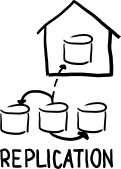
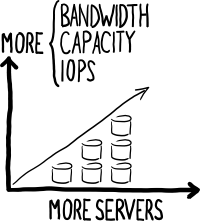
A fault-tolerant distributed file system from Zuse Institute Berlin that runs across multiple servers and scales to thousands of nodes across data centers. It provides transparent file replication with automatic failover, read-only replication for caching, metadata service replication, and striping for higher I/O throughput. The system is POSIX-compatible, serving as a drop-in NFS replacement, and includes SSL/X.509 security for internet deployment, asynchronous snapshots, and extensible policies for replica placement and authentication. Deployment uses three services (Directory, Metadata, Object Storage) installed via system packages on Linux (RPM, DEB, Gentoo) with client packages for Windows and macOS. Released under a BSD-style license since version 1.3, it requires Java 1.6+ and FUSE. The last stable release was 1.5.1 in 2016, though the GitHub repository shows recent activity.
Should you self-host xtreemfs?
xtreemfs scores 46/100 on selfhost.directory (how scoring works) and ranks #11 of 15 in File Storage. It has 348 GitHub stars.
There was no stable release in the past 12 months, so check the repository's recent activity before you rely on it.
Setup is advanced: plan for several services and some ongoing maintenance. It is Other-licensed and written mostly in Java.
Its closest alternative on selfhost.directory is leilfs (48/100, 133 stars). It scores higher overall, so compare the two before you pick. See xtreemfs vs leilfs side by side.
Features
- Asynchronous File System Snapshots
- Asynchronous MRC Backups
- Cloud Storage
- Elastic Scalability
- Extensible Policies
- File Replication
- Metadata caching
- Metadata ReplicationAutomatic failover considered experimental in release 1.3.0
- POSIX Compatibility
- Read-Only Replication
- SSL/X.509 Security
- Striping
xtreemfs README
FAQ
Which Java implementation should I use?
Both OpenJDK and Oracle JRE work with XtreemFS with no known problems.
What are DIR, MRC, and OSD?
DIR is the Directory service for finding servers and resolving names. MRC is the Metadata and Replica Catalog storing directory trees and file metadata. OSD is the Object Storage Device storing file content and implementing replication.
What is FUSE?
FUSE (Filesystem in Userspace) is a Linux kernel module that simplifies development of new file systems and is part of most recent Linux distributions.
How does XtreemFS differ from Lustre?
Lustre was made for local clusters, while XtreemFS was designed for wide area networks, can be mounted from anywhere, and provides replication, RAID, and checksums for high data safety.
How does XtreemFS differ from NFS or Samba/CIFS?
Unlike common network file systems, XtreemFS is a truly distributed file system that runs across multiple servers, can scale by adding machines, provides striping for aggregated bandwidth, and offers X.509-based authentication and off-site replication.
Is XtreemFS open source?
Yes, starting with release 1.3 all components are licensed under the New BSD License. Previous releases were under GPL v2.
More in Distributed Systems
 bacalhauOpen-source orchestration framework for running Docker and WebAssembly jobs close to their data; self-hosted via one binary as client, orchestrator or compute node.
 CondensationAn open-source distributed data system for app builders: conflict-free sync, end-to-end encryption and self-hosted store servers on a file system or MySQL.
 consulSelf-hosted Consul is a service networking tool for service discovery, service mesh with mTLS, API gateway and health checks across multi-datacenter infrastructure.
 CotalCotal is an open-source, self-hosted pub/sub protocol letting AI agents from different providers coordinate in a shared space with presence and durable delivery.
 etcdA self-hosted, open-source distributed key-value store using Raft consensus for critical data in clustered systems. CNCF graduated project.
 exoSelf-hosted, open-source AI cluster that links your Macs and Linux boxes to run large LLMs locally via MLX, with Thunderbolt 5 RDMA and an OpenAI/Ollama-compatible API.
 hadoopOpen-source, self-hosted framework for large-scale data work: HDFS storage, YARN scheduling and MapReduce jobs, scaling from one machine to thousands.
 mesosOpen-source Apache Mesos is a self-hosted cluster manager that pools CPU, memory and GPU across your own servers for frameworks like Hadoop, Spark and Jenkins.
 minikvA self-hosted, open-source distributed key-value and object store written in Rust that achieves strong consistency through Raft consensus and two-phase commit.
 nsqOpen-source self-hosted distributed messaging platform: push-based pub-sub over topics and channels, in-memory queues that spill to disk, plus the nsqadmin web UI.
 OpenAFSOpenAFS is a self-hosted, open-source distributed filesystem providing location-independent file sharing across Linux, UNIX, macOS, and Windows with Kerberos auth.
 temporalSelf-hosted, open-source workflow engine that keeps application logic durable across crashes and retries, with multi-cluster replication and archival.
0 comments