
Self-host Templatical
v0.51.1Drag-and-drop email editor SDK for embedding in web apps
- Stars
- 528
What is Templatical?
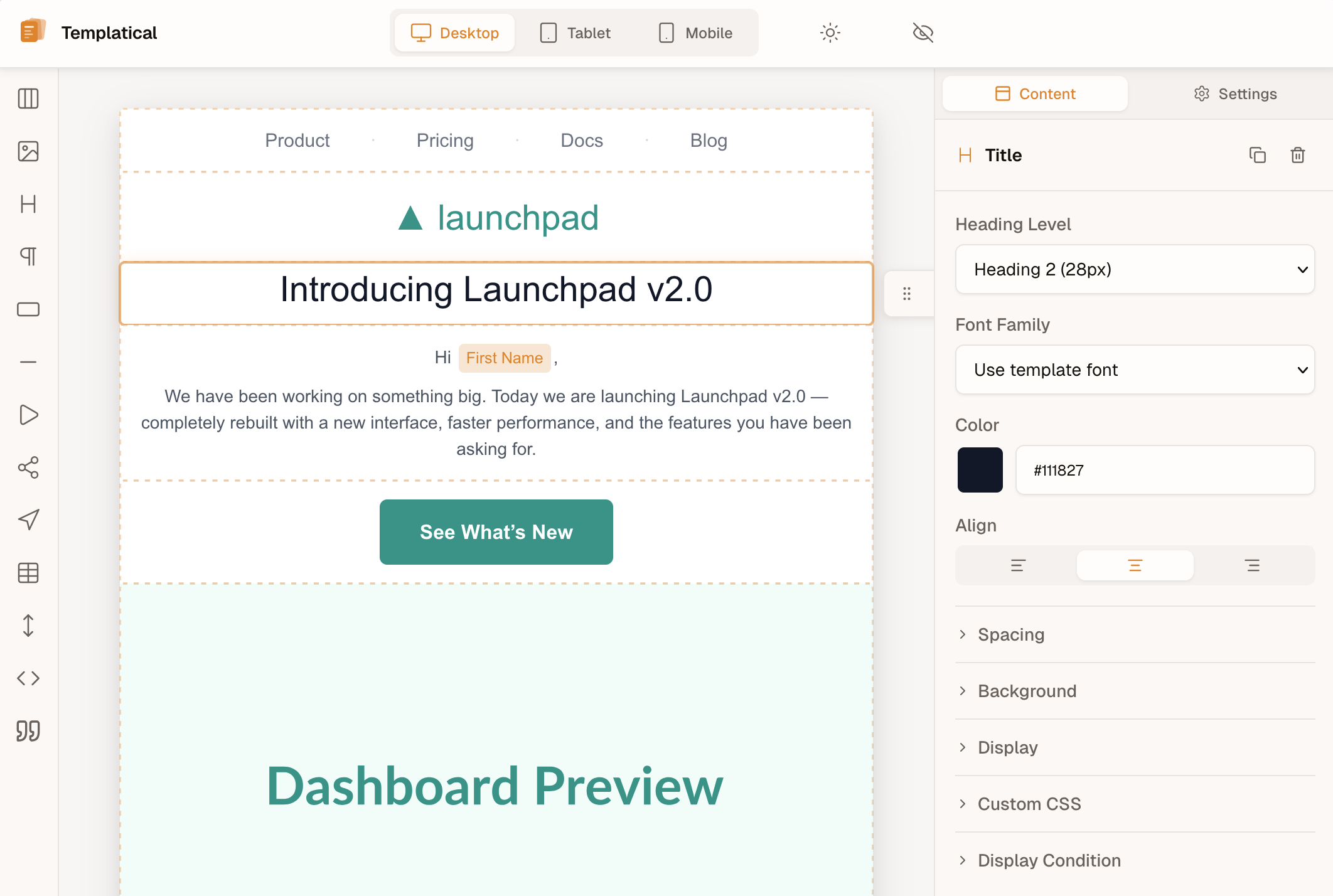
Templatical is a drag-and-drop email editor SDK for embedding into web applications built with React, Svelte, Angular, Vue, or plain JavaScript. You add it via npm, mount it with one init() call into a container element, and gain a full visual email builder. Templates are portable JSON that render to MJML, producing table-based HTML that works across all email clients. Core features include custom blocks fetching live API data at preview time, merge tags with readable labels in your ESP's syntax (Handlebars, Liquid, JS literals, or custom), display conditions to show or hide blocks per recipient with live preview, complete theming via design tokens with dark mode, reusable saved blocks stored in your own backend, version history with preview and restore, and test email sending through your own ESP. The editor runs entirely in the browser with no runtime dependencies (Vue and TipTap are bundled), uses Shadow DOM by default for style isolation, and requires no license key or activation — it works offline and never contacts external servers. Editor packages use FSL-1.1-MIT (source-available, converts to MIT after two years per release), while the renderer, types, quality linter, template tools, and all importers are pure MIT. An optional paid Cloud tier adds real-time collaboration, AI rewrite/chat, hosted media, multi-tenancy, and API access, but all core editor features remain free to self-host.
Should you self-host Templatical?
Templatical scores 48/100 on selfhost.directory (how scoring works) and ranks #65 of 106 in Email. It has 528 GitHub stars.
It shipped 10 stable releases in the past year. The latest, v0.51.1, came out on 26 October 2026. New versions land roughly every 1 days.
Setup is easy: most people get it running in one sitting. It is Other-licensed and written mostly in Typescript.
Its closest alternative on selfhost.directory is Listmonk (80/100, 24 012 stars). It scores higher overall, so compare the two before you pick. See Templatical vs Listmonk side by side.
Features
- Custom blocks with API-backed data sources
- Display conditions
- Drag-and-drop email editor
- Framework Agnostic
- Full theming via design tokens
- Import from other editors
- Merge tags with ESP syntax support
- Multilingual
- Reusable saved blocks
- Shadow DOM style isolation
- Test email sending
- TypeScript strict
- Version History
Templatical README
FAQ
Will the editor inherit my app's CSS?
No. The editor mounts inside a Shadow DOM by default, so host stylesheets stop at the boundary. You can opt out with shadowDom: false if needed.
Where does my template data go?
Only to your own backend. The SDK runs entirely in the browser with no telemetry, no remote calls, no analytics. Data leaves your app only through providers you configure.
Is there a paid version, and is it required?
No, paid is not required. The SDK is fully standalone with all editor features free to self-host. Templatical Cloud is an optional managed subscription adding real-time collaboration, AI rewrite/chat, hosted media, multi-tenancy, and API access.
What frameworks are supported?
Templatical works in React, Svelte, Angular, Vue, and vanilla JS. The published package is fully self-contained with Vue bundled inside.
Do I need to display "Powered by Templatical"?
No. The editor renders a small footer credit by default, but it's opt-out — pass branding: false to init() to hide it.
Which packages are MIT vs FSL?
Every package except the editor, core, and media library is pure MIT today: types, renderer, quality, template-tools, ai-kit and every migration importer. The editor, core, and media-library packages are FSL-1.1-MIT.
Can I use it in commercial products?
Yes — paid SaaS, internal tools, on-premise software, agency builds, anything. The only restriction is you can't rebrand Templatical and sell it as a competing hosted email-editor SaaS.
Is Templatical really free?
Yes, the editor SDK is licensed under FSL-1.1-MIT — free to use in any project with no usage caps or per-seat fees. Every release automatically converts to MIT two years after it ships.
More in Email
 tempmail-serverSelf-hosted disposable email backend with SMTP server and REST API. Features auto-expiring addresses, multi-domain support, and PostgreSQL storage.
 tinetine is a self-hosted open-core groupware suite for organizations with calendar, email, contacts, tasks, file management, CRM and time tracking.
 TwakeTwake Workplace is a self-hosted, open-source Microsoft Teams alternative with encrypted chat, secure email, file storage, and calendar.
 uninboxUnInbox is a self-hosted, open-source email platform for teams with native collaboration, conversation notes, and sender screening.
 usesendOpen-source email platform for transactional and marketing sends on Amazon SES, with dashboard, REST API, SMTP relay and self-hosted Docker or Railway deploy.
 UVdesk HelpdeskOpen-source service desk for support teams: email-to-ticket mailboxes, workflows, saved replies, knowledgebase. Self-hosted via Composer, Docker or an AWS image.
 Viesti-ReportsViesti-Reports is a self-hosted, open-source DMARC and SMTP-TLS report processor with BIMI, MTA-STS, and Outlook autodiscover hosting.
 wildduckWildDuck is a self-hosted, open-source IMAP/POP3 mail server backed by sharded MongoDB, with stateless instances, 2FA and full REST API control.
 AliasVaultOpen-source, self-hosted password and email alias manager: end-to-end encrypted vaults, a built-in receive-only email server, TOTP, passkeys and browser/mobile apps.
 AnonAddyOpen-source anonymous email forwarding: unlimited aliases to your real inbox, custom domains, OpenPGP encryption, self-host with Docker or Ubuntu.
 b1gMailOpen-source PHP email-service platform: webmail plus address book, calendar, tasks, notes, cloud drive, smart folders, filters and spam protection, managed via a web ACP.
 bbyenSelf-hosted open-source tool that restores YouTube email notifications by checking subscriptions via the YouTube Data API and sending new video alerts via SMTP.
0 comments