
Self-host Rakazo
androidOpen-source AI agent for persistent teammates
- Stars
- 6 103
- CPU
- 2 CPUs per bot computer (default)
- RAM
- 2 GB per bot computer (default, minimum 6 MB)
- Storage
- Not explicitly stated
- Ports
- 5173 (Web UI (Vite preview)), 3100 (API server), 7091 (Sandbox supervisor (internal))
- Requires
- PostgreSQL
ghcr.io/elie222/rakazo/app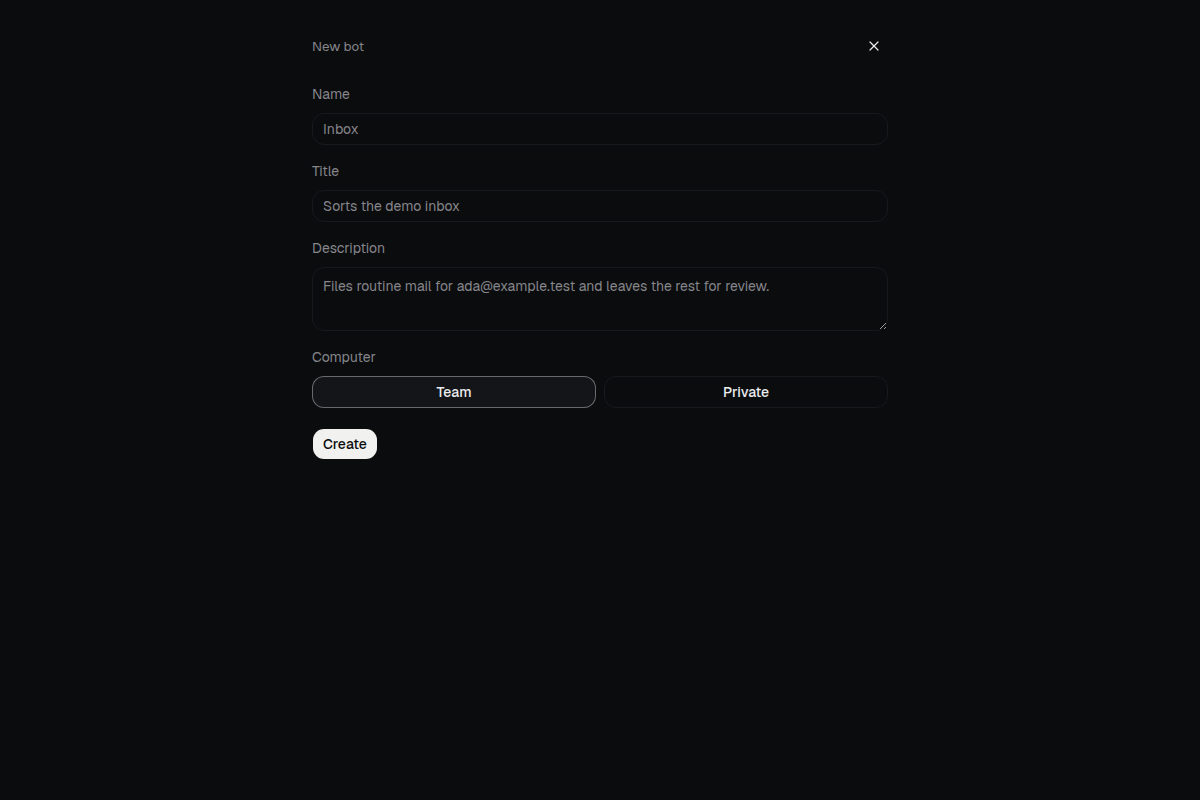
What is Rakazo?
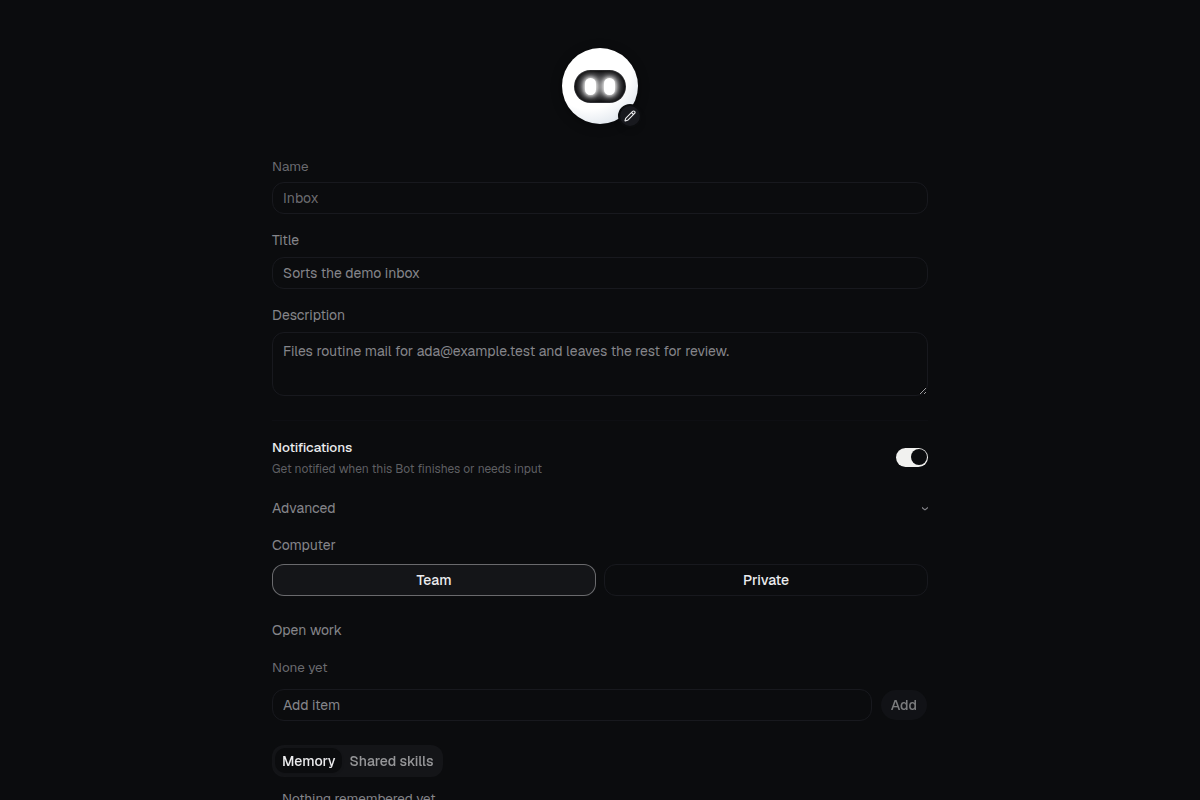
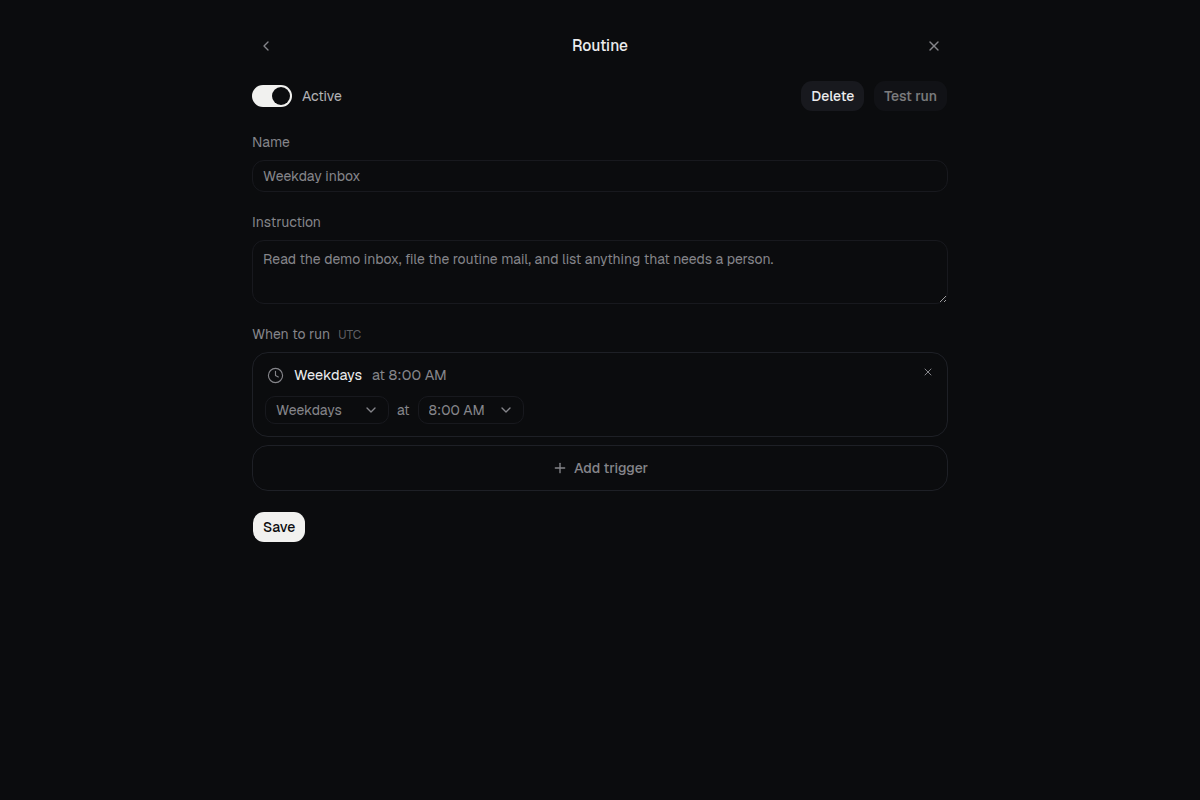
Rakazo is an open-source AI agent platform for creating persistent AI teammates (bots) that can use a browser, shell, and graphical desktop to perform real work. Each bot maintains its own conversations, memory, and routines written as readable Markdown. You self-host the stack on your own hardware — either via Docker Compose with published images (no Node.js required) or from source — and bring your own model credentials (OpenAI, Anthropic, OpenRouter, Ollama, LM Studio, etc.) or use Claude/ChatGPT subscriptions via OAuth. Bots can hand off tasks to peer bots or spawn short-lived subagents, and integrations with Composio, Pipedream, MCP, and OpenAPI extend their toolset. The web UI runs at port 5173, with native Electron desktop apps and iOS/Android mobile apps that connect to your self-hosted instance. Authentication supports built-in passwords and optional OpenID Connect SSO. The software is Apache-2.0 licensed with no seat limits or gated features; a hosted cloud version is planned but not yet generally available.
Should you self-host Rakazo?
Rakazo scores 65/100 on selfhost.directory (how scoring works) and ranks #41 of 209 in AI Agents. It has 6 103 GitHub stars.
It shipped 8 stable releases in the past year. The latest, android, came out on 27 October 2026. New versions land roughly every 2 days.
Setup is advanced: plan for several services and some ongoing maintenance. An official Docker image is available. It is Apache-2.0-licensed and written mostly in Typescript.
Its closest alternative on selfhost.directory is AstrBot (88/100, 44 330 stars). It scores higher overall, so compare the two before you pick. See Rakazo vs AstrBot side by side.
Features
- App integrations (Composio, Pipedream, MCP, OpenAPI)
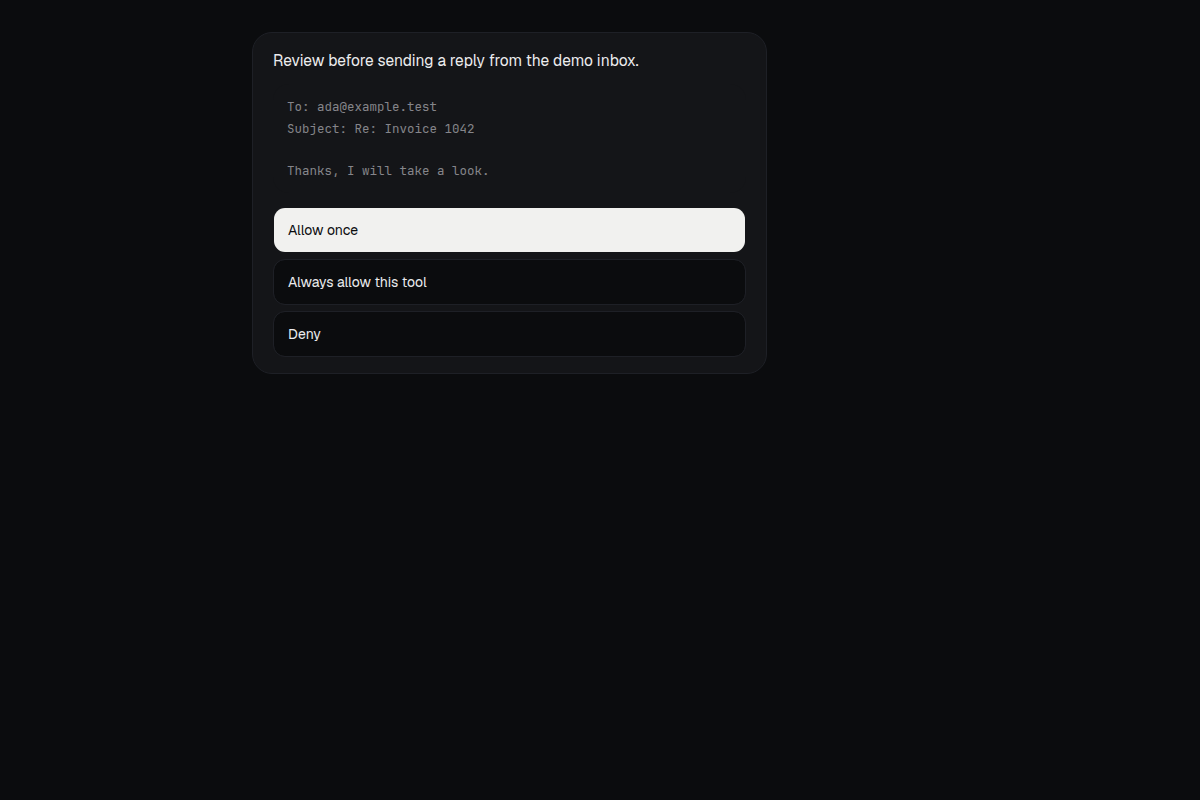
- Approval workflows with audit log
- Bot delegation and subagents
- Bring-your-own model credentials
- Browser, terminal, file, and desktop access
- Multi-language UI
- Multiple computer providers
- OpenID Connect SSO
- Persistent AI teammates (bots)
- Routines as Markdown
- Team and private computers
- Voice ModeRequires user-provided API keys for TTS providers
Rakazo README
FAQ
Can I run a local model?
Yes. Point a bot at a local OpenAI-compatible server such as Ollama or LM Studio. Each bot can use a different model.
Do I need an API key if I already pay for Claude or ChatGPT?
No. Sign in with Claude Pro/Max or ChatGPT Plus/Pro and that subscription covers the model. An API key is the other path for Anthropic, OpenAI, OpenRouter, or Grok.
Can I use my Claude Pro/Max or ChatGPT Plus/Pro subscription?
Yes — sign in with that subscription, or use an API key / OpenRouter / a local OpenAI-compatible server. Rakazo does not pay the model bill.
How does this compare with OpenClaw?
Both are open source and run on hardware you control. Rakazo is a chat for persistent teammates after Docker/desktop install; OpenClaw adds a wizard, a Gateway, and a separate step to connect a chat app.
Is hosted Rakazo available?
Self-hosting is available now. Hosted Rakazo Cloud is not generally available; there is a waitlist.
How do model choice and cost work?
You connect your own model keys or local/OpenAI-compatible server, pick a different model per bot. No seat fee for the open-source software; you pay model and computer providers you use.
Where does my data live?
Postgres, bot files, browser profiles, and the audit log stay on your deployment. Model provider content is processed under their terms.
What do I need to self-host Rakazo?
Published images need Docker Engine 26+, Compose plugin, curl, and OpenSSL (no Node.js). Source checkout needs Node.js 22.22.2+ (22.x), 24.x, or 26+, pnpm 9, and Docker.
More in AI Chat
 ReameSelf-hosted LLM server for CPU inference using ternary models, runs 8B models in 2.2GB RAM on free-tier ARM with OpenAI-compatible API.
 ReMindSelf-hosted AI chat app with streaming, sessions, share links, file uploads, and privacy controls for users.
 sapphireSapphire Blue AI is a self-hosted, open-source AI companion with voice, memory, personas, and plugins. Runs locally with optional cloud LLMs.
 sciraSelf-hosted AGPL-3.0 AI search engine that plans multi-step research across 17 modes, pulls live sources, and answers with clickable inline citations.
 Self-Hosted AI StackOpen-source Docker Compose project running local AI models, chat, documents, voice, and MCP tools on your server with optional HTTPS and GPU acceleration.
 SillyTavernSelf-hosted open-source LLM frontend with unified API interface, character management, chat history, image generation, TTS, and plugin extensibility.
 SiloSilo is a self-hosted, open-source pure front-end app for multi-model AI chat and text-to-image generation with PWA and browser extension.
 SmarterRouterSelf-hosted AI gateway that automatically routes queries to the best local or cloud LLM based on prompt analysis, with VRAM management and OpenAI-compatible API.
 sqlchatOpen-source, self-hosted chat-based SQL client that lets developers query and edit MySQL, PostgreSQL and MSSQL databases in plain language using OpenAI or Ollama.
 Telegram LLM BotSelf-hosted Telegram bot running local LLMs via Ollama, transcribing voice with faster-whisper, tool calling, web search, SQLite history, optional MinIO voice archive.
 Text Generation WebUIAn open-source, self-hosted LLM chat app you run on your own machine: vision input, tool-calling, LoRA fine-tuning, and an OpenAI/Anthropic-compatible API.
 ThesysSelf-hosted open-source research workspace for searching papers, uploading PDFs, on-PDF highlights with citations, reader mode Q&A, paper comparison, and citation export.
0 comments